Building Afghanistan’s Future: Strategic Assets, Infrastructure, and Investment Pathways
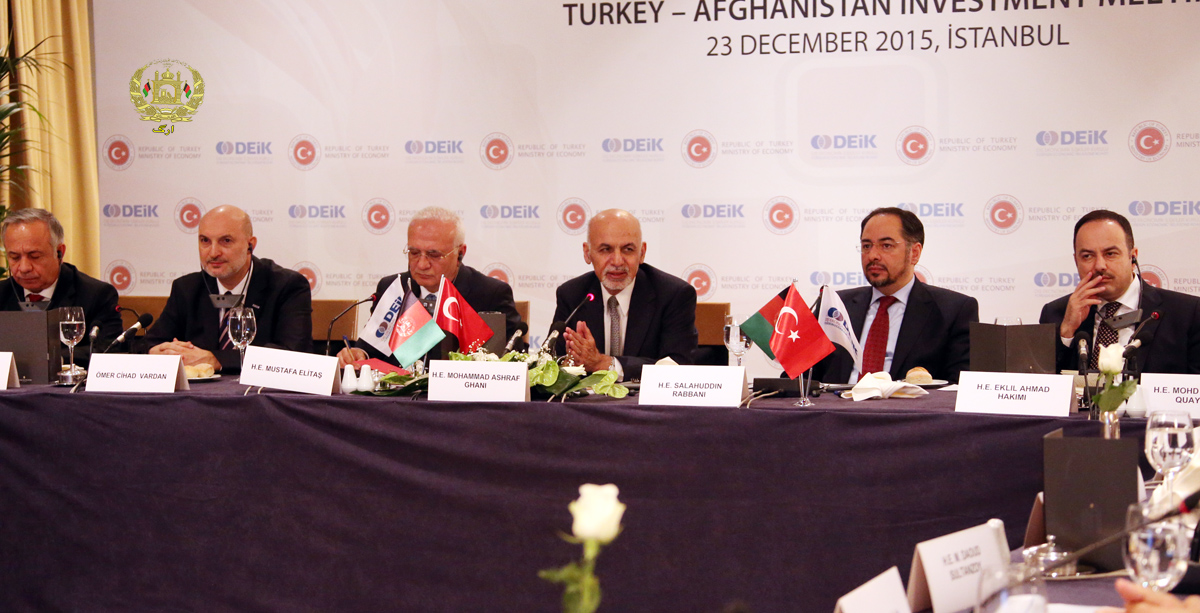
Speech at the Turkey–Afghanistan Investment Meeting in Istanbul, Turkey
Keypoints:
- Budget & Spending – Improve feasibility, supervision, and coordination for effective use of funds.
- Strategic Location – Leverage Afghanistan as a regional transit hub (TAPI, rail, ports, fiber).
- Water & Energy – Harness hydro, wind, solar; manage floods and droughts.
- Land & Agriculture – Expand cultivation, value chains, and food self-sufficiency.
- Mining & Minerals – Develop minerals, marble, stones, oil, and gas.
- Capital & Private Sector – Turn money into productive capital; promote firm formation.
- Human Capital & Infrastructure – Mobilize youth; build integrated infrastructure clusters.
- Institutional Reform – Streamline procurement; strengthen governance and oversight.
- Economic Self-Reliance – Energy and transit hubs; boost regional trade and cooperation.
- Risk & Investment – Provide guarantees, insurance, and incentives to attract investors.
In the Name of God, the Most Gracious, the Most Merciful.
Excellency Minister, Excellency Chairman of the session,
First, please accept the warm greetings of the people of Afghanistan. Afghanistan had the honor of being the first country in the world to recognize the Republic of Turkey. During that era, all the people of Afghanistan spontaneously collected donations to stand alongside Turkish soldiers—whom they considered their brothers and coreligionists.
Our relations are long, deep, and extensive. I would first like to express my gratitude to Excellency Erdoğan, Excellency Ahmet Davutoğlu, and the entire government of Turkey for their abundant assistance following the transformation of September 11th. Turkey was the second country to command the international forces in Afghanistan. Turkish forces have always stood with us, and in the past year, Turkey again played a key role in the Resolute Support Mission. I want to thank the government of Turkey for showing commitment to continuing their support for the Resolute Support Mission for the coming year as well.
In the sphere of culture; Turkish is our third language, as Uzbek and Turkmen—which are closely related to the Turkish language—have been the third and major languages of our country for centuries. We take pride in all our national languages, and their strengthening and development are part of our broader program.
Because our relations in the sectors of politics, security, and culture are so deep, I will not focus on these sectors. Tonight, with your permission, we will focus on the economic sector.
I’d like to highlight 5 things and then allow for an open discussion.
-
The Budget Constraint: First, Afghanistan has a fundamental problem; we cannot spend money. None of the fourteen years have we been able to spend more than 40% of our budget, so my first priority is to spend money.
-
The Complexity of Spending: But, spending money properly is not easy. 100 countries around the world cannot spend money no matter how much you give them, and this is where you come.
-
Feasibility and Implementation: The first reason we cannot spend money is because we don’t have feasibility studies. Absence of feasibility studies is a significant barrier that prevents us from spending money. I’ll come back to infrastructure issues.
-
Implementation Gaps: The second issue is that we don’t have proper implementation arrangements. Dozens of projects get started; they don’t get to be supervised; there is not proper engineering, there is not proper design.
-
Harmonization: The third reason is that the private public sector relations have not been harmonized. Some of you have worked; I am very pleased that you have worked. I am a very blunt person because unless we name the problem, we will not be able to deal with them.
-
A National Infrastructure Approach: Fourth; we have not had a national infrastructure approach. We have been operating by projects; operating project by project does not give you development because you are focused on the project, you are not focused on the outcomes that you need to achieve. Because we have this problem, I wanted to begin with this and ask for your partnership.
Now, the second thing that I want to highlight, I could elaborate further, but I want to just name the problem. Prior to my focusing on this, the whole world was chasing money. Once I named this phenomenon, I think the focus has changed to a very constructive dialogue.
Asset 1: Strategic Location and Connectivity
The second issue is what are our assets? What is it that we are putting on the table in Afghanistan? Our first asset is our location.
-
Historical Context: As the minister kindly highlighted, we are the shortest way of connecting different parts of Asia together. For 200 years, our location has been as very significant disadvantage. For 2500 years before that, it was an advantage. In the next 25 years, it is going to become our key advantage.
-
TAPI and Energy Corridors: Illustration; the Turkmenistan-Afghanistan-Pakistan-India pipeline is the first indication of our geographical location. Central Asia’s energy cannot get to South Asia without going through Afghanistan; there is no way around it. But, this is where again the relational advantage comes.
-
Economic History: 1898 is the date when the Russian Empire imposed the tariff and cut off and finished the old circle. 1928 is the consolidation of the Soviet Union. The collapse of the Soviet Union is made Afghanistan again a central part of Central Asia.
-
Caspian and Regional Links: In 3 years, 70% of our imports and exports will be coming via the Caspian. So, connecting to Azerbaijan, connecting to Turkmenistan, to Azerbaijan, to Turkey, to Georgia is central to us, but we are also connecting to China and we are connecting to Iran. We are developing extraordinary well toward Central Asia, northward.
-
Westward and Eastward Expansion: We are developing westward now, a new port in Iran; the Chabahar port built with Indians. We’ll open up access with developing eastward towards China.
-
Southward Energy Transfer: Southward; the pipeline is the first indicator, next to us is going to come a major energy project to transfer power from Kyrgyzstan to Tajikistan to Afghanistan to Pakistan. Simultaneously, we are beginning projects to transfer energy from Turkmenistan 500 MW along the TAPI line.
So, our location is really significant. But, what is it that we need in order to develop the location? It’s infrastructure but I will come back to our approach to infrastructure then invite your participation.
Asset 2: Water and Ecological Balance
Our second asset is water.
-
Hydro Potential: Except for China, we provide the head waters for every single one of our neighbors. The hydro potential alone is 23,000 MW but also, given your immense experience in building dams, harnessing of water is critical to our agenda.
-
Strategic Value: With every degree of global warming, our water is going to become more significant than the oil and gas of our neighbors and we hold the key to the ecological balance.
-
Losses and Management: We lose every year 800 million to a billion dollars to floods. But, we also experience drought, because the cycle of drought used to be 30 years, the cycle of drought now has come down unfortunately to 3 years. Water management is absolutely key.
Asset 3: Land and Agriculture
Our third major asset is land.
-
Cultivation Gaps: We are a mountainous country, but 12.5% of it is good land. Yet, despite all the foreign assistance, we only cultivate three fourth of what we cultivated in 1978.
-
Domestic Market: We import the stunning amount of $4 billion in foodstuff a year, so there is a domestic market; there is a full domestic market; developing agricultural value chain is central, and Turkey’s experience in this regard is remarkable.
-
Post-Harvest Infrastructure: We produce 113 varieties of grapes. We produce some of the best pomegranate in the world, the best apples, etc. but they rot. The infrastructure for bringing land and entrepreneurship together has not been developed.
Asset 4: Mining and Natural Wealth
Our fourth asset is our mining wealth.
-
Geological Survey: When I was finance minister, I wanted to do a geological survey. Every single donor turned me down. They said, ‘He is crazy, Afghanistan is full of rocks.’ So, I stole money from the regular budget, I hired the US Geological Survey. We paid them $30 million of our own money. Once they did the initial thing, then everybody was pouring money, then they provided between 200-300 million dollars.
-
Resource Estimates: One third of our mineral wealth has been surveyed; It is estimated at 1-3 trillion dollars. In the next 10 years, we have the possibility to become the largest producer of copper in the world, the largest producer of iron in the world; a very significant player in the gold market.
-
Marble and Jewelry: We have enough marble, about sixty varieties, to last the entire region 400 years. Precious stones which Turkey again specializes, you both import golds but you have an enormous export in jewelry; this is critical to us, so our mineral wealth is critical.
-
Energy Exploration: The oil and gas situation is exploratory. We have gas, Minister Saba is here, our Minister of Mines and Petroleum. Our gas production, and again thanks to Turkish assistance in exploration, doubled last year. Next year, we will be able to generate at least 100MW of energy from natural gas.
-
Proven Fields: Northern Afghanistan is proven, southwestern Afghanistan; the province of Herat, Helmand province which is in the news these days and particularly the field of Paktika in the south are very likely deposits of major gas deposit. Oil we are extracting, it was extracted during the Soviet Union, Chinese company is active, but the oil picture again is promising. But there, we need exploration and we invite, I will come back to in terms of investment.
Asset 5: From Money to Capital
Our fifth major asset is we have money, but not capital.
-
Capital Formation: There is a major difference between having money and having capital. You have seen it. Prior to the reforms of the last 15 years, there was a lot of money in Turkey but very little capital formation. One of great transformation of Turkey in the last decade has been to turn money into capital and to create a competitive private sector that can make this.
-
The Turkey Model: What has been remarkable about Turkey is that from a patronage based economic system, you have gone to a competitive system and that is what is key.
-
Firm Formation: In terms of competitiveness, as individuals, Afghans are remarkable. We are like the Chinese and the Americans. When it goes to formation of firms, our competitiveness comes down a thousand times, not a thousand percent, a thousand times; because the obstacles to the private sector have been very significant. So, what we need here to turn money into capital is the institutional experience of Turkey in the last two decades and to connect with formation of firms.
The Human Asset and Infrastructure Clusters
The other asset that I’ll stop there, is our people.
-
Demographics: Japan is a very old society. It’s becoming increasingly older. The percentage of people above 60 in Afghanistan is extraordinary small. 60% of our population is below 25, so we have a very young population and it’s increasingly educated, but it is an unskilled population.
-
Skill Development: What it requires again and where we look to Turkey for a remarkable example of skill developing. So, when you put these, there is an asset base. Next to this asset is an infrastructure asset base.
-
The Airport Opportunity: The first part of this are airports. Thanks to the NATO investments; tens of billions of dollars have gone into nine airports. We have a cluster of airports, and the first thing we are going to do, Mr. Sultanzoi is sitting there is in charge of changing these military airports into special economic investment zones, we have Chord Group which you are familiar with is working with us.
-
Vietnam Comparison: The initial findings are very promising. They went to Vietnam, the week before they came to Afghanistan and then we’ll show them some of our airports. They were stunned by the contrast between the infrastructure that has been created in Afghanistan and the lack of it in Vietnam.
-
Airbase Readiness: For instance, the Kandahar Airbase; it housed 10,000 American troops in one single location, so the cost of establishing facilities will not be borne by you. We have an infrastructure from first-rate air capability to housing to related things as well as storage and related issues. We have also created thousands of kilometers of paved roads and other related issues, government buildings, etc. There is an asset base that I will not elaborate, but it is there.
The Cluster Approach to Infrastructure
Now, what is it that we want to do with our infrastructure? Because what is key, of course, is that if our location advantage, our mineral wealth, our water, our land our people is going to be utilized we have to have good infrastructure plan.
-
Rejecting Piece-Meal Development: Our approach to infrastructure is that of a cluster. We don’t want to go project by project or piece by piece.
-
TAPI and Digital Transit: What do I mean? TAPI; TAPI is a pipeline, but what we have already persuaded our partners in Turkmenistan and yesterday we extended into Azerbaijan and Pakistan and India; right along with TAPI, we will build the fiber optic network to connect India to Europe through on land. You and the Azeris have already built the remaining part, so it just remains an alternative to the Suez on the one hand, and of course to the Trans-Siberian the other. This simultaneously would enable us not only to connect India, but in future at China and Tajikistan and Uzbekistan.
-
Electricity Transmission: The third thing we are doing is right along TAPI and the fiber optic would be the 500 KV line taking power from Turkmenistan to Pakistan. This transmission line will meet 20% of the energy needs of Pakistan.
-
Railway and Regional Integration: What is it that we want now and why am I imposing on you this evening? We want now a railway from our border with Turkmenistan to go to our border with Pakistan and in between connect with the Iranian railway system and then it will connect northward to northern Afghanistan and allow us to connect Turkmenistan to Tajikistan and on to China, next to that would be canals; water management.
-
Water Systems: We have five water systems; each one of these, we want to develop the system. You did this in eastern Turkey with 22 dams so that’s the model. What is its issue? Its issue is if we go dam by dam, it will take 20 years and the cost of mobilization would be much less if we approach it as a cluster simultaneously, and people can be brought in to this development.
-
Energy Potential: I brought it to your attention what our hydro potential is, but we have remarkable additional potential in wind and in solar. Our wind potential is estimated at 63,000 megawatts which is a significant order of magnitude higher than all of India, and altogether wind, solar and hydro is 316,000 megawatts.
Institutional Reforms and Procurement
Our minister of Energy, Dr. Osmani, is there and I want to introduce Dr. Mohammad Humayon Qayoumi; he was sitting here. He was president of San Jose State University until some months ago. His problem in life was that he was my college roommate so that I have imposed him, and he has come back.
-
Human Capital: He is leading our infrastructure portfolio, he has six advanced degrees and he has run a number of, including Engineering University of Rolla in Missouri. So, our human capital is being fully mobilized in this.
-
Solving Expenditure: So, if we approach infrastructure as a cluster, it gives us the means to address one of our significant problems. First is the expenditure constraint that I highlighted to you. If you cannot spend money, you cannot raise more money, and I have a sense of urgency.
-
Credibility through Commitment: We have a conference in October of 2016 in Brussels. We’ll have to raise billions more for the period from 2016 to 2024 so we need to use the existing money and fully have it committed because that is what will create the credibility here, I am proposing particularly partnerships between Turkish companies and Azeri companies and Afghan companies in state-owned enterprises so we can solve the problem coherently.
-
Cutting Red Tape: Procurement is an obstacle. I am chairing the National Procurement Commission myself. We will cut through the red tape. I have amended the procurement law once. Fourteen days, our parliament goes on their winter recess. I will be willing to amend the procurement law again in dialogue with our international partners because at times procurement delays projects by a year to a year and half, and we are determined to cut through it.
Economic Self-Reliance and Energy Hubs
Our other critical issue is our import-export balance.
-
The Threat of Imbalance: We don’t need terror to destroy our future. Our import-export imbalance will do it, so I am determined that in four years we become self-reliant on food production and turn from an importer to an exporter, and that acquires, of course, standards.
-
Revenue from Transit: Third is we need to earn money. There is not a country on earth that has turned from poverty to prosperity through foreign aid. It’s only through regional cooperation and through economic development so our major source of revenue is going to be transit and services.
-
Energy Arbitrage: We want to become the energy hub of the region. Between Central Asia and South Asia, there is a remarkable potential. Pakistan has breakdowns; I’ll give you just one illustration. There is a city called Faisalabad. Faisalabad is the center of textile in Pakistan. Three years ago, it was exporting 10 billion. If had had reliable energy, its export could increase to 100 billion, but instead last year it lost 4 additional billion because they were brown-outs.
-
Strategic Ally: So what we have that is other possibility because Turkey has such remarkably good relations with Pakistan –it has been strategic ally friends –is to create that possibility of energy trade. We produce it, they consume it between our transmission systems and others, if you are bringing electricity all the way from Kyrgyzstan, certainly the Kabul River and the Helmand River make a lot more sense to generate this because the distance would be remarkably short.
-
Regional Hub Potential: So becoming an energy hub is critical to us as is becoming a transit hub because transportation will increase. Once we have the railway systems, the volume of trade that can be generated is remarkable, and then the people to people set of relationship.
-
Regional Cooperation: So, regional cooperation is critical. We want to figure our systems vis-à-vis our region. The Turkmen railway is going to reach our northern border in March, a port called Aqina. We are intending to transform our airports into special economic zones. We want to also do our dry ports into special economic zones.
Access to Markets and Export Advantages
Because the question that you will be asking is saying 30 million people, 36% of it below poverty line doesn’t have purchasing power.
-
Zero Tariffs: What I want to bring to your attention is a distinctive advantage. We have 0% tariff in China, 0.2% tariff in India and a remarkably lenient regime bordering almost on 0 –1% with Europe.
-
Competitive Edge: As one of the least developed countries, we have export advantages that Turkey as a middle-income country, and you know as a country aspiring to become one of the tenth largest economies, does not have. Look at us as a hub for regional and global exports and that’s where the system of railway; Turkmenistan is connected wants Azerbaijan, the linkage has been very established with Turkey brings Europe within 5 –7 days as well as India as well as China, related set of issues.
Addressing Risk and Guarantees
So now I want to take up the key question that on must be on everybody’s mind; risks.
-
Risk Management Systems: The private sector is not afraid of risk provided that there is risk management system. What Afghanistan has lacked except for the American investors has been a regime of guarantees or insurance.
-
OPIC and MIGA: When I was finance minister, I persuaded President Bush to bring OPIC so American investments are guaranteed in Afghanistan, but Turkish investments are not; Afghan investments are not. What we want to propose to you is to develop risk guarantee instruments. We’ll do it with MIGA through the World Bank, we’ll do the political risks through the World Bank, we’ll do the economic risks through MIGA also the Asian Development Bank, but we are also willing to establish a dialogue with global insurance companies.
-
Quantifying Risks: So we need to, I think, address the question of risks directly otherwise our conversation would remain at the level of contracting. So, what we invite you to do is particularly from perspective of the Turkish companies that have been operating in Afghanistan is to assess the risk comes with us, with quantified hierarchy of risks so we can development the risk management instruments together.
-
Framework for Cooperation: That enables us to develop a framework for medium to long-term cooperation because if we are going to ask you for instance to develop a railway or build-operate or finance-build and operate or the power sector, these are commitments that are not realized in two years it requires a time horizon and we want to tackle the question of risks as well as security risk very directly and have instruments for its realization.
Final Investment Focus Areas
Last point, investments. Private sector investments are critical through the transformation.
-
Latent Wealth: The tragedy of Afghanistan is that we are a very rich country inhabited by very poor people. Our natural wealth is amazing from variety of ways, but we have not had the institutional arrangements to develop this latent wealth into actual manifest prosperity because of it, we want to discuss varieties of investments;
-
Demand for Power: The first of those is power sector because there is a demonstrated demand in South Asia for the power that can be generated, my proposal here building again, as I said earlier on the approach that the Turkish government took towards eastern Turkey is to build systems, not a dam at a time.
-
Kabul River Basin: Kabul River for instance has the potential of 3500 to 5000 MW properly. Let us build it at one goal because then we can bargain with key producers of turbines, transformers and others. One part is simple civil works the other part but that’s where feasibilities come. We want feasibilities from Turkish companies so that we can develop the right partnership and financing we can put together. Similarly, railways, transmissions, you know, whatever else is vis-à-vis infrastructure.
-
Mining and Materials: But the second area is mining. Mining wealth needs to be developed. We have some of the best construction material on earth but we are an importer of cement. So, every aspect of the construction industry that you have done so well with, we invite you to join us.
-
Agriculture and Banking: The third area is agriculture, and with that of course the fourth area becomes financial services. We again have a tragedy, we have 3 billion dollars in our banking system we can’t lend because the guaranteed system of saying what company, so you could actually properly likely find financing from our banks, because they are looking the system of property rights and others that we are going to change was not sufficient to enable the banks to lend to Afghan companies, but they could easily probably lend to Turkish companies.
The Economic Reform Team
And the other part of financing. Mr. Ajmal Ahmadi; He runs hedge funds and assessed central banks till a couple of months ago. His misfortune that once he is turned with me, he has two advance degrees from Harvard and a lot of other things so he has returned too. He will put together the risk guarantees system with all the global system and he understands the banking sector, and he made his living from assessing central banks after 2008 fiscal crisis.
Our team; let me introduce them so that then we can conclude.
-
Foreign Affairs: Minister Rabbani, who knows Turkey very well because he served here as ambassador.
-
Finance: Minister Hakimi, he has been our ambassador to Japan, to China and to the United States. Please don’t negotiate with them. I lose my shirt always.
-
Infrastructure: Dr. Qayoumi, I have introduced to you.
-
Mining and Petroleum: Dr. Saba, he is PhD in that regard and he is also a very successful governor in our most prosperous province in Herat.
-
Public Works: Minister Baligh is an engineer.
-
Energy: Dr. Osmani.
-
Economy and Security: Mr. Sultanzoi, I have highlighted to you and other colleagues, and our deputy national security advisor Mr. Kakar is sitting on the other side.
Conclusion: A Winter of Opportunity
One reason I have come again right after signing of TAPI and the Heart of Asia-Istanbul Process, that we are grateful for President Erdogan; it was the fifth meeting; he initiated the first one that’s why it’s called Heart of Asia–the Istanbul Process, is that both economic cooperation is moving and we are hopeful that the peace process would be moving during this winter.
So winter is an opportunity for us to really work together to create the enabling partnerships and the mechanisms of cooperation and ministers will be able to discuss this with you, but where there we need to follow up we would be very pleased to do it via video-conferencing or special visits with your group.
Again, my compliments to your organization, you have had such as sustained dialogue with America, with Germany, with China, with Japan, with Turkey, with Russia, with others. We do hope that Afghanistan becomes part of that very successful set of processes cooperation that you have begun.
Thank you again.