Bridging Heritage and Opportunity: Empowering Central Asia’s Youth to Lead in Innovation and Unity
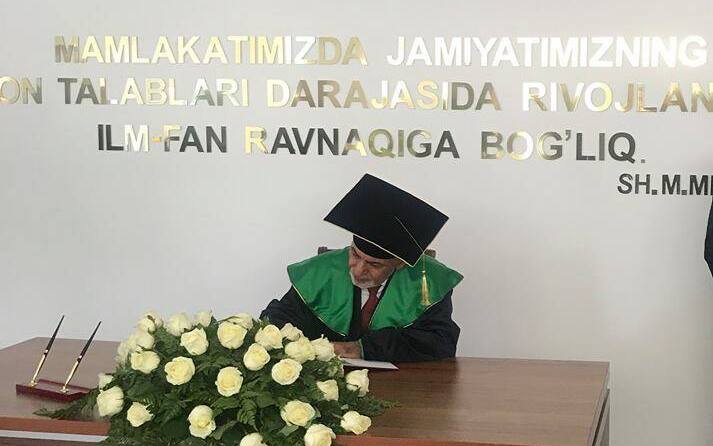
Speech at Bukhara State University - Uzbekistan
Keypoints:
- Historical Ties: We celebrate centuries of Afghan–Uzbek friendship and cultural exchange.
- Opportunity & Change: Your generation studies during a pivotal moment of transformation.
- Leadership: Master vision, change management, and strategic thinking.
- Management: Planning, discipline, and precise execution are essential skills.
- Learning: Commit to lifelong learning in modern sciences and traditional fields.
- Infrastructure: Railways, electricity, and fiber optics drive regional development.
- Central Asia’s Role: We are the crossroads linking Asia, India, and the Gulf.
- Islamic Civilization: Study our scholars to promote moderation against extremism.
- Collaboration: Progress requires teamwork, partnerships, and shared platforms.
- Youth Responsibility: Leading economic and scientific initiatives is your duty.
- Economic Integration: Projects like the TAP pipeline and rail networks reshape borders.
- Cultural Heritage: Bukhara and Imam Bukhari form a cornerstone of civilization.
- Global Perspective: Embrace your role in Asia’s rising economic and cultural influence.
In the name of Allah, the Most Gracious, the Most Merciful.
Honorable Prime Minister of Uzbekistan Abdulla Aripov, Honorable Governor of Bukhara, respected scholars, intellectuals, ladies and gentlemen, Peace be upon you!
I am immensely pleased to meet with you. Visiting the noble city of Bukhara, which holds a grand stature in history and the Islamic world, has long been a dream of mine. I express my gratitude to my brother, the President of Uzbekistan, for facilitating this visit. Since yesterday, a new chapter has opened in the history of our two brotherly nations. Congratulations to us all!
Mr. Rector, honorable faculty members, dear students!
You have bestowed upon me a unique honor. I cherish this honor and view it as a testament to the eternal friendship between the people of Afghanistan and Uzbekistan. An imposed century separated us; however, my brother, His Excellency President Shavkat Mirziyoyev, and I are determined to compensate for the damages of a century within just a few years.
I wish to speak to you about leadership and dealing with a changing world. Your generation, on one hand, enjoys immense opportunities and, on the other, faces major challenges. The opportunity you have arises from the leadership of your country under the wise guidance and management of His Excellency President Shavkat Mirziyoyev.
In truth, you are fortunate to be studying at a junction where Uzbekistan is changing from within. This country has assumed a major leadership role in the region and is becoming a global player for peace and stability.
I wish to congratulate the people of Uzbekistan on the transformation and development program of 2017 to 2021. The speed with which national consensus was achieved on this program, and its current implementation, is truly admirable.
Another matter of equal importance is that Uzbekistan has extended the hand of friendship and cooperation toward every single one of its neighbors. An agreement has been reached on over 90% of the border with Kyrgyzstan. Without the vision and leadership currently expressed, thinking about this would have been impossible. Uzbekistan is establishing connections with Turkmenistan to create mutual prosperity; bridges over the Amu Darya now link Uzbekistan to Turkmenistan. Tajikistan is also becoming part of this process. But specifically, we in Afghanistan are pleased that we are making history.
The welcome I received is a tribute to the people of Afghanistan and creates an opportunity for friendship and prosperity for hundreds of years to come. Likewise, on a global level, Uzbekistan has secured a position as an important player on the world stage. Therefore, you—the generation to whom the implementation and responsibility of this vision and action plan will be entrusted—are truly lucky. I congratulate you.
Your country, the region, and the world expect much from you; because you sit in the place where Imam Bukhari laid the foundations for world history. We expect much from you.
You also live in a specific era of Asian history. For centuries, Asia was merely an idea, but today we are witnessing the emergence of a continental Asian economy. About eight years ago, trade within Asia surpassed its trade with the rest of the world. Asia is not yet integrated, but at the very least, there is an emerging consensus that the 21st century can be the Asian Century, and this once again proves the importance of Uzbekistan’s location and culture.
Central Asia, with Uzbekistan at its heart, possesses the shortest connection routes between all parts of Asia. Therefore, every step taken toward building infrastructure, establishing higher education institutions, and for management is, in fact, a step toward the emergence of a continental economy. We only witnessed such an experience once in 1869, when the Western and Eastern United States joined together to create a continental-scale economy. The transport revolution and the Suez Canal were significant in the emergence of the world economy at that time. Now, you are faced with the leadership and management of this massive change.
Therefore, understanding opportunities is vital, and I am certain you are well-prepared for this task. On the other hand, your generation also faces significant challenges. In your generation, learning is not about how much information you can memorize, but how much you can think independently and understand patterns and connections; because despite the national environment being infinitely constructive and effective, an atmosphere of ambiguity prevails in the global environment.
Allow me to point out five of these global challenges regarding uncertainty.
First Challenge: The global economy has not yet emerged from the 2008 financial crisis. While Asia is embracing the process of globalization, some parts of the world are withdrawing from it. This necessitates double the effort from you to ensure that the growth of Uzbekistan and the growth of Central Asia—of which Afghanistan is an inseparable part—takes place.
Second Challenge: We are at the beginning of the Fourth Industrial Revolution. Unfortunately, in this part of the world where we reside, we missed the first two revolutions. We created the first revolution, which was the agricultural revolution, but we missed the industrial revolution. The prevailing global trend will be computerization, digitalization, and transformation through instantaneous communication and information. Hence, the definition of work, expertise, and knowledge will fundamentally change. Men and women must respond to this in various ways. Your generation must lead a change that previous generations did not; they were recipients, but you must be the leaders and founders of this process.
Third Challenge: While Uzbekistan enjoys the blessing of full security and stability, the world lives with the threat of terrorism and instability. This challenge is the fifth wave of political violence and terrorism—which began with anarchism. Let me be clear: terrorism has no connection with religion or civilization; this phenomenon began in Europe. It has surrounded every other part of the world, including America and Japan. Therefore, do not associate it with names like "Islamic terrorism." Islam has nothing to do with terror. Read Imam Bukhari and reject terror.
Fourth Challenge: Radicalism. The danger threatening us is that this phenomenon seeks to distort our holy religion. Its basis is built on ignoring our history. This phenomenon has no understanding of the civilization we are proud of (which I will address) and in which Uzbekistan has played a significant role. For this reason, we must avoid narrow-minded interpretations of our 1,500 years of collective work.
Fifth Challenge: Old habits and the "zero-sum game." We must be capable of doing what President Shavkat Mirziyoyev courageously expresses. The result achieved through cooperation is far greater than isolation. When you focus on a win-win situation, you avoid the zero-sum game, which is a lose-lose equation. Therefore, we must understand that listening is an art; whether in personal life, in relationships between men and women, between generations, or between countries. We must put ourselves in others' shoes. We must listen to see what we can learn, rather than worrying about lecturing others that what we say is right. We must have a common ground.
So, given these challenges and opportunities, where do we look for examples? How do we unite our past and future as a common ground and common vision?
The first matter is taking inspiration from the past. I recommend you read the wonderful book titled The Silk Roads by Professor Frankopan. The name of the book is The Silk Roads—in the plural—and the author precisely documented the origin of the Silk Road to the year 117 BC. This means that 2,050 years ago, Bukhara and present-day Uzbekistan were important points in thriving global trade.
Consider just two animals to understand this centrality. First, the horse; hundreds of thousands of horses were exported from our countries to India and China. Every Chinese ruler paid the highest price for the precious horses of Central Asia. Second, look at the Bactrian camel. Without the camel, long-distance trade was an impossibility. But it is not just this; study the texts and writings of ancient periods, such as the Buddhist era when Bukhara was known as "Vihara." You will see that Bukhara’s roots as a center of science date back at least 2,500 years. Traditional written texts in Bukhara were so advanced that research is currently underway showing that the writings of Imam Bukhari and Imam Muslim originated from a tradition with extensive roots in logic, mathematics, and written texts. Therefore, they could achieve the impossible. After the Quran, the book most widely studied globally is Sahih al-Bukhari. This proves the existence of a grand educational tradition that inspired it.
Second, Islam created a world order. Allow me to quote Frankopan: "The Islamic conquests brought about a new world order, an economic giant bolstered by confidence, intellectualism, and a burning passion for progress. With immense wealth and few natural, political, or even religious rivals, the Islamic realm was a place where order prevailed, where merchants could become wealthy, where spirituality was respected, and where different opinions could be discussed and debated. A desperate beginning in a cave near Mecca led to the creation of a cosmopolitan utopia without ethnic or local dependencies."
And the role of certain cities in Uzbekistan in this regard is remarkable.
Allow me another quote: "The Muslim conquests created a vast network of trade and communication routes connecting the deserts of Afghanistan and the Fergana Valley to North Africa and the Atlantic Ocean under their administration. The wealth concentrated in Central Asia was staggering. Excavations in Panjikent, Balalyk Tepe, and other locations in modern Uzbekistan testify to the patrons of the finest artworks and the money that followed. Scenes from courtly life and Persian epic literature were beautifully painted on the walls of residences. A collection of images in a palace in Samarkand shows the diverse world the Muslims had stepped into, depicting a local ruler receiving gifts from foreign officials arriving from China, Persia, India, and perhaps Korea." I bring these matters to your attention because we in Central Asia have been deprived of our history and must reclaim it.
Another part that has remained unknown until now, but is depicted in an extraordinary book by Professor Frederick Starr, is the Central Asian Enlightenment. A serious discussion can be held regarding the "Mamun Revolution" that began in Central Asia, which is now being documented in great detail.
Why should we look to the past? Because, on one hand, our location and our history as the meeting ground of cultures and civilizations re-establish our position in the 21st century.
But now I turn to the future. How can we own the future? The first quality you need for that is Leadership. Let me point out the important qualities of leadership:
-
Vision: You must have an understanding of a vision. Without understanding the future, you cannot achieve it.
-
Understanding Change: As humans, we dislike change. Normally, as we age, we resist change more. But when change occurs, you will have one of two reactions: either you understand and lead the change, or the change leads you and leaves you disappointed.
-
Design Thinking: In leadership, you must be able to design different ideas. What do we mean by designing ideas? You must consider potential. The cooperation between my brother, President Shavkat Mirziyoyev, and me is the ability to see benefit where others do not. Two examples: transferring 1,000 megawatts of electricity from Uzbekistan to Afghanistan and, hopefully, 5,000 megawatts in the future to Pakistan and India. This was a "potential" that is now turning into resources, capital, money, and light in our homes and for our generation. Uzbekistan will be the bringer of light to Afghanistan, Pakistan, and India. Another example: the railway from Mazar-i-Sharif to Herat and beyond to Iran and the Gulf. Our estimate, one year after the completion of this railway, is the transport of tens of millions of tons of goods, and in the fourth year, twenty million tons. This is the beginning of this process. When we lay the foundation, future generations will add millions of tons more. Therefore, you must reflect on the fact that when others do not perceive an opportunity, you must find that opportunity.
-
Partnership: You must create partnerships. No one can lead alone; you must perform teamwork and find common grounds. "Listening" is of paramount importance in this regard.
The second thing we need, especially regarding your generation, is Management. The first point in management is that it speaks not of words, but of actions. For this reason, you must have a plan, you must know about timing, you must know the schedule, and you must be sure that trust is created through execution. Going from Bukhara to Tashkent requires one type of planning; going from Bukhara to Samarkand requires another. If you are changing Central Asia, it requires a different method of planning.
The second quality of management is the discipline of details. No detail is unimportant, because it is the details that destroy great visions and great plans. We must know what is important and ensure it is done. I am pleased that my young friends in Afghanistan have adapted to me; because I was outside the country for thirty years, they see me as a 36-year-old, not a 66-year-old. But every time they present a vision to me, I ask them for a plan. I demand "execution" from them, and this is vital.
Third, regardless of your field—be it engineering or literature—you must know about program and project management. Programming is the short-term and long-term collection of projects. I will give you an example of why this is needed. After the 2008 financial crisis, about fifty countries adopted exactly similar programs. They wanted to return their GDP to its original state; they wanted to build infrastructure. How many of them do you think were able to do it, even if they arranged a budget and had resources? How many succeeded? Fewer than ten! And if we think this is a difference between developed and developing nations, it should be noted that President Obama made it his priority to build one trillion dollars' worth. But he was unable to build any infrastructure because the U.S. Congress did not help him. In contrast, Canada designed everything in six months and was able to implement and execute thousands of projects. Malaysia and Singapore performed beyond expectations because everything depended on management, not a grand vision.
And the fourth topic is learning to learn. In the past, when I went to school (1968), knowledge was limited. If you studied engineering, you could practice it for forty years. If you studied medicine, whatever you knew more or less about the field could be a lifelong occupation. But today, what matters is the necessity of permanent learning. A field like Computer Science changes every year or every six months. The definition of medicine has fundamentally changed, as has engineering or any other field.
In conclusion, allow me to thank you, Mr. Rector, for this unique honor. Allow me to express gratitude to the academic community at Bukhara University for the respect shown to me. You respected the nation of Afghanistan and the friendship between Afghanistan and Uzbekistan. Both the generation of students today in Uzbekistan and their peers in Afghanistan will lead affairs for the next 40 to 50 years. Similarly, the rest of Central Asia awaits the capabilities that this educational institution will produce.
I am confident that with the opportunities President Mirziyoyev has created, you will likely be the finest generation of contemporary Central Asia today. We wish you success and look forward to your actions and works.
Long live Uzbekistan!
Q&A
Question: Honorable Mr. President, peace be upon you. My name is Babar. Welcome to Uzbekistan. I want to thank you for the intellectual and wonderful speech you delivered. My question concerns the friendship between Uzbekistan and Afghanistan; how do you evaluate Uzbekistan's efforts toward developing relations between the two countries?
President Ghani: [Addressing the moderator] Would you like me to answer the questions one by one?
Moderator: Yes.
President Ghani: First, I thank you for your excellent hospitality. Afghanistan and Uzbekistan have laid a foundation that will endure for hundreds of years.
First, my visit yesterday was historic. There are few countries that sign 23 agreements in a single day. Second, Afghanistan and Uzbekistan, thank God, have no disputes or conflicts between them. Third, in terms of vision, planning, political will, and commitment to execution, there is complete and shared agreement between President Mirziyoyev and myself, the cabinets of Afghanistan and Uzbekistan, and the honorable Prime Minister of Uzbekistan.
Economically, we are making history. I pointed out only two major projects to you, but there are many other initiatives that will expand into hundreds of projects. Specifically, I am grateful for President Mirziyoyev’s leadership in organizing a global and regional vision toward bringing stability, peace, and progress to Afghanistan.
I believe the result for your generation is that all of you will have thousands of Afghan friends, and Afghans of your generation will have many Uzbek friends. Do not forget that Amir Ali-Shir Nava'i, Abu Rayhan al-Biruni, Gawhar Shad Begum, and hundreds of other figures have linked us together in the past and present. I hope you spend part of your lives in Afghanistan, and part of the lives of Afghans will be spent in Uzbekistan. In this way, you will know Afghanistan, and Afghans will gain a greater understanding of Uzbekistan.
Babar Alimov: Thank you.
Question: Honorable Mr. President, my name is Farrukh Alimov. First of all, welcome to the city of Bukhara and to Uzbekistan. I express my gratitude for your words, which were not only interesting but inspiring. My question is: can you share your perspective on the role of Afghanistan in economic cooperation and the integration process in Central Asia?
President Ghani: Certainly! Thank you for the welcome. It is a pleasure to be here in Bukhara and at this university.
Historically, Afghanistan possesses three distinct identities. Afghanistan and Uzbekistan have been referred to as the "Heart of Asia." Muhammad Iqbal, the prominent poet of Pakistan, visualized Afghanistan’s position magnificently:
"Asia is a body of water and clay, / And the Afghan nation is the heart in that body. From its discord, the discord of Asia; / And from its harmony, the harmony of Asia."
This poem summarizes everything. Due to the war of the last forty years in Afghanistan, we were the source of conflict and ambiguity in Asia. In the past, countries avoided us, but now, with the beginning of a shared vision between the Presidents of Turkmenistan, Uzbekistan, Azerbaijan, Kazakhstan, and Tajikistan, Afghanistan is re-joining Central Asia after 117 years. We are definitively here to be a part of Central Asia.
Second, Afghanistan has been called the "Gateway to India." Remember that Babur went from Fergana to Kabul and through there conquered India. He loved Kabul so much that his body was moved there after his death, and we honor his memory in a magnificent garden in Kabul. The days of war have ended. We will be united as the "economic corridors of the subcontinent."
Therefore, thanks to the excellent leadership of the President of Turkmenistan, the TAPI gas pipeline will reach Afghanistan in February. We will receive electricity from Uzbekistan, but we actually plan to transit the mass production of Uzbek energy—led by the Prime Minister—to India. Regarding fiber optics, the Prime Minister and I, with the President’s approval, agreed that all projects will be connected via fiber optics.
The railway we are beginning from Mazar-i-Sharif to Herat will extend to Kandahar and the Pakistani border, eventually connecting to the Indian railway network. There is a great historical link between Northern India and Central Asia that will be revived.
The third identity is as a "Crossroads"; a place where ideas, people, and goods flow in all directions. The beauty of this path is that you can have multiple crossroads: Uzbekistan as one, Afghanistan as another, and through these vast exchanges, Ashgabat will also become a crossroads.
Thus, we play the role of the connector between Western Asia, Iran, and the Gulf on one side, and India and Pakistan on the other; eventually, all of us will connect with China. The two great development drivers of Asia—China and India—will be brought together through Afghanistan’s mediatory role. I hope all of you, especially your generation, are among the beneficiaries of this process. Let us embrace the economies of China and India.
Farrukh Alimov: Thank you.
Question [in Dari]: Peace be upon you, respected President! I am Fazluddin. Firstly, we are very happy for your visit. We thank you for your profound speech. As you are aware, the President of Uzbekistan, during his speech at the OIC meeting, proposed creating a Center for Islamic Civilization in Tashkent and the Imam al-Bukhari International Research Center in Samarkand. Could you please share your views on the importance of these two centers in raising the young generation with loyalty to national values and countering anti-religious ideologies?
President Ghani: Thank you for your question, and thank you for asking it in Dari.
Fazluddin: You are welcome.
President Ghani: As I mentioned earlier, extremism is as great a danger as poverty, terrorism, and instability. What has happened? A tiny minority, insignificant in number or quality, wants to hijack the holy religion of Islam. Unfortunately, in the past, there was a lack of clear vision and moral courage to tell this minority: "Our religion is not your religion." Our religion is the religion of Imam Bukhari; an Islam that never knew fear; an Islam that convinced other civilizations through logic; a religion that people welcomed with their hearts and souls, leaving their previous faiths by choice.
Therefore, both centers are very important steps. The Tashkent center will help us understand our past as a civilization. By the grace of God, your generation understands who Al-Biruni, Al-Khwarizmi, or Ibn Sina were; but in the past, Islam’s contribution to global civilization was hidden under a black shroud. The Tashkent center will bring this back to life. Next year in Kabul, we will jointly celebrate Al-Biruni with Uzbekistan and this center. In Uzbekistan, our women—who have always shone in history like Gawhar Shad and hundreds of other Muslim women—will be a subject of discussion between Afghan and Uzbek women.
The Imam Bukhari center must again play the role of providing fatwas and presenting Islam as a religion of peace, moderation, and empathy. We must take inspiration from the Seerah (life) of the Prophet in Medina. The first written constitution in the world was written in Medina, granting rights to all people regardless of their religion. The role of Uzbekistan’s scholars, including Imam Bukhari and especially Imam Muslim and Imam Tirmidhi, is immense. We must revive this tradition. If we do not understand the intellectual foundations of Islam, we might think any extremist idea is reasonable. The worst thing is that these individuals interpret the ideas of Orientalists in an extremist way and argue with them. Therefore, I hope you not only shine in natural sciences, math, engineering, and medicine, but also fundamentally understand the basics of Islam, because that is the "vaccine" and prevention against extremism.
Fazluddin: Thank you for your answer.
Question [in Pashto]: Peace be upon you, dear and respected President! My name is Oghuljan Abdul-Ali, a student. It is known that Afghanistan and Uzbekistan are landlocked. In this regard, what is your opinion on the importance of Afghan-Uzbek cooperation in the field of transport and communications development?
President Ghani: Thank you very much, sister.
President Ghani [in English]: I will answer this in English because translating from Pashto might be difficult, but thank you for asking in Pashto. Uzbek is considered our third language; if we learn it, we connect more, and you connect with us by learning Dari and Pashto. Thank you for having such a spirit.
The question was: Afghanistan and Uzbekistan are both landlocked; how can we reach the sea? First, I should question the term "landlocked." We are connecting bridges. It depends on how you perceive being landlocked. As long as sea routes were the only thing that mattered, we were considered landlocked. But in the 21st century, railways, highways, and fiber optics will weave and connect Asia together.
Second, the Mazar-i-Sharif to Herat railway project will connect Uzbekistan and Afghanistan directly to the Gulf. This means Uzbekistan will be connected not only to Iran but to India and countries beyond. Next, we hope to extend the railway to the Pakistani system, connecting Uzbekistan to the ports of Gwadar and Karachi, and ultimately to the Indian Ocean.
In other words, it comes down to a clear vision. When we see ourselves as "connectors," we can imagine the best way to bring countries together for the best results. We are working on this now. I want to thank Mr. Irgashev, the Uzbek Ambassador to Afghanistan, for his tireless work, and all officials, especially the President of Uzbekistan. The President and I focus our attention every day on how we can reach the ocean. We will reach the sea, and with the help of God, we will achieve this great goal.