Afghanistan in an Age of Global Uncertainty: Security, Transition, and Regional Cooperation
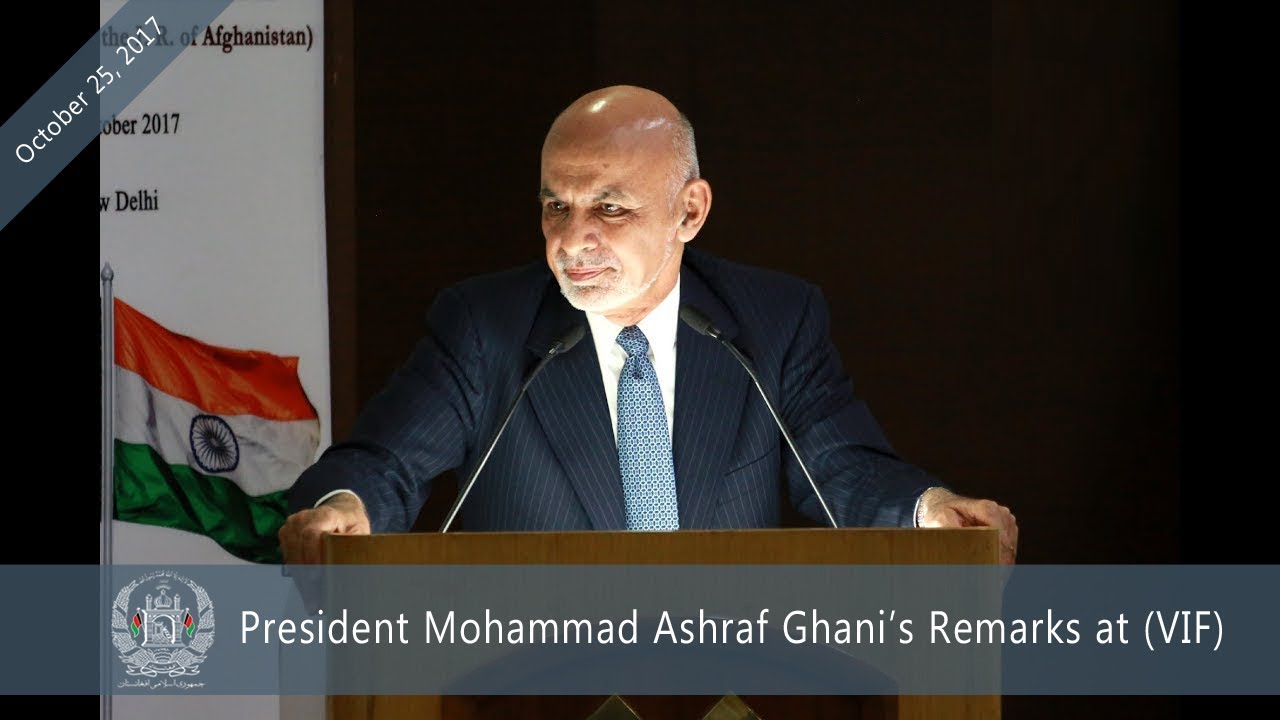
Speech at at Vivekananda International Foundation (VIF) - India
Keypoints:
- Global Uncertainty: Managing unpredictable international challenges.
- Security Transition: Afghan forces lead national defense.
- Political Transition: Building inclusive, democratic governance.
- Economic Growth: Promoting development and self-reliance.
- Regional Connectivity: Linking Asia through trade and infrastructure.
- Counterterrorism: Combating extremism and protecting stability.
- International Partnership: Strengthening global cooperation.
- Vision for Peace: Achieving a stable, prosperous Afghanistan.
In the name of God, the Compassionate, the Merciful
Dr. Gupta thank you for that very generous introduction, Admiral Nair, distinguished ladies and gentlemen, friends.
It is pleasure to be with you this afternoon. Let me first begin with the global context, then the regional context, the international context and then discuss the new context provided by the South Asia Strategy of the United States, and then we can engage in a discussion.
Global Context
We live in a radical environment of global uncertainty. There are four drivers of this uncertainty. First, the shape of the definition of the 21st century is unclear. There is a struggle over the definition of 21st century so rules of the game regarding the 21st century have yet to be reshaped. Periods—if history has a judge, periods when the global rules of the game are uncertain, produce enormous mis-guessing. Instead of analysis we engage in guesstimations, but we act on our perceptions rather on realities.
Second, the global economy is on four speeds; the prospect of globalization is wit. Western Europe, the consensuses, the European Union rather is going to have extremely time growing. The United States may recover but the prospect of sustained jobs and bringing down poverty and inequality are considerable challenges. China is likely to settle to 6% rate of growth, the bright prospect is India, regarding a consensus of 8% potential rate of growth. In this kind of situation, inequality between men and women, poor and rich, the bonds that we knew from the welfare state are under attack. And because of it the democratic process is failing, considerable stresses and strains which translates into short-term policies. The only game in town, as Mohammad Arian said, are the central banks, and the central banks are reaching their limits.
The third driver of uncertainty is what I call the Fifth Wave of Violence. Terrorism is manifesting itself in its fifth wave since the launch of anarchism and it is radically morphing. I think we can have a consensus that the level of threat posed by terrorism today is much larger than what it was in 2001. But the response to terrorism is country-focused, not global and not regional. And because of that the transnational networks of terrorism are combining with transnational criminal economic organizations to pose a fundamental challenge, never has political violence been so well funded and grounded and so much interactive and when you had cyber threat, in terms, so face to faceless is combining with face to face networks producing an entirely new challenge to hierarchy. States are slow, networks are fast. Our response as states is incredibly slow vis-à-vis the challenges that we face.
And the fourth driver is the fourth industrial revolution, what we know as structure of jobs is likely to become obsolete. So we are engaging in economic policies that are made for a 140-60 years ago rather than looking forward to—and this environment uncertainty is not just characteristic challenge for the countries that are in conflict; it is a global challenge. It is not that there are stable models that we are looking for; the whole global situation is one of uncertainty.
Regional Context
Second regionally, on the one hand, we are facing the probably the greatest moment in Asian history. The prospect of an Asian continental economy emerging, only once in 1869 when the United States became a continental economy by joining the Atlantic and Pacific railway did we witness such a phenomenon. Here to put it simply the Great Trunk Road can lead the silk roads. An Asian continental economy is no longer a dream. The prospects particularly with the growth not just India and China everybody knows, but every day we are getting closer to transport infrastructure, and into infrastructure fiber optics, transmission lines and others that would weave and net the Asian continental economy together.
But on the other side, Asia has been at war, the longest war for 600 years. Asia as a concept, as a geographical space has been a space of conflict for 600 years. There were two long wars; the 500 war of Europe. Dean Acheson best characterized these in his book “Present at the Creation”; the Asian war still has not ended. The bulk of the conflict, use of violence is still taking place in Asia.
In here the third characteristic unfortunately is that particularly in the area where we are standing and where I belong and the people I represent, the rules of the game between states have not formed up. Because some states as a matter of policy resort to malign non-state actors as instrument of policy. The distinction between good and bad terrorism is still haunting us. The challenge is becoming more pronounced; the response is fragmented and not coherent. All we need to look at the UN paper on terrorism, and a strategy to which–a convention to which all the states have signed, but that document clearly indicates the state sponsorship of terrorism as a global phenomenon is threat. And because of this the regional environment in which we deal is one of uncertainty. Instead of seeing one of the conflicts or enduring conflicts in the region as an opportunity to reach a regional consensus, lack of consensus, and more than that, active engagement and destabilization is a challenge. Instead of seeing, that all of us engage in win-win policies, some players still engage in lose-lose policies and that is a fundamental challenge.
Afghanistan’s Four Transitions
In this environment, if we take the question of my beloved country of which I have the honor to serving; first, the job in the last three years. First we tackled the impossible; now we are dealing with a very difficult. It is improved radically but compared to any other job it is still a very difficult job. Why did it seem impossible? Because Afghanistan had to engage with four transitions under conditions of global and regional uncertainty in end of 2014. The first was political transition. For the first time in our long history, now documented not to be 4000 years but 6000 years, we had a democratic transition of authority, not power. For the first time the people of Afghanistan chose their leadership. And instead of adopting a winner take-all approach, we adopted an approach of constituting a Government of National Unity and most commentators in the region and the world gave us about at most generously 3 to 6 months, but the National Unity Government is well and functioning. Let’s not forget, most established democracies take 6 months to establish a coalition government. The global norm now is not the global exception. But the politics of consensus in a country that has taken 40 years is a major challenge and it needs to be constantly reconfigured and I will come back to.
The point that I would like to make we can single out my young colleagues. There number of Afghans who have graduated from Indian universities, could I call on them to please stand up. What politically Afghanistan is witnessing, is one of the greatest generational changes. Half of our Cabinet is under forty. This generational change in a country that has endured forty years of conflict is a phenomenal beacon of hope. We are attempting something that has not been done before. Generationally people follow each other, they share similar experience. Our experience for five generations has been one of divisions. For the generation of 1970s, there are one and half million dead people between them, the division and it goes on. But this is likely to be the greatest generation of contemporary Afghanistan, and I am delighted that men and women are taking equal part. When you have a woman as minister of Mines in Afghanistan that suffered from gender apartheid, it tells you where we have come, my chief advisor on the United Nations or my chief advisor on the economic councils. All graduates of top universities; women who would challenge any man to debate them. And please do not challenge our Afghan woman to debate.
The second transition was security. We had one of the largest deployments of the international forces of about 43 countries helping us. And we went suddenly to complete management of the security, leadership of the security by Afghan security forces. Let me pay to the men and women who with payment of their lives have secured our freedom, our dignity and our sovereignty. Minister Atmar, thank you to you and your colleagues. There is not a single battle where the Afghan army has run away. Because we said we are dealing with a radical environment of uncertainty, the guessing was that Afghan army will last 6 months. Well, Afghan Army is well and good, thank you. But we have paid a very high price. Let’s go back, the premise of security transition that I had the honor of leading. Former President Karzai asked me as a national duty, I responded. Security environment was that with the withdrawal of international troops, peace will dawn. That the regional players will embrace peace, not conflict, instead we have seen a war imposed on us that has had no sense of mercy and no qualification and we have contained it.
What I am saying that we have achieved the impossible is that now the people of Afghanistan trust that the survival of the state is not at stake. Yes, the fighting has been hard. The last thing I wanted to become on earth given my affirmation and over a decade of teaching was to become a war president but I am enormously proud to be the commander-in-chief of patriotic forces; a force that is fighting for nation, for honor, for God, for dignity. And we have a four-year plan and within four years we can assure you that the Afghan Security Forces will achieve what Columbia achieved under President Uribe; an environment where Afghan men and women, the citizens of our country that are bound by the rule of law and constitution will be able to live in peace and in security.
The third transition was economic. Our economy was totally dominated by the international forces. For each member of the international force, there were at least 4 to 6 contractors. So you had middle class demand in one of the poorest countries, upper middle class demand and this was suddenly taken out. Because of that we experience a great recession bordering on a depression. Now even the IMF is projecting 3.5% rate of growth. We have come out of the sheared depth of the economic meltdown to economic growth. And this is being reflected in the latest Asia Foundation survey that is projecting 60 percent optimism regarding the future.
The fourth transition was in the culture of the state. The state was being perceived as an estate, as a series of claims of property rights for various networks and where corruption had become the norm. Our fundamental issue has been to tackle our problems and to own them. I hope the international community does not preach to us regarding what our problems are. We own our problems; we solve our problems; we tackle our problems. And we will increasingly be able to overcome them. And the change in the culture of the state is the fundamental issue that we are tackling. Today I am enormously proud that the Chief Justice of Afghanistan, the members of Supreme Court of Afghanistan, the Attorney General of Afghanistan are known for their integrity and impartiality. This is the legacy that we hope to transmit to the future generations.
Foreign Policy and Regional Relations
Let me turn now to the question of foreign policy and regional and internal relations. In Afghanistan, foreign policy is domestic policy. Simply put why? Because we are not facing a civil war, we are facing a regional and global set of challenges in terms of security, in terms of economy, and of course in terms of stability. I hope that it has been demonstrated. Thanks for the remarks and I would like to acknowledge the remarkable leadership of Prime Minister Modi, the government of India and the 1.2 billion people of India.
India gave us a one-billion-dollar generous package of assistance for the Brussels Conference last year in October. In effect, every Indian contributed $1. Thank you every Indian! A billion of ties bind us through thousands of years of history but our partnership is based on vision of the future. A vision where our central challenge is poverty and inequality and insecurity, not at the sub-national level but at the regional level.
South Asia despite its enormous history of connectivity today is the least connected region of the world. And because of it, our fundamental challenge is to bring vision to this and cooperation. In 2001, when 9/11 happened, there was a spontaneous consensus in the region and the world that a stable Afghanistan was to everybody’s benefit. Alas in 2014 this consensus did not exist. And we as the government of Afghanistan have had to work incredibly hard to make sure that a set of relationship is established where the region, again, reaches consensus based on a view of shared interest and with an understanding that there is a competitive advantage in cooperation rather than confrontation and conflict.
What have we achieved? First, a breakthrough in our partnership relationship with the United States. The South Asia strategy of the United States that I will return to is the fundamental manifestation of this. Let us not forget, President Obama had publically announced that American troops would be reduced to 600, American Embassy based. We were able to restore this partnership and fundamentally transform it.
Second, we have reversed 117 years of history vis-à-vis our northern neighbors in Central Asia. Today Afghanistan is incredibly well-connected to Turkmenistan, to Uzbekistan, to Azerbaijan and beyond that to Georgia and to Turkey. With the launch of Lapis Lazuli Route, we will be a railway system. Transport agreement, we will be able to reach Europe in five days. The railway terminal in Aqeena in northern Afghanistan, and I hope that by time of my visit to Uzbekistan when we will be signing 16 agreements; a foundation for connecting Central Asia to the Gulf and beyond will be established.
We are talking potentially about 15 million tons of cargo going through northern Afghanistan and southwestern Afghanistan. I mean I have picked an exact date because in 1998 the Russians Empire imposed the tariff that made trade between then India and Central Asia dropped to a halt and we had 117 years of isolation. This is extremely important. If you want a witness, ask His Excellency the Secretary General of the United Nations. He spent a week in Central Asia and when he came to Afghanistan, we were delighted to hear that the Central Asian neighbors were looking south.
TAPI, the Turkmenistan-Afghanistan-Pakistan-India pipeline which everybody thought was a pipe dream in February 2018 is going to reach Afghanistan. We are going to be the first country to have access to Turkmen gas. We are creating the basis for CASA-1000 the Central Asia-South Asia electricity transmission line; we are moving to construction; again, an impossible project. We are talking about transfer of 5000-15000MW of power from Central Asia to South Asia, the first fiber optic line across the Wakhan corridor from China; we have agreed in principle. The five-country railway that will connect us to China from Tajikistan to Kyrgyzstan and then on to Iran, is now seriously under feasibility step. With Iran, we have had a dialogue that our Iranian counterparts are describing as something that has not happened in 100 years. And equally with India and China, it is obvious and I do not need to go into details. We forged relations that provide the basis.
Where we have not had progressed, despite trying, unfortunately, has been with Pakistan. We held the hand of peace and the hand of dialogue; unfortunately, we saw conflict and intensification of conflict. But we hope that the new context which I will now return to and then answer your questions would enable us to bring a new perspective and hopefully new outcomes.
South Asia Strategy of the United States
The South Asia strategy announced by President Trump is a game changer. First, let’s remove a fundamental misunderstanding or ambiguity. The goal of strategy is a two-fold stabilization, stabilization in Afghanistan and stabilization in South Asia. And the key instrument is political. A dialogue that would result in internal peace and regional peace.
Second, the instruments are all multidimensional. It is not a single-dimensional strategy that just relies on use of force, but diplomatic and economic instruments are equally significant to this approach.
Third, it singles out India for engagement in this approach and particularly on the economic front where India has been such an important partner to us from air corridor to Salma, to Parliament, to range of other issues.
And fourth, it is a condition-based approach. As Secretary Tillerson stated yesterday, the strategy requires fulfillment of conditions.
Let me now highlight both the current conditions and the prospects.
First, we have 7 army corps, 6 deployed in the provinces and one our Special Forces that has be just elevated from a command to a corps command. Our Commando Forces are doubling; our Air Force is tripling. What is the meaning of this? The state is not at risk of collapse. Just the Special Forces are sufficient to underwrite the sovereignty of the state. Last year at this time, all 6 of our army corps had been commanded attack and had faced severe losses. Today, our six army corps are on advancing. We are winning the rural war. The prospects of prevailing in the rural war are good. The problem is one of the worst attacks on human history has been launched against our urban population and against our civilians. This needs condemnation. This is a global level outrage. Mirza-olang, Shinwar, the mosques; these are the fundamental violations of human rights and abuses that require prosecution.
I am not given to a hysteria because my people did not elect me to scream; my people elected me to reason. And reason is what we master because when the going is tough and the job is impossible or extremely difficult, you needsteadiness of purpose. Nerves of steel and instead of a heart you need to put a piece of stone in your chest because the casualties that our civilians incur, the losses that our children suffer, the pain that is inflicted on our women is unspeakable. This cannot be tolerated, but we must move forward.
So in this regard, what are the challenges I have outlined? The question fundamentally is two-fold. Peace internally; our approach to internal peace is to own through Afghan-government-led process. We have a record of success. Nobody thought that the leader of Hizb-i Islami Mr. Engineer Gulbuddin Hekmatyar would now be living in Kabul through an intra-Afghan peace dialogue. We succeeded. We demonstrated that we have the intention, the political will, the capacity for discussion and all of it done through an intra-Afghan dialogue.
We need to take this issue out because we would like a push factor from Pakistan vis-à-vis Taliban, not a Pakistan-managed peace process with the Taliban. Why? because we want peace with Pakistan and that the fundamental issue for our stability and regional stability, because the issue to us is not Taliban; the issue is our peace and our security. Taliban are one manifestation of this. The larger issue is destabilization of Afghanistan.
And because of it, we have held the hand of dialogue and discussion, but this again is to be done by deeds, not by words.
Usually at this time in 2015 or 2016, I could tell you the shape of coming year and the nature of conflict that we would be facing, but today I cannot. In two months I would be able to tell you more or less with 80 percent accuracy, why? Because we need to deal with the scenarios and drivers and a context, where the context has changed and the question is whether the leadership of Pakistan and all our friends and allies from India to Azerbaijan, Iran and extending to Russia would re-emerge on a consensus on the need for stable Afghanistan.
Specifically, let’s take up the most fundamental issue; nature of violence. Last year, we underwent five waves of violence. The war had five phases. And the most brutal started on October 5th when the world pledged $15.2 billion. Now this year in 2017, the war had gone through two phases; the third phase took place in the last 2 weeks. It is one of the most brutal phases. So the indicators for us are very simple. Will the intensity of violence continue through the winter but most significantly will 2018 be year of intense conflict? This does not require debate, it does not require huge discussion, it requires the registration of the level of violence on the bodies of our women, on our mosques, on our public buildings. So we will be able to judge, whether there is an intension or lack of it.
Second, will there be a pause in 2018 in order to prepare for a worst conflict in 2019.
Third scenario, gradual change but cumulative.
And fourth, desirable but whether feasible, a breakthrough. All of these require coordination. All of these require persistence. And what is fundamental is we should not engage in mutual deception. We should engage in a responsible dialogue as globally and regionally responsible stakeholders and as responsible human beings because it is that level of responsibility on which not just the prospect of Afghanistan and how the generation of Afghan children will grow depends but also how the region is shaped and ultimately the world.
Conclusion
Last words, the case for Afghanistan has largely been made on negative grounds meaning that if the Afghan government, God forbids, were to collapse, what would happen to the region and what would happen to the world? I am not engaging in that; I leave that to you. One Osama [bin Laden]; and what was he capable of doing! Now, there twenty internationally recognized terrorist groups operating. My proposition is that none of these groups would function to their degree of effectiveness if it were not for the platform provided by the Taliban networks and for the drug running organizations. Drugs need to be taken seriously as a regional problem and as a global problem. And it is not enough to just pay it or not, it needs to be tackled. So financing of violence or political violence need to be tackled.
The second issue is the positive guess for Afghanistan. Our problems and our prospects are exactly located in the same thing, our location. And the person who captured it best was Iqbal the poet laureate of Pakistan.
Asia is a body of water and earth of which the Afghan nation is the heart From its discord, the discord of Asia; and from its accord, accord of Asia
We have been at the heart of networks. A roundabout, a place of meetings, civilizations, religions, cultures and of course armies, traders and pilgrims. Afghanistan is the shortest route for connecting South Asia to Central Asia and South Asia to West Asia.
Our mineral wealth; our tragedy is that we are potentially one of the richest countries on earth while is one of the poorest countries on earth. The country can move in a generation from poverty, first to live with dignity and then to prosperity. This connectivity is absolutely essential so that positive case needs to be taken. It is now up to imagination and up to principle. We need courage, compassion and determination in equal measure. We need Courage to think the unthinkable and to take those actions that will bring an end to these 40 years of violence for us, 600 years of instability for Asia. We need Compassion to understand that suffering inflicted on people is not justified. And We need the determination that in case the hand of peace is rejected, to be willing to serve with honor as the commander-in-chief to the last breath and to the last drop of blood.
Thank you.