Transformational Leadership and Lasting Peace in Afghanistan and South Asia
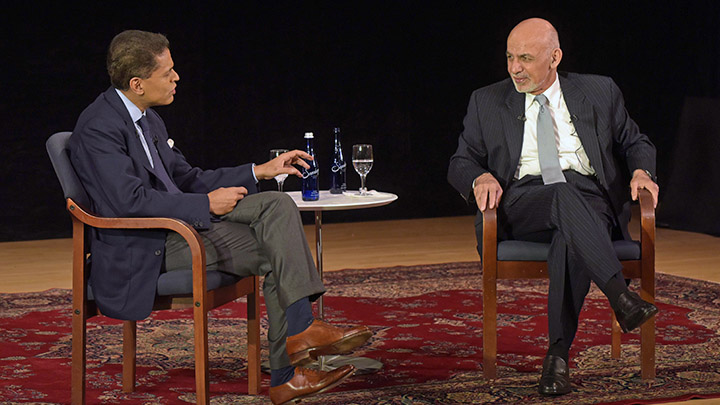
Speech & Interview at Asia Society Policy Institute, USA
Keypoints:
- Security and Defense: Strengthen Afghan forces to protect the nation and maintain stability.
- Political Settlement: Engage in dialogue with the Taliban and neighboring countries for lasting peace.
- Governance Reform: Implement anti-corruption measures and ensure accountability at all levels.
- Youth Empowerment: Entrust the new generation with leadership and decision-making roles.
- Women’s Rights: Promote inclusion of women in government, workforce, and civil society.
- Regional Connectivity: Build economic and infrastructure links to enhance prosperity and cooperation.
- Counterterrorism: Combat terrorism and transnational crime through coordinated efforts.
- Civilizational Dialogue: Foster culture, knowledge, and engagement to strengthen society.
In the Name of God, the Compassionate, the Merciful
Prime Minister Rudd, Mr. Fareed Zakaria, friends, colleagues, distinguished ladies and gentlemen.
Let me begin by paying tribute, both to our security forces and to men and women in uniform from many countries among our allies, particularly the United States, and of course Australia where a museum in Sydney honors those brave soldiers and officers who fought shoulder to shoulder with us.
Over a million American men and women in uniform have fought with us, lived with us. And, it is an extraordinary pleasure that when I see them they say, they have left their heart in Afghanistan. This is an extraordinary tribute to our people, because the welcome that the people of Afghanistan have accorded to our international partners is unique.
We are at the moment of change; a radical change in context, and we have two ways of having a conversation: One is to dwell on the past; another is to take stock of today and this opportunity and really focus on the prospects of the future.
Briefly on the past. When I was sworn in as Afghanistan’s president, we dealt with a radical uncertainty as our overwhelming context. President Obama had publicly announced that American troops will be reduced to 600 and departure was proceeding very rapidly per our desire and as the person who had headed the security transition, I was determined to finish the security transition in Afghanistan which we did on time on December 31, 2014.
Our first attempt in that context was to raise the issue of peace, and peace for us is meant a double process of peace. First and foremost, peace between the state of Afghanistan and the state of Pakistan. This peace is fundamental to creating stability and following that prosperity both in South and Central Asia, so I reached out and we all reached out the Government of National Unity (NUG) my colleague Dr. Abdullah and my all colleagues. But unfortunately the last two and half years were not productive on that quest; instead, we had to fight and I hope it has become clear that the Afghan Defense and Security forces have fought with determination, with valor and with distinction.
Let me just highlight how some of our forces are doing extraordinary things. On May 31st this year, five Afghan policemen at the diplomatic quarter in Kabul saw a truck bomb heading towards the German embassy. It was question of decision of minutes. They decided to sacrifice themselves causing the truck to implode before it would hit the German embassy. Had the truck hit the German Embassy and its surrounding embassies, Kabul probably would have had done unfortunate distinction of entering the Guinness Book of Records as the slaughter house of international diplomatic presence.
These men [the five policemen] did not hesitate. This type of story recurs with enormous regularity. We have fought hard because we had to, but also what is extraordinary is that in the moment of fighting we have been able to carry significant reforms, and the reform of the Ministry of Defense is a tribute again to the imagination of my colleagues particularly I like to single out Mr. Atmar my colleague national security advisor, my other colleagues for their enormous work to making sure that one of the most successful generational transitions in our history and security forces is underway. Our Minister of Defense is under 40. He is not part of the generational quarrels of the 1970s, 80s and 90s. This generational transformation is taking place both in the civilian and security sector in Afghanistan and it is quite significant.
So the news, because the question is always asked that what part of the country is under whose control and etc. What I want to put is this simple equation. The Afghan army has been able to take every single district within days. Our problem has been holding and this is because our police is not substantially reformed and lacks the capacity, but this is changing and hopefully we will be able to move.
Before coming to the present, the dominant characteristic of the present is what I call the fifth wave of political violence. Terrorism is not new, Mr. Zakaria has written on this and it seems he knows a lot better. Beginning with anarchism this is the fifth wave, what is new, is the way all previous waves were based on secret societies face-to-face networks; this is a Facebook to faceless networks. It is an extraordinary combination of transnational networks, transnational criminal organizations and transnational cyber security linkages.
What we need to take account of, if the previous waves are to go by this, its is not going to be a phenomena or a challenge of a year or two, it is more likely to be a challenge of a decade or two decades. The politics is necessary, the international coordination is necessary to deal with this, and it requires a different perspective and I hope we can rise to that challenge.
The other components of the security, regional and domestic security and in that context, I would like to welcome the announcement of the South Asia’s strategy by the Trump administration. The number of troops, sp the first clarifications, they increased in the number of troops is modest. Second, I want to assure every American parent that American forces are not going to be involved in combat. The security transition is not being reversed; the increase in troops is within the limits and understandings of the Bilateral Security Agreement and the Strategic Partnership Agreement.
What is new is bringing all instruments of American power to the equation. It is the combination of diplomacy and also economic engagement that makes this distinctive. Because of this, the opening is to a comprehensive dialogue between Afghanistan and Pakistan, on the one hand, and in the context of the quadrilateral dialogue between Afghanistan, Pakistan, United States and China on the other hand.
It is a unique opportunity for the leadership of Pakistan to discuss with us the legacy of the past in a determination not to repeat the past, but to overcome the past. Securing the future of South Asia is enormously significant because tens of millions of people who live today in poverty as a result of our common understanding could have seen their pathway towards prosperity.
But we look at Asia being located at its heart and being at the heart means something very simple, the Asian continental economy will not come together unless Afghanistan is made in whole. The shortest way between different parts of Asia is to go to Afghanistan and what we have focused on in this again is a significant difference; all our neighbors near and far with the exception of Pakistan until now have been engaged in a very intense and productive dialogue. That dialogue in the context of the strategy will be intensified and we will be able to move forward.
The goal – the overarching goal of the strategy into which the Afghan government and people are dedicated is a political settlement and this political settlement, again, has two parts; one, state to state understandings in the primacy of state to state relationship in contrast to reliance of non-state actors particularly maligned non-state actors, and second, an offer of political dialogue to Taliban.
It should be clear to various Taliban groups that they cannot win in the military field. Had it been possible, it would have happened in the last years where we were fighting them under enormous constraints. Today, with the support and clarity of support that is provided, a military victory for them is impossible. Second they need to realize that they are losing the people of Afghanistan. Each atrocity that is committed, each violation of Human Rights, each attack on a mosque, a shrine, a village, a woman’s network etc. is alienating people further.
We need, however, to prepare our society for peace because peace must lead to stability. It is not every type of peace that we seek but a peace that can bring enduring stability to us and to the region. To make sure that an Afghan can prove an Australian wrong [President Ashraf Ghani is joking with Mr. Kevin Rudd, the Australian President and CEO of the Asia Society] I end my comments and I welcome Fareed Zakaria for a conversion.
Q & A Part
Fareed Zakaria: I am going to ask some questions and I encourage President Ghani to answer, making some of the same points he has already made for the tens of millions people who are watching on television; they will not have had the privilege of hearing President Ghani’s speech as a good politician. I imagine you understand that your best points are worth repeating and repeating and repeating. So what I thought I’d like to do Mr. President, let me start by saying welcome President Ghani.
President Ghani: It’s a pleasure to be with you, thank you for what you are doing for global engagement and dialogue. You are a voice of reason and understanding, and it’s a pleasure to interact with you.
Fareed Zakaria: You are trying to soften me up! [laughter]
President Ghani: That has never worked with you [laughter] It’s meant genuinely. [Laughter]
Fareed Zakaria: Let me begin by asking you a few personal questions. You are an academic by training; you’ve worked in the development field at the World Bank; you’ve lived as a scholar in the United States. Here you are, the president of one of the most difficult war-torn countries in the world with incredibly complex tribal politics, corruption, international politics with the United States, Russia, China. How difficult was that transition?
President Ghani: It wasn’t difficult; it was close to impossible. [Audience’s laughter] No, seriously, I am an accidental president because my life has been a preparation for this job. I spent 14 years of my life looking at the last 600 years of Afghan History. I have traveled to every single province of Afghanistan during the security transition. I know the history, the feelings – I hope – of each segment, each strait of Afghan population. I was raised on patriotic text books; a sense of Afghanistan as an entity with 2 to 5 thousands years of history; a place where the poetry of Rumi still sounds, where Khosh’hal Khan’s call to actions still echoes, and where Amir Ali Shir Naway’e’s call for justice is still very prevalent.
The second part is [that] my country needs representation and the other part which has been, you know, the World Bank, Johns Hopkins, Berkeley [University], etc. comes to use because we have had a problem. We have always won in the battle field, but we have not been able to represent ourselves and speak for ourselves politically. Now, we are capable; we have an entire generation that is connected and is able.
The third area is reform. I inherited a system where corruption was the system, so tackling it, articulating and moving and arriving at the sense. Our problems are chain-linked, and when you have chain-linked problems, the weakest chain determines your momentum, but you had to sequence and prioritizing has been immense. What… Where I am privileged, and what made the job much easier is the team; the interaction and the ability to discuss, so we have created fora; they are called councils where we are really are discussing and coordinating.
And when I look at the face of young soldiers, I give you a very small vignette to allow other questions, it used to break my heart, each time I went to the army corps, the cadets were shorter than me, the problem of stunting in our country. I have been through six army corps last month; for the first time, I am finding soldiers and non-commissioned officers that are taller than me. This is a vote in the future and they’re fit and it reflects. So to win the world for those who don’t have voice, which is the absolute majority of the Afghans, 40 percent of the people live below $1.35 but to deliver on the aspiration is an inspiration that keeps me going.
Fareed Zakaria: So everybody knows you are spotless, even your worst enemies don’t accuse you of corruption, but you preside over what is regularly regarded as one of the most corrupt countries in the world. How do you change that, and how do you function effectively without being corrupt? If the corruption has been the grease that made Afghanistan work, aren’t you handicapped by your honesty?
President Ghani: No, because corruption has not made Afghanistan work; corruption robbed us of two chances; the first was after 9/11. The people of Afghanistan had hope. I traveled all across Afghanistan; I went after 24 years on 26th December 2001. I traveled 10 provinces of Afghanistan without an escort; it’s corruption that took away the hope.
Second, one of the largest interventions in history under President Obama’s first term took place in Afghanistan, but again the Afghan elite did not do its job, so to make the argument that corruption greases the wheels and will make it function, no! It’s the opposite, it has deprived the majority. It has exacerbated the gap between the rich and poor, and sudden wealth came to people without the accountability for it. Why did the people vote for me? Precisely, because I had an anti-corruption agenda. People of Afghanistan are not corrupt, a small elite indulge in corruption and now we are coming, and every action that we are taking against corruption is welcomed. We have created a center for justice and for the first time high ranking officials – civilian and military – are being indicted.
Fareed Zakaria: Why is not reflected in the rankings of say Transparency International while you are still…?
President Ghani: Because It takes time. It takes time. I think in two years; you will see hopefully very significant shift. And what we did – an excellent question, thank you for it. Transparency International ranks functioning systems. When corruption itself – and unfortunately there are at least 50 countries where corruption is the rule, not the exception. When you are doing the foundational work, it does not reflect itself immediately in the rank, so one part, for instance, is completely based on the stroke of pen reforms. Those we could not focus on at first, because we need to focus on cleaning up security, so the sequencing and ranking are too different. Now, last week we finished a comprehensive anti-corruption strategy, I think as a result, you would see it.
Second, the rankings take place in middle of the year, so the efforts that you have done in the last 6 months of the year are only reflected in the next year, not in the current year.
Fareed Zakaria: Let me go back to your lack of political experience. So, people would look at a place like Afghanistan think, you’d need to be a kind of tribal chief and of all your predecessor did come from a very important family from an important tribe. You need to have the ability to arm-wrestle people in various ways as I say perhaps give them some patronage money. Did you find that you had to develop some skills like that, but surely at Johns Hopkins and the World Bank you didn’t need?
President Ghani: Well look. I was raised on the knees of my grandfather. He came from one of the largest clans in this country and the mediation skills that were required. The old Afghan political elite, prior to 40 years, was linked; it was networked. It had an ethos that had been formed during centuries; sense of justice, sense of fair play etc would vary. I had a visitor once, a journalist, and he interviewed me and asked me questions in English so I responded in English. He wrote and said that international vocabulary rolled from my lips, another time he saw me with students of Kabul University and I was speaking in Pashto and Dari, and he was stunned that I could communicate. Part of the problem is perception; international commentators classify us, if we speak English, they think we don’t know how to speak our own language and when we speak in our own languages, they get to be surprised.
Fareed Zakaria: Are you tough enough, do you have the ability to drag dead bodies across the room to show people in Afghanistan that you can do business?
President Ghani: You don’t need to drag dead bodies; you need to implement rules. We have enough of dead and destruction. No, seriously I mean, my problem was the opposite. I had the reputation as finance minister of being so tough that people thought they would vote for me but they were afraid that I would be so tough that I will break the system. What pleasantly surprised them is flexibility within principle.
Fareed Zakaria: You are one of the few world leaders I think who has generally been happy with the Trump Administration? [Audience’s laughter]
President Ghani: I am!
Fareed Zakaria: And have you had any personal interactions with the president?
President Ghani: Yes, absolutely.
Fareed Zakaria: How does he strike you?
President Ghani: We have had wonderful conversations, flowy!
Fareed Zakaria: And he seems – just give me a sense of your perception of him on from those phone conversations
President Ghani: Engaged, informed and determined to see and hear; but it requires immense preparation. If you want to keep him engaged, you better be informed and communicate everything significant in two minutes. It’s the standard thing that you are formed when one comes on your program. And you know, the first training that I got when I interacted with Fareed Zakaria was that if you have a message, don’t take more than two minutes to deliver. It is the same with President Trump! [Audience and the host’s laughter]
Fareed Zakaria: I would take that as a compliment. Is his strategy significantly different from President Obama, after all the number of troops that seems to be increased is not very significant?
President Ghani: It is different. I think several differences are involved here; first, with all modesty President Obama didn’t have a partner in Afghanistan. President Trump has, not just an individual, a team as partners in Afghanistan. We own our problems today. No one has to preach to us about corruption being an evil. No one has to compel us to saying that your security sector needs reform, your justice sector needs reform, your economy, and particularly, no one needs to tell us that you need to reach out to the region. After 117 years, Afghanistan is firmly a part of Central Asia. Central Asia for the first time is looking ‘south’.
The second element is that President Obama for whom I have enormous respect and appreciation because he really – the re-appraisal of strategy in light of the sacrifices of our forces and our commitment was the foundation for the current administration’s approach. We cannot ignore that. President Obama asked as tough a series of questions as President Trump, but at the end, he changed his mind and renewed the commitment which ensured our survival.
Fareed Zakaria: And you were not president at that time?
President Ghani: I was president. I was.
Fareed Zakaria: You were…
President Ghani: I was. It’s after 2014 because during that time in 2014 the original strategy arrived internally. The Trump Administration’s strategy is at the uniqueness of immense consultation with us.
Fareed Zakaria: What should we make of the reports we get that 46 percent of the country is under the Taliban control, or you see report that says, every time American forces and Afghan national forces withdraw from village or area, it is taken over by the Taliban. It seems to give a sense of hopelessness to those who want to support Afghanistan.
President Ghani: Well. This is product of the Slam Dunk remark on Iraq. It is because of the way figures are kept. So an enemy now, the CIA and related intelligence agencies are so careful to record every armed group attack, but they don’t report back on when territory is taken back.
Second, the Taliban have not been able to take a single province. Their aim in 2014 when I became president was two-fold; one, to bring the government down, and that was the universal belief that the Afghan Army won’t fight; the Afghan political class would be divided, that the economic transition would be too hard, etc. No success.
Second, to divide the political geography into two so that they would have 8 provinces minimally or at least their ultimate goal was 5 to 6 provinces. They have not succeeded in this. Has fighting been hard? Absolutely! But if you look at the fighting in 2015, 2016 and 2017; our armed forces today are in the best position they have been in the last years. Additionally, hundred thousand American and international troops with hundreds of planes, helicopters etc. were fighting; and between 2009 and 2014, they all left, we felt the gap and it is like a teenager suddenly taking responsibility for a family and having to perform the job of a 30-year-old. We have grown and institutionally we have changed.
Where is the weakness? The strength is that the Afghan Army, particularly our Commando Force, is second to none in the region, are able to take every single location in the country. We have not had the police forces with the capability to hold, so our next phase of reforms is precisely oriented towards the police.
Fareed Zakaria: But it is not that the Taliban have political support in these areas?
President Ghani: No they don’t.
Fareed Zakaria: They didn’t.
President Ghani: On the contrary, Taliban are becoming less and less popular. They have gone; it is a sign of weakness to attack a mosque. It is a sign of weakness, not strength, to kill people, soldiers who are praying. It is a sign of weakness to attack civilians in daylight, they blowing bombs, truck bombs particularly do not make you popular. They need to understand that society doesn’t support violence, particularly a society that has suffered 40 years of violence. As a result, look at any public survey. The most unfortunate consequence of this is that, now that the diplomatic environment has become feasible for peace, public attitudes toward peace might hard. We need to engage back with our population in intense dialogue, because the wounds are too fresh. I have to take the long view, but how might you explain to a person who has lost his sister, to a mother who has lost her child, to a husband whose wife has blown to bits, a grandfather whose grandson or vice versa. The Taliban did not calculate this, and their supporters needed to advise them much better.
The other component we really need to come to. What is driving the world? Without drugs, this war would have been long over. This is another component which is transnational crime, because the heroine is a very important driver of this war. Colombia has been extremely useful for me as a point of reference both under President Uribe and under President Santos, because if we don’t understand the linkage between transnational crime and transnational terrorist organization – where does their financing come from?
Fareed Zakaria: So how do you end that? Afghanistan has the unenviable distinction of being the world’s largest opium producer.
President Ghani: Indeed, but this is precisely where we need to focus to make sure. The potential – the economic potential is immense. Regional economic cooperation will provide an alternative. Thailand was able to do this; it was one of the few countries that did it successfully. We can move to a different dynamic, but the fundamental issue is to take the political factor out of the criminal factor because today crime is justified.
Fareed Zakaria: Meaning what? Explain how?
President Ghani: Meaning engaging in a peace process, making sure that there are no sanctuaries, no networks of support. When we face terrorism – and unfortunately the problem of terrorism is a different problem. It is a more medium-term problem. Then people can rally in support of that, but when it is mixed with the elements of domestic dispute bordering on a civil war, and etc., it complicates. If this complexity is reduced, then we can focus on the threat of transnational terrorism and transnational crime with a much more coherent focus and approach.
Fareed Zakaria: When American heard President Trump’s decision to expand both the number of troops and also the rules of engagement, I think many of them thought, will this ever end, you know? What is your message? What are the conditions under which you imagine American troops can withdraw, and do you think that will happen any time soon?
President Ghani: Well first of all, American troops are not re-engaging in combat. The transition, the security transition that was completed in 2014 is not being revisited.
Fareed Zakaria: So they are just training…
President Ghani: Their advice, train and assist mission; except for counterterrorism that is different phenomenon, we cooperate with each other.
Second, the number is very modest. During President Obama, it was a massive search in increasing numbers. So this is a sustainable proposition.
Third, we have a four-year-plan. It is in support of that four-year-plan that we articulated and I’d like to pay tribute to General Nicholson and all colleagues, the commander of the military forces as well as the key generals in the past; General Dunford, Votel, Scaparrotti, Thomas and others who have all served. Fareed, we have had the advantage that American generals know us extremely well because they are all very significant number of veterans of Afghanistan veterans including Secretary Mattis who was among the first who arrived in Kandahar, and General Kelly who lost his son in Helmand.
The advantage of this knowledge is that they can discern both intention and performance. We have convinced a very hard jury that reform of our security forces is real. Today, a three-star Afghan general for the first time in our history is serving a prison sentence because, in Helmand, he misused fuel that was intended for soldiers. This has convinced them. Within the four-year plan, we think we can consolidate.
And the second component that is most important is the political clarity of the South Asia Strategy.
And third is the wider regional realignment that is taking place. The region is seriously concerned about the threat of terror, and hence both our work first is the China, when I became president, it was my privilege to facilitate a trilateral dialogue and it got formalized between China, US and Afghanistan. This outreach is creating the grounds. I think we are not talking decade or long, we are talking some limited years.
Fareed Zakaria: What do you say to the one million plus Americans who have now served at some point in Afghanistan?
President Ghani: Well. First, I am saying thank you. I have always thanked them. And we are extraordinarily grateful to these men and women.
Second, I say their sacrifices are not going to be in vain. People like the son of General Kelly who stepped on a mine in Helmand or Jane’s husband – Jane is a distinguished lady that worked with our embassy in Washington with veterans – whose husband lost his life in Zormat. We are saying that what you sacrificed for is now bearing fruit. The Afghan Army is not going to collapse; the Afghan society is not going to collapse.
Third, we are saying what you provided in the way of training, and advice is now being institutionalized. Our non-commissioned officers are all product of post 9/11. All our soldiers are products of post 9/11. Now our senior officers and our generals are becoming products of post 9/11. Our society was dominated by the generation of 1960s until now. The generation of 1990s is now stepping forth and this is a generation that really is in the 21st century and coming together. So my message to veterans is to thank you for your support, we need your moral support. And we are looking forward to receiving you with your families any time; our hearts have a very big space for you, and you’d be always welcomed to interact with us.
Fareed Zakaria: Final question. You have now seen this phenomenon as an academic, as a World Bank official, and now as president of Afghanistan. Would you say to answer to people who say ‘why is there so much terrorism in Muslim countries? What is the cause of Islamic Terrorism?’
President Ghani: Well. First of all, if we go back to the first wave, the first wave was totally in Christian countries.
Fareed Zakaria: You talk about hundred years ago…
President Ghani: No, 140 years ago; anarchism. Anarchism was a predominantly Euro-American phenomenon originated in Russia.
The second wave was a wave of national liberation. Africa got engaged and Asia got engaged. Look at Sri Lanka, Buddhism; the most peaceful. And now look at Myanmar.
The third wave involves students.
Fareed Zakaria: 60s, Maoists.
President Ghani: 60s, Maoists, and American Black Panthers, Japanese. Terrorism cannot be related to particular religion. First on Islam; the key issue is we, the leaders of the Muslim World, have not spoken enough; we have not taken responsibility. I have the privilege of representing Rumi.
Fareed Zakaria: The great Afghan poet.
President Ghani: The great Afghan poet; the birthplace. If the Muslim World had only contributed Rumi to the global civilization, it will be enough. It echoes the number of people who read Rumi and are inspired by him is limitless.
Fareed Zakaria: And it is the message of love.
President Ghani: It is the message of love; it is a message of engagement; it is a message of harmony. Our problem is – the expression that Naipaul used for the India of 1960s, I think, applies to Muslim world; we are a wounded civilization. And part of the difficulty is that we’ve forgotten our enlightenment. Fred Starr has done an immense work for us, for everybody, having written a book on Central Asia called the Forgotten Enlightenment [The official name of the book is “Lost Enlightenment”]. The history of science and civilization in China is immensely known, but the history of science and civilization in the Muslim world is just being scratched. We need to know that a thousand years ago, we were a self-confidant civilization; we had no difficulty translating Greek books, or incorporating Roman Law, or bringing Indian mathematics or others. The civilizational engagement is important.
The other is unemployment. Several-hundred-million people and the youth that are unemployed.
Fareed Zakaria: In the greater Middle East!
President Ghani: In the greater Middle East, and this problem needs handling, so the complexity of it – and then there is anger. Anger that has been interpreted because the issue is – 20th century was not kind to the Arab Muslim world. Most of the hot wars of the 20th century took place and this has brought a re-interpretation with the so-called clash of civilization. So a comprehensive engagement is required to make sure that we can deal with a phenomenal violence that is morphing. That is not new, but is significantly changing because of the changed circumstances and it requires coordinated action. But the other fight is that it’s not just killing. You need to empower people; you need engage in a civilizational dialogue; you need to have a comprehensive approach. And women, of course, Afghanistan had the horrible distinction of having experienced gender apartheid. Now, our deputy minister of Foreign Affairs is here; Women in the cabinet, we have 6 ambassadors across, but still our gender performance stinks, because of the past. We need to be able to handle these things.
The most significant message I take is we have to speak truth to each other, engage in a dialogue that is non-confrontational within our societies, analyze or else find a way and form the partnerships. The rest of the world is not our enemies; the west is not our antagonist. We are now engaged in a truly global quest for stability and I hope very much that we would be able to rise to the occasion, the way that the wise men and women of 1945 did. It requires a vision. The thing that is lacking globally is a sense of the future. Human-beings are not one dimensional, you don’t live in present, you have it to have a sense of destination. And I think when destination is articulated the way we are beginning, I hope to articulate in Afghanistan, we would be able to move forward.
Fareed Zakaria: President Ghani, thank you so much.
President Ghani: Thank you.
[Audience’s applause]
Fareed Zakaria: I have to say that I think that there is nobody on the world stage today who can combine the level of academic and deep scholarly knowledge you have with, as I said, the practical skills that you have somehow developed and mastered. I think it is an enormous tribute and it is great honor and privilege to see, and I think the Afghan people are very lucky.
President Ghani: Thank you.