Afghanistan and the United States: A Legacy of Sacrifice and Enduring Horizons | Speech at the Pentagon
Keypoints:
- Gratitude to America: Thanks to the U.S. people for sacrifices made for Afghanistan’s freedom since 2001.
- Hope for Girls: Millions of Afghan girls now attend school and dream freely.
- Honoring Sacrifice: Tribute to fallen and wounded U.S. service members, including General Greene.
- Lasting Legacy: Afghan security forces strengthened by U.S. partnership and professionalism.
- Enduring Partnership: U.S.–Afghan cooperation remains vital against terrorism.
- From War to Trade: The Northern Route became the Lapis Lazuli Corridor of peace and commerce.
- Accountability & Self-Reliance: Afghanistan commits to transparency and managing its own future.
- Shared Struggle: Defending Afghanistan means defending global freedom and future generations.
Speech of U.S. Secretary of Defense Ashton Carter
Good morning.
President Ghani, Chief Executive Abdullah, Secretary Kerry, members of our armed forces, and all members of the Department of Defense family.
In 1999, after nearly a decade of service in uniform, Lieutenant Lonn Larson retired as a Navy flight officer and began a successful career in the private sector. Yet he felt that his service to his country was unfinished. More than a decade after leaving active duty, he chose to return to the Navy as a reservist. Last May, he was called back to service, and as we gather today in the Pentagon Courtyard, Lieutenant Commander Larson is serving in eastern Afghanistan, where he deployed nine months ago.
While Lieutenant Commander Larson is deployed, his wife of almost twenty years, Mary Ann, left her job to spend more time with their nine-year-old daughter, Reese. Together, Mary Ann and Reese have sent a care package to Lieutenant Commander Larson every single week, and they eagerly await his return home in about a month.
Despite the hardship of having her husband deployed, Mary Ann has described this experience as an opportunity to teach Reese how fortunate and blessed Americans are, to explain what would happen if no one answered the call to service, and to talk about the kind of future we want for all Afghans—especially young girls Reese’s age.
We are honored to have Mary Ann and Reese with us today.
One month after Lieutenant Commander Larson deployed, a promising young soldier, Captain Jeremy Haynes, was in his fourth month serving as aide-de-camp to Major General Harold Greene, the commanding general of the U.S. Combined Security Transition Command. As many of you know, General Greene was tragically killed in Afghanistan on August 5, 2014.
Captain Haynes was with General Greene when they came under fire. He suffered multiple life-threatening wounds that left him unconscious and paralyzed below the waist. His condition was so grave that his wife, Chelsea, was told to prepare to travel to Germany as he underwent multiple surgeries.
Through extraordinary resolve and perseverance, Captain Haynes regained consciousness about a week after arriving at Walter Reed. Against all odds, five months after his injury, he took his first steps again—just one day before New Year’s Eve. One month later, he and Chelsea welcomed their third child, Jordon Harold Haynes, named in honor of General Greene.
Captain Haynes is now determined to pass the Army physical fitness test, not only for himself, but, as he says, to be “a rock, a motivation, and a torch” for the soldiers, sailors, airmen, and Marines he has met and inspired at Walter Reed.
We are honored to have Captain Haynes, his wife Chelsea, their son Jordon, and Jordon’s godmother—the widow of General Greene, retired Colonel Susan Myers—with us today.
As we reflect on the stories of the Larson, Haynes, and Greene families, we recognize that there are millions of similar stories—stories of duty, honor, sacrifice, and sometimes grief. Since 2001, more than 850,000 American troops and civilians, along with thousands of contractors, have served in Afghanistan, and their families have served alongside them.
President Ghani’s initiatives are well known, but so too are the details that define his leadership: meetings that result in decisions rather than discussion, snap inspections, and personal accountability. He demonstrates that public service is a public trust. Along with Dr. Abdullah, he has made clear that while international support remains vital, Afghanistan’s future ultimately belongs to Afghans themselves.
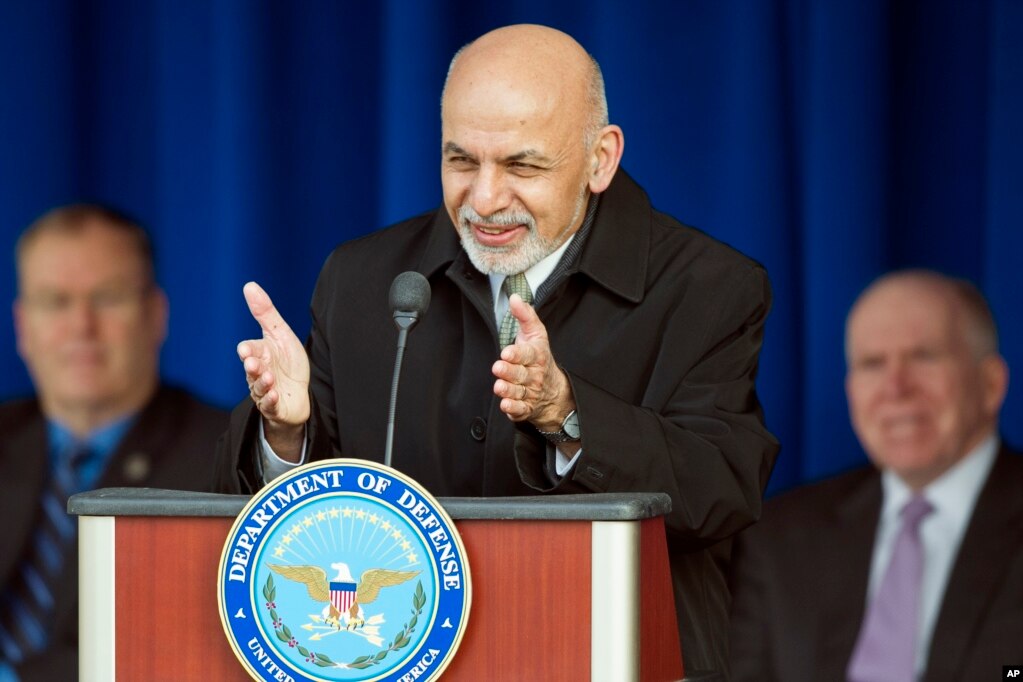
Ladies and gentlemen, it is my privilege to introduce the President of the Islamic Republic of Afghanistan, President Ashraf Ghani.
President Ashraf Ghani:
In the name of God, the Compassionate, the Merciful.
Secretary Kerry, Secretary Carter, generals, members of the Pentagon community, and dear Reese—it is a rare pleasure to be with you today.
On behalf of a grateful nation, I thank the people in this building and the wider American community who have sacrificed continuously since September 11 to bring freedom and hope to Afghanistan.
Reese, I bring greetings to you from three million young Afghan girls who are attending school today. Fourteen years ago, that number was zero. Each one of them shares your hopes, and your father is helping make those hopes possible. Please thank him and remember that he is making a difference.
To the family of General Greene: on the 18th of this month, I presided over the graduation ceremony at the military academy he so compassionately helped shape. I saw determination, hope, and honor in the eyes of young officers—men and women—committed to Afghanistan’s constitution and inspired by his legacy. We hold his memory dear, and upon my return, a section of the academy will be named in his honor.
Captain Haynes, congratulations on your remarkable recovery. Your determination and resilience embody the very essence of your profession. I congratulate you and your wife on the birth of your third child. With parents like you, and a godmother such as Colonel Myers, we can be confident this child will carry forward hope and service.
I pay tribute to the 2,215 Americans who made the ultimate sacrifice, to the more than 20,000 wounded in action, and to the nearly one million Americans who have come to know Afghanistan. You served in our remotest valleys and highest peaks. You left a legacy, and Afghanistan left a mark on you. I have heard many veterans say, “I left a piece of my heart in Afghanistan.”
You did more than fight. You built schools, dams, and roads, but more importantly, you brought an attitude of discipline, compassion, and sacrifice that our people—and our security forces—honor deeply.
The U.S. combat mission ended on December 31, 2014. Its legacy lives on in a proud Afghan Security Force that now carries the mission forward. Our army, police, and special forces have been transformed through partnership with you.
I have had the privilege of working with some of America’s finest military leaders, whose dedication and sense of purpose remain unmatched. I also extend my gratitude to Secretary Kerry for his tireless diplomacy and to Secretary Carter for his principled and analytical partnership.
I thank President Obama for his clarity of leadership, including the 2009 surge and its time-bound conditions. The logistics routes once built for war now serve peace and trade, linking Afghanistan to Europe.
My message today is simple: thank you—to the American people, to your taxpayers, and to all who supported Afghanistan. We are committed to accountability and to building sustainable systems. We will not be a burden. We will put our house in order.
Afghanistan is a frontline state. We suffer daily losses, yet we will never be defeated. Terrorism will not overwhelm us. Together, we will overcome.
My hope is that one day you will return to Afghanistan as visitors and friends. Come back, and we will welcome you into our homes.
Thank you. God bless the friendship between the United States and Afghanistan.