Understanding the Fifth Wave of Political Violence: Global Security in a Networked Age
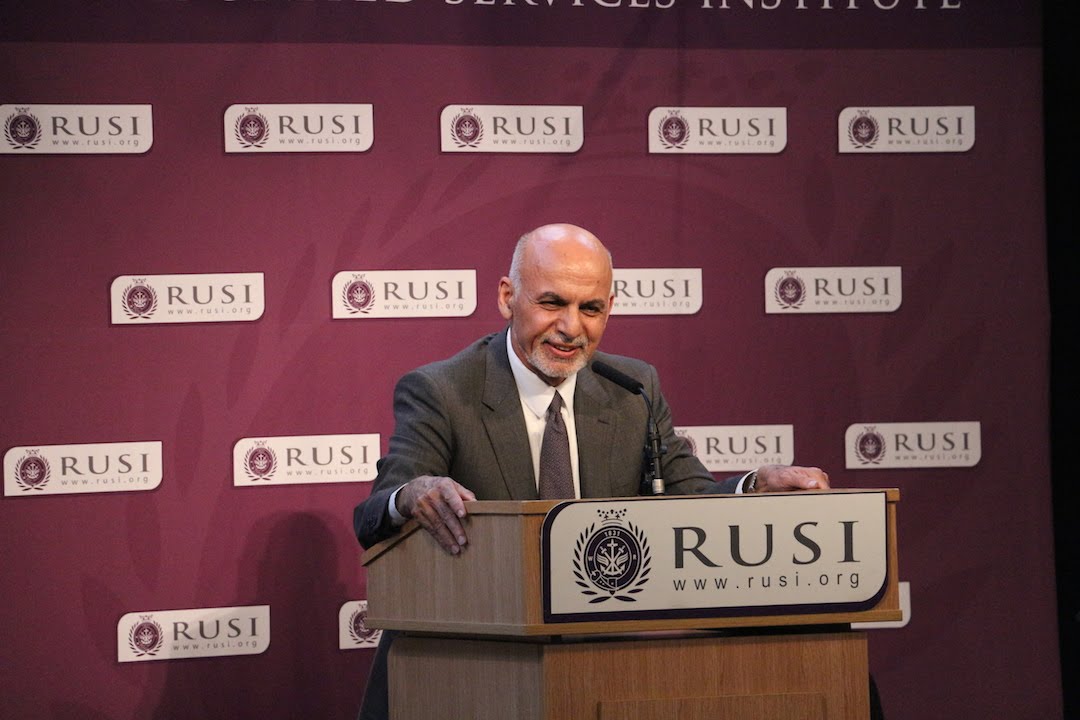
Speech at the Royal United Services Institute (RUSI), Whitehall, London
Keypoints:
- Historical evolution: Political violence occurs in historical waves.
- Fifth wave: Modern violence combines terrorism, crime, technology, and state capture.
- Global networks: Extremists use decentralized digital networks worldwide.
- Psychological impact: Violence spreads fear and weakens citizen–state trust.
- Multi-level response: Action is needed at global, regional, Islamic, and national levels.
- Effective states: Strong states help prevent political violence.
- Institutional capture: Weak institutions enable instability and violence.
- Long-term strategy: The threat requires proactive, flexible policies.
- Narrative struggle: Extremism must be challenged ideologically.
- Global interdependence: Security depends on international cooperation.
In the name of Gods, the Compassionate, the Merciful.
Lords, ladies and gentlemen, friends; First of all, let my pay tribute to the 454 British servicemen and women who paid the ultimate sacrifice. Let me call upon you to express the deepest gratitude of a grateful nation and a state to their families. Let me also ask you to thank every British veteran who fought with us, who has helped us whether in the military arena or in the civilian. Britain has been a strategic partner and I am very proud to be here today. Tonight, I would like to speak about the fifth wave of political violence. Our understanding of how global security and peace are shaped depends on how we grasp this. My argument will be in five parts.
Historical Context: The Previous Four Waves
First, what were the previous waves? The First Wave can be dated with Nechayev’s manifesto of a revolutionary, the anarchist wave. The anarchist wave roughly lasted forty years engulfed Europe, brought us the First World War and it was a global phenomenon. The Second Wave is the national liberation movements which again spanned roughly three decades. The Third Wave was the wave of terrorism in Europe, Japan and the United States following 68’s student movement, and in the United States, took the form of the Black Panthers and related movements. The Fourth Wave started with Sri Lanka that invented the phenomenon of the suicide bomber and traveled across to the Middle East and then to Latin America, etc. Each of these waves shook the foundation of political stability and required distinctive ways of dealing with. What comes out of this is that political violence does not relate or is not owned by a specific culture, religion or geographic space. Any generalization regarding this medium view of history requires careful analysis.
Characteristics of the Fifth Wave
What is it that specific about the fifth wave? A number of characteristics jump. First, criminality and political violence have become organically related. Take the cartels in Mexico or the heroin production in Afghanistan, there is an interrelationship. This is fundamental to grasp because there is a distinctive form of violence that is inflicted on the citizens and that results in erosion of state authority. Second, networks that previously used to be face-to-face or in small groups now have become face-to-faceless or face-to-Facebook. It is a distinctive form of mobilization that brings rapid utility of information and orientation of people. Recruitment is extraordinarily effective and replication of cells does not depend on central authority. Third, the space of operation is global whether it is Kabul, Brussels, Paris or London after July or events in the United States. There is an interlinked series of phenomena. The other point about this is probably one of the well-financed movements in history. Related to this and if we relate it to the previous things, absence of rules of the game between states and state willingness; the willingness of some states to sponsor non-state actors is fundamental initially to its operation. They have posed a threat to state authority but the rapidity of networks puts our inherited bureaucracies and stretches them. Simultaneously, they thrive on weak states. Weak or failing states are the natural harboring phenomena. The other thing that manifested itself, of course with Daesh and earlier continues with Taliban is attempt at state capture because except for the movements of national liberation that focused on state capture, the other movements were about undermining state authority. Here, there is a very distinctive phenomenon. And last that needs to be mentioned is its distinctive affiliation with invoking and hijacking a great religion and a great culture.
Operational Mechanics and Innovation
How do they operate? Counter-insurgency was the rage in early 2000s but the insurgency literature, I would argue and in certain understanding of insurgency, is cumulative and much more incorporative. From Nechayev to Usama Bin Laden, you can draw a straight line and to the current thinkers of Daesh and Al-Qaeda. The degree of knowledge regarding previous counter-insurgency movements is incredibly high. You are not dealing with an enemy that does not know its enemy. But by contrast, we do not understand the phenomena sufficiently. So both in terms of theories and in terms of techniques and practices, there is a great deal of continuity. Simultaneously there is a great deal of innovation. Where the innovation comes is first in techniques of communication. In terms of network theory, you can see all people who have worked on the phenomenon would argue that they are surprised by the theory of networks. Sometimes four to five stages of network formation have been passed in a single year or two. And the use of media is fundamental.
The Objective of Fear and the Attack on the Compact
Why do they attack cities? Why do they attack airlines? Why do they attack public spaces? Because fundamentally what is under attack is the compact between the citizen and the state. The great achievement of the modern state has been its compact with the citizenry; freedom of movement, freedom of assembly, freedom of worship and democracies, and those values are precisely what are attacked. Fear is what the objective is. Inflicting fear, producing fear in a systematic manner, ensuring that we live narrow lives that affect the bond of trust between citizen and citizen and state and state is the issue. You don’t need further evidence; look at previously open borders in Europe and now the number of controls that have been brought in. Look at what we take daily in any airport and accept it. What we did not accept under exceptional circumstance, now we willingly accept and that is precisely the environment. So here, particularly with Daesh that has refined the technique, infliction of pain for the sake of pain is not the objective. The spectacle of the theater of violence is critical to achieving this objective. They do not kill six-month-old (babies) or 90-year-olds, just for that sake. It is to awe over populations, to ensure that the reflection of violence can destroy our will.
Four Levels of Action
If I am correct about the description of this, we need a right understanding and action at four levels; global, regional, Islamic and national levels. Why do we need global understanding? Because if the threat is medium-term, we need to muster the right time horizon and the right alignment. Our understanding has been reactive, not proactive; because of that, our actions at the global level have been sporadic rather than sustained. Sustained understanding requires different time horizons and the global politics is not oriented towards medium time horizons, but this phenomenon like the other threats to global peace and security requires a medium-term understanding. Second, some regions of the world are a lot more exposed than others; my country is being one of those. Who fights in my country? I was in Ufa in Russia when President Putin was hosting both the BRICS Summit and the Shanghai meeting and there was talk as if Afghanistan was not in the room. So I posed the question and said, ‘Who fights in my country?’ Chinese, ETIM, Chechens, Uzbeks from Uzbekistan, Tajiks from Tajikistan even the odd Kyrgyz and Kazakh, but the greatest one of course is a huge movement from Pakistan. There are all the rejects of the Arab world that are sent on to us. Can anyone point out a historical precedent or a political framework where people who do not belong to a nation and do not have a quarrel internally in terms of rules of the game have such heavy presence? And the impact of this, of course, is global because the activities that they engage in threaten all of us. Here, my plea is development of common understanding, I am not saying to take a national perspective, but take a neutral international perspective because it is imperative that we understand the phenomenon. If we don’t understand the phenomenon properly, how can we devise the appropriate means for dealing with them? The third level is Islamic. Because the phenomenon is being put in terms of abuse of the fundamental understanding in history of this great culture and civilization to which I am proud to belong, we need to speak back and regain the narrative. Important step was taken last year in 2015 in Makkah where declaration on definition of terrorism and the weaknesses of the Islamic World were described. Acting on those and making sure that the narrative is not left to a tiny minority, I think, becomes fundamental to the dialogue and understanding of civilizations and the integrated global world that we live. The other level is national which of course is embedded in these others. What is fundamental here is national ownership. We are proud not to be engaging in blame games, but to own our problems.
National Challenges: Poverty and Corruption
What are some of those? If you take the poverty line to be $2 a day, 70% of our population is below that line. If you take it to be $1.25, 39% of our population is below that line. Corruption is not a symptom; corruption is an enabler for terror and for political violence, because what is critical in the struggle against corruption and has been proved in time and again is effectiveness of the state but not an authoritarian state. You have to have a citizen-focused state. Our discussion is many folded. The two young men who were here are actually protesting about a transmission line. I am actually very proud of them because in the midst of a war for survival, we still take debates on infrastructure extraordinarily seriously. I thanked them the other day when I was leaving for engaging in a discussion on infrastructure. The decisions on the project were made in 2013, a decision was made to pass the transmission line through the Salang pass rather than Bamiyan valley. It was the wrong decision at the time but meanwhile three years of work have gone to prepare the Salang pass. Six million people will benefit from this transmission line compared to 100,000 from the alternative but you have to take young men seriously. I appreciate their anger because if you don’t have the tolerance for people’s legitimate anger, you cannot guide a state or guide the destiny of a nation. We have inherited many things but corruption is probably the most significant. This is a national shame as is our mortality, the mortality rate of our women. We have halved the mortality rate of women but it is still one of the highest in the world. What is our tragedy? Our tragedy is that we are potentially one of the richest countries in the region and yet inhabited by extraordinarily poor people. This means that corruption needs to be rephrased, not as abuse of public office for private gain, but as forms of capture.
The Four Forms of Capture
There are four forms of capture that are fundamental to the challenge that we face. First is the capture of institutions; patronage, bribery is made a mockery of formal institutions. Second is economic capture. Over 500,000 acres of public land alone have been seized by small number of individuals. Public assets have been disposed of as though there were no tomorrow. The third form of capture is capture of security. Legitimate monopoly of force that is key characteristic of the state has not been accomplished because there are many groups and individuals that continue to use the threat of force to deprive others, to prevent them from a dialogue. Because of that skins are thin. The fourth form of capture is political capture. Politics becomes a zero sum game of competing claims without the arbitration. In this kind of situation, what is really important now is to think back. If effective states are key to enabling us in global, regional and Islamic level cooperation is central to overcoming this phenomena, then we need to agree on horizons and strategies required to overcome the threats posed by the fifth wave.
Horizons and Strategies for the Future
In terms of time horizon, we cannot operate on a yearly basis. We cannot operate in a reactive basis. We cannot be letting narrative be controlled by their actions. It requires a steady focus and the will to master this threat as previously threats like Nazism, Fascism, other forms that have come have been mustered. In terms of strategies, what is critical is to understand that this is going to be a constantly changing phenomenon. It is not a constant situation; it is strategic situation. A strategic situation means that there is a large degree of in-built uncertainty into the situation. It is going to constantly morph into other thing and that morphing requires that we both focus on the visible and on the invisible. Daesh has taken all the oxygen. What keeps me awake still is what is Al-Qaeda up to. Is it gone down dark in deep? Is it preparing another surprise? Which is going to be the more enduring phenomenon? What is visible or the dog that did not bark? My English education I hope is paying. And strategies cannot be in terms of static objectives or terrain that is constant. This is going to be a constantly shifting set of phenomena, relationships and therefore we need to have flexibility. That is a challenge to our institutional architecture. Being plodding, being slow, being deliberate has served us well in periods of great global stability. Now it requires fundamental rethinking about how global and regional organizations will work; how our relationships are defined.
International Support and Interrelated Fates
But unlike, I was in the Munich Security Conference when I coined the term ‘fifth wave’ and there, there was a feeling of doom. Let me again acknowledge that as far as Afghanistan is concerned, NATO is alive and well and their alliance is delivering. There is no combat role for NATO in Afghanistan but our armed forces have fully fulfilled the departure of 135,000 NATO-ISAF troops and the accompanying 600,000 contractors. This needs to be appreciated in terms of the context, but it also needs to be appreciated that if I am right about the phenomenon, then our partnership needs to have medium and long term horizons and of course the foundation of that is in place. I would like to thank President Obama, Prime Minister Cameron, Chancellor Merkel, European leaders, Prime Minister Renzi and others for staying with us. Last year, we were operating with nine months as our horizon. And it took enormous political courage by these leaders to make the argument that it was worth staying with us. And I hope that our people’s sacrifice, the great sacrifice that our armed forces and our people have done shows that our partnership is indeed an enduring one. One thing is certain. Our fates are interrelated. There are no walls, great or small, that can separate us. So what is required is joining hands, being able to forge those partnerships that can enable us to change lives fundamentally. To ensure that stability is off the order in which participation becomes deeply embedded, where hope is renewed and where trust at all these four levels is re-established. Thank you for giving me the opportunity. I will be delighted to engage you in some discussion.