Afghan Women from Courage to Leadership: Empowering a Nation Through Equality and Opportunity
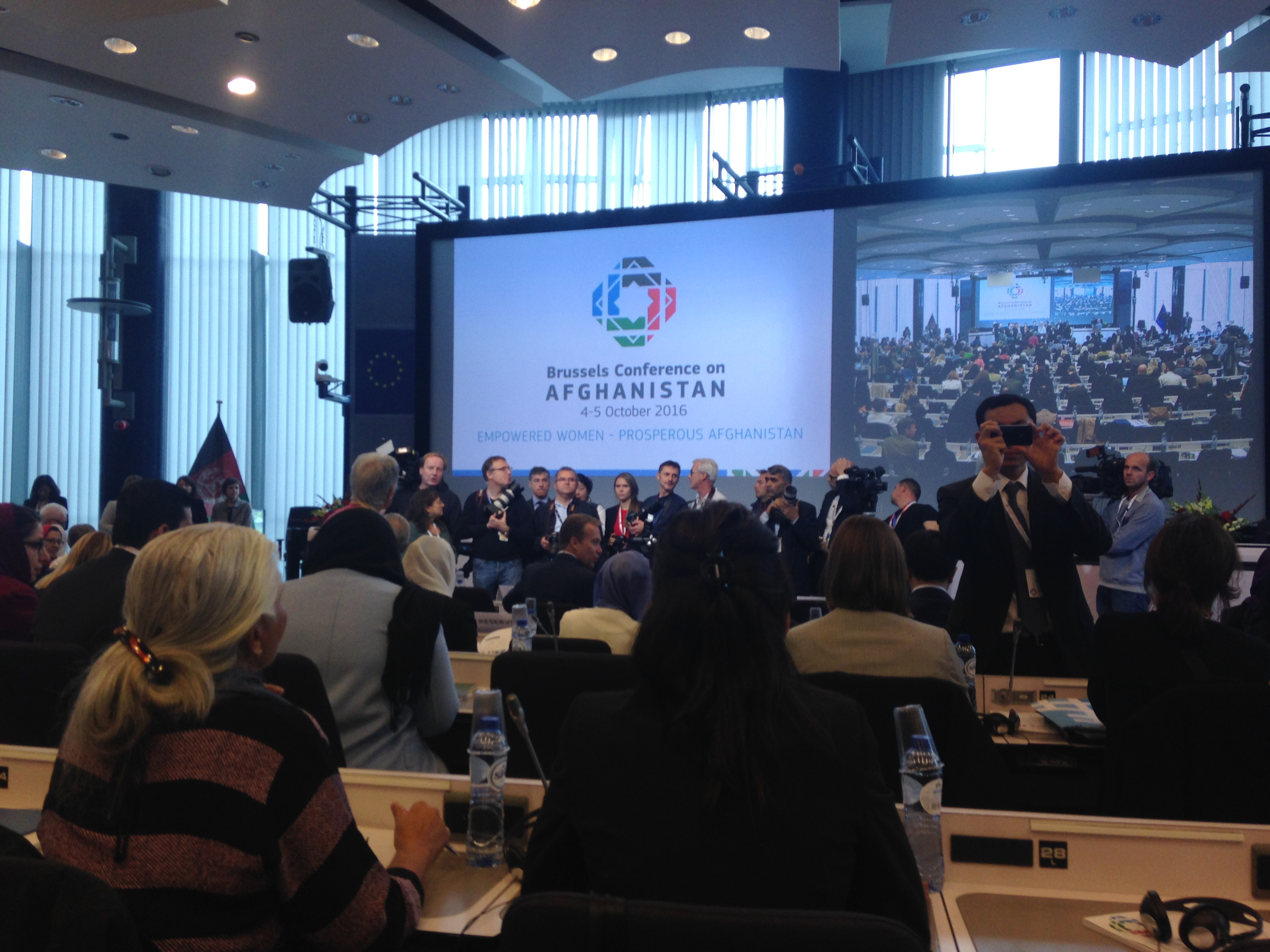
Speech at the Brussels Conference on Afghanistan (BCA): Afghan Women Empowerment Program
Keypoints:
- Courage & Agency: Afghan women have become active leaders and providers.
- Self-Representation: They speak for themselves with clarity and vision.
- Equality & Identity: Women are recognized on their own terms, not through men.
- Democratic Guardianship: Women protect and advance democratic values.
- Cultural Change: Institutions must overcome male-centered norms.
- Economic Empowerment: Access to markets and value chains is essential.
- Education & Training: Quality education and skills are needed for all women.
- Legal Rights: IDs, inheritance, and protections ensure full citizenship.
- Health Services: Maternal care and healthcare are vital for progress.
- Sustainability: Programs like the Citizen’s Charter ensure nationwide inclusion.
Brussels, Belgium | October 4, 2016
In the name of God, the Compassionate, the Merciful.
Madam Mogherini, Madam Bokova, the First Lady, ministers, distinguished women from Afghanistan and everywhere, our great friend, please do sit.
Thank you for the opportunity to be with you today.
Afghan women are profiles in courage. There is a booklet in front of you. It is case studies of a number of leading women farmers; Ms. Nazira Rahman has compiled it. Every one of these is a story of overcoming, but what is remarkable is $40 as an instrument of a changed life. The government has been a catalyst, but the people who are the true heroes are the illiterate women who are now putting a roof over their children, women who from dependence have changed to the bread earners of their families. I salute their courage!
Looked at individually, it is micro-action. Once looked from a network perspective, you can see that Afghan women have truly come a long way in the last 15 years. What is remarkable, and they will speak for themselves, is that Afghan women do not need others to speak for them. They can speak for themselves with clarity, with vision, with determination. I salute you! [Addressing Afghan women]
They are everywhere. They are ministers. They are ambassadors. They are deputy ministers. They are farmers. They are entrepreneurs. But more than anything else, what is it that has changed? Their identity is no longer derived from their relationship with men. They are still sisters, mothers, and others, but unlike a thousand years of history, now they are referred to in their own terms, not derivative from their relationship with men.
This is a sea change, and we need to understand, appreciate, and expand it. I hope that the relationship of their First Lady to their President would be an example of mutual respect and mutual inspiration. Thank you, Rula, for years of guidance.
But the scale and scope of what is in front of us should not be underestimated. For every empowered woman, there are ten that are still deprived and the gains are all too fragile. Women can sink back; therefore, we must make a compact. The gains of the Afghan women under our democratic constitution are not up for negotiation; they are not up for sale.
Afghan women will be the guardians of democratic values, and they will guard their gains and they will only expand and develop them, not go backward; therefore, a platform for change has been created. It is important in your discussion to see how this platform can be used as grounds for a takeoff, a takeoff that would be truly a major cultural change, and an enduring one.
Let me conclude this part by saying that women are no longer passive victims to be helped, but active makers of history who need to be assisted in their own terms, and we have to appreciate, listen, and act upon their recommendations.
Let me highlight some of the key challenges.
The first one, because we have to begin from ourselves, is the culture of the State. I can appoint women to all positions, and I do, but the reception they get is not one of colleagues. The male-centered culture is all too entrenched, and women are not welcomed. We are against the inertia; we are against the entropy, and particularly we are dealing with fears of young men who think young women are their competitors.
The second issue is that all policies in the past had been male-centered. Our policymaking is derived from a masculine background that needs questioning, that needs attention.
Look at the building of schools. Are there bathrooms for women? Doesn’t that very simple fact prevent women at the age of 14 from starting school? Why is it that we cannot think policies again from a balanced gender perspective? At times, it is very small steps that make a major difference, and in this regard, we need to make sure that we understand the obstacles that our implicit assumptions, inherited assumptions, and attitudes put in our way.
The second issue is market access. 1.1 million Afghan young people are given jobs by the guild system. The guild system is the greatest employer in Afghanistan. But outside the carpet industry, how many of the apprentices are really women? How much of the vocational schooling effort is oriented toward the needs of women? We are not creating an equal playing field, so we need to fundamentally think about the relationship of Afghan women to market access. The lead farmers that Ms. Rahman has helped so much, and for which we are grateful, had one message: they can take care of everything regarding growing, but where is their market access? What is the value chain that connects an Afghan woman producer to the markets, particularly to the global market? And here is where you both see the opportunity, but you also see the obstacles.
The third issue is violence. Women have been the greatest victims of violence in the last 40 years in our country. You have to go back to the Mongol invasion to find a similar episode. In all our previous wars—conflicts—women were sacred. People dared not interfere with them. There were codes. The old codes of honor actually protected women, but women victims have been immense.
We are a country that on one estimate 66 percent of us suffer from Post-Traumatic Stress Disorder (PTSD), and our women are at the forefront of this, but what is remarkable despite this suffering is their resilience. They don’t want to talk about the past, but the wounds of the past are there. And then, what is really important to acknowledge is the specter of gender apartheid haunts this. It was only fifteen years ago. We have moved with enormous speed, but the specter is all too alive when you had to learn to read or have a sewing circle.
Related to this, the fourth issue is education. In terms of quantity of education, we have made immense advances, but in terms of quality of education, we have fundamental issues. And also, serious attention has not been paid to seeing why women at certain ages go to school, but systematically drop out. Most of our universities don’t have dormitories for women. We don’t have five high schools with dormitories for women.
I want to salute Sima Samar’s work, who single-handedly has brought an enormous number of young girls and women to the educational sector. Thank you! (addressing Dr. Sima Samar) Dr. Sahib. But we need the emulation of her example. We need the scaling up of those because the women whom Dr. Samar has trained have a model. They want to be the future Dr. Samars of Afghanistan and head the Human Rights Commission, and one day be the president of this country. But there are others whose ambitions are blocked. The paths that are blocked need to be opened up.
And then is the legal issue. The sad secret: Islam’s injunctions—our holy religion, the basis of our Constitution—are not being observed. How many women are there in the country whose rights to inheritance are actually being implemented?
So what I want to again conclude in this section: the scale of the challenges, their interrelated nature requires serious attention. We cannot count our successes by the number of women in high-ranking positions. We have to measure our effort by true empowerment of millions of girls who all need to have the same opportunities as millions of boys next to them because that is when the country becomes prosperous.
We have a critical choice to make: do we create equality of opportunity between our girls and boys, or do we keep the scale unbalanced? This means “putting targets.”
Where are we beginning? I had the honor last week to inaugurate the Charter, the compact. For the first time in Afghanistan, there is a national program that covers all of Afghanistan: rural and urban, nomadic and displaced, every one. This is the “Citizen’s Charter.” And what is remarkable is that in all the councils where the Citizen’s Charter is going to be formed, it is going to be for the first time 50/50: 50 percent women, 50 percent men.
I want to thank Minister Atmar for having guided the National Solidarity Program, which I had the honor of designing with him and he implemented. At that time, the tyranny of assumption was such that I had to argue with all our international colleagues and advisors from the World Bank and others. They were saying, “Oh Dr. Ghani! You have come back after 24 years of exile. You have become modern. Afghan women will never be permitted in Afghan villages to form councils.” So I said, “I have not become modern. I am just trying to do what my grandmother told me to do.” And my grandmother was a formidable woman. Men shook before they spoke to her, and her six sons were terror outside, all were like lambs inside. The reason I want to thank Minister Atmar is that he stayed with it. And all the studies show that National Solidarity, on which we took a bet, has made a major difference to the empowerment of the women.
Citizen’s Charter is going to be a fundamental change because this time urban Afghanistan as well as rural Afghanistan are included, particularly the most vulnerable communities: the displaced and the returning refugees.
The second step, and that is where you come in. If the women in this room from all the countries, particularly Madam Mogherini, you don’t want our migrants. But do you want women-based products? Please support a label called “Made by Afghan Women.” We are extraordinarily grateful for the aid that has just been called by Commissioner Mimika, and thank you for that. What we need is value chains. We need the importers’ associations in Europe to go for pro-women labeling.
Our women do not need charity. Charity never empowers, but market access does. Today the products that are sold for $40 could be sold for $400. So it is extraordinarily important to open the market access and think about the “value chain” as a “gender chain.” Don’t leave the bulk of the chain, the intermediaries, to men. Men are, of course, important in some ways!
The third issue is to rethink vocational training. Vocational training needs to be taught fundamentally, and it is important particularly to have a consortium with Switzerland, Holland, Germany, and the Scandinavian countries where the rate of unemployment is extremely low because we have to think fundamentally about investment vis-à-vis empowerment. Our liberal educational system does not train people who are needed for jobs, and the jobs that are required have no takers. So it is important in this regard to think it through.
The third point is about legal empowerment. We need to begin from having IDs: identity cards where they can vote, identity cards where their age can be determined, identity cards where their marriages are registered, identity cards where divorces are indicated, identity cards for inheritance, and identity cards for interactions, for having credit in their names, for networking.
The fourth thing is looking at this platform and really listening to them as to what are the most effective ways to produce combined impact. What I bring to you humbly is that a lot of small things have been done, a lot of things at small and medium scale. I want to thank USAID, Bill, thank you! Gary, thank you, for having provided it. But we need now to think at a scale and a scope that can bring mass change. Fifteen years ago, this was impossible. You didn’t have women as makers of history; they were traumatized, but the young generation is not traumatized. The older generation has come out of trauma. What they require is a truly national dialogue with our international colleagues not as recipients but as equals. Listen to the voice of Afghan women. Speak for Afghan women. It is a rich voice, diverse, and united. Respecting that voice is going to be extremely important to seeing that we move forward.
And then it is education and health issues. We are very proud that we have reduced women’s maternal mortality. Every woman that dies at birth is a life that we have not saved, which means our medical system and entire approach to healthcare needs a fundamental overhaul. All too often, women die for no reason whatsoever, and we need to be able to change this.
In terms of education, that is the most important issue of our lives. We need to put targets. If we wait for time to bear its impact without addressing key constraints, we will have to wait a long time.
Once again, let me thank you for this opportunity. It is the most auspicious beginning because women are most likely the majority of citizens of Afghanistan. You are not addressing a side issue; you are addressing the core issue. In an Afghanistan where the Constitution is the rule book, man and woman are created equally. Can we deliver on that promise? That is what this body, I am sure, will deliberate. I am looking very much forward to your results.
I am a pessimist-optimist, or an idealist-pragmatist. I am a pessimist because I need to know all the obstacles. Without understanding the obstacles, there is no way forward because you need to prioritize. But I am an optimist because I believe that Afghan women can overcome any obstacles, as Afghan citizens have the endowment, will, and capability to overcome history.
Thank you.