Understanding Afghanistan: Challenges, Opportunities, and Partnerships for a Resilient Future
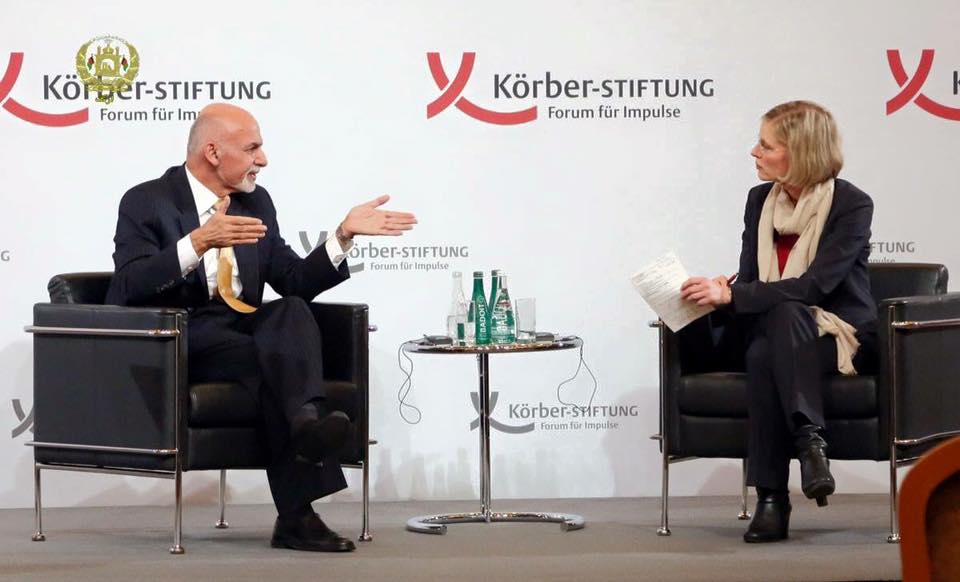
Conversation with Nora Müller at the Körber Foundation in Berlin, Germany
Keypoints:
- Resilience of Afghan People: Determination to stay and rebuild despite conflict.
- Security & Counterterrorism: Afghan forces defending the country with necessary support.
- Economic Opportunity: Jobs, agriculture, transit, mining, and renewable energy.
- Governance & Rule of Law: Ownership, accountability, and democratic institutions.
- Women & Youth Empowerment: Education, economic participation, and leadership.
- Regional & Global Partnerships: Cooperation with Germany, EU, and neighbors.
- Legal Migration & Criminal Economy: Human trafficking, push/pull factors, legal frameworks.
- Afghan-German Friendship: Century-long ties; civil society, government, and education.
- Connectivity & Infrastructure: Trade routes, energy, and transport networks.
Thomas Paulsen’s Opening Remarks
Dear President Ghani, distinguished members of the delegation, Excellencies, ladies and gentlemen:
On behalf of Körber Foundation, I would like to extend a warm welcome to all of you. Mr. President, we are really delighted to have you here in Germany today, but we are even more delighted to have you at Körber Foundation this afternoon.
Ladies and gentlemen, President Ghani has described himself as an unshakable optimist. I believe that, when you want to be a political leader, without unshakable optimism, it’s tough. But in times like this, it must be quite a challenge to even have a minimum of optimism—that’s true not only for Afghanistan. Some analysts have talked about the great unravelling, some have talked about a new thirty years’ war, and some even about a third world war.
One thing is certain: we are confronted with a collapse of order on multiple levels, in combination with the renaissance of classical great power politics. This is an explosive mix.
Ladies and gentlemen, the citizen Johann Wolfgang von Goethe says, and I quote:
"When in Turkey far away,
People one another batter.
You sit by the window: have a glass."
Well, clearly, we cannot afford this attitude any longer. Today, Europe is directly affected by the conflicts in the arc of crisis stretching from the Mediterranean to the Hindu Kush. No man is an island, as the English writer John Donne famously put it more than 400 years ago. In a globalized and networked world, this is also true for countries and for continents.
The influx of refugees to Europe, the threat of terrorism both approving every day the crisis of the vital Middle East and South Asia, have become the crisis of the old continent. The tens of thousands of Afghan refugees who keep knocking on our door after perilous journeys to Europe give a face and a name to the crisis of their home country. There are constant reminders that stabilization of Afghanistan is not a mission accomplished—it is a work in progress.
A recent report drafted by the Federal Foreign Office here in Germany paints a bleak picture, as it highlights the Syria security problems in Afghanistan. Germany has borne a large share in the effort to help Afghanistan: reconstruction aid, capacity building for government institutions and security forces, as well as military engagement. Today, Germany remains engaged in many ways, also within the framework of NATO’s Resolute Support Mission—an important signal of continued support for Afghanistan and its people, and in line with Germany’s security interests.
Ladies and gentlemen, Körber Foundation’s mission is to make a contribution to a better mutual understanding in international affairs. We stand for dialogue that helps to overcome political, national, and religious borders. We stand for an open and respectful discussion. Let’s talk with each other rather than about each other. As our founder Kurt A. Körber put it more than forty years ago: we are deeply convinced that dialogue is more relevant than ever because radio silence has never proven to be a very successful problem-solving strategy.
Afghanistan and Germany’s engagement in the Hindu Kush was again and again on our agenda over the past ten years. We have published several books, set up roundtables, and hosted lively debates—for example with Abdullah Abdullah or, most recently, with Hamid Karzai.
Mr. President, we are truly delighted and honored that you have accepted our invitation to share with us your view about the way ahead in your country, how to deal with the manifold problems which you have inherited, and the contributions Germany can make. Let me thank you, in particular, for your willingness to engage in an open exchange with us after your speech, and my colleague, Nora Müller, who is the Executive Director International Affairs of Körber Foundation, will moderate this debate.
Last but not least, our discussion this afternoon could hardly be better timed. This year, we are celebrating 100 years of friendly relations between Germany and Afghanistan, which began in 1915 with the establishment of initial contacts between the government of the German Royal and the Emirate of Afghanistan. Mr. President, you just told me that your grandfather was the first ambassador of your country to Germany. Speaking of ambassadors, I would like to thank the embassy of Afghanistan, above all Ambassador Hamid Sediq, for the excellent cooperation, which we look forward to continuing in the future. I would also like to extend a cordial thanks to Ambassador Markus Potzel, Head of the German Mission in Kabul, for his untiring support.
Mr. President, may I now invite you to take the stage, please? Thank you very much.
President Mohammad Ashraf Ghani’s Remarks
In the name of God, the Compassionate, the Merciful.
Dr. Paulsen, it is a great pleasure to be with you today and to be able to engage in a conversation. My sense of politics was formed by Max Weber's classic essay On Politics as a Vocation. Politics is a calling, not a profession. Politics is an obligation to the citizens and to the world, not an opportunity to rob the people blind. I hope that formation translates into a sense of optimism that is grounded in very strict realism.
So, I'll begin with laying down "The New Normal": the threat, the world of threat that we confront on a daily basis. Terror, morally reprehensible, has become sociologically a system. We can no longer dismiss terror, narcotics, and human smuggling as sociological aberrations. There is an ecology that unites all these into a system. The global criminal economy is $1.7 trillion a year. Without confronting and understanding this global criminal economy, we are not going to face our critical problems.
In this ecology, the bedding is provided by the criminal economy. That is the platform that enables terrorist financing and the smuggling of human beings. Every Afghan who comes to Europe spends $20,000–$25,000. For everyone that makes it, four to ten perish along the way or lose everything. This is not an organized movement; it is not like the way the Germans went to the United States. You're familiar with moving out—Germans were among the very first people to see opportunity on the shores of North America, wave after wave. I lived in Baltimore, which was a gateway for the Germans to the Ohio Plain and other parts. Irish migration—every potato famine produced a wave out.
Our globalism is focused on the freedom of the well-to-do but restrictions on the poor. We need to understand this profound inequality in order to be able to deal with it systematically. It is a joint problem; it is not either our problem or yours. What we need to understand is that together, we have a series of problems that we need to solve.
Terrorism, as an ecology, is inhabited first by networks that are cross-national in composition. The world of the state is organized around hierarchies; the world of criminality is organized around networks. I’ll come back to the morphology, but networks by definition are fast and self-replicating, while states—even the best—are slow and deliberate. This makes them respond to the needs and aspirations of citizens, but cooperation between states is a fundamental problem.
The second thing: we live—particularly in our part of the world—with an absence of rules of the game between states. The ecology of terror is made possible both by terrorists but also by the indifference of states and by the willingness of some states in the past to use malign state actors as instruments of policy. As long as some states differentiate between good and bad terrorists, the state system as a whole is going to be in peril. Getting the rules of the game right is fundamental.
Acheson famously observed that, at the time of post-1945 creation, they got half the world right, and we have been dealing with the legacy of not getting the other half right. Second, terrorism has acquired a morphology, as has criminality in general, as a movement of violence. The morphology is that it is very fast-changing. It took Al-Qaeda 20 years to move from planning to its heinous attack on the World Trade Centers, with trials along the way in Kenya and Yemen, but Daesh moved from conception to execution within four years.
In terms of network theory—and that’s been summed, with very substantial open-source analysis, which I comment to everybody—it has been done by CentCom. Daesh’s formation passes five to six stages of network theory formation. This is a morphology of constant change. In this world, cyber has become critical. We are not dealing with face-to-face communities of terror. We are not dealing with classic hierarchies.
We are dealing with fast-replicating movements that recruit through the Internet, forms of action that replicate and create the ground. Unless we understand the enemy and the threat we are dealing with, our response will be partial. With apologies to Microsoft, if Al-Qaeda was version 1, Daesh is version 6, and we need to be prepared for version 6, 8, and 9. Moore’s law, regarding innovation halving, does not apply to these networks of violence. First understanding of the phenomena is fragmented. Intelligence is organized around countries. Sharing of a common vocabulary regarding threats is still absent—much more fundamental than the initial understanding. Common frameworks of action, regarding whether the threat is short-term, medium-term, or long-term, are still in search of an answer.
The third aspect is the pathology. You have seen the recent news: Istanbul, the Russian plane in Sharm el-Sheikh, Beirut, Paris, Mali, and unfortunately the list could go on. What is characteristic here is that the pathology is directed toward producing news. The narrative of the news cycle is now set by the actions of terrorists. Which day has it been in the past month that the news has not been dominated by these networks, that they have not set the terms of coverage? The counter-narrative is weak. It is there, but it is manifested in action and usual sets of policies, not in a coherent narrative that previous struggles have enabled us to deal with.
So, in this pathology, who is the object? The goal: first, our freedom of movement. The tourist industry has been hit because freedom of movement for tourism has been one of the fundamentals. Second, the trust between the state and citizen is the key objective. Can you imagine people in Paris constantly looking over their shoulders to watch where the next threat is coming? New York in the 1970s was similar, but Paris of 2015—not so much.
As a result, the randomness is actually ordered, and it needs reflection and our ability to deal with it. I hope I have delineated the key issues of threat. Within this, the refugee crisis is related both to a lack of certainty and the criminality underlying it. Why does narcotics travel through well-ordered governments? Why is there no fundamental focus on dealing with the root causes of narcotics and its elimination? Is it time for habits of the middle class in some wealthy countries to change so that we can deal with the root causes of this criminality, and finance? The world of finance is highly criminalized. It takes one transaction for black money to move into the global cycle. We have a comprehensive threat, which requires comprehensive understanding and measures.
Opportunities and Vision for Afghanistan
But let me next turn to the opportunities. If my job is described probably as one of the two most difficult jobs on earth—I don’t know how close the competitor is—but it is a job worth doing, because the fate of thirty million people depends on it. I am very proud of the Afghan public, who have engaged in one of the most democratic conversations and continue to engage in democratic conversation. We are a resilient people. Anyone else in our position today would have abandoned everything. Yes, some of us are moving, but what needs to be remarked upon is that for thirty thousand who have left, there are thirty million determined to stay.
We faced one of the most brutal attacks in the last forty years. In 2015, an all-out war was declared against us; it went through seven phases. If, in conversation, there was interest, I could describe it to you. What was the strategic objective? The strategic objective was to create two political geographies in Afghanistan and then force us into a humiliating peace deal.
Most analysts last year, when we faced our triple transitions simultaneously—the political transition, the security transition, and the economic transition—were not giving us any chance. Today our armed forces, our security and defense forces, have stood their ground. Yes, we have paid a very high price, but it is the price of patriotism. I am very proud to have been functioning as the Commander-in-Chief.
The last thing I wanted, given my formation in social theory and citizenship, was to be forced into the role of Commander-in-Chief. But I have played it proudly, and I am proud that our forces are standing. In this regard, let me pay first tribute to the Germans, who have paid the highest price in helping us create institutions that today are able to cope with the departure of 130,000 NATO ISAF troops and stand their ground. Second, let me thank Germany for its remarkable leadership this year. I am very grateful to Chancellor Merkel, not only for Germany’s contribution, but for partnering with us to persuade the rest of our partners—including a very cogent argument to President Obama—that Afghanistan is worth investing in and continuing its support. German support—from civil society, from foundations, from political parties, and particularly from the government—is highly welcomed, and I hope our one hundred years of relations will continue for centuries.
The larger world of opportunities: first, Asia is transforming from a geographical notion into a continental economy. Afghanistan is in the middle of four billion consumers. When you look at a map, all routes in the past for Asian trade, pilgrimage, and at times conquest, have led through Afghanistan. Our location, which for two hundred years was a phenomenal deficit, is in the next 25 years going to become one of the most important assets in the region.
Our vision, and it is not just empty vision, is to become the hub for a series of connectivity projects. The first project, taking energy from Kyrgyzstan to Tajikistan then to Afghanistan and Pakistan, is already underway. We have raised $1 billion for it, and it is soon going to be implemented. The Turkmenistan-Afghanistan-Pakistan-India pipeline, on December 13, will have its ground-laying ceremony in Ashgabat. It is moving from theory to practice. The Turkmen railway is going to reach our border in February, along with transmission lines.
So, what is significant is to see this space, which was a cul-de-sac, become a roundabout. Roundabouts are places where ideas, people, and goods move freely and flow. The networks of violence need to be confronted by networks of virtue, and that is the possibility on offer.
Second, the fundamental question is always asked: will Afghanistan be able to afford statehood in financial terms? Today, of course, the overwhelming set of resources that underpin statehood is derived from foreign aid. The world is tired, exhausted with the syndrome of foreign aid, particularly when it is not effective. One-third of our geography, as documented today, is worth between $1 trillion and $3 trillion. In the next twenty years, we will become the largest producer of copper and the largest producer of iron in the world. We will become a significant player in the gold market. We have fourteen of the seventeen rare earth materials, and most geologists describe us as the Saudi Arabia of lithium.
That gives us a very different set of connectivities. In terms of environment, we have the headwaters. Except for China, every single one of our neighbors depends on us as the upper riparian. In the next ten years, when global warming rises by two degrees, our water will be as valuable, if not more valuable, than the oil of our neighbors.
But the most fundamental asset that gives me hope is our people. Some characteristics of our people, then I can conclude (I will stay within your 15 minutes, Ms. Müller—I am very disciplined):
-
First, we are not a nation of beggars. You don’t find Afghans begging on the streets. We interact, trade, and take our destiny in our hands. Our dignity is fundamental to our resilience.
-
Second, we are a young population. Our land is ancient, but our people are very young: 70% are below 35, and only 3% of the population is above sixty. We have three majorities that are numerical, but political and economic minorities.
Women: women probably are a numerical majority, because we lost a million and a half people defending our freedom against the former Soviet Union, and the majority of them were men. They are 104 women born to 100 men. Empowerment of women is critical. The change in women’s positions of leadership is enormous. Two years ago, it was taboo to talk about a woman being in the Supreme Court of Afghanistan. I had the honor of nominating the first woman to the Supreme Court, and she lost only by nine votes.
The second is youth. Our youth is the majority, both male and female. Empowerment of youth is critical. I want to thank GIZ for an enormously constructive set of studies and for highlighting key opportunities. A remarkable German in Afghanistan spent five years studying vocational schooling, and I had three hours of fascinating conversation after reading his six papers. He believes we can get vocational education right; if we do, illegal migration can turn to legal migration to the Gulf and North Asia. The demography of migration needs our understanding. The Gulf needs legal migrants, and Northeast Asia is undergoing demographic transition. We should not give way to fear regarding this; it is a phenomenon that can be dealt with systematically. Push and pull factors need to be addressed.
The last and key group, of course, is the poor: 36% of our population lives below $1.25 per day. If you change the poverty line to $2, it would rise to 70%. I describe this to show the legacy our Government of National Unity has received. Because we know this legacy, we are determined to overcome it. Our key issue is to overcome the ineffectiveness of the government, pervasive corruption of the past, and lack of accountability. Responsibility is key: we must own the problem ourselves.
Since my inauguration, the formation of the Government of National Unity has meant that Afghans own our problems, define them, and define the solutions. We have partners in Afghanistan willing to tackle issues—whether counter-terrorism, counter-narcotics, or illegal migration—in a systematic and coherent manner. We know the dimensions of our problems, how we relate to each other, and how we create proactive partnerships. Our problems are medium-term, and the solutions must match short-, medium-, and long-term actions in a systematic framework.
Thank you again for the opportunity. I look forward to the conversation.
Questions and Answers with Nora Müller, Executive Director International Affairs, Körber Foundation
Nora Müller: Mr. President, thank you very much for this very intriguing and dense statement. I would say 50% of the words we heard were President Ghani, and 50% were Professor Ghani. Let me start with the first point you mentioned. You talked about the morphology, ecology, and pathology of terrorism. Now, in Afghanistan, we also see, in its infancy I would say, cells of Daesh or ISIL, but it seems to me that this movement is gaining ground in your country as well. You talked about ISIL-type terrorism as terrorism 6.0. So I wonder, what kind of potential do you see for Daesh in your country? You hinted already at some of the strategies for finding a potent counter-narrative. Could you elaborate on the counter-strategies?
President Ghani: Sure. Thank you. First, in the Munich Security Conference I coined these terms; then I warned about Daesh. You know what was the reaction? “There goes Ashraf Ghani trying to receive money for his country.” We need to understand that those of us on the edge, on the frontline, need to be part of the equal conversation. Intelligence analysts, one after another, have gotten the picture of terrorism wrong. This requires a serious conversation, and that’s what I am asking: all of us put together the information, our understanding, and our sense. Our national security agencies, our national intelligence agencies, need fundamental change.
Second, in terms of Daesh, they have what is called Organizing, Orienting, Deciding, and Acting (OODA). These have been very well-documented for Iraq and Syria. Another part that needs to be appreciated about Daesh is that its command and control is organized from the bureaucracy of the Baathist regime. These are not amateurs. As a result, we identified the phases, and before they got to acting, we hit them. Daesh would have been a lot more potent in Afghanistan had the government not decided, through a series of Special Force operations, to hit them.
But the war imposed on us forced us to deal with a series of changing scenes. Unlike in the past, northern Afghanistan and northeastern Afghanistan became subjects, and we were stretched. Within this stretch, Daesh was able to make its presence felt. Today, there are two areas: one is the province of Zabul, where they engaged in one of the most inhumane acts, cutting the head of a young girl and killing others they had taken hostage. The second is the province of Nangarhar along the Durand Line, where they have made people literally sit on bombs.
The reaction of the Afghan public has been enormous, with demonstrations across the country asking for unity and focus. Daesh is under retreat, but given the morphology we have spoken about, we really need to be vigilant and not declare victory too soon. Declaring victory too soon would be costly.
Nora Müller: Let me follow up here, Mr. President. Does Daesh capitalize on the strange situation the Taliban finds itself in at the moment? Just yesterday we heard the report about Mullah Mansour being shot and severely injured somewhere in the vicinity of Quetta, apparently as a consequence of infighting within the Taliban. You yourself said there is no such thing as the Taliban anymore. So, do you think this kind of dynamic is in Daesh’s favor in your country? And secondly, how does the situation of the Taliban affect the Inner-Afghan peace process?
President Ghani: Sure. First issue: Daesh—this is why we need the word “ecology”—both competes and cooperates with other groups. It is a man-eater. Who were its first targets? Its competitors in Iraq and Syria. It literally swallowed them—how did it swallow them? By fear, by injecting fear, by systematically destroying their ranks and leadership. This is what it is attempting today with the Taliban.
Second, there is a large reserve army of labor. Thousands of people were trained during the Soviet period, and subsequently trained. We should deal with the root issue for this manifestation. The Taliban is one manifestation of the disorder. The fundamental issue is Pakistan. Pakistan has been in undeclared state hostilities with Afghanistan for the past 14 years, some say forty years. Unless we get peace—fundamental peace between the sovereign states of Afghanistan and Pakistan—new phenomena can be produced if states provide sanctuary, financing, or recruitment, overt or covert.
Specifically with the Taliban, the conflict today has three dimensions:
-
Rejection by other countries. I was in Russia with President Putin, President Xi, and others for BRICS and Shanghai meetings. Some statements suggested Afghanistan is a source of danger. I asked a simple question: where do the majority of terrorists come from? They come from China, Russia, Tajikistan, Uzbekistan, Saudi Arabia, Egypt, and particularly Pakistan. Where are Afghans as terrorists in other countries?
Yes, there are Afghan suicide bombers inside Afghanistan, unfortunately. They are not part of this.
-
The Taliban is not just an Afghan phenomenon; it is probably numerically more Pakistani Taliban than Afghan Taliban. Pakistan has declared them terrorists and amended its constitution and army act accordingly. How do we deal with this cross-boundary, cross-frontier phenomenon?
-
Relation between two states. The primary peace, from our judgment, is to ensure Pakistan engages fundamentally regarding the commonality of threat. Then we can forge solutions.
There is no single Taliban; there are groups, competing and fighting in various places. We will not comment on unconfirmed events. Inner struggles are happening, and it is important to understand outcomes for peace. Sacrifices have been made by all partners; the first and second chapters of Afghanistan’s constitution are non-negotiable. Women cannot go back to apartheid; equal rights of citizens cannot be compromised.
I will never accept a peace that would be a shame in history. Peace must guarantee the future of citizens. We want the Taliban to convert into a legitimate political movement. If people vote for them, fantastic. Mostly, they would not.
Nora Müller: We’ll take you on your word, Mr. President. We further open this to our guests. Please ask very brief questions. I see Matthias.
Matthias Gebauer (Der Spiegel): Mr. President, my name is Matthias Gebauer, from Der Spiegel here in Germany. I have one question: because you claimed that most of the Afghans, about 30 million, would like to stay in your country, how do you want to convince your people in Afghanistan to stay, when most of your government staff—including ministers and vice-presidents—bring their families to foreign countries, because they think they are not safe?
President Ghani: Sure. Excellent question. Our ministers are the product of the diaspora. They were given asylum in the 1980s and 1990s. This is not a world of villages. When I visit Afghan villages, I ask two questions: how many of you have been abroad? Usually about 60%. How many have relatives abroad? Another 40%.
Afghanistan is not the cul-de-sac of the past. Over 5 million people have returned to Afghanistan in the last 14 years. We have a set of connectivities. We have 5 million refugees today in Iran and Pakistan. Commitment comes with a sense of sacrifice. Increasingly, leadership includes people without diaspora connections.
In 2001, I returned after 25 years of exile. Kabul had less than 400,000 people; today it has 3.5 million. People were sending onions to Peshawar because Kabul did not have purchasing power. Today, Afghanistan has changed.
The absolute majority of Afghans want a stable and prosperous Afghanistan. What we ask for is partnership to deal with the dimensions of the problem, and to support the creation of a stable framework. Many Germans emigrated to the United States after World War II and III; many had families abroad. Look at the Irish, Indian, and Chinese diasporas—they returned and contributed to growth. We hope to achieve the same.
Nora Müller: Mr. President, ladies and gentlemen, while we are discussing here in this room, there is a very intensive debate going on—on Twitter. I have one question here posted on Twitter, and it asks: “In what areas do you see the most potential for EU-Afghan cooperation, Mr. President?”
President Ghani: Sure. The first issue is environment. This will surprise you. Our potential for renewable energy is remarkable: 316,000 Megawatts of power. Dr. Humayun Qayoumi, sitting here, is my chief advisor on infrastructure and education. Until some months back, he was president of San Jose University in California and won last year the Silicon Engineer of the Year award. Only 12 individuals in the world have been granted this honor. He resigned to come back.
The traffic of talent is both ways because of this. In the last 70 years, Afghanistan has produced 234 MW. Thanks to Dr. Qayoumi and Minister Osmani’s leadership, this year we are going to produce 240 MW. Getting energy is the frontier. What I argued in Paris, and I would like to repeat here: don’t treat the least developed countries—we are the 4th poorest country on Earth—as cases of charity. These have to be the frontiers of innovation.
Backwardness is an advantage because you are not paying the cost of restructuring.
Second is trade. We are opening up the Lapis Lazuli Road to Europe. This goes through Turkmenistan, Azerbaijan, Georgia, and Turkey. Europe would be 5–7 days away. Europe has changed fundamentally and wants to close in on itself, but products—Afghan products—need access. I am asking German importers in Hamburg and elsewhere: work with us on developing value chains, where Afghan products can reach markets.
There has been endless talk of women empowerment. I have been asking, for 14 years, a series of supermarket chains to join us in producing a label called “Made by Afghan Women.” Afghan women become legally empowered when they have money in their pockets.
On education, education is fundamental. In terms of quantity, we have achieved a lot, but quality is extraordinarily poor. There is a range of areas where Europe can partner. The most fundamental issue is a partnership of values, so democratic institutions can be consolidated, and citizenship rights and obligations are clear. I am grateful to both President Tusk and Chairperson Mogherini. In October, there will be a conference in Brussels in support of Afghanistan. Let’s put all key issues on discussion to develop a true partnership with a medium-term horizon.
Nora Müller: Mr. President, I see that your chief of protocol is still very relaxed. Could we take one more question?
President Ghani: Absolutely. My chief of protocol is used to town hall meetings in Afghanistan. I was in Kunduz on Thursday, and my speech was interrupted ten times by other speeches.
Audience #1: We are on the safe side here. Mr. President, it gave me great pleasure to listen to your profound analysis of Afghanistan. It’s good news for you that your country is getting younger by the day, while we are getting older, unfortunately.
President Ghani: My people, not me. I wish it were true for me too. They elected an old man to represent the young people.
Audience #2: You mentioned optimism. You said that about half a million young people come out of school every year in Afghanistan. What concrete reforms and projects do you have to give them perspective?
President Ghani: Sure. Thank you for the fantastic question. Last year, we inherited a deep recession, bordering on a depression. The reason was that ISAF/NATO was not just a military-security actor. 130,000 troops plus around 450,000 contractors were the largest consumers in the economy. Their departure suddenly removed a consumption force of 600,000, profoundly impacting sectors.
Because the previous Afghan government lacked credibility with the IMF, we had to impose austerity. We are now coming out of austerity. We have fulfilled all obligations to the IMF, including raising revenue. For the first time, Mr. Hakimi needs to be congratulated; we are meeting revenue targets.
Our key focus is a stimulus package called “Jobs for Peace.”
First, agriculture. We import, believe it or not, $4 billion worth of foodstuff per year. Afghanistan’s agriculture now cultivates only two-thirds of the land cultivated in 1978. Our goal in the next five years is self-reliance on food. Twenty-one dams are planned to improve water management. Agriculture declined to about 30%, but 70% of the population relies on it. 2–3 million jobs can be created in agriculture. Getting agriculture right is essential for stability.
Second, transit. Afghanistan will become a destiny hub again—the Asian roundabout. The service sector, about 40%, is transport-related. Transit agreements are being negotiated and opened.
Third, housing. We have started a partnership with the Chinese to build 10,000 affordable homes, with a goal of 100,000. Urban renewal is part of this.
Mining: we needed a pause to avoid the “resource curse.” If mining is done wrong, you become like Congo; if done right, like Norway or Chile. Norway is beyond our institutional grasp due to inherited corruption. We chose to contain corruption first; mining will create revenue, not jobs, laying the foundation to move forward.
Audience #2: Assalamu Alaikum and good afternoon. Very warm welcome to Mr. President and distinguished colleagues in Berlin. I am Maryam Sanjesh, an Afghan student in Public Policy at the Hertie School of Governance. I appreciate your achievements during the economic and security transition. I also appreciate your work on women’s empowerment, e.g., introducing women to the Supreme Court and supporting women in the cabinet.
However, the situation of women is deteriorating day by day. What is your agenda and plan for women empowerment in Afghanistan in the short term? Also, there has been a gap between the public and government. How do you explain it? What is your message to young educated Afghan women studying here like me?
Nora Müller: We extend the event by another hour for this discussion.
President Ghani: Thank you. First, thank you for studying. Explore the world. Question received wisdom, as Dr. Qayoumi and I did. Enjoy Berlin; explore museums and other places.
The future for women like you is to become leaders. I see myself as a bridge over which young Afghans will cross to management and leadership. I have no political family; I belong to all Afghans.
Every day I think about what inheritance I leave for successors, which is the test of sustainability. One-time achievements are not sustainable.
Regarding the gap: it comes from expectations. People expected peace and prosperity, but we are fighting for survival. Explaining this is extraordinarily difficult. Peace is the greatest need. We must choose between peace that is the mother of future conflicts or peace that is sustainable. I had to act as both president and commander-in-chief. Human capital has not received enough attention.
Women: 1325 UN commitment is fundamental. Medium-term issues include reducing maternal mortality; rates have been halved in 14 years. Fertility is almost 5.1 births per woman. Family planning needs a full understanding, as in Iran and Bangladesh.
Education: women’s schools are better run than boys’, but quality is poor. Latrines and safety prevent girls from attending. Fiber optics to schools and mosques is needed.
Legal empowerment requires social-cultural change. Property rights programs now register men and women equally. Economic empowerment is crucial. Women work 12–16 hours per day, often unpaid. Women’s labor must link to the market. Connectivity and global partnerships are essential.
Nora Müller: Mr. President, ladies and gentlemen, we are at the end of 60+ interesting minutes. Thank you for sharing your analysis.
President Ghani: I am an optimist. Look at my family history: in the last 600 years, every generation lost everything, and yet we stand. Resilience.
Nora Müller: Resilience is the word. Thank you very much.