Dimensions and Drivers of Modern Terrorism: Toward a Coordinated Global Strategy
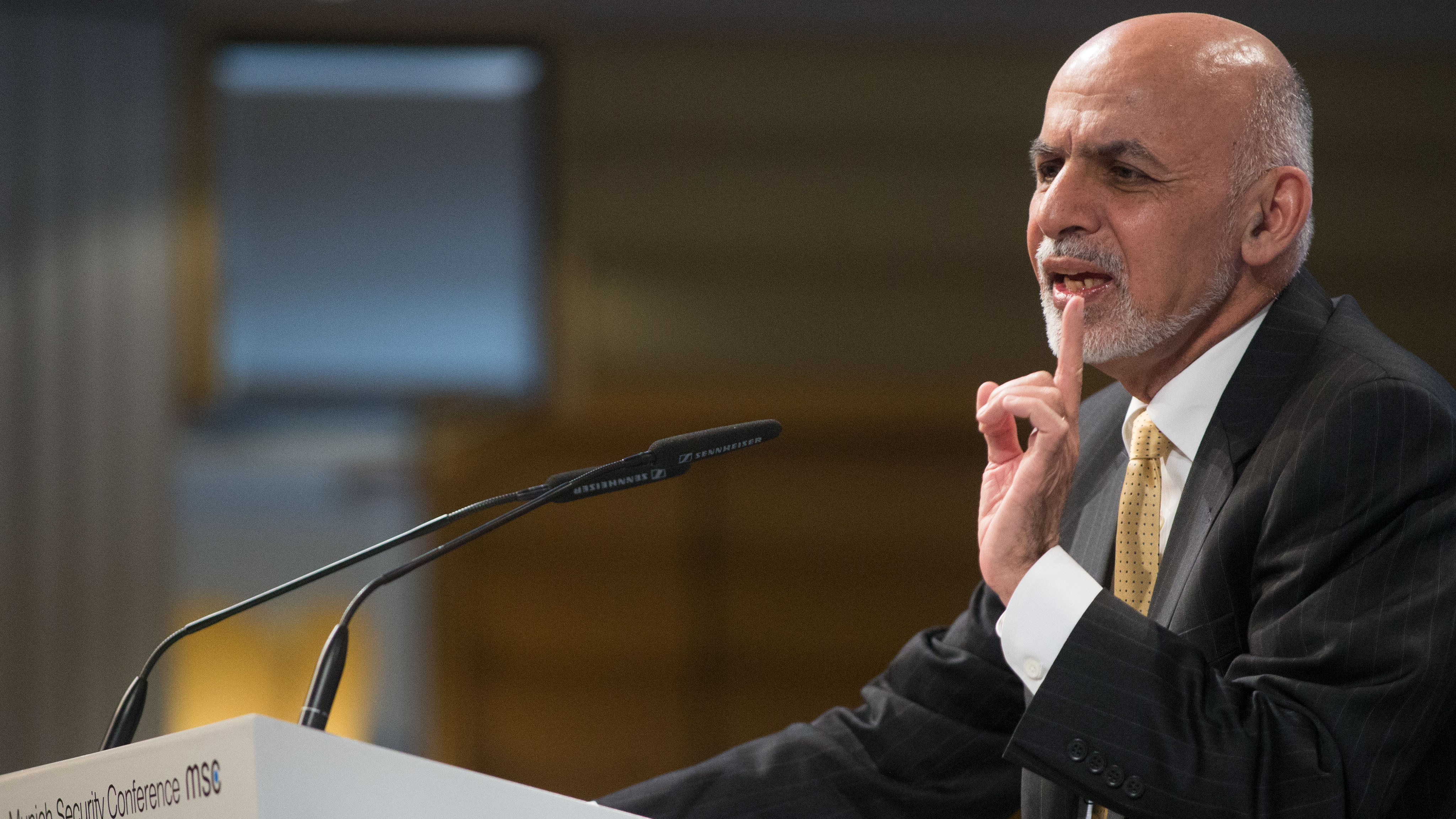
Speech at the 52nd Munich Security Conference (MSC) in Munich, Germany
Keypoints:
- Global and Regional Security: Promoting cooperation against shared threats.
- Counterterrorism: Fighting terrorist networks in Afghanistan and the region.
- State-Building and Reform: Strengthening Afghan institutions and governance.
- Economic Development: Supporting trade, infrastructure, and regional connectivity.
- Peace and Reconciliation: Pursuing a political settlement to end conflict.
- International Partnerships: Emphasizing continued global cooperation.
- Regional Connectivity: Positioning Afghanistan as a bridge in Asia.
- Stability and Self-Reliance: Building a secure and sustainable state.
In the name of God, the compassionate, the merciful.
Ambassador Ischinger, minister von der Leyen, ladies and gentlemen:
Let me first deal with context. We are confronting the fifth wave of political violence and asymmetric war in hundred forty years.
-
Anarchism was the first wave;
-
National self-determination was the second wave;
-
New lift in Japan, Europe and the United States was the third wave;
-
Jihad against the Soviet Union and struggle in Sri Lanka started the fourth wave;
-
The post 9/11 terrorism constitutes the fifth wave.
A narrative combining epistemology, history and teleology matched by utilization of the information technology of the fourth industrial revolution is translated into a distinct ecology, morphology and pathology of violence. Our knowledge and response are both fragmented, as we are struggling between naming the phenomena, knowing it, and having an action plan on the basis of an aligned strategy to disrupt, overcome and destroy the fifth wave of terrorism.
Symptoms are often addressed; causes are rarely confronted. Voices of analysis are not followed, and there is no common framework. Without a common framework on intelligence that drives use of force, we keep repeating mistakes, while the enemy learns fast, we are slow to adapting. From seeking ungoverned spaces, the aim of this fifth wave is to establish territories of terror.
Dimensions and Drivers of Conflict
My second point is on dimensions and drivers of conflict. I am focusing here on Afghanistan as an illustration; often times the war is described a civil war. It is not.
-
First, we have regional and global conflict. Every country in the region has been exporting its misfits to us. China, Russia, the-stans particularly Pakistan and others.
-
Second is Daesh. When we warned against Daesh, particularly in this conference last year, it was greeted as a way that I wanted to attract attention to Afghanistan. Today, I hope nobody is in denial.
-
Third, Al-Qaeda. Al-Qaeda is not finished. At the time that we have focused on Daesh’s threat. I hope I am wrong, Al-Qaeda is regrouped, now we need to deal with a renewed Al-Qaeda threat.
The Tehrik of Taliban of Pakistan, the Haqqani networks and others are common threats, but what is the platform? The criminal economy provides the common platform for all these movements. Narcotics and refugees, smuggling are part of the same network, and unless we focus on the soft belly of the globalization which is the 1.7 billion dollars of criminal economy, we will be addressing only part of the problem, not all of it.
There is the additional problem state sponsorship of malign non-state actors continues. Worse, some states behave like non-state actors, and this is, of course, driven by the failure to agree and act on rules of the game. All of this combines toward displacement effect. When we address the problem in one part, it results in displacement of the phenomena in the other, what, from an Afghan and regional perspective, particularly needs attention, action in Syria and Iraq against Daesh is likely to displace it. Geographically and socially, we need to define the boundaries of this ecology carefully otherwise we will be missing a significant part of this solution.
Levels of Coordinated Strategy
Ambassador Ischinger describes 2016 as bleak. From an Afghan perspective, I’d like to describe it as one of cautious optimism. I think everybody in a bleak forecast needs a ray of hope, align strategy requires simultaneously preferably coordinated action at five levels:
-
Global
-
Islamic
-
Regional
-
National
-
Subnational
So, why the good news? First, I like to express gratitude to president Obama, Chancellor Merkel, Prime Minister Cameron, Prime Minister Renzi, leaders of forty countries that have agreed to renew the Resolute Support Mission in support of Afghanistan. NATO, ladies and gentlemen, is fully alive in willing to act responsibly. I’d like to extend a very big thank you to NATO, to its secretary general, and to the entire organization.
Second, regional support. We have worked very actively with China, with Central Asian states, Azerbaijan, Turkmenistan in particular; India, Iran, Russia and Turkey to bilateral and multilateral mechanisms. We are in process of creating an emerging consensus that a stable Afghanistan that can tackle the actors and drivers of instability is in everybody’s benefit. This requires continuous work, and because of that; bilateral, trilateral and multilateral mechanisms all need to be supported. But key to this is the country that wants this has to take ownership of the process, and not just wait that others act on goodwill.
The Islamic Dimension and Cultural Heritage
On the Islamic dimension, the Mecca declaration against terrorism is a very very significant development, for the first time, Muslim scholars on confronting the problem, naming it, and simultaneously exposing the fundamental weaknesses of governance. I hope that this declaration is matched with coherent action and coordination. What is fundamental from Islamic perspective is who claims to speak for the Islamic civilization, culture and history.
Islamic civilization is a grand synthesis. When we measured the circumference of the earth, the rest of the world did not know that the world was round, and that was a thousand years ago. We need to claim back our heritage and create a vibrant and comprehensive debate among ourselves, so we can work.
National Responsibility and Reform
The other dimension is national. In here, our emphasis is first of all to acknowledge our problems:
-
A country that is inherited, the mantle of being, the dishonor of being among the tenth most corrupt countries does not have the right to speak for itself unless it addresses its fundamental corruption.
-
A country that has 41% of its people living below poverty must bear the shame.
-
A country that cannot empower its women, youth, and the poor must bear responsibility for addressing the fundamentals.
So as a result, we need to get politics right, it is the politics of empowerment, it is the politics of creating citizens and turning the state into instrument for the realization of the rights and obligations of the citizens. We are working a compact with our citizens and are in the process, a very difficult process, no doubt of turning the state into an instrument for the realization of the hopes and aspirations of our citizens.
Mobilizing for Security and Counter-Daesh Efforts
Second is mobilizing for security; security is not about use of force alone. Every problem is not a nail to be hit by a hammer. A multidimensional approach where we take governance and that’s where subnational issues come to the front. I am delighted that we have pioneered for the first time in couple hundred years a balance between our governors and cabinets, and created written compacts with every single province so I can preside over mechanisms of delivery.
But on Daesh, again we are very grateful and proud that our partners have agreed now to target Daesh like Al-Qaeda. In the last month, we have silenced the voice of Daesh to its radio in one of the remotest mountains of Afghanistan, they are on the run. They have lost 150 people, but what makes us particularly hopeful, 750 retired Afghan army officers, all commandos, enlisted in a single day to take on Daesh. Their atrocities, if brought back a reversal at the level of narrative that now has resulted in significant mobilization in eastern Afghanistan, and that’s the key. When people mobilize to tackle terror, it is a very different approach. Then, when guns are alone are used, people asks for simultaneous use of air power with ground mobilization in a will to push them out that is the key to success.
The Refugee Crisis and Economic Realities
Equally, because we have been speaking about refugees, and the minister named us. Pull and push factors both need to be addressed. A country with 41% rate of poverty forced into a significant recession bordering on a depression, and networked globally will produce refugees. We must analyze the root causes and create the condition for stability:
-
The current economic recipes of global institutions for fragile states are not working.
-
If Europe does not want refugees, it has to create the conditions for getting commodities, and value chains and linkages.
-
Our people don’t want to move, but we need to create the opportunities, and it must be on the basis of a just society where foreign assistance is used to create opportunities and not enrich a few, this is key to the public.
Conclusion: Resilience and Resources
Because of this the public must be put first, because what makes us trust in the future, first is our resilience. We have coped with the earlier waves of violence; our historic resilience gives us the confidence that we will overcome the fifth wave.
Second is our latent resources where an extraordinary rich country inhabited by extraordinary poor people. It has to be reversed our partnership, now based on mutual values, accountability and mutual trust should provide a platform for an align strategy. We invite governments, firms and global civil society to join us in deploying the tools of great imagination in creativity to overcome the fifth wave of violence.
Thank you.