The First Mile to Self-Reliance: A Roadmap for Institutional Reform and Economic Productivity
Keypoints:
- Solidarity and Symbolism: Partners standing with Afghanistan in times of need.
- Open Dialogue: Mutual accountability as the basis for self-reliance reforms.
- Economic Strategy: Productivity, competitive markets, and regional partnerships.
- Human Rights: Growth aligned with fundamental freedoms, especially women’s rights.
- Institutional and Electoral Reform: Strengthening governance, elections, and stable institutions.
- Anti-Corruption & Procurement Reform: Executive oversight to ensure transparency and accountability.
- Private Sector & Job Creation: Stimulating investment, business growth, and employment.
- Security as Development Foundation: Afghan forces safeguarding progress and national stability.
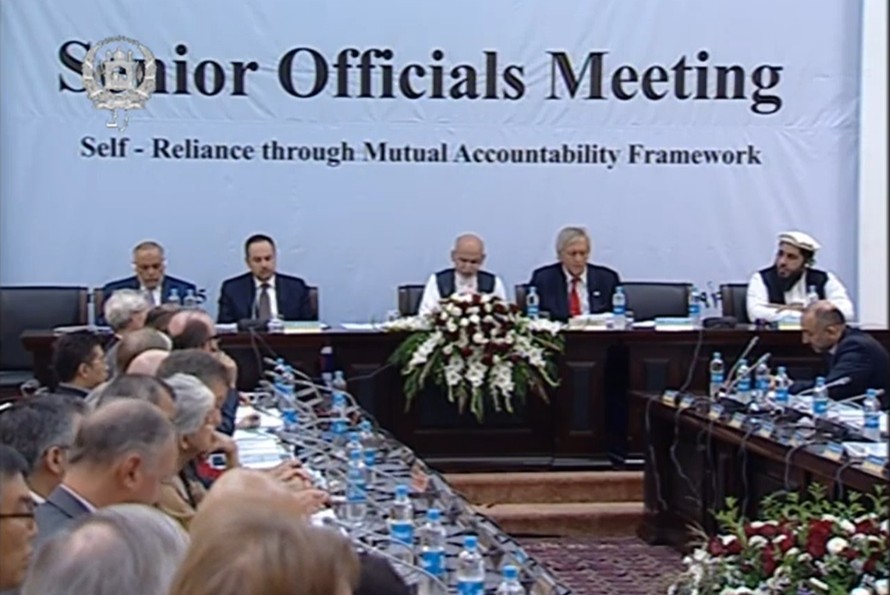
Senior Officials Meeting (SOM) | ARG, Kabul, Afghanistan
September 5, 2015
In the name of God, the compassionate the merciful.
Minister Akimi, Minister Hakimi, Chairman Muslim, distinguished guests, members of the cabinet, Governors, ambassadors, heads of agencies, all our guests, and ladies and gentlemen: it's my pleasure to welcome you to this Senior Officials Meeting.
The Symbolism of Your Presence
Your presence here is not just substantive but highly symbolic. Your decision to come at a time after Kabul has been in mourning is an act of empathy, understanding, sympathy, and commitment. On behalf of the state, the nation, and all segments of public opinion—Civil Society, the Ulema, and the women of Afghanistan—I want to thank you from the bottom of my heart. Friends in need are friends indeed, and you're showing by your presence that you are indeed in our needs with us and together we can stand tall and face all the challenges that confront us.
The Goal: Open and Candid Discussion
We have an exciting day ahead of us. This will be the first opportunity since London, where Dr. Abdullah and I first presented our self-reliance reform strategy, to have an open and candid discussion with our international partners. And I do emphasize open and candid. Open in the sense that there are fundamental questions where early closure will not be helpful. Candid because Mutual Accountability demands candidness and we should not shy away from grading our efforts, particularly that of the government, because a government elected by the people and bound by them needs to be evaluated and evaluated clearly in order to have benchmarks to see how we are changing and how we are delivering.
In London we were a new government; today we are a fully formed Administration. Our speakers and panelists are Afghanistan's best and brightest leaders. You will have many interesting discussions over the course of the day, but for Dr. Abdullah and myself, the most interesting part of all would be to watch our Government of National Unity demonstrate to the world community that we've become one team with a shared vision for repairing our battered country and bringing about a better world for our children and their children.
The Three Pillars of Economic Strategy
In my remarks last night I gave an overview of our government's economic strategy and how we plan to introduce the structural reforms that will move Afghanistan from an economy that was built on the consumption of foreign aid to one that is built around rising productivity through commercial investment, job creation, and trade. I will not repeat that discussion but I would like to quickly summarize the main elements of that strategy:
-
The first pillar of the strategy is to raise National productivity by focusing our investments in agriculture, mining, infrastructure, and regional connectivity, and particularly of course in human capital.
-
The second pillar is that Afghanistan needs to foster markets where firms compete fairly, where jobs are created, and where value chains provide better access to the capital and knowledge that we need to pursue opportunities in new markets.
-
The third pillar is that a state focused on development must build partnerships with the private sector that enable growth and partnerships with our neighbors, near and far, to build regional cooperation for peace, prosperity, and development.
Human Rights as a Foundation for Growth
It is important to highlight our economic strategy for this meeting and for the people of Afghanistan because creating jobs and moving the economy forward will underpin the success of our other efforts to build an inclusive and tolerant society. We must strive for both peace and prosperity, but prosperity is not purely an economic concept. The pursuit of growth must never come at the expense of our values. Our government firmly believes that human rights are not luxuries that can be traded off in order to increase the size of the economy or set aside indefinitely until the time comes when we can afford them.
In a war-torn country like Afghanistan, human rights and building the institutions to ensure that they are respected is as fundamental to successful development as inspiring the private sector or building more hydroelectric dams. It is no accident that for all of our other challenges, Afghanistan is today among the countries in our region with the freest press, the most open for civil society, is given the most autonomy to our Human Rights Commission—where our distinguished leader Sima Samar is with us—and is the most explicitly committed to carrying forward a national policy to advance the rights of women.
At a time when even the most developed countries are finding it too hard to reconcile their legal obligations to protecting the rights of the refugees with the social economic and political challenges they pose, we and the National Unity Government of Afghanistan recognize the fragility of our fundamental freedoms and we'll repeat in this and other forums our unwavering commitment to preserving and advancing them. There can be no compromise on our fundamental rights. Chapter 2 of Afghanistan's constitution on the rights and obligations of citizens is non-negotiable.
The Compact of Mutual Accountability
The Tokyo Mutual Accountability Framework and our own self-reliance strategy draw heavily on global agreements such as the Paris and Accra declarations and the non-binding Busan Declaration on development effectiveness. The core idea of all of these discussions was very simple: rather than seeing development as a transfer from rich countries to poor ones, Mutual Accountability would consist of a compact between them that was defined by trust, focus, and delivery. Today's discussion is an assessment of how far we've come since taking office in an effort to reach agreement on the way forward between now and next year's ministerial Gatherings—first in Warsaw to discuss security and then in Brussels to discuss development cooperation.
Institutional Reform and Electoral Integrity
Before we begin the day I would like to make some comments on how we've been organizing to implement our reform agenda in the road map that we see unfolding between now and Brussels next year. Our approach to reform, to achieving reform, has been institutional. The collaboration between myself and Dr. Abdullah has demonstrated that power is not a zero-sum game but that it can be an exercise in moral responsibility and accountability. Our commitment to constructive politics will be measured by its success in building stable enduring institutions.
I am pleased to inform you that our electoral Reform Commission, whose distinguished leader Mr. Aki is with us, having worked diligently, has now shared its first set of recommendations. We will have a special cabinet session tonight to consider them. Since Parliament cannot legally change the electoral law in its final year, the electoral law will then be amended by legislative decree tonight thanks to the exemplary work by the Electoral Reform Commission. In the immediate future, we will announce the dates for the Parliamentary and district council elections. While not all of the problems of voter lists will be solved in time for the upcoming parliamentary elections we're totally confident that the 2019 presidential election will be amongst the cleanest held in any country, especially any developing country.
Legislative Progress and Rule of Law
The Government of National Unity is a success. We have chosen a cabinet that is not just highly qualified but that is here to make the reform agenda become a reality. In just 6 months the government has revised or passed more legislation than the past two years combined. Key laws or regulations passed have included a revised banking law, electricity laws, and updated procurement laws and a myriad of others. Every cabinet meeting has a legislative component to it whose purpose is to make the implementation of the self-reliance agenda possible. The first duty of the president of Afghanistan constitutionally is to ensure the application of rule of law and that's why we are focusing on legislation to get the rules of the game right and then reorganized accordingly.
Implementation Reforms: Building a Competent State
First and foremost, it has been to start the process of building a clean competent government. A big achievement of the past year has been the restructuring of the capacity building for results program which is now recruiting qualified staff for Ministries on the basis of approved Resource Management plans. And in recognition of this progress, I'm very pleased to have learned that donors will also align their invoicing rates behind the CBR scales so that we can halt and then reverse the brain drain out of government. As I mentioned last night just a few days ago we also assigned the responsibility for choosing director generals and Senior officials to their ministers rather than the Civil Service Commission so that going forward our ministers can build their own teams and be accountable for what they deliver. I congratulate Minister Akimi on this accomplishment because as Minister of Finance I singly failed to do what he's managed to do so thank you to all of you.
The second key reform area has been to begin reforming the budget process. Afghanistan's budget system served it well when the objective was primarily to track the expenditure being made on projects; it has not been an effective tool—as effective a tool—in driving National development policies. To support government-led reforms we must renew our efforts on reform and create a national budget that is less fragmented, more responsive, and which allocates resources based on performance. The new public financial management road map will improve the quality of planning, reflect the true cost of government policy decisions, and use better and faster reporting to let the finance ministry monitor the quality of implementation.
The third key reform has been to accelerate our war against corruption. In London we promised to make tackling corruption a first-order priority for our government. Over the year we've launched that war on many fronts. Kabul bank is no longer a symbol of impotence of government but a symbol of resolve, as well as defense procurement and a range of other examples. We established a national procurement commission that I chair every Saturday in which Dr. Abdullah, VP Danish, and the Ministers of Finance, Justice and economy are members to review all high-value contracts that in the past ended up costing the government hundreds of millions of dollars in inefficient and faulty specifications.
The fourth key reform has been to reorganize Afghanistan's justice system so that we can begin to manage the country through the respected rule of law. The Supreme Court led by our very able chief justice is focus on its core legal functions and is initiating comprehensive reform. We nominated the first woman to Supreme Court and I must express my disappointment that she lost by eight votes. She has one of the most competent legal minds in this country and stands head and shoulders above all the other candidates that I considered. I do hope that our members of parliament will consider merit and not just gender in terms of their decisions.
The Fight Against Narcotics and Addiction
Recognizing that lack of law, violence, and criminality go hand in hand, we formed an inter-ministerial commission to clamp down on narcotics trade and the moral as well as financial corruption that grows with it. There was an attitude a decade ago: "well we Afghans grow it, others consume it." Well, I have news: we have three to three and a half million addicts. Daily the toll that addiction takes—we are a very tight-knit society; the Community Values and Family Values are very high. Today Bridges under Kabul River are full of people who've been disowned by their families and have been thrown out. Producers, processors, traffickers, and consumers must come in a compact to deal with this worldwide phenomenon because none of us can ignore it and particularly not we who are suffering in a major way and will lose a generation of our best young people to this addiction.
Fostering the Private Sector
The fifth key reform has been to begin fostering the private sector to stimulate the investment that will create the jobs that this country so badly needs. We've passed bills and negotiated agreements to increase the supply of electricity to Afghanistan including efforts to advance our use of renewable resources of energy which is a fundamental precondition for any form of Industrial Development. We began to streamline business licensing requirements and we anticipate opening Afghanistan's first one-stop shop for business registration and licensing later this year.
Sixth, while the first set of reforms focused on the government on the Ministries and we implemented our first 100-day plan, the second 100-day plan will focus on relations between Ministries and provinces. Minister Popal, a very able leader of local government, the independent local government Authority, has been instrumental in preparing provincial plans of reform and we are moving to implement. I welcome the governors—I see the governor of Nangarhar, I see the governor of Herat who spoke to you, the governor of Kandahar and others who are here. This again is a very distinguished and committed group of governors and two women governors who again are making history.
Announcements for Investors
I would therefore like to open this Workshop by making the following announcements:
-
The Afghanistan investment support agency (AISA) and the ministry of Commerce and Industries will increase its consultations with the Afghan Chamber of Commerce and Industry (ACCI) and the Afghan industries Association.
-
We will submit to the cabinet a reform to increase the standard length of business licenses from one year to 3 years.
-
We will work to review and possibly eliminate the requirement for a tax clearance letter in order to renew a business license.
-
Customs Department overhaul: no one will serve in the Customs Department unless he or she is a graduate of the Customs Academy and totally transparently recruited.
-
To encourage investment in telecommunications, private telecom companies will be allowed access to the optical fiber cable backbone.
-
We will soon announce an initiative to revive investor confidence in developing the Sheberghan gas fields.
The Priority of Jobs and the Path to Brussels
We called our progress report "The First Mile" because we recognize that the road ahead will be long and full of curves and potholes. Success is far from guaranteed. Before we open today's discussion I would like to emphasize to you the seriousness of the current lack of jobs. We are a country where 3% of our population is above 60 and 30% of our population is below 15. Poverty is the driver of instability.
Immediately, jobs, jobs, and jobs are our priority. Afghanistan is not Greece. Our economic contraction has not come from bad policy choices. We cannot simply abandon the poor today in pursuit of long-term prosperity tomorrow. Before opening this workshop for general discussion I would like to make three explicit commitments that you can use to hold me and my government to account:
-
First promise: By the time of the Brussels Gathering, the government of Afghanistan will have produced a credible budget.
-
Second promise: Afghanistan will be moving up the human rights scale and in particular will be bringing a positive story about the advancement of women's rights across the country.
-
Third promise: Provided that we have a willing partner, peace discussions will have advanced and a serious dialogue to end the killings will be under way.
Security: The Umbrella of Development
I cannot open this workshop on development without acknowledging the critical role that our Armed Forces is playing to defend the country and provide the security umbrella without which all talk of development loses meaning. Their success and the success of development for Afghanistan are inextricable.
Afghanistan is a country under attack by forces who believe in none of the values that we will be discussing today. It is no coincidence that the road to Brussels passes through Warsaw. We are committed to Afghanistan's National development need and appreciate the support and learning that our partners with Resolute support have provided us and we continue to acknowledge the brave commitment shown by our foundational Ally the United States.
Let me remind you that last year a lot of people were saying that the Afghan security forces will disappear like a puff [of smoke] and will not be able—this is a country of patriots. We have defended this country for 5,000 years and let me assure you we will defend our honor and our independence for the next 5,000 years.
Closing Remarks
Let me stop here and hand the baton over to my very capable cabinet and colleagues. I know that you will have a fruitful and exciting discussion. Afghanistan is on the move. I wish you all of the best and I look forward to reconvening in Brussels a year from now so that I can present the highlight of all of the results that would have delivered over the years. You are indispensable to delivery, to generation of hope, and to ensuring that the Afghan people know that we are not alone but also the Afghan people know that we must own the responsibility for the future ourselves because no partnership will work unless the partner that is in need and is articulating the future can own the future and commit to it.
Thank you.