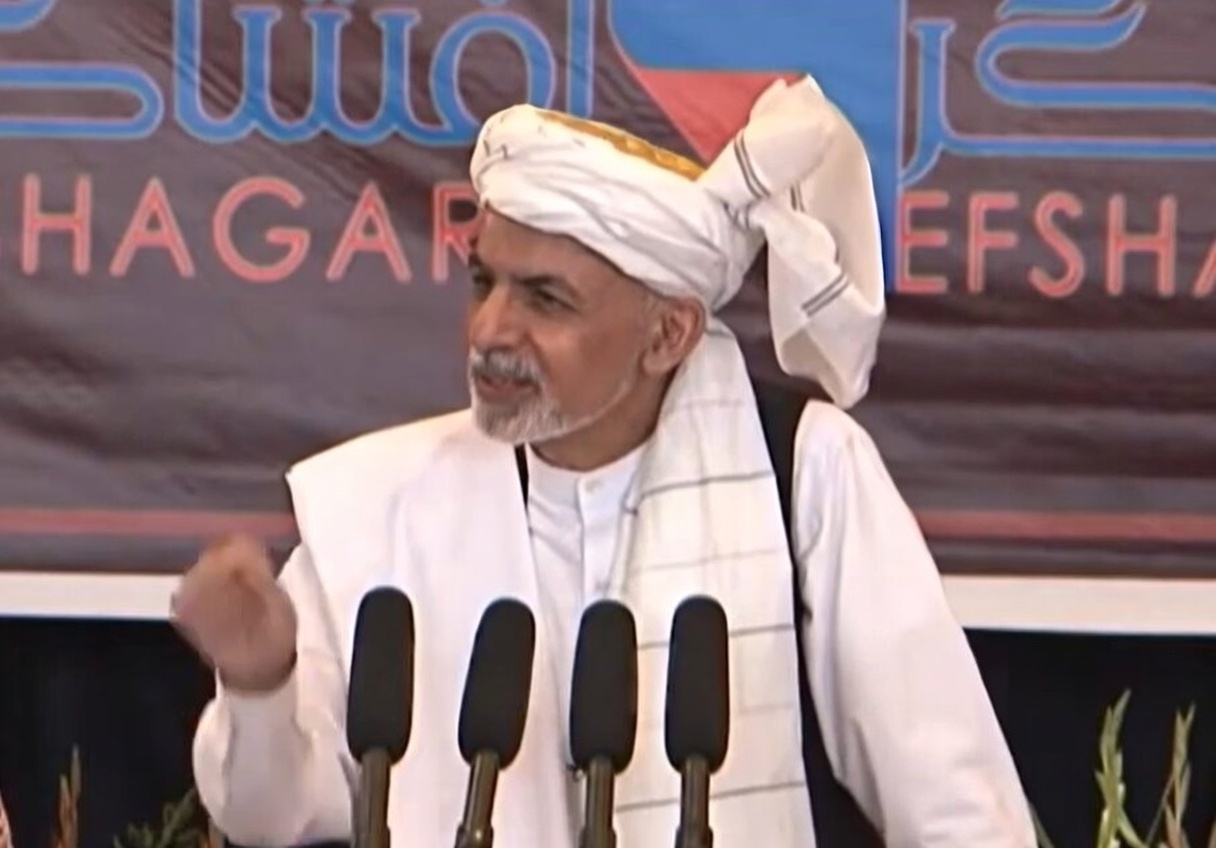
Justice as the Foundation: Speech at National Symposium on Islam and Anti-Corruption
Keypionts:
- Umaric Governance: Hazrat Umar Farooq (RA) as a model for transparency and accountability.
- System over Individual: Stability through institutions, inspired by Singapore.
- Procurement Reform: Turning state spending from graft into domestic growth.
- Property Rights: Sharia-compliant deeds for informal housing and land protection.
- Narcotics Challenge: Breaking the vicious cycle of addiction and system failure.
- Economic Sovereignty: Prioritizing “Made in Afghanistan” over low-quality imports.
- Revenue Professionalization: Merit-based civil service through Customs Police and Academy.
- Banking Reform: Recovering assets and building a global Islamic banking system.
- National Anti-Corruption Jihad: Mobilizing Ulema and citizens against graft.
Ulema Kram, the inheritors of the Prophets; Honorable Khpalwak Sahib; Honorable Akbari Sahib; Abedi Sahib; respected members of the Ministry of Hajj and Religious Affairs; dear brothers and sisters!
The central axis in the political philosophy of Islam is "Justice," and its realization depends on the "eradication of corruption." The teachings of the Holy Quran regarding the struggle against corruption are very clear. In Verse 77 of Surah Al-Qasas, the Divine Being says: “And seek not mischief in the land, for Allah loves not those who do mischief.” And in Verse 83 of the same Surah, He has said: “That home of the Hereafter We assign to those who do not desire exaltedness upon the earth or corruption.”
We all know that the Prophet (PBUH) placed the curse of Allah (SWT) upon the solicitor of a bribe, the receiver of a bribe, and the intermediary between them. The historical experience of Islam showed that the holy religion of Islam, compared to any other religion or creed, bridged the gap between theory and practice in the field of corruption, the realization of justice, and system-building in the shortest possible time. The successful experience of the Khulafa-e-Rashideen, especially during the caliphate of Hazrat Umar Farooq (RA), is the best example of how the judicial system, land tax (Khiraj), and financial accountability were put into practice with total transparency.
The importance of the biography of Hazrat Umar (RA) is not only in his individual conduct but in the fact that his method of governance turned into an extensive system throughout the realm of Islam. Which other ruler is there from whom a companion can ask, "You did not do justice; you are taller than us—give us an account of how the fabric (clothing) reached you in an equal manner?" He descends from the pulpit and says, "I am equal with you; you speak correctly, my brother; I am taller, but my son gave his share to me." This is what is called transparency, accountability, and effectiveness. These words did not come to us from the West; they are the heritage of the clear religion of Islam.
The political philosophy of the government and this Constitution is, only and only, the framework of the clear religion of Islam. Today, nearly a hundred countries in the world face the serious problem of corruption. Corruption, even if it is a secondary phenomenon in administrative and commercial affairs, poses a threat to the system of society; but if it turns into a widespread and organized phenomenon, it takes the form of a cancerous tumor that can destroy the entire existence of a nation. Is it not a point of shame for every Afghan that every year the whole world says Afghanistan is among the most corrupt countries? Our people are not corrupt, our Ulema are not corrupt; it is a limited number of officials and a limited number of traffickers who put the reputation of this nation at risk, and the nation must not accept this.
Now, the fundamental problem of corruption is that the people imagine it is natural—that whichever office they go to or anywhere else, no one has the right, no right at all, to ask for a bribe from the people. And we must stand up. We must stand up from the pulpit, we must stand up from the school, we must stand up in the entire society. Specifically, countries have three conditions. One is the condition where ten percent work in the administration and ninety percent are tainted by corruption. Such countries can never progress. I give you the examples of two countries. Singapore has no natural materials; it even has to import drinking water; but in the past forty years, Singapore, which is a small island, has turned into a massive economic power. The negative example is Congo. Congo has so much wealth that there is no limit; the world’s best mines are in Congo, but in sixty years, their national income has increased by only one billion dollars. Time and again they are in war, time and again in trouble, because they did not build a system.
What is the living message of Hazrat Umar Farooq and the Khulafa-e-Rashideen (RA) to us? Build a system; because in a system there is stability, in a system there is prosperity, in a system there is unity. Second are those types of states that do "dry accounting"—they spend money and say if it went below or above this limit, they call this transparency. This is not transparency; this is a dry, cold bureaucratic administration. What is the original point? The Bait-al-Mal, the foundation of which was laid by Hazrat Umar Farooq (RA) and to which Hazrat Ali (KW) paid attention—this has reached us as a heritage; money must have effectiveness. Money is a tool; the goal is the well-being of the people and the pleasure of Allah (SWT). Therefore, for that type of system, it is necessary to lay the foundation, and for that, your voice, your call, your part, and your guidance are necessary. Specifically, because we should not speak "into the air" (vaguely). And some things specifically require attention. Five years ago, when the London Conference was held, the international community and Honorable Karzai Sahib had reached a deadlock; they asked me to explain these factors. We must distinguish between cause and effect. What are these factors, what are we doing about them, and what do we want from you?
The first factor is contracts. Government contracts throughout Afghanistan have turned into a source of corruption. A project was not completed on time. You understand yourselves—those who were absolutely not experts in that profession were taking the contracts. They would sell the contract four or five hands further. What have we done in this sector? Every Saturday, a High Procurement Commission meets under my personal supervision with the participation of Honorable Dr. Abdullah, Honorable Danish Sahib, the Minister of Finance, the Minister of Economy, and the Minister of Justice. What have we done so far? 350 projects have been reviewed, 295 of them came to the Procurement Commission, 252 cases were approved, 43 projects were sent back, 28 projects were rejected, 26 companies were barred from procurement due to forgery of documents and false information—we barred 26 companies. What is the result? The value of these projects is 51.5 billion Afghanis; we have saved 8.5 billion Afghanis so far.
This is the first stage, because until now we did not have a framework for contractors to know which contractor can do what work with what transparency; at the same time, we could not stop the government. You remember in the Ministry of Defense, in one contract there were a hundred million dollars—we stopped it! We only need two things: One, how to clean the old heritage so that on that cleaning, our fundamental framework is built. Second: how to ensure transparency in the future? And for the future, I want to give you assurance and ask of you: if you saw that there is a mistake in the contracts, refer to me personally. This is your money, this is the people's money; the people have the right to participate, and without the participation of the people, you cannot do contracts. If you bring savings in every contract, there will be that much of a framework.
Henceforth, 15 percent of government contracts will give preference to domestic products. The demand of the Defense and Interior Ministries alone amounts to fifty million dollars—all of this comes from abroad. Now my goal is that 18 percent of the national income is the government’s expenditure; no one had paid attention to this. The people must work. Walk in Kabul—what do you see? How many factories do you see in Kabul? This city is built on consumption. Brothers, Ulema Kram! If you do not produce and do not stand on your own feet, how will you eat tomorrow? This food that was in your pockets just now—this was the charity of the foreigner. We do not move on charity; we want to stand on our feet, and one way of standing on our feet is these procurements.
People say the President sits for three hours looking at files. If I do not look at them, this culture that has become common—that every part of the law must be implemented—will be stepped upon, and we and you must join hands so that the law is implemented. The law is higher than me and higher than every individual. Because in the law, and especially in Sharia, a system is built. Second is the usurpation of property, especially land. Secondly, properties are informal. 64 percent of houses in Kabul today do not have a deed. Think about it—every house that has been built is the result of the people's perspiration; but today, to what extent is the harassment of people in this regard? In the coming few weeks, we will begin the basic actions I promised you regarding the Sharia-compliant way of formalizing property, so that every Afghan individual, Insha-Allah, understands that first, their dwelling is protected just as it is protected in the holy religion of Islam; and second, we must fundamentally end the usurpation of property in the coming few years.
In this year, we know that our security problems were beyond limits, because of the people who imposed a big lie on the nation of Afghanistan and drew people to war in the name of Mullah Omar; they reduced the opportunity for reforms. We will not destroy the opportunity for reforms for anyone until the Ulema Kram and the Palace are in a single rank.
The third factor is narcotics. The cancer of this country is narcotics. Previously, there was a philosophy that "we produce, others consume, it has no negative effect on us." Ulema Kram, respected brothers and sisters! Today we have three and a half million addicts; look under the bridges of the Kabul River! The Afghan family is a very strong foundation. You know we have always relied on each other; today, a father and mother are forced to throw a young child out of the house. Is it so or not? What is the reason? The reason is that they can no longer cope. So what is the issue here? The production of narcotics has four parts: the producer, the processor who turns it into heroin, the transit that moves it, and the consumer. We are not solely to blame; this is a global "vicious chain" network. we are organizing all four parts, but we ourselves must come out of this false thought that narcotics is not our problem. We request the Ulema Kram to make the (preaching) against narcotics nationwide.
Billions of dollars of money come; ninety thousand goes into the pockets of European traffickers; others are in the regional transit. I said clearly in Russia to all the leaders of the region: do not put the blame only on Afghans; but now it is also necessary for us not to change the agriculture of Afghanistan. We and you import billions of dollars a year. This year, which is one of our good agricultural years, by estimation, we must import only one million tons of wheat. This is a point of shame for us. Afghanistan must be an exporter of agricultural products. We cannot produce chicken—do you know what one of our neighboring countries does? They inject a chicken several times to make it big quickly; when it comes here, that is poison. This open door, where every low-quality thing must come into this country, must be taken under control.
This is a fundamental change, and we request of you, as consumers and as individuals in whose hands the future of our children lies, to make the people aware. Low-quality goods are not to our benefit. In the coming few months, we and you will start a nationwide campaign to prefer Afghan products. What a strange country—we cannot even produce the linen (Katan) that your President wears. Until we stand production basically on its feet, and also agriculture, industry, and services, we cannot lose narcotics.
The fourth subject is smuggling. Smuggling has two forms. First, it comes officially—if someone has a connection and the powerful appoint their individuals in the customs who give them a 50 or 60 percent discount. Is it so or not? We must speak clearly. With the Ulema Kram, lies are not allowed, and if we do not diagnose what the disease is, we cannot treat it. From this direction, in the sector of customs and revenue, we did two fundamental things: First, a special Customs Police has been created which is directly under the Ministry of Finance and its responsibility is to do this work. Second, a special Customs Academy is being created. The children of the poor have always kept this soil; the children of the poor must be able to enter the most important financial and administrative subjects without a "connection" or intermediary. I will accomplish this, Insha-Allah, by next year.
Another part is preventing smuggled revenues coming toward us; despite every border province of ours being turned into a transit province, having customs and facilities—it is not happening. When I was the Minister of Finance, no one looked at Nimroz; they said Nimroz is a far place, who knows what is happening here? I agreed with the Iranians to build a bridge in Abrisham. I brought the Indians to build the road. Today, 100 million dollars a year come from the Nimroz customs. In Zaranj, the structure and price of houses are higher than in Wazir Akbar Khan. Kabul is not all of Afghanistan. Wazir Akbar Khan alone is not all of Kabul, and Kabul alone is not all of Afghanistan. We must share all Afghans together, and this is the way. Twenty of our provinces have borders. We must provide the ground for transit for every province so that Afghanistan's trade is expanded in a principled way and becomes legal. Wherever there is a way, the smuggler comes on it; but if there is a law, then goods come in a reasonable way, and here I want your attention.
The fifth subject is our minerals. Contracts (in this sector) have been given in a very scattered and non-transparent way. Honorable Saba Sahib, our Minister of Mines, has undertaken a nationwide review of all large and small contracts. Insha-Allah, through minerals, Afghanistan will live for four hundred years. In one contract, are eight sentences good or bad? So you must give me time; that which comes "baked" (finished) must be baked. What is the difference between a raw brick and a baked brick? A raw brick melts under the rain. A baked brick, because it has first seen the furnace, does not break. Consequently, our minerals sector must be "baked"; we have taken basic actions so that the future of our children’s children is protected. Some of the self-willed actions and lawlessness that occurred do not come under control in one day; we have a firm will to bring them under control. And I request of everyone: whichever contract has a problem, come and discuss it—you understand! Whatever you send to me, I read it; seeing me is difficult because the burden is great, but reading is easy.
In smuggling, it is not only one-way smuggling. Today, our history is being smuggled. Our estimate is that several hundred million dollars a year of our antiquities are smuggled. Today, unfortunately, there is no peace. If you look at China, if you look at India, or if you look at Turkey, they obtain hundreds of millions of dollars in revenue from these same artifacts. Our forests are being smuggled; these same forests belong to us and your children. Why have floods increased today? Why did so many floods not come before? The reason is that we cut the forests. If serious attention is not paid to forests, floods are certain. The attention that the clear religion of Islam has for the preservation of nature is peerless. You are Ulema—is it so or not?
We do not need a new philosophy. Our struggle is that we are Muslims, but we do not understand Islam, and I want to thank you for this movement—that you have gathered the Ulema here and are showing all the commands and regulations of Islam to this society. So, this accusation that if you make reforms—reforms benefit the majority and harm a very small minority, and even then, injustice is not done. But they who say transparency is a "Western thing," the struggle against corruption is a "Western thing"—may Allah (SWT) give you goodness. Was Hazrat Umar Farooq (RA) Western? If we look at the entire Sharia and Sahih Bukhari—this is the most read book after the Holy Quran. Where was this peerless book written? It was written within a legal framework, and all its commands were arranged in Balkh, Herat, and Bukhara. So it is necessary that we understand what to do.
The sixth subject was our banking system. Kabul Bank was not created to save people from Hawala and interest (Sud) and create ease for them; without a banking system, especially an Islamic banking system, craftsmen and industrialists cannot stand on their feet. What was the result? From the nation, more than eight hundred million dollars were stolen by a few limited people. Our first point: all their files have been completed. Today we are in the process of taking the money back from them. Look at the banking systems of other countries—no one has acted in this way. Insha-Allah Ta'ala, it must have been proven that we have a strong will regarding such violations and laughing at the people; we do not leave anyone aside. But more importantly, in the first two months—because our Central Bank Governor had not yet come, who is a very expert individual and it is hoped that the Ulema Kram speak with Honorable Khalil Sediq Sahib—I personally reviewed every bank. I looked at every bank with all its accounts for half an hour each. Today we have all reform programs. Insha-Allah Ta'ala, Afghanistan will become the owner of such a banking system that sets the economy in motion. Now my good news is that based on your recommendations, we are working seriously on the Islamic banking system. We will bring the successful general experiences of Saudi Arabia, the Emirates, the Gulf, and the whole world to reach a result.
The seventh part was corruption in government appointments. "Unless there is something small, people do not say things" (There is no smoke without fire)! Here, in two basic sectors related to the two basic powers connected to the state—the Executive and the Judiciary—we have nationwide and comprehensive actions underway to clean the administration; but we must understand the depth of the forty-year heritage we have inherited. The first action is that the high-ranking government officials themselves in the cabinet, independent directorates, and the judiciary must not be caught in corruption. It is hoped we have passed this test. Second, a clear political will exists that anyone in a high position who, God forbid, reaches for corruption, will be dismissed from their position. But third, in our Executive power, we have five sectors: the central Executive, local administration, independent directorates, state enterprises, and companies. Never had these come into a single framework. Akbari Sahib!—who was with "Harakat" and before that in AISA—do you remember a state enterprise ever being gathered even once? We called all of them and laid the foundation for a clear coordination so the administration is gathered, and especially the balance between the ministries in the center and the provinces must change fundamentally.
The first hundred-day plan was on the initial reforms of the ministries. In the second hundred-day plan, I will bring these sectors, especially the center and provinces, into a clear framework. The cost that our country has endured until now from the perception of corruption has, before anything, been directed at three major majorities: women, youth, and the destitute classes. You saw the estimates—the people of Afghanistan were giving millions of dollars a year in protection money (Baj). This "protection money" not only tramples all the principles of the clear religion of Islam, but it tramples all morality. They force the poorest individuals to give protection money. You saw in that video, the one who was acting like a scribe (Mirza)—he was a scribe—he throws the paper that way and that poor boy is standing with such etiquette. This is not a representative of the rule of law; rather, it is a moral explosion. To fight this ominous phenomenon, we need a National Jihad for the eradication of corruption. Here, it is necessary to sincerely thank the Ulema Kram for paying attention to this important subject and, based on your important role, I request that you mobilize our Muslim people for such a nationwide and fateful Jihad. The government also stands with all its power alongside the Ulema Kram and its people in this way.
Honored participants! The struggle against corruption is a primary duty of the government. We have started some basic actions to end this destructive disease, which naturally requires some time for full implementation. We have rolled up our sleeves to dry the roots of corruption and, Insha-Allah Ta'ala, with the help of the nation and the Ulema, we will bring this struggle to the stage of full victory. I request the participants of this important meeting against corruption to share the results of their discussion with us, because every specific proposal you have, we must act upon it, and Insha-Allah Ta'ala, we will act upon it.