The Incomplete Chapter: National Sovereignty on the 96th Independence Anniversary
- National Unity: Afghanistan’s strength built on the people, defenders, and rule of law.
- Heroic Defenders: Soldiers and security forces safeguarding sovereignty with unmatched courage.
- Sacrifice Honored: Families of the fallen embraced as permanent partners in the nation’s defense.
- Rule of Law: Constitutional governance as the only path to lasting stability and accountability.
- Civilian Partnership: Security and stability require participation, inclusion, and national conviction.
- Economic Resilience: Domestic production and natural resources as engines for prosperity.
- Strategic Engagement: Independence demands regional and global cooperation, not isolation.
- Historic Responsibility: Continuing the unfinished legacy of King Amanullah Khan through reform.
- Enduring Afghanistan: Every citizen’s duty to protect freedom, heritage, and national sovereignty.
In the name of Allah, the Most Gracious, the Most Merciful.
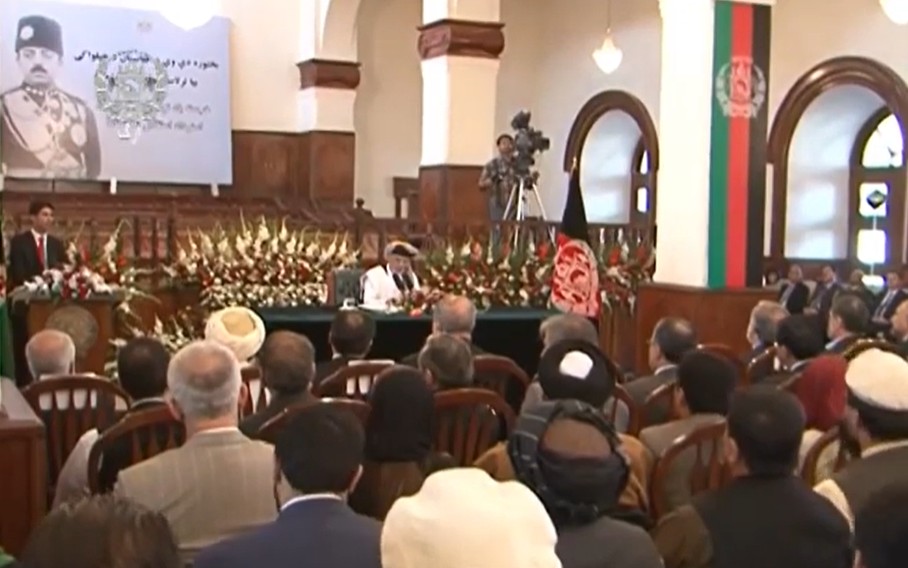
Honorable Vice President Danish, Chief Executive Dr. Abdullah, the esteemed Jihadist personality Hazrat Sahib, Speakers of the Two Houses of Parliament, distinguished Ulema, Mr. Kashaf, members of the Cabinet, Generals of the Resolute Support Mission, members of the Diplomatic Corps, the gallant and courageous Generals of Afghanistan, our youth, sisters, and brothers!
First, I offer you the greeting of the Leader of Humanity: Peace and the blessings of Allah be upon you!
Above all, I congratulate all compatriots on the anniversary of the restoration of our national independence. On this day, let me begin by expressing my profound gratitude. I thank the National Defense and Security Forces (ANDSF) who, with matchless gallantry and slandering spirit, have stood as the guardians of this soil and thwarted the diabolical schemes of those who sought the ruin of this land. You are the noble descendants of the giants who first secured this independence.
We take immense pride in the chivalry of our brave sons. It is our intent that the culture of appreciating their sacrifices becomes a deeply institutionalized norm. To this end, and in honor of the day of defense of our independence, we have dedicated the majority of one thousand state medals to our soldiers, officers, and security personnel. Other honors have been conferred upon our Ulema, academics, teachers, exemplary women, and families of martyrs. Furthermore, I have directed that Corps Commanders may be promoted to the rank of Lieutenant General upon completion of their terms. We have reorganized the promotion systems for pilots, doctors, and security personnel, removing the structural barriers within our organizational frameworks (Tashkil). We are also amending the procurement laws to ensure that the highest quality medical care and pharmaceuticals are provided to our wounded heroes.
I personally thank Dr. Abdullah and Mr. Danish for their presence in every procurement session, ensuring we address every facet of our forces' needs. We are determined that our soldiers shall never again suffer from a lack of food, clothing, or essential supplies. These services are now managed under the highest levels of government leadership.
Our commitment to the families of our fallen heroes remains absolute. We are eternally indebted to their martyrdom. We pray for their eternal peace, but we bear a permanent responsibility toward their survivors. Furthermore, we are aligning the supply chains of our security forces with domestic production, ensuring that the virtuous cycle of national industry benefits our farmers and producers.
To the courageous people of Afghanistan! I thank you for sending your children to the ranks of the National Army and Police. It is a testament to this partnership that recruitment has increased by 9% in recent months. When our heroic people stand ready as volunteers to defend this sovereignty, the cry of "Long Live Afghanistan" becomes an eternal reality. Our youth prove their commitment to independence and stability by voluntarily joining the defense lines.
A year ago, some imagined that following the withdrawal of international forces and the transition of security responsibilities, the enemies of stability would seize entire provinces. Yet, our valiant soldiers did not permit them to capture a single provincial capital, nor even a district center. Those who sought to stall our progress have been taught a stern lesson, and they shall be taught again.
Our forces have demonstrated that their cohesion, mobility, and strategic management are improving daily. They do not serve out of mere financial necessity—for material gain exists in the civilian sector—they serve out of a profound commitment to a unified, national system. As the Commander-in-Chief, I stand in awe of their resolve.
It must be noted that the primary responsibility for civilian casualties lies with the insurgents (Baghian). It is they who plant mines on public roads and launch suicide attacks in marketplaces, mosques, and wedding halls. Conversely, our forces have frequently risked their own lives, even abandoning the pursuit of the enemy, to ensure that no harm befalls our civilians.
I also extend my gratitude to our Ulema and tribal elders for supporting our forces and condemning terror. Historically, the Ulema played a decisive role in King Amanullah Khan’s struggle for independence. Today, they continue to ensure that Afghanistan remains a free and sovereign nation like any other in the world.
The anniversary of our independence is an opportunity for celebration, but also a ground to re-examine our historical experience and walk toward the future in its light. This event is inextricably linked to the name of King Amanullah Khan; however, intellectuals, Ulema, and the youth were all part of this movement. For us, he represents not just an individual, but a transformative ideology. He did not merely restore political sovereignty; he provided a vision for state-building—modernizing education, codifying law, and building infrastructure. Regrettably, he could not complete this journey because a national consensus was absent and the political class fractured; importantly, Afghanistan was then in extreme political isolation.
Following him, leaders like Sardar Mohammad Daoud Khan and King Mohammad Zahir Shah attempted to resume this incomplete chapter of our history. After a period of brutal occupation by the former Soviet Union and the subsequent national resistance, we once again offer prayers for the souls of all Mujahideen who regained our freedom.
The enemies desire a weak or dependent government, but the nation’s need is a strong, unified, and rule-of-law-based state. Whether this is achieved depends on the will of the people. Countries like South Korea, Malaysia, and Singapore were once in our position, but through purposeful movements, they transformed from fragile states into global powers.
Compatriots, we face three paths:
Political Suicide: Consciously or unconsciously undermining public trust in the system and striking at its roots.
Stagnation: Living in perpetual crisis by misusing power and trampling the rights of women and the poor.
National Unity through the Constitution: This is the only viable path. The Constitution tames the struggle for power and paves the way for the will of the people.
A state built on the will of the people is an accountable state. We must shift our focus from "how to fail the state" to "how to become a successful nation."
With the participation of the people, our adversaries will realize they face a determined nation, not just a security apparatus. Security is achieved through force, but stability is achieved through participation and national conviction. The role of the civilian sector in our national struggle for survival is just as critical as that of the military.
The National Unity Government is transforming the Presidency into a facilitator and an overseer of progress. From the National Security Council to the commissions on Water, Land, and Procurement, we are building institutional efficiency. Cabinet effectiveness is increasing, with 50% of initiatives now coming from the institutions themselves. Success lies in initiative.
In foreign policy, I have signaled to our neighbors that the fight against terror must be the priority. No one can impose their will on Afghans through threats. However, we remain committed to a dignified and sustainable peace with the world. We are a poor people, but a wealthy country. Political independence cannot be sustained without economic momentum. By next year, the results of our foundational economic reforms will be visible on the "dastarkhan" (dinner table) of our citizens.
One objective of recent enemy attacks was to deter foreign investment. But we have made it clear: Asia cannot achieve prosperity without a stable Afghanistan. We are the Heart of Asia, and as long as the heart is restless, the entire continent will remain in turmoil. Independence today does not mean isolation; it means strategic engagement with the world to counter shared threats. I thank General Campbell and our international partners for their support in equipping our forces.
Although the political participation during King Amanullah Khan’s era was insufficient to sustain reforms, today our people's awareness is vastly increased. We must ensure that when future generations judge us, they do not see our efforts as just another failed section of that incomplete chapter.
We are all transient—only Afghanistan is eternal. It is our collective responsibility—politician, soldier, scholar, and citizen—to ensure this country is never again vulnerable. Afghanistan is not a gift; it is the result of centuries of sacrifice. Let us preserve this heritage.
Long live Afghanistan! May Afghanistan be forever free and powerful!