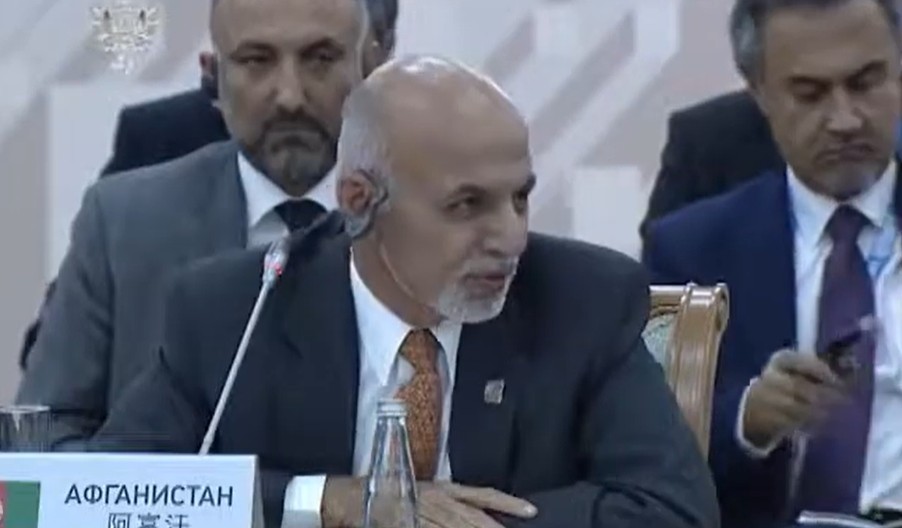
The Asian Roundabout and the Front Line of Global Security | Speech at (SCO) Summit
Keypoints:
- The Paradox: A rich country with poor people, stuck between potential and war.
- Exported Terror: Regional citizens use Afghan soil to attack their own homelands.
- Narcotics Link: The drug trade is the global "bank account" for terrorism.
- No Vacuum: Afghan forces held the line alone after international troops left.
- Regional Shield: Afghanistan fights to protect the security of its neighbors.
- Shared Intel: We need a common regional framework for intelligence and verification.
- Political Peace: Solving the Taliban issue requires an Afghan-led political framework.
- The Roundabout: Afghanistan must be a hub for cooperation, not a site for rivalry.
President Putin, Excellencies,
Let me first congratulate President Putin on a remarkable chairmanship and the founding members of this body for proving the relevance of the Shanghai Cooperation Organization (SCO). At a time when many organizations are formed only to dissolve, the SCO has solved significant issues and is expanding; the desire of India and Pakistan to join is a testament to its growing significance. I also thank the President of Bashkortostan for his hospitality and Mr. Mezentsev for his stewardship.
I wish to make several urgent points regarding the two competing images of Afghanistan today.
1. The Tragedy of Paradox
There is one Afghanistan that is a source of threat—a driver of narcotics and terrorism. Then there is the other Afghanistan: a nation where the majority of citizens participated in democratic elections, where 36 percent of the electorate were women, and a country poised to be a source of prosperity.
With our location, water, minerals, and energy, our tragedy is that we are a rich country inhabited by poor people, threatened by forces from both inside and outside the region. I represent the vision to realize that latent potential.
2. The Common Enemy: Transnational Terror
We must recognize the fundamental enemies: Terror and Narcotics. We must acknowledge a difficult fact: a significant number of these terrorists come from your countries. They use our territory as a base to destabilize your nations and the wider region.
These are not people with a political problem with the Afghan government; they have a design to destabilize the entire region. We face terrorists from Central Asia, China, Russia, and the Middle East. Furthermore, there is a continuous flow of terrorists from Pakistan who target both our nations. This is a common enemy.
3. The Narcotics Chain
Narcotics involves a chain: producers, processors, traffickers, and consumers. Those who consume have as much a problem on their hands as those who produce. The largest benefits go to the traffickers. This criminal economy provides the "bedding" and the financial enabling conditions for terrorism. They are two sides of the same coin.
4. Afghan Resilience and the Regional Gap
Since the departure of 120,000 international troops, many expected a vacuum. Instead, our 354,000-strong National Forces are seeing action every day. We are losing lives, but we are winning. Just in the last three days, we eliminated Gul Zaman and other key leaders of the TTP and Daesh.
However, while the international component of our assistance is in place, the regional component is missing. We lack a common regional strategy. To address this, I propose:
Deep Counter-Terrorism Cooperation: Moving beyond talk to common intelligence sharing, analysis, and action.
Verification Framework: We must identify where these people come from, who supports them, and how they are financed.
5. Political Reconciliation
The Taliban are an Afghan problem. I thank Pakistan, China, and the United States for facilitating our first direct conversations. This psychological shift must now result in changes on the ground. We desire a national political framework for reconciliation where every Afghan who wishes to be included can be.
6. A Call to Action
On counter-narcotics, past efforts have been half-hearted. When tons of narcotics reach their destinations, it reveals significant security gaps in every country they pass through.
I propose a Ministerial-level meeting in Kabul at the earliest opportunity to share analysis, arrive at a common plan of action, and commit our energies to overcoming these twin menaces. Afghanistan wants to breathe. Our people have sacrificed immensely, and we find this continued bloodshed unnecessary.
I congratulate Uzbekistan on assuming the leadership of the SCO and look forward to a productive year ahead.
Thank you.