The Role of Sufism and Mysticism in National Unity, Islamic Identity, and Cultural Revival in Afghanistan
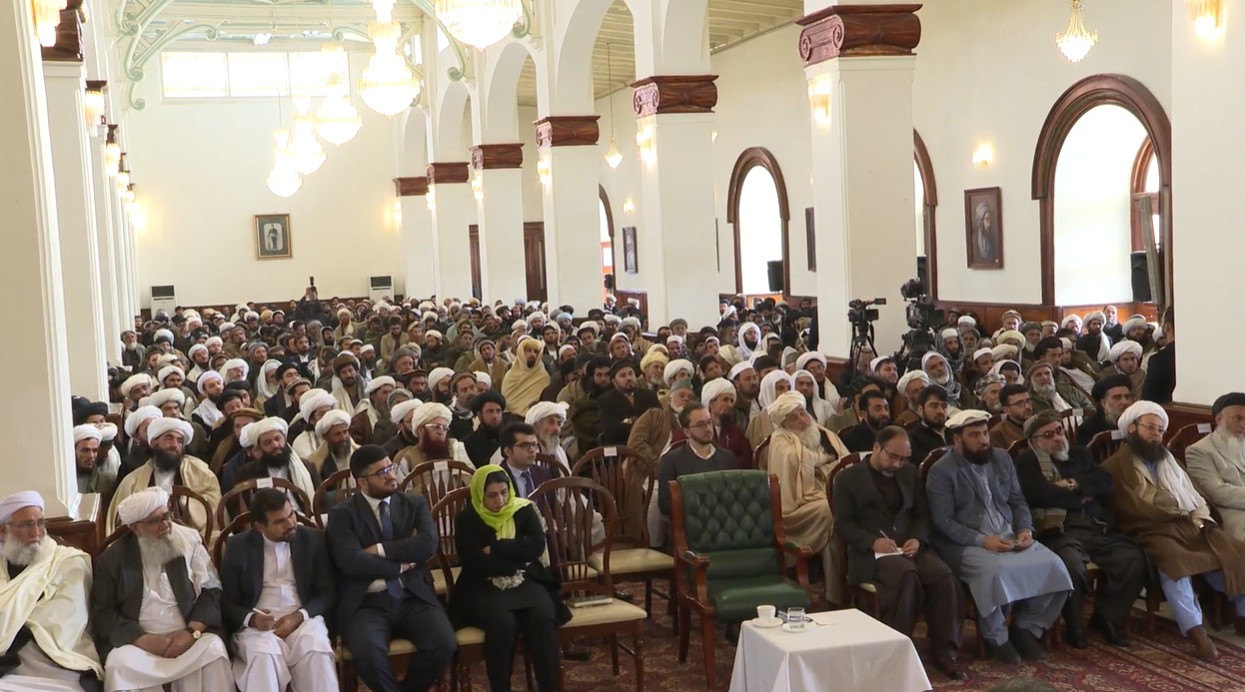
Speech in the gathering with Afghanistan’s religious scholars, mystics, and Sufi leaders
- Sufism shapes Afghan identity: It defines culture and literature.
- Sharia and Tariqa unity: They are complementary, not separate.
- Social cohesion: It connects diverse communities.
- Historical resilience: It helped restore order after crises.
- Active Sufism: It engages society, not isolation.
- Textual revival: Classical texts need study and publication.
- Education role: It should be included in education and media.
- Counter-extremism: It helps resist extremism.
- Institutional support: It needs research and recognition support.
- Heritage preservation: Sites and legacy must be preserved.
Salam Khana Palace
In the name of Allah, the Most Gracious, the Most Merciful.
Dear Sufis, venerable mystics, esteemed scholars, and all attendees of this gathering: First of all, I offer you the greeting of the leader of humanity; Peace be upon you and the mercy of Allah and His blessings.
In the presence of the Truth, one must be all etiquette, As long as life remains, one must remain in pursuit. If at every breath you drink a thousand seas, Consider it little, and remain with joyful lips. — (Attar, from the Mukhtar-nama)
From the bottom of my heart, I thank each and every one of you coming from all corners of Afghanistan. Welcome! Khosh Keldeng! You have honored me.
A Personal Connection to Sufism To begin, if you permit, I would like to say a few words about my personal familiarity with the history of Sufism. You may be aware of other aspects of my life, but perhaps less so with this one. I have read the letters (Maktubat) of Imam Rabbani, Mujaddid Alf Thani, word for word. I have studied all the works of Sanai and the history of the four primary Sufi orders (Tariqas). I spent at least ten years of my life trying to understand their history—specifically the Naqshbandi order, as the literature on it is vast.
Allow me to speak to our fellow citizens—since you all are already familiar with these matters—regarding the role of mysticism (Irfan) in the history of our society.
The Influence of Mysticism on Language and Thought First, all three major languages of our country—Dari, Pashto, and Uzbek—are deeply influenced by mysticism. Rhetoric and theology (Kalam) play a massive role in Islamic culture and our beliefs. The Islamic civilization was the first to bring Kalam to perfection because it was the means to understand the Word of God and the Great Quran. Our young colleagues might think that the science of discourse and interpretation was invented in the 20th century in the West; I tell them: go read the history of Sufism. Even our most secular poets are influenced first by religion and second by Sufism and mysticism. If a leftist poet speaks of "sin," what does that imply? It implies that from the cradle to the grave, they are surrounded by the Divine Word. This country was Muslim, is Muslim, and will be forever. [Allahu Akbar].
Second is the knowledge of man and the universe. Our manifest religion is the religion of understanding the cosmos. The secret of the universe lies within the Holy Quran and our legitimate mystical paths. It is essential that we recognize man as a creation and deeply understand the relationship between human beings—something you, the scholars and leaders of the Tariqas, know better than anyone.
The Unity of Sharia and Tariqa The third issue is a major error found in history written by Orientalists: they have pitted Tariqa (the path) and Sharia (the law) against each other. If you read the works of Khwaja Ubaydullah Ahrar, Imam Abu Hanifa, Imam Mujaddid Alf Thani, or any others, you see that Tariqa and Sharia are interdependent; they open the path to Ma’rifat (gnosis) and Haqiqat (truth). Unless these pillars are connected, the superstitions that people talk about have nothing to do with the true Tariqa. We must understand the depth of those who developed these paths and drew inspiration—especially those whose lineages trace back to Hazrat Abu Bakr Siddiq. These lineages were not just passed person-to-person in the physical world, but were transmitted in the internal, spiritual world.
Outsiders cannot explain the Tariqa. The fundamental task the Afghan society asks of our mystics today is to explain the Tariqa yourselves, in your own language, to the people. There is no conflict. In the entire history of Sufism, I have found no contradiction between the path and the law.
Sufism as a Force for Connection Fourth, the Tariqa has always been a means of connection (wasl), not separation (fasl), in our society and Islamic civilization. Look at the Chishti order, which rose from Chisht-e-Sharif; today, the largest shrines in Multan and Agra belong to the Chishti path. Look at the Naqshbandi order, which began in Central Asia and, within a century, spread through Afghanistan to India and Iraq. Look at the Qadiri and Suhrawardi orders.
Do not forget that today, the most widely read book in America is the work of Rumi (Mawlana). [Allahu Akbar]. It is a tragedy that the center of Rumi studies today is not in Balkh or Herat, but—with all due respect—in America. What happened? We have forgotten Rumi's message:
Whoever remains far from his origin, Seeks again the days of his union.
Today, we are in pursuit of connection—the connection of society is our primary goal. I have analyzed the successors (Khalifas) of the Mujaddid Alf Thani and the Naqshbandi masters one by one through their writings. What do we find? The Tariqa was never limited by language, ethnicity, province, region, or country. Just as it seeks to explain the universe, it connects human beings. And let us not forget that there have been great female Sufis as well.
If these paths of connection did not exist, our Jihad in the 19th and 20th centuries would not have succeeded. When the call of Truth was raised, all the people answered.
Historical Resilience and Modern Challenges After the invasion of Genghis Khan, Islamic leadership was completely decimated. Thousands were put to the sword. Who converted the Mongols to Islam? Our Sufi Shaikhs. It was then that a fundamental shift occurred between the Murshid (spiritual guide) and the Sultan (ruler). Ubaydullah Khan, the powerful Uzbek ruler, stood in great awe of Ubaydullah Ahrar, and his grave lies at the saint's feet. It is necessary to see how, on the day when all of Khorasan was leveled to the dust, a spiritual radiance emerged again. I say this because today we need a similar revival, just as was needed after Genghis, because society is in a state of ambiguity.
One reason for extremism is that we have become alienated from our origins. That is why people turn to any interpretation offered. we must guide our youth, and this cannot happen without our deep cultural and religious roots.
The question is: who has explained these texts? I began studying them myself because I once read Western sociological works about Islam. I said to myself: "I may not know enough, but these writers definitely don't know anything!"
So, I began to identify the texts and study the lineages (Silsilas). This was before the internet. Sometimes I had to wait two weeks to two months just to find a specific text from somewhere. The texts were difficult, but the point is that we must know ourselves. We cannot know ourselves until we correctly understand our Islamic history and realize that we are a civilization.
The Roots of the Nation Today, the problem is that young people who turn toward extremism imagine that we have no roots. I declare here today to all of them: the roots of this country are in this hall. These roots grow stronger every day, and as long as these roots exist, the tree will not fall. [Allahu Akbar]
And do not forget the political arena. When tragedy struck Herat, was it not Khalifa Sultan who acted as its guardian, leading 10,000 people from Balkh? If the Tariqa did not exist, under what name would they have come? We have mentioned others: Najmuddin Akhundzada (the Shaikh of Hadda), the Pir of Swat, Abdul Ghafoor Akhundzada... but do not forget Mulla Mushk-e-Alam. When Mulla Mushk-e-Alam rose at the age of 90, he broke the back of the British.
Forty-nine thousand Mujahideen were stationed in Andar—and do you know who they were? Whenever Arsala Khan, the Foreign Minister of Emir Sher Ali Khan, came to the court, he would hold the reins of the Emir's horse and lead him up to the Bala Hissar. On the day the British arrived and the government collapsed, the people witnessed the spiritual power of this nation. No one should underestimate the spiritual capital of this nation; foreigners have always miscalculated it, yet it is this very spiritual capital that saves us.
Sufism and the Material World Another point regarding the Sufi orders: remember that "Solitude in a Crowd" (Khalwat dar Anjuman) is a core principle. Those who think Sufism is isolation, turning away from the world, and avoiding economic participation have mistaken other countries and civilizations for ours.
Let me give you an example: Khwaja Ubaydullah Ahrar was the largest landowner and merchant of his time. The Sufi orders have never turned their backs on life. Therefore, this misconception must be rejected and discarded.
Proposals and Practical Steps I turn now to the proposals and thank you all. Sahih al-Bukhari mentions "intention" three times and Sahih Muslim mentions it once. Our intention in creating this Deputy Ministry [for Sufism and Mysticism] is pure and sincere. My proposal is this: a group of you should sit together, define the duties of this Deputy Ministry, and provide a list of qualified individuals. From that list, I will appoint the Deputy Minister and their staff so that there is no doubt about our intentions. Is that agreed? [Audience: Absolutely!]
Secondly, I welcome Professor Hamid’s suggestions. Next year, as we celebrate 100 years of independence, I also want to honor a thousand years of Dari literature. My promise to you is that I want to publish the major Sufi texts. Let us agree on a clear list; the people of Afghanistan must become familiar with these texts. I requested catalogs from four major bookstores and found fewer than a thousand titles. In a country of over 30 million, having only a thousand titles in major bookstores indicates a major void. Therefore, we will fundamentally take up the publication of these texts.
The third suggestion was that major texts should be translated among our three primary languages [Dari, Pashto, Uzbek]. Professor Ghazanfar and a committee will be tasked with facilitating this. I also welcome the translation of Arabic texts into Dari and other languages; we need a clear focus on this.
Regarding your other proposal, if I may rephrase it: we will establish academic awards for the best research articles or books on the history of Sufism, based on the classifications I hope you find acceptable.
To Minister Safi: I request that on the newly established second television channel, a significant portion be dedicated to our mystics, Shaikhs, and Sufis so they can provide explanations to the public.
Preserving Our Cultural Legacy I don’t give away books easily because people don't return them! [Laughter]. Some scholars even think stealing a book is "religiously permissible" (Shar'i). So, we must be cautious. Right, Mr. Samim? But I have made a promise here, and I will keep it. If one is convinced by a book, I will give a hundred books! [Laughter].
The good thing about me is that whenever someone sends me a book, I read at least half of it, if not all. I have benefited from this; when people give me books, I call them back to discuss them.
To Mr. Osmani and Mr. Paikar: regarding the major Khanqahs [Sufi lodges] in our history that need restoration and identification, we must take action. We should not rely on other countries—who take pride in our great figures—to come and help rebuild them. We are not that poor.
When I was the Chancellor of Kabul University, I visited the Faculties of Literature and Sharia; many students there do not know our great figures. It is necessary for the Ministry of Higher Education, the Ministry of Hajj and Religious Affairs, and the Ministry of Information and Culture to work together on a new cultural curriculum and texts. Two of the three pillars of Dari poetry—Rumi, Sanai, and Attar—are Afghans. Yet we neglect our culture all day while others claim it as theirs. It is fine if they claim it, but we must not forget that it belongs to us. We need a clear focus on this and clear ways to interpret it for the modern age.
Final Words My final request is for a group of professors of mysticism to come together to explain these concepts to the people of Afghanistan in plain, accessible language. These traditions exist, but they have weakened somewhat during forty years of crisis. We need a reasoned discourse. The more we understand our history, the more we realize that the work our Sufis did in knowing God, strengthening the Sharia, and building our national character is unforgettable.
I thank you again for your warm presence. This is a positive step that will be followed up, and I look forward to your practical suggestions to guide our progress.
Long live Afghanistan!