Afghanistan’s Resources and Economic Vision: Afghanistan–Iran Economic Meeting
Keypoints:
- Geographical Advantage: Afghanistan as Asia’s trade crossroads.
- Infrastructure Development: Transport corridors, Chabahar, and customs modernization.
- Water and Agriculture: Efficient water use and agricultural value chains.
- Minerals and Energy: Copper, iron, gold, oil, and gas development.
- Financial Capital: Mobilizing Afghan wealth and strengthening banks.
- Entrepreneurship & Human Capital: Technical education and workforce alignment.
- Transparency & Anti-Corruption: Eliminating graft to attract investors.
- Regional Cooperation: Bilateral trade with Iran for stability and growth.
In the Name of God, the Most Gracious, the Most Merciful.
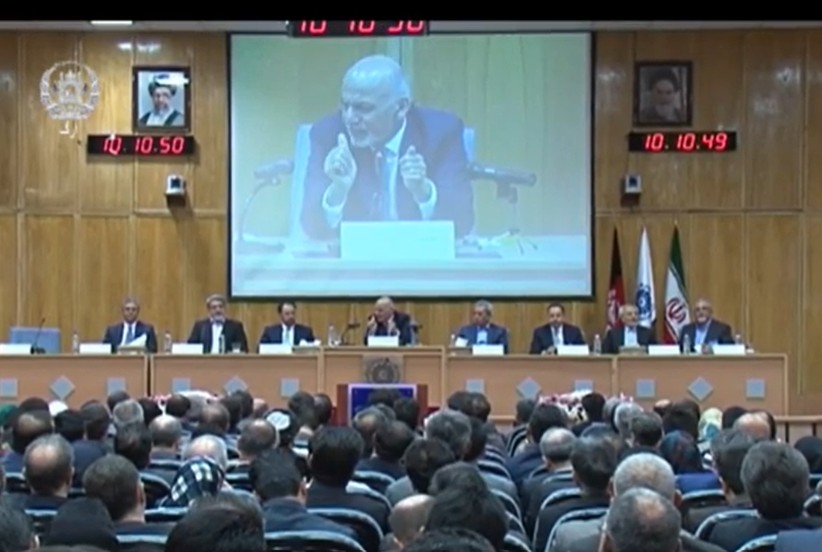
Honorable Minister of Interior, Mr. Rahmani; Honorable Engineer Shafiee; esteemed members of the Iran Chamber of Commerce: Today is truly a moment of great satisfaction for me, as I engage with the Iranian private sector in a constructive dialogue.
First, allow me to introduce my colleagues: Honorable Salahuddin Rabbani, Minister of Foreign Affairs of Afghanistan; Honorable Akheel Hakimi, Minister of Finance; and Dr. Dawood Shah Saba, Minister of Mines and Petroleum of Afghanistan.
Thank you, Mr. Shafiee.
My focus today will be on several key subjects. First, the resources of Afghanistan. Afghanistan possesses five major resources:
First, our geographical location. Central Asia, South Asia, and West and North Asia cannot be fully connected without a prosperous Afghanistan. Over the next twenty years, Asia will transform from a geographical concept into an economic continent. The greatest economic power of Asia is taking shape, but today, the economic body of Asia is incomplete. Afghanistan is not only the heart of Asia in sentiment and thought; geographically, we are its true heart. For this reason, our bilateral and multilateral relations with all neighbors are a fundamental objective.
Our vision is to restore Afghanistan to the crossroads of Asia, as it was for five millennia until the mid-nineteenth century. What opportunities does this position create? For the first time, we have undertaken a comprehensive infrastructure plan for Afghanistan. Once realized, Iran will be directly connected to China through Afghanistan. This connection, via Tajikistan and Uzbekistan on one route and through Afghanistan on another, will transform regional relations. Currently, the Wakhan Corridor, which defines 60 kilometers of our border with China, is under serious study to determine whether a direct transport corridor can be established, with Tajikistan as an alternative.
We are prepared for full cooperation in studies, investment, and integration in infrastructure. However, the real obstacle today is not infrastructure but the “software” of governance—customs management, transit systems, administrative management, and, most importantly, corruption. Administrative corruption is the greatest barrier to economic cooperation. We will not tolerate it. I assure every Iranian investor that if anyone seeks a partnership through corrupt means, I will ensure that person is removed from Afghan institutions. Any indirect taxes imposed as bribes will no longer be tolerated. Our commitment is to transparency.
Our location requires that trade with Afghanistan be mutually balanced. As Engineer Shafiee mentioned, imports currently outweigh exports by three to one. Official trade figures are inaccurate, which is why we aim to soon implement a system for data exchange. The real volume of trade between Afghanistan and Iran must be formalized. All trade should be legalized, and smuggling must be curtailed. I am ready to expand official customs and border operations with Iran within the next three months. Our relations must be based on action, not rhetoric, and the private sectors of Afghanistan and Iran will serve as both judges and monitors.
I propose the formation of a joint chamber to monitor progress. Every four to six months, members will evaluate the percentage of advancement and identify upcoming challenges. Unresolved issues will be escalated to the Cabinet and the Supreme Economic Council. This approach ensures that minor obstacles are addressed promptly, leading to the resolution of fundamental challenges.
Second, our groundwater resources. Currently, only 10% of Afghanistan’s water is used officially, while 40% is lost between channels and farms. Our water-use practices are flawed. Unfortunately, over the past thirteen years, we have only restored half of the arable land that existed in 1978. Afghanistan should be a major food exporter. Today, we import roughly four billion dollars’ worth of agricultural products annually. Investment in agricultural production and transforming Afghanistan into a food exporter is a primary goal. Here, we have significant shared interests. While the agrarian economy globally is well-supported with credit, logistics, and management, the formal economy in which most Afghans live lacks banking access, regular transit, and development. We invite both the Iranian Ministry of Agriculture and the Iranian private sector to collaborate comprehensively in establishing value chains. We aim not to export raw materials but to develop value chains that first meet domestic demand and second foster bilateral economic relations.
One challenge remains: factories near the Iranian border produce mislabeled products that are smuggled into Afghanistan, undermining domestic industry. Preventing such illegal activities is crucial for the credibility of both nations. Afghan industrialists are partners of Iranian industrialists. If unfair competition destroys emerging industries, protective tariffs may be necessary, but we hope for clear cooperation that ensures tariffs facilitate investment and collaboration rather than impede it.
The illicit drug economy is another shared threat. Alternative crop production, value-chain development, and the vast Iranian market represent core mutual interests.
Third, our mineral and energy resources. Preliminary assessments suggest that 33% of Afghanistan’s mineral reserves are valued between 1 and 3 trillion dollars. Under the capable management of Minister Saba, this sector has tremendous potential. The challenge has been the lack of foundational infrastructure and organized planning.
Transit remains crucial. Afghanistan is a landlocked crossroads of Asia. Establishing a reliable transit system, including the Chabahar route, is vital. In return, we can offer transit networks benefiting Iran, China, Pakistan, and the region. The mutual opening of Central Asia and China ensures shared benefits.
Our gas reserves are substantial, and oil production is in early stages. Minister Saba will facilitate comprehensive cooperation in this sector. Within ten years, God willing, Afghanistan will become the world’s largest exporter of copper and iron, and a major producer of gold. Precious stones also present significant opportunities. Infrastructure, credible policy, and value-chain development are essential to avoid Afghanistan becoming merely a raw material exporter. Investments that create sustainable value chains will receive our full attention.
Natural resources, from international experience, can be both a blessing and a curse. Mismanagement of mineral, oil, or gas revenues risks national ruin. Our focus is a production-driven economy, not a consumption-driven one. Hence, Minister Saba is empowered to act decisively yet principled. Temporarily enduring scarcity is necessary to ensure centuries of prosperity for future generations.
Fourth, financial capital. While most Afghans are poor, Afghan entrepreneurs are wealthy. Yet their wealth is not productive. Traders earn 200–400% profits, while investors gain only 10%. This discrepancy is not caused by traders but by government inefficiency, corruption, unstable policies, and lack of transparency.
Afghan traders abroad—from Iran, Uzbekistan, India, to Dubai—accumulate wealth, yet inside Afghanistan, they remain mere traders. We have engaged openly with Afghan entrepreneurs to identify why the domestic environment hinders investment. Our first step is the establishment of a centralized land administration. Land distribution will be handled solely by this entity. Over the past thirteen years, land has been a source of corruption rather than production. With a unified land and water council, this issue will be fundamentally addressed.
A strong banking system is another priority, enabling capital to become productive. We measure our success by the creation of dynamic, large-scale companies. The private sector alone cannot drive growth; a clear partnership between the Afghan government and private sector is essential. Our pledge to the Iranian private sector is to ensure that you are partners in Afghanistan’s growth and prosperity.
Fifth and most important, our entrepreneurial culture. Afghans are industrious and self-reliant. Observing Kabul from morning to night demonstrates this vibrancy. Yet government policies have hindered entrepreneurship. Strengthening human capital and technical education, drawing from your experience, is critical. Our labor force abroad contributes remittances, but these are insufficient to combat domestic poverty—a testament to government shortcomings in human capital development. Universities must align their output with private-sector needs to avoid misallocation of labor.
In conclusion, I reiterate my gratitude. Customs expansion will be addressed within three months under Minister Hakimi’s leadership. Afghan visas will be multi-entry, reciprocal with Iran. Trade must be bilateral to curb illicit trade. Opium and heroin must not dominate commerce; legitimate trade should define our relations.
We aim for a fully integrated regional economy—gas pipelines, electricity, fiber-optic networks, water pipelines, railways, and highways. The Central Asia–South Asia electricity project, valued at $1.5 billion (from Kazakhstan to Pakistan), is underway. Our goal is a regional electricity trade network, balancing seasonal supply and demand.
Finally, a stable and prosperous Afghanistan is a prerequisite for regional security. A stable Iran and an open Iran have always supported us. Poverty and unemployment cannot be resolved without regional cooperation. Sustained collaboration between Iran and Afghanistan will foster a stable and prosperous region where all citizens benefit from shared prosperity.
Thank you.