Peace, Progress, Partnership: Joint Press Conference with President Obama
Keypoints:
- Condolences: The U.S. mourns the European plane crash victims and offers help.
- Security: Afghan forces now lead security; U.S. troops train and advise.
- Partnership: U.S. and Afghanistan maintain a long-term strategic partnership.
- Reforms: Afghan leaders fight corruption and support women and girls.
- Military: U.S. troops face risks; budgets affect readiness and support.
- Peace: Afghan-led talks with the Taliban continue with U.S. support.
- Global Impact: Afghanistan’s progress supports regional and world stability.
President Obama:
Good afternoon everybody, please have a seat. Before I begin, I want to say that our thoughts and our prayers are with our friends in Europe, especially the people of Germany and Spain, following a terrible airplane crash in France. Uh, it's particularly heartbreaking because, uh, it apparently includes the loss of so many children, some of them infants. I called German Chancellor Merkel, and I hope to speak with President Rooy of Spain later today to express the condolences of the American people and to offer whatever assistance that we can as they investigate what has proven to be an awful tragedy. Our teams are in close contact, and we're working to confirm how many Americans, uh, may have been on board.
Germany and Spain are among our strongest allies in the world, and our message to them is that as their steadfast friend and ally, America stands with them at this moment of sorrow.
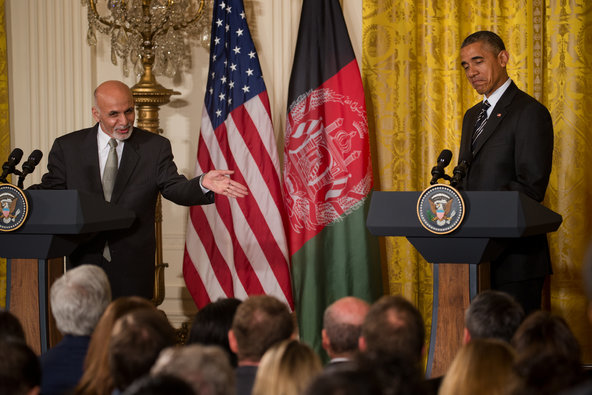
Now, uh, it is a, uh, great pleasure to welcome President Ghani to the White House. As many of you know, President Ghani spent time here in the United States as a student and as a scholar, uh, he happened to go to Columbia University, where we both studied, uh, and then spent time in the World Bank just down the street from here. And so his life reflects in many ways the friendship and mutual respect between Americans and Afghans.
And in that spirit, Mr. President, I want to extend to you the warmest of welcomes. President Ghani's presence here today, along with Chief Executive Abdullah, underscores Afghanistan's progress in last year's election. Millions of Afghans defied the threats from the Taliban and bravely cast their ballots in the spirit of compromise and putting their interests, uh, behind the interests of the nation.
President Ghani and Dr. Abdullah ensured the first peaceful and democratic transfer of power in Afghanistan's history, and together they now lead a national unity government that reflects the diversity, the strength, and the determination of the Afghan people. Their government signed the bilateral security agreement between our two countries, and on December 31st, after more than 13 years, America's combat mission in Afghanistan came to a responsible end. Afghan forces now have full responsibility for security across their country. Some 330,000 Afghans serve in the police and security forces, and they are making extraordinary sacrifices, fighting, and often dying for their country, and they continue to grow stronger month by month.
Today we honor the many Afghans, men, women, and children, uh, who have given their lives for their country. We salute the more than 2,200 American patriots who made the ultimate sacrifice in Afghanistan and the many more who were wounded. This morning, President Ghani and Dr. Abdullah visited Arlington National Cemetery to pay respects to our fallen heroes. Uh, we are grateful for that gesture of gratitude, and we know it meant a lot to the families as well.
We'll see the bonds again between our people on display when President Ghani has an opportunity to address Congress tomorrow. So with a new government in Afghanistan and with the end of our combat mission, this visit is an opportunity to begin a new chapter between our two nations. President Ghani and Dr. Abdullah, I thank you both for your strong support of the partnership between our two nations. Yesterday, they had a chance to spend time in Camp David with our respective teams and had excellent discussions on how we can move forward together.
Today, guided by our strategic partnership, we focused on several areas. First, we agreed to continue to, uh, keep in place our close security cooperation. Afghanistan remains a very dangerous place, and insurgents still launch attacks, including cowardly suicide bombings against civilians. President Ghani is pursuing reforms to further strengthen Afghan security forces, including respect for human rights. And as part of the ongoing NATO mission, the United States will continue to train, advise, and assist Afghan security forces. As we announced yesterday, we'll work with Congress on funding to sustain 352,000 Afghan police and troops groups through 2017.
At the same time, we'll continue to conduct targeted counterterrorism operations, and we agreed to maintain a dialogue on our counterterrorism partnership in the years ahead. Now, at our peak four years ago, the United States had more than 100,000 troops in Afghanistan. In support of today's narrow missions, we have just under 10,000 troops there. Last year, I announced a timeline for drawing down our forces further, and I made it clear that we're determined to preserve the gains our troops have won.
President Ghani has requested some flexibility on our drawdown timelines. I've consulted with General Campbell in Afghanistan, my National Security team, and I've decided that we will maintain our current posture of 9,800 troops through the end of this year. The specific trajectory of the 2016 drawdown will be established later this year to enable our final consolidation to a Kabul-based embassy presence by the end of 2016.
And this flexibility reflects our reinvigorated partnership with Afghanistan, which is aimed at making Afghanistan secure and preventing it from being used to launch terrorist attacks. Reconciliation and a political settlement remain the surest way to achieve the full drawdown of U.S. and foreign troops from Afghanistan in a way that safeguards international interests and peace in Afghanistan as well as U.S. national security interests.
Second, and since the best way to ensure Afghanistan's progress is a political settlement, we're going to continue to support an Afghan-led reconciliation process. President Ghani, you've shown bold leadership in reaching out to Pakistan, which is critical to the pursuit of peace. Afghanistan and the United States agree on what the Taliban must do: break with Al-Qaeda, renounce violence, and abide by Afghan laws, including the protections for women and minorities.
Third, we'll continue to support the national unity government in its efforts to truly serve the Afghan people. We discussed the urgent need with parliament's support to seat a full cabinet. President Ghani, in your inaugural address, you spoke forcefully about the need to combat corruption, uphold rule of law, and strengthen democratic institutions. The United States very much commends you for those efforts, and you moved many Afghans with your eloquent tribute to your wife and partner, First Lady Rula Ghani.
America will continue to be your partner in advancing the rights and dignity of all Afghans, including women and girls. And finally, we'll continue to support the development that underpins stability and improves the lives of the Afghan people. Over the years, there have been major gains: dramatic improvements in public health, life expectancy, literacy, including four million girls who are in school.
President Ghani is a leading expert on development, and I've been impressed by the reforms that he's pursuing to make Afghanistan more self-reliant. He wants to empower Afghans in these efforts, and that's why, under the new development partnership that we announced yesterday, U.S. economic assistance will increasingly go through Afghan institutions in support of Afghan priorities, with an emphasis on accountability, performance, and achieving results.
In closing, I'd note that, as many of you know, President Ghani is by training an anthropologist, as was my mother. It has been said that the purpose of anthropology is to make the world safe for human differences. Afghanistan and our world are marked by incredible diversity and differences of history and culture and faiths, but I believe that the progress that we've made in this visit will help to advance the goal for which so many of your citizens, Mr. President, have sacrificed over the years: the goal of making our two countries and the world safer.
President Ghani, Chief Executive Abdullah, thank you both for your leadership and your partnership. America's combat mission in Afghanistan may be over, but our commitment to the Afghan people will endure.
Speech of President Ashraf Ghani
President Ghani: President Obama, first of all, I'd like to express the deep sympathies of the government and the people of Afghanistan to German and Spanish families and governments. Both of these countries took part in the ISAF coalition. They have had major commitments and they've sacrificed in Afghanistan. I'd like to take this opportunity to pay tribute to those common sacrifices and simultaneously take the opportunity to pay tribute to the 2,225 American servicemen and women who paid the ultimate sacrifice, more than 22,000 American soldiers who've been wounded in action, civilians, numerous contractors, and others who stood shoulder to shoulder with us. I'd like to say thank you.
I would also like to thank the American taxpayer for his and her hard-earned dollars that have enabled us. Yesterday in the Pentagon, I saw a young girl. Her name is Reys, and her father came out of retirement, out of reserve, to serve again in Afghanistan. She's sending a care package every week to her father, and I want to thank her and the fathers of all other American children who are making sure that their parents are helping us in standing next to us. Reys, I promised now has 3 million Afghan sisters in school. Those sisters are dreaming of achievements, that they would have a career path, and hopefully one day we'll see an Afghan woman president. It should not be too soon; it's not too far because we now have four women in the cabinet. That's 20% of our cabinet. I hope that some other countries will match us.
We are intent, and thank you for the reference to Afghanistan's First Lady. She was delighted to have an opportunity to speak to Mr. Obama. She's devoted her life to the most underprivileged Afghans. All of us are committed to make sure that the 36% of Afghans that live below poverty will live with dignity and, one day, not in a distant future, see prosperity.
Dr. Abdullah and I are grateful for the reception that you've accorded us, Mr. President. Your National Security team has gone out of its way to engage in intensive, comprehensive discussion, and both of us would like to thank Secretary Kerry for the loss of hours of sleep we caused you and, uh, for your very able diplomacy and catalyzing the unity that today is on display.
The government of national unity is going to be an enduring phenomena, and both of us stand for unity against the divisions that our opponents and enemies hope for. This unity is a reflection of the desire of the Afghan public to overcome the last 200 years of our political history, where rarely public figures, if chosen, put the country before themselves. We are committed, in this regard, to emulate the founding fathers and mothers of the United States, where national interest will stand above personal or factional interest.
I am glad that the security transition is completed. You fulfilled your promise to your people, and we fulfilled our promise to our people. Afghans for millennia have guarded our homeland and have a reputation for serving. The last years were an exception when we needed help, and we're grateful that help was provided. But we are pleased that the security transition has been met according to the timeline that you set.
The combat role of the United States in Afghanistan is over, but the train, advise, and assist mission is a vital part of our collective interest and collective endeavors. Tragedy brought us together. Interests now unite us. We can assure you that the government of national unity has revitalized the partnership and looks at this partnership with the United States as foundational, not just for Afghanistan stability, but for regional and global stability.
Much binds us together, and the flexibility that has been provided for 2015 will be used to accelerate reforms to ensure that the Afghan national security forces are much better led, equipped, trained, and are focused on their fundamental mission. I'm pleased to say that the departure of 120,000 international troops has not brought about the security gap or the collapse that was often anticipated.
I'd like to pay tribute at this moment to the continued sacrifice of the Afghan security forces, civilians, and a patriotic nation. Our patriotism is part of, simultaneously, our internationalism. We are unique in that we have embraced democratic ways. We're very proud of our Islamic civilization, that in Islam is truly in dialogue with the world, and we have the capacity to speak truth to terror. They do not speak for Islam; we do, and it's the genuine Islam that is interested in dialogue between civilizations and cooperation and endeavor.
Forward on regional cooperation: we have taken both novel steps. We do hope that these steps will be reciprocated because the threats that exist, the changing ecology of terror, are making it imperative that all governments cooperate with each other. Today, the state system as we've known it is under attack. These are not classic national liberation movements; these are destructive nihilistic movements, and it's essential that we confront them with vigor and determination. But we must differentiate between those and Afghan citizens who desire peace.
Any political difference, anything that divides us, must be resolved politically. And we've shown the wisdom and determination that we can arrive at unity of purpose. So our commitment to peace is clear. What we require is reciprocity so that Afghan patriots will choose the country over themselves and unite in resolving whatever might be that divides us. But we will not have peace with those who use our territory as a proxy for other purposes, as a battleground for alien forces, or as a launching path for global terrorism.
This trip is provided as an opportunity to have a comprehensive overview, and I again want to express thank you for your commitment to submit a bill to Congress for support of our security forces to 2017. There's much work that lies ahead of us, and the flexibility that has been provided will be used to maximum effect to accelerate reforms to ensure that our security forces honor human rights, internalize the practices that bind an army, a police force, a secret service to the people. Violence against our people has no place within our security culture, and we will overcome those types of legacies.
It's again a pleasure to be standing next to a graduate of Columbia University. There's much that unites us. Your mother was an inspiration to us. I understand that the president of the World Bank actually got the job because he invoked your mother's teachings to convince you that an anthropologist could lead the World Bank. So thank you for according him that rare opportunity. He's doing a great job.
All right, with that, let's take a couple of questions.
Leo Shen, Military Times: Thank you, Mr. President. This is on, right?
I can start with, with the increased slowdown in the drawdown here. We're looking at more risk, more danger for U.S. troops that are in Afghanistan. How do you justify that to them? How do you tell them that the mission is still worth it? And how do you assure them that there is an end coming to this mission?
And for President Ghani, you've talked the last couple of days a lot about the sacrifice of U.S. troops. You were at Arlington earlier today. How do you tell them that this continued sacrifice will be worth it to them as well?
President Obama: Well, first of all, I think it's important, Leo, to remember that the timeline for a withdrawal down to an embassy-centered presence, a normalization of our presence in Afghanistan, remains the end of 2016, so that hasn't changed. Our transition out of a combat role has not changed.
Now, I am the first, uh, to say that as long as our men and women in uniform are serving in Afghanistan, there are risks involved. It's a dangerous place. Casualties have come down precipitously as we've engaged in the drawdown. It's been over 90 days since two Americans were killed in Afghanistan. That has occurred precisely because we're not in a combat role. And I think it is worth noting the significant casualties that the Afghan security services have incurred as we've drawn down. They've stood up, and they're fighting, and they're fighting with courage and tenacity, and they're getting better month by month. But you can't minimize the sacrifices that our military families make.
It means some folks are going to be rotating back into Afghanistan for a few extra months relative to what otherwise would have been the case. We're essentially moving the drawdown pace over to the right for several months, in part to compensate for the lengthy period it took for government formation, in part because we want to make sure that we're doing everything we can to help Afghan security forces succeed so we don't have to go back, so we don't have to respond in an emergency because counterterrorist or terrorist activities are being launched out of Afghanistan. We're on the path to do that.
It was my assessment as commander-in-chief that it made sense for us to provide a few extra months to help on things like logistics, making sure that equipment is not just in place but it's also used properly, that the train and advising and strategic input continues through this fighting season. In part so that President Ghani, who has taken on the mantle of commander-in-chief in a way that we have not seen in the past from an Afghan president, can do a serious review and assess, "Here's where our strengths are; here's where our weaknesses are," and we can proceed with more effective joint planning going forward.
So, you know, the bottom line is our men and women in uniform make enormous sacrifices. Their families do too. They serve alongside them. This will mean that there are going to be some of our folks who are in Afghanistan under the new schedule who would have been home. But it is important to keep in perspective, first of all, that we've gone down from 100,000 down to under 10,000. They are not on the front lines because they're not in a combat role. We are doing all that we can do to make sure that force protection is a priority for those who are in Afghanistan. And the date for us to have completed our drawdown will not change.
But it is my judgment, it's the judgment of General Campbell and others who are on the ground, that providing this additional timeframe during this fighting season for us to be able to help the Afghan security forces succeed is well worth it. And, in that sense, once again, we are asking our men and women in uniform to fight on behalf of our freedom and on behalf of a more orderly world.
It does perhaps raise one thought, which is, right now there's a debate going up on Capitol Hill about budgets. This would be a good time for my friends up on Capitol Hill, including on the other side of the aisle, to take a look at their budgets. If we're holding both our defense and non-defense budgets to 2006 levels, it's a lot harder for us to do the job that we need to do, not only on the national security side but also here at home, making sure that when our men and women come home, and when they potentially go into civilian life, that they've got a strong economy, that their kids have good schools, that they can send their kids to college, that they get the veterans benefits that they have so richly earned and deserve. That would be a good way for us to express thanks for the sacrifices they consistently make.
President Ghani: The widow of General Green, she would like the memory of her husband to be preserved by a sustainable Afghanistan that is secure. The 2,215 Americans that have died must not die in vain. They must leave behind a legacy of a stable Afghanistan, and it's that preservation of those gains that I think inspires the American servicemen and women to obey the call of their commanders.
Second, we have taken them out of harm's way, as the president mentioned, for the past 100 days because the combat role is ended. The exposure, the number of casualties, is really down. There isn't, you know, my most horrible reading of the day—first, middle, and end of the day security reports—where I see the casualties of figures, but thank God they're no longer American or European casualties.
John Campbell is making sure that they remain in a support role—the train, advise, and assist role. There are risks, but they're nowhere comparable to combat role. And the end of that combat role is very significant. Again, the institutional gains that would be achieved through the train, advise, and assist role are what will guarantee that the investments of the last 14 years pay off in terms of gains that would ensure...
Point: Afghanistan is the front line. Because of American engagement in Afghanistan, they have not had attacks on the mainland United States. But let's not forget that fortresses cannot be built around countries or continents. We are living in an interconnected world, and our security is joined together.
Cal-based Daily Newspaper: President, you're talking about the long-term strategic partnership between Afghanistan and the United States. At the same time, you're talking about deadlines about the withdrawal of the soldiers from Afghanistan. How do you ensure the long-term, or how do you define the long-term strategic partnership after 2017, or from 2017 onward?
Mr. President, what do you expect coming to the United States, and what would you like to return with to Afghanistan?
President Ghani: Our expectations were that our cooperation will be enhanced and we will have a clear, practical vision for cooperation for an enduring cooperation with the United States. This change of environment has occurred, and today the United States government considers the government of Afghanistan a really reliable partner. Commitments that are made are considerable.
The funding proposal of supporting Afghan security forces by 2017 has reached $4.1 billion. It's nothing less; it's a significant issue. Also, yesterday, there was a new framework for economic cooperation laid out, according to which $800 million were made a commitment. Those will be spent through the Afghan budget, but most importantly is the flexibility that has been shown in the area of security cooperation. This flexibility is going to ensure and provide confidence to our security forces and our people, and also send a very strong message to the region that this cooperation is not short-term, but enduring and long-term.
Our strategic partnership is based on a very simple principle: we want the Afghan people, through their security forces directed by their president and commander-in-chief, to be able to provide for their own security, and our goal is to make sure that we are a strong partner in helping to build and sustain effective Afghan security forces.
President Obama: So from the start, when I first came into office, we put additional U.S. troops, coalition troops, and resources into Afghanistan to shift momentum at a time when the Taliban and the enemies of peace and stability inside of Afghanistan had momentum. We broke that momentum. Elections took place, and the Afghan National Security Forces began to build up, get trained, and become more effective.
Because of a successful election and a national Unity Government and the leadership of President Ghani and Dr. Abdullah, we are now in a position where the Afghan security forces are not only more effective but are also better directed by the civilian government. We've been able to draw down and remove ourselves from a combat role, as President Ghani indicated, without collapse, as was predicted. Afghan soldiers have fought, and they fought well. Obviously, there's still improvements to be made, but they're making significant progress.
The strategic partnership involves us continuing to help support Afghan security forces. That means financially, the international community is going to have to continue to provide assistance to the Afghan government, which is carrying a significant security load, not only for itself but for the region and, in some ways, the world. We've made a commitment to do that.
We're going to continue to provide the kind of security cooperation and support that is required: training, assisting, advising, helping on logistics, developing enabler capacity—all the things that go into a modern, professional military and police force that can provide security on Afghan soil by Afghans.
The cooperation and strategic partnership involves building up the prosperity and opportunities for the Afghan people through economic development, as was mentioned by the president. We intend to be working with the Afghan government and Afghan people for a long time. In many ways, our troop presence and military assistance is just one component of what is a much larger process. The more successful we are in building Afghan capacity and strengthening the Afghan economy, the stronger the strategic partnership will be. It will be like the partnerships we have with many countries around the world, based on mutual interest, scientific and educational exchanges, business opportunities, commerce, and trade. That, I think, is the goal that we're all looking for.
Josh Lederman, AP: Thank you, Mr. President. You've made very clear that you're not buying Prime Minister Netanyahu's attempts to walk back the comments he made before the election opposing Palestinian statehood, and that you're reassessing your approach. What could Prime Minister Netanyahu do, if anything, in the short term to persuade you that he's serious about Israeli-Palestinian peace and that he's an honest broker you could work with? Or is it too late to repair that relationship during your presidency? And is there any truth to allegations that Israel was spying on the Iran talks?
And President Ghani, if I may, you've been working very hard to pursue reconciliation talks with the Taliban, but there are some indications that that's not going so well and that they may not be willing to sit down with you. What makes you hopeful that you can get those talks off the ground, and do you want the U.S. to be involved in those talks?
President Obama: Let me first address your second question about spying allegations. As a general rule, I don't comment on intelligence matters in a big room full of reporters, and I think I'll continue that tradition.
With respect to the possibility of an agreement that ensures Iran doesn't get a nuclear weapon, we have briefed Congress about the progress or lack thereof. We've also briefed the Israelis and our other partners in the region and around the world. If an agreement is arrived at that we feel confident will prevent Iran from obtaining a nuclear weapon, it's going to be there for everybody to see. People will be able to lift up the hood and see what's in there. I have confidence that if there's an agreement, it's going to be a good agreement, good for American security, Israeli security, and regional security.
With respect to Israel's relations with the Palestinians, the issue here is not what I believe but what the Palestinians and the parties in the negotiations and the Israeli people believe is possible. Prime Minister Netanyahu, in the election runup, stated that a Palestinian state would not occur while he was prime minister. I took him at his word. Afterwards, he pointed out that he didn't say never, but that there would be a series of conditions in which a Palestinian state could potentially be created, but the conditions were such that they would be impossible to meet anytime soon.
Even if you accept the corrective statements of Prime Minister Netanyahu, there still does not appear to be a prospect of a meaningful framework established that would lead to a Palestinian state, even with a whole range of conditions phased in over a long period of time.
So the issue has never been about creating a Palestinian state overnight. The question is whether a process and framework exists that gives Palestinians hope for a secure state standing side by side with a secure, fully recognized Jewish state of Israel. That possibility seems very dim.
Our military and intelligence cooperation with Israel will continue unabated, unaffected. We are committed to making sure that the Israeli people are safe, particularly from rocket and terrorist attacks. The evaluation we're doing is specific to what happens between Israelis and Palestinians going forward. We'll continue to engage both parties, but we cannot pretend that there is a possibility of something that isn't there.
This is not a personal issue between me and Prime Minister Netanyahu. He represents his country's interests, and I represent ours. The issue is a substantive policy challenge with significant consequences. Peace is our priority, and we will continue to work toward it, but we must be realistic.
President Ghani: Peace always requires focus, attention, and sacrifice. That is what we are willing to do to bring it about. We have asked for Afghan-led peace processes, with support from the United States, and we are confident this approach will bear results.
Question from another reporter: Mr. President, you just mentioned Afghanistan is still a dangerous place. Is it the right decision to draw down force levels at a dangerous time, while Afghan forces are less equipped and cannot fight fully?
President Ghani: The peace process will be led by Afghans. Afghanistan will become less dangerous as Afghan security forces and police become capable of keeping law and order and providing security. Foreign forces will continue to provide specialized cooperation on intelligence, counterterrorism, logistics, and training, but Afghan forces must take responsibility for their own security.
President Obama: We've removed ourselves from combat roles, and the Afghan security forces have stepped up. They are better equipped than the Taliban and the Haqqani network, and with strong leadership from President Ghani and Afghan military officers, Afghan forces are proving themselves. When they fight, they can be successful. We stand with them because we are invested in their success.
President Ghani: Thank you, Mr. President, for an outstanding visit.