Innovation, Meritocracy, and Reform: Building a Citizen-Centered Public Service
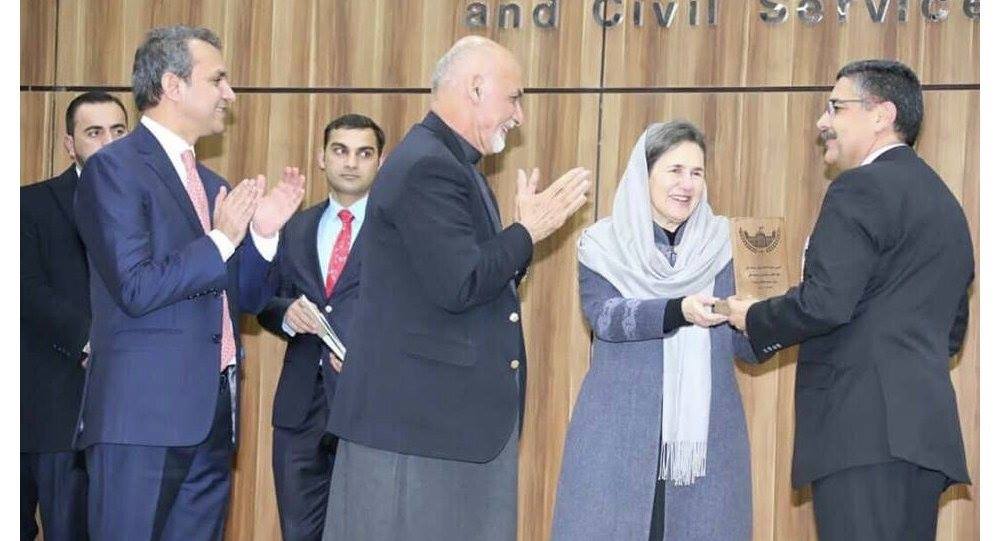
Speech at the National Awards Ceremony for Creativity and Excellence in Civil Service
Keypoints:
- Innovation and excellence: Promoting creativity and merit in public service.
- Merit-based governance: Ensuring fair and transparent recruitment systems.
- Public sector reform: Improving efficiency, accountability, and performance.
- Citizen-centered state: Making government responsive to citizens’ needs.
- Youth empowerment: Recognizing and supporting young innovators.
- Gender inclusion: Increasing women’s participation in leadership and administration.
- Anti-corruption: Eliminating favoritism, abuse, and lack of transparency.
- Institutional trust: Strengthening confidence between citizens and state.
- National unity: Reinforcing shared identity and national cohesion.
- Continuous reform: Sustaining long-term structural transformation.
Civil Service Commission Hall
In the name of Allah, the Most Gracious, the Most Merciful.
The First Lady of the country, esteemed Ahmad Wahid Wais, the Kankor team and the National Examination Authority, Dr. Sadiqa Abdullah Adib, my colleague and professional peer Mohammad Qasim Khan Olfat, Dr. Naeem Musamem, dear sister Nasiba Holkar, dear sister Basira Basiratkhwa, esteemed Hamayun Shams, esteemed Mohammad Zaman Bahlol, my very dear sister Ziwar Jan, Mr. Sarmast, Mr. Naderi, esteemed members of the Cabinet, Dr. Qayoumi, the Attorney General, esteemed members of the Civil Service Commission, innovators, esteemed members of civil society, all sisters and brothers, and the media: First of all, I offer you the greeting of the leader of humanity; Peace be upon you and the mercy of Allah and His blessings.
Redefining Afghanistan
My first point is this: people always say, "This is Afghanistan" [in a negative context], but today I say this is what Afghanistan is: Innovative, Dynamic, and United. They used to say that transformation, innovation, and commitment were impossible in this Afghanistan. Look around you; God willing, thousands of people in the Afghan administration will draw inspiration from this, and hundreds of thousands will carry this torch forward.
Secondly, they said a citizen-centered culture was impossible. Someone once said—forgive the expression—that Afghanistan is a riding horse, previously ridden by the royal family and now by our new elites. Afghanistan is no one’s horse. Afghanistan is a distinguished nation, and today we have seen examples of a citizen-centered culture.
They said structural change in Afghanistan was impossible—that our administration could not change because our culture is static. Today, you showed that changing the culture of governance is not only possible but can happen rapidly. They said transparency and efficiency were impossible and that bringing them would spark resistance. Today, you see that the people do not want resistance; they want the examples of the Afghan Robotics Team and the Cricket Team to be repeated in every sphere of our lives. I thank our Robotics and Cricket teams!
They said the men and women of Afghanistan could never move forward together. Look today: the men and women of Afghanistan, with an understanding of our great Islamic culture and a firm belief in our Constitution, are moving in step. No one can hold our women back.
They said Afghanistan is in the 16th century. Our youth are firmly in the 21st century. Those who thought Afghanistan was in the 16th century are the ones living in the 16th century themselves. What has been proven today is the love for this homeland.
Today, we cherish even the thorns and dust of our homeland as the pupils of our eyes. The sentiment shown and solidified here today is a profound love for every inch of this soil—a love that exists in the people and is now emerging within our administration.
A Message to the Enemy
My second point: I offer my condolences to the Ministry of Public Works, the Authority for Martyrs and Disabled, and Mr. Zaki for the loss of their colleagues. Martyrdom has, unfortunately, become a weekly and daily part of our culture. But I have a message for the enemies of Afghanistan.
No matter how much of our blood you spill, you cannot bring us to our knees. This nation has the will and now possesses the serious capacity to determine its own path. If you think you can push this country back from the path which is the result of the consensus of the Loya Jirga and the Constitution, think again. War is not the solution. If you are Afghans, know that all Afghans are like you—no one bows to force. The only way is peace. The only way is mutual acceptance. Who are you oppressing? Whose children are kept from school today? Whose mothers lack access to health services? Who is being mown down like grass today with no one to ask why? It is vital we realize that our will does not change.
Particularly on the 6th of Jadi—a day that marks both the tragedy of Afghanistan [the Soviet invasion] and the epic of its Jihad—we must renew our vow. Forty years of crisis is enough. The future of Afghanistan must be a future of light, not darkness. The future of Afghanistan is the equality of every Afghan with every other Afghan; it is the implementation of constitutional values regarding our rights and obligations.
A Culture of Connection
I congratulate Mr. Naderi for the naming of these awards; they are all fitting. From [the late] Awtar Singh, who sacrificed his life, to Rohullah Nikpai, who brought us honor, to the Cricket and Robotics teams. Our expectations for the Robotics Team have grown significantly. Fatima Jan, if something is named after you at such a young age, imagine our future expectations! We hope both you and the Cricket Team reach the peaks of glory.
The past forty years require deep reflection. Five generations—especially in our contemporary literature and poetry—succumbed to grief, despair, and distrust. Today, our other generations, the current ones and especially the future ones, must become forward-looking. Our responsibility and mission are to end the crisis and bring lasting stability and prosperity so that all Afghans, based on national unity and the acceptance of different local languages and cultures, become part of a great culture of national coexistence.
A nation that has been the crossroads of Asia for thousands of years cannot be narrow-minded. Read Babur’s descriptions; his definition of Kabul was a place where East and West, South and North—from the far reaches of India to China and the Ottoman Empire—all gathered. Our culture is one of acceptance. Every language of ours is a strength, and every part of our country is a point of connection. We came to connect, not to divide. This new chapter is the chapter of connecting all Afghans with one another, and connecting Afghanistan to a dynamic Asia and a dynamic world based on our thousand-year-old values.
Do you think an Afghan will ever forget the poetry of Rumi, the personality of Alisher Navai, or the discourse of Khushal Khan Khattak? This is part of our culture. Be assured that we are confident in ourselves. Our national identity is not at risk. We were not born yesterday, nor is Afghanistan a gift given to us by anyone. Afghans earned Afghanistan with their blood. I want to specifically thank the security and defense forces who, through their constant sacrifice, proved they are the faithful children of this land. At the same time, I thank all of you colleagues who brought transformation. Your actions are as valuable as the sacrifices of our security forces, because you bring hope—and innovation brings hope.
Gratitude to the Innovators and the Commission
Thirdly, a point of gratitude and congratulations. First, I thank every innovator from the bottom of my heart. What did you prove today, sisters and brothers? You proved that you are the builders of this nation; you proved your ownership. Every one of you who brought light—whether in education, in the postal service, or in a district—your innovations impact people's lives. I am merely a bridge and a tool. Every President is a tool. We are not the goal; the people are the goal. You are laying the foundation of democracy; you are strengthening it.
I thank the Civil Service Commission, especially Mr. Naderi and his team of commissioners. In eighteen months, you moved as much as one would in eighteen years. Each of your months is equal to a year. This was the commission that people once thought was created for nepotism—where nothing could move without personal connections. Today, the Civil Service Commission is a point of trust for the youth, especially for all those taking exams. If an exam is based on "connections," how can one believe in the result? If the gate to joining the government is a gatekeeper [favors], how can transparency and accountability exist? How can trust between the state and the nation be built? In eighteen months, you showed that a major state institution can fundamentally change the culture of governance and the relationship between the people and the state. Congratulations and thank you to all of you.
A Network of Innovation
Thirdly, I thank all our innovative colleagues. Fortunately, today innovation is not limited to the sisters and brothers who were honored here; it exists in hundreds of other areas. What is necessary is for all of these efforts to be gathered so that we can see a connected network. We see examples now—something we previously lacked. Before, a young person, a district governor, a doctor, or a director of women's affairs might ask, "Who is our role model?" Now, the examples are very clear. If you wish to be appreciated, follow their lead and take great strides forward. We expect these innovators to continue their journey toward the future.
Gratitude to the Afghan People
However, my most important thanks go to the people of Afghanistan. Show me one place in Afghanistan where you brought reforms and the people pointed a gun at you or insulted you for it? The people of Afghanistan want reform; they understand very well what is in their best interest and what is not.
Our fundamental point must be that every Afghan citizen possesses sufficient intellect and fair judgment. The general pulse of our brothers and sisters is one of reformism. Those who oppose reforms are in the minority. Even if they possess "gold and power," they do not represent the majority of the Afghan people. Who wants to live in hunger? Who wants 40% of their people to live below the poverty line? Who wants one-third of their people to go to bed hungry at night? Who wants their children to receive a poor-quality education? For this reason, it is essential that we thank our people for their boundless patience, their clear commitment, and for the fact that they are the ones practicing the greatest innovation in their daily lives.
The people of Afghanistan are the true heroes of our national epic. I thank every man and woman, and I am proud to represent them and be accountable to them. We are in a national dialogue, and the upcoming presidential elections will provide a clear opportunity for the people of Afghanistan to decide which direction they want to go.
But the key point is that the people of Afghanistan are the decision-makers. Any changes in governance outside the framework of the Constitution are neither acceptable to us, nor possible, nor feasible. We reject such ideas firmly; the people are the ones who decide their future.
The Necessity of Continued Reform
Fourthly and finally, the necessity of continuing reforms. We said that you, who represent Afghanistan, represent the future Afghanistan. Yet, every day you hear voices saying, "This is Afghanistan, don't do this, don't do that." We spent 40 or even 100 years saying "don't do this." What was the result? Is the continuation of corruption and inequality acceptable? The real issue is transformation—one that comes realistically, prudently, purposefully, and through national consensus.
I want to emphasize a few points briefly. Four years ago, when we started, people said we were "digging holes" rather than "laying foundations." The people had a right to be skeptical; for 40 years, various holes had been dug, and people never reached the first floor of progress. I hope that today you see these were not holes, but foundations, and you have reached the first floor of reform. Now it belongs to the people of Afghanistan to decide whether you will build a forty-story building on this foundation or leave it at two stories. But there is no doubt that in these last four years, a clear, legal, and principled foundation for the implementation of the Constitution has been laid. 390 laws, procedures, and regulations have been passed; now, the Constitution is not just a dream—it has a legal and principled basis.
A Generation of Transformation
The "launchpad" is ready. We are not jumping into an unknown pool; the future direction is clear. For that reason, I hope the First Lady and I have been a means for a fundamental transformation—both generational and in terms of gender—so that women and youth can manifest their true talents. The Afghan woman is a manager, prudent and committed, and no one can take her future away from her. The same applies to our youth. However, we do not want a generational conflict; we want the coexistence of all generations. This is a natural thing. Remember Saadi’s story of the old man who was asked the price of his "bow" (meaning his bent back from old age); he replied, "Time will gift it to you for free." Change is natural for all of us, but we must plan clearly so that capacities are distinguished. Afghanistan needs all its generations. The experience of our elders and the 1,400-year continuity of our scholars are resources we must use positively. But there is a need for dynamism, and that will come, God willing.
Our Global Opportunity
What is our primary opportunity? In the 19th century, we fell into isolation. In the 20th century, we became a world battlefield. The 21st century is our opportunity to transform ourselves into the true crossroads of Asia in every dimension. Today it is clear—with air and land corridors being a reality rather than a dream—that every corner of the country realizes Afghanistan has this capacity.
Another vital dimension is that Afghanistan was the intellectual center of the Islamic world. The civilization that went to Baghdad came from Balkh and Bukhara, from Merv ("The King of the World"). It is essential that we know our historical past and understand the connection between our three major national languages. For the 100th anniversary of Afghanistan's independence, there must be a clear review and celebration of our national language, Dari.
For a thousand years, Dari was the language of connection for all Afghans. Whether it was our second or third language, it was the language of our administration. We must analyze the connection of Dari with the development of our modern Uzbek and Pashto cultures. Could Alisher Navai or Khushal Khan Khattak have been such transformers without a complete grasp of Islamic culture and the Dari language? No language belongs to a single race or religion. Language is a means of communication; our three national languages and our other languages are all means of connection.
Building the Nation as a Crossroads
We must now think about nation-building in a way that avoids the failed experiences of others—those who always spoke ill of their neighbors and defined themselves negatively. The definition of an Afghan is that Afghanistan is a "point of connection." Our culture is one of hospitality; who has ever come here with good intentions and not been welcomed? Those who look at us with an "evil eye" have seen the strength of our sword. But here, we must see our core culture in terms of connectivity. If we want 8% growth and beyond, it cannot happen without regional connectivity. Therefore, our administrative culture must be regional and international.
Without knowledge of the region and the world, we cannot secure Afghanistan’s national interests. We must understand our neighbors better than they understand themselves, if possible. Unless we map out shared interests, our image remains negative. Our successful experience with Central Asia shows that changing this image is possible. Every successful experience with the world proves this.
A National Legacy
Finally, as we began, our greatest need is for the rule of law and enduring institutions. Human beings are temporary—especially us. Change always comes to an administration; people come and go, Presidents must come and go, just as rain and snow come to irrigate the land. The fundamental legacy we must leave for Afghanistan is a national administration where every individual thinks about the whole of Afghanistan and sees their core duty.