Khushal Khattak: Literature, Politics, and the Intersection of Civilization
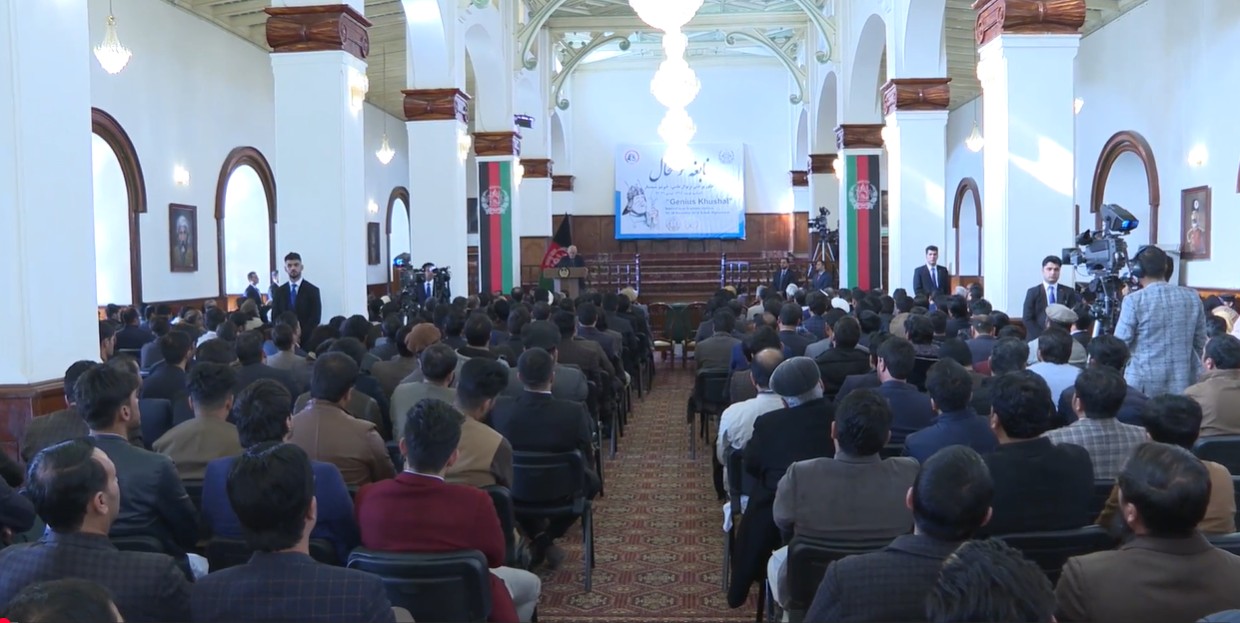
Speech at the Closing Ceremony of International Acedimic Seminar "The Genius Khushal"
Keypoints:
- Discourse Founder: Created the intellectual and linguistic framework for Pashtun identity.
- The Hujra University: Transformed his guest house into a global hub for scholars and princes.
- Trade-Based Power: Built authority on commerce and highway security, not just on land.
- Sword and the Pot: Perfectly balanced military bravery with radical social hospitality.
- Accessible Genius: Mastered the profound "easy-difficult" style in the common tongue.
- Civilizational Heir: Linked Pashto thought to the peak of the Great Islamic Civilization.
- National Architect: Provided the ideological blueprint for the modern Afghan state.
- Global Literary Peer: Ranked as a universal figure alongside writers like Shakespeare.
In the name of Allah, the Most Gracious, the Most Merciful.
Distinguished guests, visitors from Khyber Pakhtunkhwa and Quetta, sisters and brothers, fellow citizens, and all Afghans: Peace be upon you!
First and foremost, I thank all of you—honorable attendees, scholars, and especially our guests who have traveled from Khyber Pakhtunkhwa and Quetta—for participating in this seminar on the genius Khushal Khan Khattak. Through your contributions, you have added a new chapter and a fresh perspective to the grand discourse of "Khushal-ology." My heartfelt thanks to you.
I also extend my gratitude to the Academy of Sciences of Afghanistan and Kabul University for organizing this seminar. Furthermore, I thank Kandahar University for holding the appreciation ceremony for the powerful poet Darwish Durrani and the beloved short-story writer Tahir Athar Afridi, and for publishing their books. Darwish Sahab is present here today; whenever I am struck by sorrow, I read his works. Unfortunately, Afridi Sahab could not join us; I pray to God for his health and well-being, but please know that what happens across the Khyber remains deeply embedded in our hearts.
I thank Azmoon Pacha, Professor Ghazanfar, the Academy of Sciences, Mr. Lewal, and everyone else. Azmoon Pacha, may God reward you. I also offer special thanks to the scholars who published books on this occasion. Dr. Abdul Hakim Shah Khattak has conducted a very detailed investigation into the Dastar-Nama, for which I am grateful. Similarly, Dr. Lal Pacha Azmoon has collected dozens of scholarly articles about Khushal Khan Khattak and published a book on poetic theory. I read the works of [scholars like] Habibi, Ulfat, Benawa, Rasa, and others last night—my gratitude to you; this is a true treasure that shows the continuity of this intellectual lineage. Mr. Lewal has written epics, and I am especially thankful that he accepted my humble request to write an epic about Sultan Baba—I am from that very village.
Ajmal Pesarlai has written a book on the beauty of Khushal’s ghazals. Mohammad Tahir Kani has translated an important work on 19th-century Afghan history. Chief Researcher Latifa Qureshi has prepared for print a useful work by our hardworking late historian, Azizuddin Vakili Popalzai, regarding the history of Afghan media. Additionally, students from the Faculty of Literature have compiled a book of their essays. I thank them all, and I specifically thank Professor Habibullah Rafi, who, by publishing a rare manuscript of Khushal Khattak’s poems, provided another opportunity for our scholars to gather and discuss Khushal’s art, personality, and achievements. Professor, I thank you from the bottom of my heart for your introduction. I found things in your introduction that I had never read before; congratulations, this will be remembered forever.
Khushal Khattak holds the status of a founder in the history of Pashto literature. Anyone who writes or reads Pashto must inevitably refer to Khushal. The characteristic of an intellectual and cultural founder is that they bring language, style, and expression into a cohesive framework. Before Khushal Khattak, we did not have such a tangible and clear framework. He is, in fact, more than just the founder of a style; he is the founder of a discourse. Just as you cannot understand psychology without Freud, you cannot truly understand Pashto and Pashtunwali (the Pashtun code) without Khushal. He influenced our language, our thought, and our perspective, and this influence will remain palpable for ages to come. A thousand years from now, gatherings will still be held for Khushal, and we will honor him.
I have read Khushal Khattak’s works and poems repeatedly, and each time I have learned something new. Thanks to the writings of Professor Rafi and other scholars, I recently found the chance to spend a few moments with Khushal again. In my past life, I only once had the opportunity to dedicate significant time to studying Khushal and his era. In 1980, I spent three full months immersed in Khushal Khattak’s works, the Tarikh-e-Murassa, and other historical texts of his time. Back then, I wanted to understand the environment and the context in which a personality like Khushal Khattak emerged. I reached some preliminary conclusions which I will share with you. Since I have not conducted new research in this area in recent decades, I hope these introductory views provide a ground for further investigation by researchers, especially young scholars.
To the extent of my knowledge, Pashtun Khan-Khel (chiefly) families in the 16th and 17th centuries were settled exclusively along the royal highways. Outside of these royal highways, families were commoners or local elders. These elite families emerged on the routes from Delhi to Peshawar and Kabul, and from Kabul to Kandahar and Herat. Before the time of Ahmad Shah Baba, I have found no evidence of major Khan-Khel families emerging in places disconnected from these highways.
What was the reason for this? Afzal Khan gives a very clear answer in the Tarikh-e-Murassa. Emperor Akbar appointed Malik Akoray as the chief of the Khattaks, entrusted him with the security of the highway, and allowed him to collect taxes from trade caravans to maintain a force of Khattak youth for road security.
Similar records exist regarding the Chiefs of the Tokhi and Sadozai tribes. Asadullah Khan, known as Sado Khan (the ancestor of the Sadozais), had a similar agreement with the Safavid Empire during the time of Shah Abbas I and was known as Mir-e-Afghan. The Jabarkhels also had their chiefs, as did the Mohmands and others.
Before Ahmad Shah Baba, only certain tribes and clans had recognized chiefs (Khans), but Ahmad Shah Baba granted the status of Khani to all clans and tribes. Many chiefs of the Humayun and Akbar empires were Pashtuns; similarly, there were often two Pashtun chiefs in the Safavid court. This historical pattern of a great ruler granting the status of Khani repeats itself. We can speculate that in ancient Afghanistan, similar relations existed between the empire and the local chiefs.
Some people try to equate this Pashtun Khani system with European feudalism, but this is a mistake. In European feudalism, the basis was land, and commercial relations were not of primary importance. In our Khani system, the economic basis was built on trade, and its legitimacy was based on the decrees of emperors. Mountstuart Elphinstone, the famous bureaucrat and historian of British India, noted that there is no Pashtun chief who does not engage in trade. In the Dastar-Nama, you see that the etiquette of trade is one of the essential skills a chief must possess. Regarding Khushal Baba, however, we must say that he valued generosity so much that he never hoarded wealth. His father was in debt, his grandfather was in debt, and he himself was constantly in debt—because he spent his wealth on the people rather than filling his own pockets.
Another major difference between European feudalism and our system was that there, the lord and the peasant were in conflict. Here, in the Khani structure, the chief and the clan were bound together. As the saying goes: "If you are a chief, it is through your friends!" Unfortunately, the conflict was usually between one chief/clan and another tribe, which is why our internal discord led to the success of the Mughals.
The leaders of Khushal’s family were killed in battles against the Yusafzais because the Yusafzais did not accept Mughal rule. Khushal says in the Swat-Nama that his longing to hunt and see the flowers of Swat was only fulfilled in his old age—because only in his old age did he, like the Yusafzais of Swat, become an opponent of the Mughal Empire, which finally allowed him to travel there.
To better understand Khushal Khattak’s environment, we must consider the technology of the time. Horses and camels were the common means of travel. A camel covers a maximum of twenty miles a day. Caravans were forced to stop along the road for the night. The guest houses (Hujras) of the chiefs along the highways were the primary places for travelers to stay. Therefore, hospitality was of immense importance in the Khani culture—both for maintaining relations with the clan and for feeding travelers. The emphasis on generosity and hospitality in Khushal’s poetry is not accidental.
In the Dastar-Nama, when Khushal Khattak calls hospitality and generosity a greater art even than bravery, he is speaking in accordance with the institution of the Khani.
To visualize the cultural state of these families living along the highways, we must ask: who was traveling these roads? These caravans included kings, princes, commanders, famous Sufis, mullahs, scholars, mendicants, and merchants. The greatest thinkers of India, Central Asia, and Iran passed through these highways, and we can imagine they spent nights and held discussions at the home of the Chief of Akora. It is not difficult to imagine that, for example, the highly learned Mughal prince Dara Shikoh might have met the Chief of Akora and exchanged ideas. From a distance, one might wonder how Akora Khattak could be the birthplace of such a genius. I hope it is now clear that he lived in a key global location where everyone passed through.
Mughal histories provide ample information about which kings, princes, and high officials traveled from India to Peshawar and Kabul, and then to Balkh or Kandahar. Similarly, in the histories of Sufis and trade, we can identify the great merchants and mystics who traveled the Akora route. We can assume these individuals stayed in the homes of the Akora chiefs and engaged in continuous dialogue. Until the 19th century, India was viewed primarily from the North. Kabul, Kandahar, and Peshawar were the gateways to India, and Akora's location on this path was vital. Naturally, Khushal would have known many of the important personalities of Asia at that time.
The Hujra of the Chief of Akora was not just a guest house; it was a university. This Hujra not only introduced Khushal Khattak to the scholars, politicians, and great figures of his time but also allowed him to master the language of the people. The fact that Khushal’s language is "easy yet unattainable" (sahl-e mumtani), speaking to the people in their own tongue while maintaining a high linguistic standard, is an influence of the Hujra that should not be forgotten.
Another truth must be mentioned: a chief’s day does not have a fixed schedule. He can expect someone to arrive for a meeting at any moment. His entire day is spent in interaction with people. Therefore, for someone like Khushal who has a message for the people and spends his time among them rather than in isolation, his language will naturally be the language of the people. [Scholar] Ulfat has pointed this out. The language of the people and the Pashto literature preceding Khushal—specifically the Roshanite literature—had a full influence on the creation of Khushal’s style.
The Baz-Nama (The Book of Falconry) is an important work by Khushal Baba. The interesting, detailed, and precise discussions in this book regarding the hunting and training of falcons are not disconnected from the Khani environment. In my view, there is no better masterpiece on the training of falcons than the Baz-Nama. Hunting was a major element of the political culture of the Khani era. When a Mughal commander, a prince, or a regional Nawab was a guest of the Chief of Akora, hunting trips were arranged for them.
The educational books of that time were those of the Nizamiyya curriculum, which included both secular and religious sciences, training individuals for the administrative, social, and cultural systems of the day. Khushal, having studied the textbooks of his time, possessed sufficient knowledge of religious sciences and jurisprudence (Fiqh) in addition to secular subjects like medicine, arithmetic, and literature; he also had full command of Arabic. His Fazl-Nama is a very important book of jurisprudence in Pashto literature, covering everything from beliefs and worship to Islamic etiquette and ethics.
In Dari: It is said that Etemadi Sahab claimed Khushal Khan’s Persian-Dari poems are all romantic and lack the [sociopolitical] issues mentioned in his Pashto works. However, if you want proof of the literary influence of Khushal, look at the poetry of Iqbal [Lahori] and other contemporary poets.
To better understand Khushal and our other classic poets and thinkers, it is necessary to read the textbooks of their time. I expect young researchers to introduce the educational system of that era so that we can become better acquainted with the thoughts, tastes, and worldviews of our elders.
I once found and read the Insha (prose) book of Abu’l-Fazl, the court historian of Akbar, in Hyderabad, India. Our young researchers should study the influence of such books on Khushal’s style. Abu’l-Fazl’s political theory is also important; we should consider whether it influenced the political thought of Khushal Khattak or Afzal Khan. To truly comprehend Khushal, we must find the connection between the various aspects of his life, art, and thought.
Khushal’s thought and art are a continuation of the thought and art of Islamic civilization. During the peak of Islamic civilization, we see a shared civilization and material/spiritual connections spanning from Morocco to India and China. We have a misconception that the decline of the Abbasid era meant the decline of Islamic civilization, whereas Islamic civilization remained powerful for centuries afterward. If it weren't for the strength of Islamic civilization, how could individuals like Khushal have been born? Khushal’s thought, art, and personality are not just products of his local environment but belong to the entire Islamic culture. Hanzala of Badghis is considered our first Persian poet, having died around 219 AH.
...can also be found in the surviving poems of Hanzala of Badghis. Furthermore, we find many similarities between the ideas of Khushal Khattak, Sheikh Saadi, and Amir Ali-Shir Nava'i regarding sovereignty, order, lifestyle, and politics. These shared thoughts are found largely in 5th-century AH texts like Nizam al-Mulk’s Siyasatnama, Kai Kaus’s Qabusnama, or even earlier in other Islamic texts, specifically the Nasirean Ethics (Akhlaq-i Nasiri) to which Khushal Baba refers. We conclude that historically, Khushal is a great heir to the vast Islamic civilization.
Khushal is a great poet and artist, like Shakespeare, but in addition to poetry, he also bore the responsibility of tribal leadership. The aspirations he held were put into practice by Mirwais Neeka and brought toward completion by Ahmad Shah Baba.
At this auspicious closing ceremony of the Khushal Khattak seminar, I want to announce that the Afghan government will soon begin the construction of the tomb of another of our classic poets, Hamid Momand. Furthermore, I instruct the Ministry of Finance to establish a cultural center (Farhangtoon) in the "Afghan Building" in Peshawar, providing a suitable place for poetry recitals (Mushairas) and literary activities. I also ask the Academy of Sciences of Afghanistan and other institutions to take an active role in publishing the works of writers and poets from the regions of Khyber Pakhtunkhwa and Quetta.