From Farm to Market: Roadmap for Afghanistan’s Agricultural Transformation
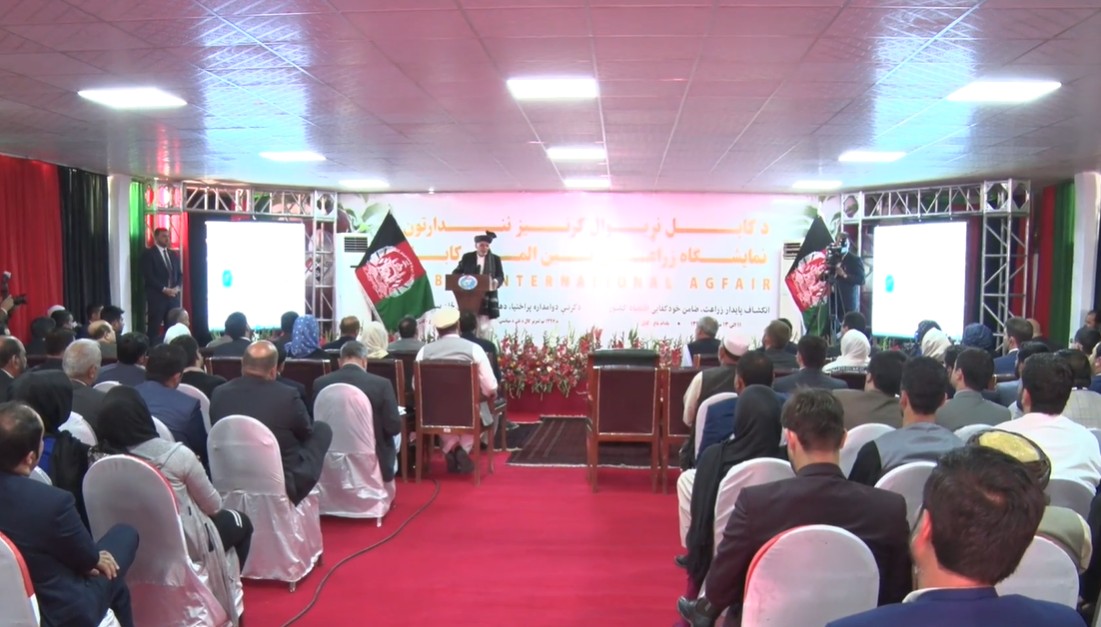
Speech at the Opening of the Kabul International Agricultural Exhibition
Keypoints:
- Prioritize the market: Produce for customers, not just for the fields.
- Open global routes: Connect Afghan farms to India, Europe, and Russia.
- Process goods here: Stop selling gold at the price of cheap copper.
- Buy Afghan products: Government must prioritize local rice, meat, and fruit.
- Support women’s work: Empower female farmers to change their family lives.
- Form national unions: Create single hubs for grapes, saffron, and nuts.
- Modernize the soil: Use laser-leveling and water management to grow more.
- Decentralize research: Move crop centers to where the plants are grown.
- Revive local fabrics: Use Afghan cotton to clothe the army and police.
- Enrich the growers: Measure success by the money in the farmer's hand.
Badam Bagh, Kabul
In the name of Allah, the Most Gracious, the Most Merciful.
Honorable farmers, dear brothers and sisters, esteemed members of the Cabinet, officials from the Ministry of Agriculture, Irrigation and Livestock, the Governor of Kabul, Mr. Helmand, Mr. Rauf, Deputy Ministers, and all distinguished guests: First and foremost, I offer you the gift of the Leader of Humanity: Peace be upon you, and the mercy and blessings of Allah.
The words of Gul Ahmad Khan [representative of farmers and orchardists] today are a sign of an intellectual revolution in Afghanistan. What is this revolution? He speaks of the "customer." He wants to produce for the customer and demands a "market" from the government. From the bottom of my heart, I thank you, Gul Ahmad Khan! If other brothers and sisters haven’t heard it, you are a fine advocate—and if you were an even louder one, what more would you tell us? May God protect you.
Do not forget that in ancient legends, the origin of the grape is Herat. By the grace of God, I was recently informed that sixty varieties of Herat grapes are being preserved at a university in California. God willing, we will witness these varieties again in the future. I have seen the grapes of Herat during very dark days; when the Soviets withdrew, I came to Herat for a week, and there wasn't a single grape in the entire province. Today, I take pride in the orchardists of Herat and the Shomali Plain alike. I saw Shomali in a similarly devastated state during the worst days of my life. But today, Herat and Shomali are green once more. Afghan grapes are world-renowned again—thank you for your hard work.
Secondly, I thank Minister Durrani and his colleagues who have worked tirelessly to move these projects forward. I also thank Mr. Helmand and his team, Mr. Ahmadi, and our other colleagues, and especially our pioneering farmers.
I have reviewed the stories of about forty of our sisters here, each of whom has transformed the lives of their children, their families, and the women of Afghanistan. On behalf of the First Lady, myself, and all senior female government officials, I thank you from the bottom of my heart.
What is the impact of this? Today’s pioneering female farmers provide milk, meat, and eggs to their children. They buy stationery for them, send them to school, and most importantly, they earn their own income—no one can force them into anything. Mr. Minister, this network must become vast, nationwide, and transform into a national network of Afghan women producers. This is my request to you: we must work directly with the Afghan woman farmer. To all our orchardists, landowners, and farmers, I offer my sincere thanks.
As Gul Ahmad Khan mentioned regarding Herat: if all of Afghanistan follows this path, we will be free from foreign imports. If we increase our production by 30% every year, the results will be clear and undeniable.
Where should we focus? We must concentrate on four main areas.
1. Market Identification
Marketing has two dimensions. First, how do we find international markets? You saw the India Corridor; the government invested $800,000, and last year, Afghan farmers and orchardists exported $70 million worth of goods. Next year, God willing, you will reach several hundred million dollars because you proved in Mumbai that the contracts are solid.
The new corridor to Turkey and Europe began last week. Our entire agreement is now with Turkish Airlines, which flies to over 140 destinations—the entire European network is now at your service. Furthermore, the first flights have reached Kazakhstan. Our major targets are Saudi Arabia and the UAE, where air corridors are being fundamentally established.
Gul Ahmad Khan made a valid point, and my focus is now on land corridors. Your largest markets are Kazakhstan and Russia; opening these is our primary goal. The government of Uzbekistan is a great partner in this, providing us with the Termez Cargo Center. The standard you set starts there. The structures of the Ministries of Agriculture, Trade, Foreign Affairs, and Finance must fundamentally change to become marketing agents for you. On this, you have my firm "farmer’s word."
2. Government Procurement
Look at how our rice industry stood on its own feet. This year, the Ministry of Defense alone purchased more than 20,000 tons of rice from you, whereas two years ago, not even a thousand tons were bought. I have directed all procurement departments to make fruit purchasing seasonal. The reason much of your fruit goes unbought is that they order specific fruits out of season, which drives prices up and quality down. Our goal is Afghan fruit. Brothers and sisters, let us stop eating imported bananas and oranges; instead, eat Afghan grapes, apricots, apples, and pears.
The poultry industry has also stood up. We achieved this by changing the Ministry of Defense’s menu, which previously lacked chicken. By changing just one day a week, the Afghan poultry industry was revitalized. If poultry farmers can reassure me, I will put chicken on the menu seven days a week. You invest; we will buy. The necessity is clear. My specific request is to Afghan women—since you manage the household shopping—please prefer domestic products over foreign ones. We need a national movement that is both excellent and Afghan.
If we focus on ten key export items, I am confident that within three years, we can reach $4 billion in exports from the orchard and natural resources sectors alone. Our focus and expertise must now be on specific commodities. In the entire Ministry of Agriculture, we couldn't find a single "Pine Nut Specialist," yet pine nuts can generate between $2.6 billion in exports. We must first focus on items Afghanistan has exported for centuries and modernize them.
What is the problem? "Forward-buying" is in the hands of your neighbors. The Afghan farmer lacks access to affordable credit, which is why foreign currencies still circulate in different parts of Afghanistan. Mr. Helmand and Minister Durrani, focus on two things: Processing.
I call upon all Afghan investors, as a national duty, to invest in the processing of our agricultural products. Look at the pine nut: it brought about $250 million to Afghanistan, but $600 million to Pakistan and an additional $1 billion to China. Do you want that $1.6 billion to go into your own pockets, or are we going to pay an "idiot tax" (ahmaq-puli)? I call it an idiot tax because we sell our gold at the price of copper. Take processing seriously. Until our farmers have the means to process, this problem will not be solved. We have the best products; let us stop selling them for a pittance. I want a "Processors Union" created so the government knows its role.
If you need one or two years of support, you will eventually stand on your own. You see it now with grape juice—"concentrate." The more you convert raw materials into processed goods, the higher your exports will climb and the more you will prevent imports.
3. National Unions
My request to all farmers and producers is to create National Unions. We need a single point of contact; we cannot reach every farmer individually. Create national unions for grapes, pine nuts, pistachios, cumin, and more. You need a vast international market—you are positioned among three billion people; how shall we utilize this?
If you want forward-funding, create an union so we have a formal address. The creation of these unions should start at the district level and move up to the national level. I direct my officials to facilitate this so we can have a common language—the language of the orchard, the field, and production.
The world has changed, and the Ministry of Agriculture must change with it. In the past, our agricultural specialists only chased "production" instead of chasing the "market." By the grace of God, when you have farmers like Gul Ahmad Khan and Bibi Zia Gul, you don't need academic specialists. Mr. Minister, do not waste time on them. If these farmers need specialists, they will find them in universities or the market. Your job is to find them a market.
People always say, "Come and use your land as collateral." That doesn't work. Our proposal is simple: we will provide credit based on the collateral of your contracts. When you have exports through air or land corridors, we will provide an advance payment, and you will repay us later. Revolving funds can only solve the problem if they address it fundamentally.
Statement of the President at the Opening of the Kabul International Agricultural Exhibition (Part 2)
October 3, 2018 | Badam Bagh, Kabul
Another point that is our promise to you is that the Ministry of Agriculture must move beyond its "Kabul-centric" approach. Major research centers must be established in the provinces based on the specific commodities they produce. Move the grape research center to where grapes are actually grown. This cannot be managed from Kabul. Herat is a thousand kilometers away; you must keep Herat and the Shomali Plain in mind. When these projects are handled by specialists—and I say this with the utmost respect for specialists, though when I question them, they seem to get angry with me, don’t they? [Laughter]
I have some doubts about the "expertise" of certain specialists. I hope you prove to me that they are truly experts. Expertise does not come through wishful thinking, dear brothers and sisters. Please do not take offense—I have spent a long time as a teacher—but expertise is not gained merely by earning a Master’s degree. Real expertise is defined by how it puts money into the farmer's pocket. If that pocket is empty, Afghanistan will not be rebuilt. If that pocket is full, everything is possible.
Therefore, my demand is for you to prepare a map of Afghanistan for me that shows exactly where the production center for each commodity is located. If you want almonds, look to Samangan and Zabul. If you want grapes, look to Herat, Maymana, Shomali, and Parwan. Once such maps are prepared, we will know what to do. If you want pine nuts, look to Paktika, Paktia, and Khost. If you want pistachios, look to Samangan and Badghis. We must know our path.
Furthermore, research centers should be established in partnership with universities. Mr. Minister, Mr. Helmand—every day you come to me asking for a helicopter to visit a province, but the real specialists are already sitting there on the ground. People like Gul Ahmad Khan—send them to other regions! If he is an expert in grapes, send him; he will find a way to produce grapes anywhere, won't he? Let other farmers learn from him.
Another point is clear: Gul Ahmad Khan, we should reduce academic scholarships for specialists and instead increase exchange visits for farmers to neighboring countries and the rest of the world. Do you know how the apple industry in Afghanistan stood on its own feet? It was because of one man, Dr. Wakil Khan—may God rest his soul. When I was a student at the American University of Beirut, he brought a hundred farmers to Beirut and introduced them to research farms. Today, Maidan Wardak is the apple capital of Afghanistan, and five other provinces stood up because of that blessing. Could our specialists do what a farmer or the "Father of Saffron" did? I am looking for the "Fathers" of grapes, saffron, rice, and wheat. Bring these pioneers forward so they can work fundamentally.
In another area, what is the duty of the state? There are two "chains" we must consider. The first is the Value Chain: how do we get from production to the international market? Every link in this chain is a link of investment and success. My message to the young generation of Afghanistan is that wealth is in the village. Brothers and sisters, we can become far wealthier through our villages than through our cities. You might say I am talking in the air, but look at the experience of South Korea. If you connect Afghanistan’s land, water, and produce to international markets, your lives and the life of Afghanistan will improve immeasurably. Every link matters: producer, processor, market, wholesaler, and retailer.
I have directed the Ministry of Urban Development to prioritize the creation of supermarkets. We need investment networks and supermarket chains. From local neighborhood markets to large-scale supermarkets—these bring standards. And if you bring standards, government procurement becomes far easier. We need a formal "address" for every sector: unions for producers, processors, and exporters. These three must see themselves as indispensable to one another. If you do not work together, you will remain stuck—as you are now with pine nuts—wondering where in Afghanistan they are produced. You could all become billionaires through pine nuts! Leave these small disputes behind and look to the grand goal. You have two choices, brothers: either you reach a conclusion, or I will decide for you. I am an old man—not just as the leader of Afghanistan, but as an elder—and I will tell a few people: if you cannot follow the rules of the village and the market, then leave the city!
Another essential point, which I hope will be good news, is the revival of Afghanistan's textile production. For next year, I have decided that all uniforms for the National Army and Police must be produced from Afghanistan's own resources. Our textile industry will be revived alongside our cotton producers. Brothers and sisters, work fundamentally on this. The people are waiting for this; they see our failure to stand the textile industry on its feet as a sign of backwardness. We must create a market for it, and the National Procurement Authority will be at its service. Investment has already begun in Herat; you must direct investment to other areas too, and we will soon find partners for factories that have been stagnant.
The second chain is the Logistics and Transport Chain. The government has not yet done enough useful work in this area. A large portion of Afghanistan's best goods is still wasted. Last year in Paktia, we saw that wheat was left over. We must invest fundamentally in logistics—cold storage and transport. The farmer must know, with just two phone calls, what the best price is. Prices must be predictable. If you provide this ground, the "virtuous cycle" will be created.
Naturally, you handle production in the field, but the right conditions must be provided for you there. I ask you to manage your water. We use far too much water. Since the 15th century, two great books from Iraq—The Method of Water Distribution in Qom and Irshad al-Zira'ah—have served as guides, but they always suggest using more water. Today, if you manage your water efficiently, our yields can double or triple. We are with you in this, as well as in the laser-leveling of fields and improving seed varieties.
At the same time, Minister Durrani and colleagues: industrial investment in agricultural production is still far too low. From shovels to tractors, most equipment is imported. I ask you, Mr. Helmand, and the Ministries of Agriculture, Trade, and Finance to sit together and provide a clear plan for producing essential materials. How do we harvest pine nuts? I want your final report. How do we handle pistachios? Small actions here can have massive impacts. Regarding water management, I tell you clearly: I would give my life for this, but we will not waste Afghanistan’s water! We must reach a result.
In conclusion: we are at a turning point. The agriculture we inherited four years ago is changing. The mindset of the Afghan farmer and orchardist has changed; the Afghan farmer is still ten miles ahead of the country's specialists. Join the specialist with the farmer and change the government's policies and priorities. When we listen to the farmer, the orchardist, and the forest-dweller, we are no longer just individuals—we are a single Afghan nation. The pocket of every farmer and orchardist is the national capital of Afghanistan. We will work together, and you will witness a great transformation. We must reach a clear result regarding wheat; wheat is like the water of our life—our food security must not be played with. It is a clear necessity to bring a plan that gives credibility to the Afghan wheat farmer. For years, misguided international aid forced our farmers to the point where they wouldn't even gather their harvest. We need a national effort to overcome this.
Finally, I want to thank all the honorable orchardists, farmers, livestock owners, and especially those individuals who consider Afghanistan's forests as their own being and invest in them. I thank all my colleagues; you have made great efforts. We have reached a point where we finally know our roadmap. We understand the problems, and we understand the solutions. Diagnosing the problem is the first step; the solution is the second. I am certain that, by the grace of God, Afghanistan's agriculture will stand on its feet, and a history will remain for us—that we made Afghanistan green and prosperous once again. Every Afghan, God willing, will receive the bread produced by the blessed hands of Afghans themselves.
Long live Afghanistan!