The Urban Road Map: Transforming Afghan Cities into Hubs of Production, Investment, and Rule of Law
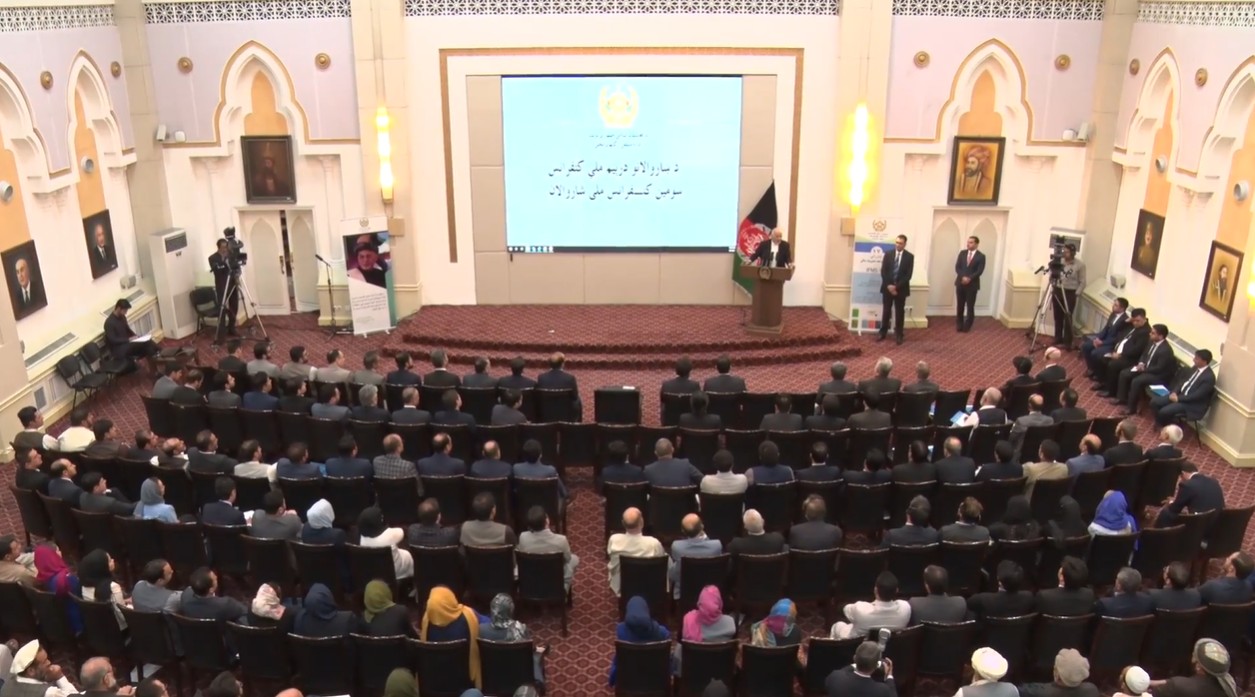
Speech at the Opening Ceremony of the 3rd National Mayors’ Conference
Keypoints:
- Local Roadmaps: Replaced foreign theories with Afghan-led plans.
- Youth Leadership: Appointed mayors by merit and vision.
- Social Contract: Legalized informal settlements.
- Production Focus: Cities as $4B agri-processing hubs.
- Rural-Urban Link: Supermarkets connect farmers to cities.
- Construction Reform: Favored local firms, improved quality.
- Citizen Oversight: “People’s Grade Sheets” evaluate services.
- Fiscal Self-Reliance: Turn $1 aid into $10 national value.
Chaharchenar Palace
In the name of Allah, the Most Gracious, the Most Merciful.
Honorable Mayors, dear brothers and sisters, all attendees, honorable members of the Cabinet—Mr. Baig, Mr. Wulsmal, Mr. Paikar, the Governor of Kabul, Mr. Rahim, Mr. Popal, Mr. Ghalib, Mr. Gilani, honorable Deputy Ministers, Mr. Tahmasbi, Dr. Sahib Talib, Haji Sahib Fazl, Mr. Jamizada, and all our foreign guests: Welcome.
Acknowledgment and Trust in Young Mayors
First and foremost, I want to thank all the mayors of Afghanistan. This was an experiment—an experiment many people doubted would succeed. Mr. Popal was involved from the beginning, and today I thank you all because you have proven through your service to the people of Afghanistan that the trust I placed in the young generation of our country was well-founded.
Vision for Cities and Citizenship
How did our vision emerge? First, during the transition process, I visited all 34 provinces repeatedly. In each province, I met with at least one to five thousand fellow citizens. Through these meetings, it became clear that the issue of the "city" and "citizenship" is a vital matter for the people of Afghanistan.
Our cities have suffered from poor strategies. We must admit that a lack of capacity in municipalities, bad governance, and flawed short-term projects created a crisis of urban living and citizenship. We talk about land grabbing (ghasb); however, a major reason for this isn't just the land grabbers themselves—it was the vacuum created by the absence of law, which forced the private sector toward corruption. If the right policies had existed, the private sector could have invested billions of dollars in our cities.
Do not forget that bad and flawed governance is the primary cause of a country’s backwardness. Because you either provide a legal path for people, or they will seek an illegal one. We have often held a stick instead of offering a hand of cooperation; therefore, it is essential that we understand our own gaps.
Selection Process and Commitment of Mayors
What was the second point? Again, because there was so much criticism in this sector, people used to say this President is "crazy" for demanding a hundred plans from mayoral candidates. Why did I ask for these plans? Because I wanted to understand what these young people, these candidates, and these citizens of Afghanistan were thinking.
From the collection of these hundred plans, I realized that there is an immense capacity and a profound love for this country among the youth of Afghanistan. Consequently, the selection we made resulted in mayors who rose from among the people, who understood the fundamental problems of their cities, and who possessed clear commitment and vision.
The vast majority of the mayors present here today could have become Deputy Ministers or Governors, but they chose to be Mayors. They left general directorates and major roles in central Kabul to go back and serve. I see a massive shift here in Afghanistan. Forty years ago, if you gave someone the choice between being a Director General in a Ministry or the Mayor of Mehtarlam or Maymana, a hundred percent would have answered that they’d stay in Kabul. But today, these brothers and sisters of ours make a different decision. This represents a clear commitment, and I thank all of you from the bottom of my heart for making this promise.
Development of Roadmap and Achievements
Based on these plans, we developed a roadmap suitable for Afghanistan's conditions. Our challenges were highlighted in the plan mentioned by Mr. Baig—thank you! Truly, Mr. Baig has a talent for "forced labor" (bigar); he comes with that permanent smile and says, "Mr. President, it will be difficult for us if you write it this way" [President laughs]. What can one say to Mr. Baig? But Mr. Baig, I express my gratitude to you, your capable management, and your colleagues—Mr. Popal, the other Deputy Ministers, Mr. Wulsmal, Mr. Paikar, and the Governor of Kabul.
The majority of what has been called "strategy" for Afghanistan in the past has been a copy of other countries. Original thought that is uniquely Afghan and tailored to our conditions has often been missing from these roadmaps. Therefore, one of my duties has been to build roadmaps for various sectors to ensure a unity of vision and action, and our governance is based on democracy, where the comprehensive participation of the people is a clear necessity.
The next point was this: This is the third year we are observing whether our mayors can be agents of positive change. Today, Mr. Alokozay gave us examples. I won’t name specific cities, because if I miss someone, they might feel slighted, and I don’t want anyone to be upset. I am proud of all of you—of all the mayors.
However, what you mayors have proven are several things. First, you can get things done. All the achievements mentioned by Mr. Darmal, Mr. Wulsmal, and Mr. Baig are practical achievements; they are not just on paper. Whether it is 200 kilometers of road, those roads were built in places that previously had no trace of a road—likewise for green spaces and more. Second, you increased revenue. It is not yet enough, but you increased it. Third, when we gave you an incentive budget, you had the capacity to spend it for the people. Now, the ground is prepared for us to realize that capacity can be built within municipalities. And what is the most important part? Your work with the people!
Mayors are successful only when they work with the people. If a road is being built in a place where nothing has moved for 40 years, it cannot be done by force; it requires working with the community. What a smiling face, intellect, logic, and prudence can achieve, force cannot. In the past, the talk was always, "Tell the police to destroy it, tear it down," but you have used logic to convince people that there is a benefit in this, leading citizens to feel a sense of ownership.
Municipal Law and Lessons from Failures
As a result, the Municipal Law was the next step we took. Without successful experience and these stages, we could not have introduced the Municipal Law so abruptly. Three times, very flawed versions of municipal laws were proposed, and I rejected them. I hope you are convinced today that rejecting a flawed law was a helpful step. Like Mr. Alokozay, I want to express my gratitude to my dear colleague Ajmal Ahmadi, who is not here today. We conducted a comparative study of municipal laws from various countries, and based on that, I made clear decisions on how the new law should be formed and what authorities it should contain.
The reason this law is so voluminous is that the roadmap and successful experiences are attached to it. What is our conclusion? Our cities today are ready for a leap. But before we get there, we also had failed experiences. Our two biggest failures: one was in Herat, where a mayor who started very well regressed into corruption, and the second failure was in Kabul. Highly educated individuals came and wrote very good papers, but in practice, you failed all the people of Kabul. I thank you, Mr. Rahim, for starting the discussion on citizenship in Kabul now, but we were not successful in Kabul. This is another result, and it’s not for the sake of blame, but to show that there must always be a clear balance between theory and practice.
The reason we brought Mr. Habibzai in was for Kabul’s traffic management. Hundreds of papers were written on Kabul's traffic, yet nothing changed in the lives of Kabul's people. Meanwhile, the taxi drivers of Kabul have very comprehensive ideas; if we had listened to them, the traffic situation in Kabul would have changed.
So, we must also state where we have not been successful; we must admit our shortcomings there.
Key Priorities for Municipalities
Mr. Wulsmal mentioned serious problems. I want to categorize these. The first point is that municipalities must become the primary engine for attracting private sector investment and must provide the conditions found in first-tier regional and global cities.
The law has opened the way for you. And what is that? Zoning for every district of your city—where and what kind of buildings should be constructed—and a very transparent bidding and auction process so that land can be placed at the disposal of the private sector without issues. This starts in Kabul; a clear roadmap for Kabul has been prepared in six volumes, which I am considering. But the private sector is your partner. Today, you should view the private sector that is ready to invest as a major partner and a solution to your problems.
Second, the identification and stabilization of state land in all cities of Afghanistan is your fundamental priority. I tell you with great regret that I had to collect the records of Kabul Municipality’s lands from the Arg (Presidential Palace); the Municipality was unaware of its own lands. I thank Mr. Rauf and his colleagues in the Office of the President. Inch by inch, we reviewed, collected, and categorized this data into a clear framework. But the Municipality was unaware of these lands, either at the district level or the central level. What did this lead to? It led to the misuse or grabbing of land because it had no "owner."
Another issue is the use of state property. Unfortunately, state properties are currently being used in the worst possible way. In past years, rents in major parts of the city were extremely low. The job of the Ministry of Finance and our Land Authority is not just to rent out property, but to create conditions for investment and utility. In Kabul, I found so much land. On the first day, I was told there is no land in Kabul, no land in the cities of Afghanistan. Thanks to your efforts, it is being identified today. I thank the municipalities for their initiative in identifying property, reclaiming grabbed land, and especially for their information management. In these conditions, how can land information be collected in Excel? We must fundamentally implement the modern technology that Mr. Paikar initiated.
We must start with the management of state lands. Instead of burdening private property and creating problems for them, we must first gain the trust of the private sector through the management of state lands. We have two clear alternatives here for comparison: one is a partnership between the government and the private sector (Public-Private Partnership), and in the coming weeks in Kabul, we will put a portion of land up for announcement. The second is the sale of these lands, so we can see how many clear proposals come for both alternatives.
What is the government's condition? The boundaries are made very clear. What plan are we working on? Two major roads are ready in Kabul: Darulaman Road and the road from the Airport to the Massoud Martyr Circle. we are opening these two areas to the private sector and we want you to come forward with clear proposals. In this framework, we will soon open locations in five other cities as well.
The point I want to make clearly is: state land does not belong to any specific government department. State land is the property of the people of Afghanistan—not the Ministry of Defense, Interior, Transport, or other agencies. It belongs to the people of Afghanistan and must be managed for the future generations of this country.
Another issue is our lack of green space. Unfortunately, Kabul is among the cities with the lowest percentage of green space in the world. I want thousands of hectares of land in Kabul to be activated in these few months to change the air and the atmosphere, and this is necessary for every city.
Unplanned Areas, Historical Heritage, and City-Village Relations
Another point regarding the legacy we inherited is the unplanned (informal) areas. My contention to you is that unplanned areas were created by the failure of government policy, not by the people. If you had sat down with a ruler and a pen, you could have made the people owners of credible property. It was we who were the problem, not the people. Honorable brothers and sisters, think about it: six million Afghans returned to their country—including myself and my family. If there had been a clear framework to absorb the energy of these compatriots and if our cities had planned areas, how much change would have occurred? In various cities, did the people not wait for years? The people understood the difference between a planned and unplanned area and its price; but finally, their cup of patience overflowed, and they came and took the land.
So, it is very essential that when mayors speak with me, they come with clear plans and say: how do we convert unplanned areas into planned ones? Loya Pyala is a good example. I do not want more papers from you; you have written enough papers. Give a message to the people of Afghanistan: how do you share everyone’s property? How do you make it legal? And how do you give this nation ownership of their own property—this nation that has always protected this homeland? This is our approach. Every Afghan must own a specific area of Afghanistan where they can live securely; without this, it is not possible, brothers and sisters.
Our next point is the preservation of historical heritage. I am proud that the residence of Ahmad Shah the Great has been purchased by the government and is in its final stages to be gifted to the people of Afghanistan. Which country do you know where we lacked the commitment to make the home of the person for whom we live today a national landmark of Afghanistan? Our historical heritage across Afghanistan must be revived. We have at least two and a half thousand years of urban heritage. All our major and minor cities were on the Silk Road; these cities of ours must realize their identity again. We should take pride, even though some of our cities today, despite all development, are smaller than they were before the Mongol invasion.
These cities must become livable. These cities must understand what our historical heritage is. In Kabul, you saw that Mashin-Khana is the latest initiative that will belong to the people of Afghanistan again, and Bala Hissar will, God willing, be built. It is a clear necessity that we include our historical heritage as part of our urban fabric.
But the subject I want to discuss with you today—and it is a point of pride because it was previously impossible—is that today you must have at least a 10-year vision, and I hope that in the next 3 years, you create a 50-year vision for your cities. Our cities must have a direction, and where does that direction come from?
First, our cities are not only important within the framework of Afghanistan; almost all our major cities are transit hubs. From the perspective of international trade, the position of Afghanistan’s cities must be clearly defined. Herat’s rival is not Kandahar or Lashkargah; Herat should see itself as a peer to Mashhad, Isfahan, Ashgabat, and Tashkent. Kabul must be on par with Islamabad and Delhi. We cannot propose only a small vision here; it must be a vast one. Why? Because after we bring security and legality, God willing, one of the major criteria for international investment is whether your cities are livable or not.
Cities in China today invest in music; Singapore or Abu Dhabi invest in museums. Why? Because the people want this. That an Afghan invests is a source of pride for us, but international investment does not happen without international facilities.
Second is the issue of the relationship between the city and the village. In the last two thousand years, in my view, the weakest relations between Afghanistan's cities and villages exist today. Elders are sitting here who are my peers; in the past, the city was both a major source of income for the village and provided services to the village. Today, you bring fruit from outside while your own fruit rots. Honorable brothers and sisters, you must fundamentally secure the connection between city and village. You might think Kabul's gate is the Lahori Gate; but its gate is Khost, its other gate is Torkham, another is Hairatan, and another is Bamyan. You cannot think of Herat differently. Today the country has become integrated, and thus the relations between village and city are very fundamental.
Our major cities are consumer-based and not productive. Mr. Alokozay, is it not so? Why do I say this? Our imports are seven and a half times our exports. Look at yourselves: the shoes you are wearing—99% came from abroad; the suits you are wearing, even the Peran Tomban you wear. In this room, what percentage of what we are wearing is an Afghan product? What does it mean? It means we have not created productive cities. If our cities do not become productive, where will we get bread to eat in the future? Urban culture is not just about consumption; cities are the primary engines of development, and we must work fundamentally on that engine, which in the first step relates back to the village.
I believe that from only 5 to 8 types of agricultural products, Afghanistan can have up to $4 billion in exports per year. But show me one city today that is a processing center for one of the major items upon which Afghanistan's exports can stand. So, Mayors! Now is a great opportunity for you to make cities productive.
Another fundamental issue is that our cities must create 21st-century jobs. Our cities are a means to perform tasks ranging from 2,000-year-old jobs—like waste collection, which can truly create employment—to the latest 21st-century work, such as e-governance and e-commerce. Innovation is necessary in this. If there is no innovation, you cannot provide work for these cities.
Responses to Proposals and Specific Directives
Based on the proposals that were very specific, I will address them first, and at the end, I have a few words regarding Kabul:
- First, I thank Mr. Alokozay for his proposal. Mr. Baig! Instruct all mayors to establish Urban Commissions that serve as a clear mechanism for all strata of society to meet once a month. You have seen the result of this. And what is the result? Has the High Urban Council provided the ground for us to have a dialogue or not? Every mayor of Afghanistan comes, and you know my habit: I do not say a word at the beginning until your points are finished, and then a free and comprehensive discussion takes place. A shared vision emerges from discussion, not in isolation. Until Afghans sit eye-to-eye, trust is not created; we must know one another and create an atmosphere of trust. Creating Urban Commissions will be a means for clear trust to emerge—of course, the principles must be such that they are not misused.
- Second, every mayor of Afghanistan has a clear discussion with the private sector. I hope you remember the question I asked you during your interviews: "You are developing your cities, but how will you feed your people?" Mr. Popal, do you remember? Therefore, it is necessary to tell the people how you will provide "bread." If you are providing bread, it cannot happen without work. If you rely on foreign aid—the $7.4 billion that you bring from abroad—where does it come from? So, a shared vision is necessary. My request is that all discussions in this sector regarding investment and communication tools should come to the High Urban Council so we can learn from our successful examples. Especially Kabul needs to learn from other cities today; fortunately, it is a successful experience upon which clear steps should be taken.
The second issue is that Mr. Rahim had several specific proposals. On the first subject, I personally want to listen to the citizens of Kabul. Provide the ground for two to five thousand of our citizens to come in a balanced way from the 22 districts of Kabul. I commit that I am ready to spend a full day with the citizens of Kabul. My request is that mayors, governors, and others need to create the same practice. We must clearly see the summary of this again so that a clear point exists in this regard.
In this discussion, let me provide the solution for the three major failures that Mr. Wulsmal mentioned to you:
- How will you make the Teachers' Townships successful? In one month, I want a clear and comprehensive plan from you for the success of the Teachers' Townships.
- How will we make the Refugee Townships successful?
- How do we provide usable housing conditions for the families of the martyrs of the security and defense forces, who are the pride of us all?
- How do we start the process of making unplanned areas legitimate and legal? We must have a clear accounting; the people of Afghanistan should not have to wait forever.
- How do we create specific investment opportunities in every province and major city, similar to what I proposed for Kabul? This is not just Kabul-centered; we need to know what the proposals are and how the process should be transparent. We must have clarity because these lands are valuable. We want to move forward fundamentally, but there should be no obstruction now, and the Land Authority has a major role in this so that our properties are approved.
Our property must be fundamentally predictable. The success of building 6,000 schools and 100 high schools using pre-fabricated methods is my essential condition. All our provinces and mayors must push forward with land that can be built upon tomorrow. At the same time, we are ready to invest in mosques and administrative complexes; other points will be presented to you soon. This must be summarized so that work can begin and the people can see the results.
I welcome the people's initiative regarding support funds. I hope this process becomes nationwide. My request to the honorable mayors is to involve the people in the security of your cities. The current war is directed against our national unity, religious brotherhood, and all our moral and religious values. Our cities must consolidate themselves; under these security conditions, a specific type of cooperation between the people and the security forces must be provided. My request to the people is to go and honor your security and defense forces.
There isn't a single army corps that I haven't visited multiple times. There is no branch of the Police or National Directorate of Security that has not received my special attention. Brothers, today I was speaking with one of Afghanistan's prominent figures; he said that back in 2014, he truly believed that despite all my efforts, I wouldn't be able to prevent a collapse within six months.
Today, the survival of Afghanistan is, God willing, secured. If the security and defense forces had not sacrificed their lives, we would not be in this position today. That there are problems is another matter; but know this: what the people of this land can do, no foreign mercenary can ever do, and foreign mercenaries will never be allowed on this soil.
Governance, Structure, and Future Directions
In all these dialogues, top-level officials must participate, and this must be Afghanistan-wide. In places where our mayors require video conferencing to make conditions easier, this can—God willing—be provided.
Mr. Darmal, I thank you. Our main point is that the Citizen's Covenant (Wulusi Taroon) must be managed by the mayors. This is the first time a clear means of communication between the city and the village has been established. One of the most significant things mayors can create is the establishment of supermarkets. Why? If standard supermarkets enter our cities and turn into standard networks, the farmers and orchardists of Afghanistan will stand on their own feet. In all your urban plans, you must have space and various designs for supermarkets to determine how our agricultural processing can be improved. We must take the industrialization of Afghanistan as our benchmark. In the vision for the five major cities where new discussions have begun, Afghan citizens must be included through the mayors and top-ranking officials. Having heard your views for every city in Afghanistan, I will relay them. You must own this process. Fifty million dollars is not a small amount of money for each of these cities. But what is our condition? For every fifty million we provide, you must generate five hundred million—and this is within your power. Every foreign dollar must be converted into ten national dollars. If you do this, you automatically solve the funding problem for other issues.
I thank Mr. Kaywan [Mayor of Maymana] from the bottom of my heart for your successful management—for reviving the memory of Ustad Maymanagi in Maymana and creating an excellent cultural center. You came from civil society; you are truly a "civil" mayor. May you be successful.
The specific proposals and their primary point are absolutely clear: the current organizational structure (Tashkil) of municipalities does not meet our roadmap for local governance. Mr. Popal, the structure must change. I ask for your attention; this must be urgently reflected in next year's budget and organizational charts.
Cooperation with the police will be fundamentally secured, God willing. Jalalabad is a very clear example of this cooperation. I express my gratitude to Mr. Raqibi, who was the provincial treasurer and is now the Deputy Minister for Customs and Revenue; I congratulate him. Wherever there is will, the city becomes secure. My request to all citizens is to prevent political interference in the police. Your security depends on the neutrality, professionalism, and national character of the police. I want to hear the voice of the citizens regarding wrong appointments based on "relations" rather than "regulations" (rawabit vs. zawabit). I ask the mayors to request the people to monitor police districts and give them a "public grade." Let them say which police district is corrupt and which one does useful work, so those who do well can be honored and those who don't can be replaced. The culture where the police think they are the "conquerors" of Afghanistan's cities is unacceptable. The police are the servants of the people; the police must be professional, national, and educated—this is essential. So, cooperation is necessary, and we need your cooperation too. The entire new police leadership came to me and said: "For God's sake, free us from one thing—supervising high-rise buildings." They said this because municipalities created various types of corruption and then threw the burden on the police. Do not throw your problems onto the police. It is clear that cooperation is necessary, but a bilateral contract and communication must exist.
The court's decision is under consideration. The Chief Justice and the High Council of the Judiciary, which plays a role in state cases, have made a clear decision and will review it. In this regard, if there is a need for another fund, it should be worked on. The main hub of production is the High Urban Council. In every meeting of the High Urban Council, dedicate a section to the problems mentioned by the mayors so it becomes part of the agenda, or allocate part of the time in every meeting to solve the problems mayors want addressed. Salaries for municipalities that lack capacity—like Nuristan—will certainly be considered. Mr. Baig, send this proposal soon; we must see that investment is needed. God willing, in ten years, Parun will return your money tenfold. If you see the beauty of Parun, it is truly unprecedented; but since it had no sources in the past, it must be worked on fundamentally.
You should all celebrate October 31st together. Another point you mentioned was that the incentive budget should be included in the regular budget—a hundred times yes! But the incentive budget must be competitive. I want clear conditions from you; you propose what you will do with every hundred Afghanis we give you. So my request is: you want incentive money? Most certainly. But in exchange, what does it turn into? Cities cannot remain consumer-based forever. If you want these principles, we are ready to give you loans on the condition that you have clear projects and pay the loans back. If you want revolving funds, you must adopt methods for resource management. Revolving funds are those you use once and then refill—and they are refilled by you. We are ready for innovations, but on the condition of clarity. If we change this once, you might think it is a permanent right. What is the characteristic of municipalities? You are the only level of governance outside the central government that has its own revenue. As Mr. Baig said, I want a revenue plan—an innovative revenue plan. How will your revenue increase? Because if your revenue doesn't increase, everything will just be maintenance while we are trying to build.
Construction, Quality, and Cultural Identity
Regarding construction, I have a few requests: The estimated cost of buildings is absolutely outside of logic and principles. You have learned to buy the smallest things for thirty million, a hundred million, or five hundred million Afghanis. In the Operational Unit of the Arg, we experimented and brought all your estimates down by five to ten times. The state of cooperation between the public and private sectors in construction is not satisfactory to us. The country does not have this kind of revenue. Second, the quality of construction unfortunately has serious problems. Can you judge the things that have been built? Are the buildings made fifty, sixty, or a hundred years ago—like Salam Khana—equal to today's buildings? It is necessary for costs to go down and quality to go up. In this sector, with all due respect, I want the private sector and small to medium-sized enterprises to work; we are breaking the monopoly of large companies. To implement this, government contracts will go to the Bannayi Construction Enterprise, and they should open offices in all 34 provinces so they can provide clear management; otherwise, we cannot fulfill this. A hospital that was estimated at one billion Afghanis was reduced to five hundred million. With that money, you can build two or three hospitals; the people need them. A final example is the poor quality of the Police Hospital. On the sixth floor, doctors perform brain surgery—may God protect them—but sewage leaks from the bathrooms, endangering the patients' lives and leaking down three floors. They built the doors such that hospital beds cannot pass through them. This shouldn't be my job, but I personally intervene because I care deeply about the police. So, there must be a clear change in the construction sector.
Another part, honorable brothers and sisters, is that most of the things you built in these seventeen years are not in harmony with our culture and have no identity. Do you think we have left behind anything of our own, like the Musalla complex, the Ikhtyaruddin Citadel, or Salam Khana? With the facilities you have, our request is that you create lasting things. How? By using local materials, local workers, and local thought. In this regard, my request to the private sector is to establish a chain of communication with the universities. Our universities and municipalities must become centers of thought. I said in a meeting yesterday: I want a clear competition for mosques in Afghanistan. I will give 500,000 Afghanis for the best mosque design coming from Afghanistan's universities; 300,000 for the second, and 200,000 for the third. Bring in competition so it becomes a fundamental and lasting culture.
Our buildings, especially our high-rises, have not been fundamentally designed or mapped.
Closing Message and Generational Transition
Regarding opportunity: for the work you have done in these four years, I was merely the vehicle. I have always told you that I am a bridge over which the new generation of Afghanistan—the young generation—will carry responsibility, authority, and leadership. The bridge has done its job. You have crossed the streams; you have crossed the ocean. Now authority and responsibility are in your hands. One of your mayors is now in the Ministry of Urban Development, another is in the Administrative Office of the President; Mr. Baig, instead of being a mayor, is in the Independent Directorate of Local Governance and "takes forced labor" from me.
Now is your time. I see in you a new generation of Afghanistan that can truly grow the urban sector. The structural problems have been solved. Now is the time for management; now is the time for policy; now is the time to fulfill our responsibility to the citizens of Afghanistan. Why did it take four years? It took four years because—who would I have worked with? If you hadn't come through a transparent process, and if I had given money then, wouldn't "cooks" have been appointed as mayors? Those dark days are over. Now, by the grace of God, a mayor has sufficient status, authority, and discretion. What you want from me is support, and I tell you again and always repeat: you have my support. Why do you have my support? Because you are clean people, committed people, and you have a "crazy" love for this country. If you didn't have that crazy love, you wouldn't have accepted these complications in our cities.
I thank you again, and I hope that through your presence, a momentum is created in Afghanistan. But the condition is this: you must not see yourselves as individuals; you are a network of united mayors and the leadership of the urban sector that must move things forward. Where does your test lie? Your test, God willing, will come in two or three years when you propose yourselves to the people of Afghanistan and see if the people elect you or not. I have given you a chance to prove yourselves to the nation; serve enough so that the people vote for you, and God willing, they will vote for you.
Long live Afghanistan!