Islamic Fight Against Corruption: Justice, Rule of Law, and the Power of the Pulpit
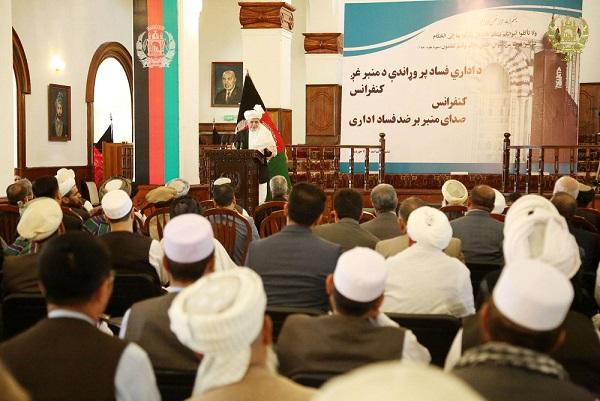
Speech in the second session of the ‘Pulpit Voice Against Administrative Corruption’ Conference
Keypoints:
- Gratitude: Thank leaders and clerics fighting corruption.
- Clerics’ Role: Pulpit guides society and prevents corruption.
- Justice: Law applies to everyone, including leaders.
- Rule of Law: Institutions enforce fairness consistently.
- Corruption Minority: Only a small fraction of people are corrupt.
- Islamic Leadership: Follow Prophet ﷺ and Rightly Guided Caliphs.
- Accountability: God and people witness all actions.
- Active Voice: Silence against corruption is not allowed.
In the name of Allah, the Most Gracious, the Most Merciful.
Esteemed scholars, personnel of the Attorney General’s Office, distinguished guests, Mr. Halimi, Mr. Qattali, Mr. Kashaf, and the Honorable Attorney General: First of all, I offer you the gift of the Leader of Humanity—Peace, and the mercy and blessings of Allah be upon you!
I begin with gratitude. First, I express my appreciation for the initiative of the Attorney General and his constant efforts in the fight against corruption. The day a Minister of this country faces a public trial, the day a three-star General goes to prison, the day no one can consider themselves above the law—that is a day of joy for us. I thank you for your decisive struggle against corruption.
Second, I thank the esteemed religious scholars for their coordination and harmony. Without coordination and the active role of the Minbar (pulpit), corruption cannot be eradicated. Let it be clear: no television, radio, or book can take the place of the Minbar. Is there any other institution that gathers the entire country and the whole Islamic world every week? If not five times a day, then four times a day, for most people, it is a place of discussion, decision-making, and judgment.
Furthermore, consider the harmony of a country whose official name is not just "Afghanistan." Our name is the "Islamic Republic of Afghanistan." Our Constitution is clear, and our traditions are clear. We were Muslims, we are Muslims, and Inshallah, we shall remain Muslims forever. All our laws, all our principles, and specifically our Constitution are based on the holy religion of Islam; therefore, without the religious scholars, this great objective cannot be achieved.
The Vicious and the Noble Circles
Based on the teachings of Islam, we are dealing with a "Vicious Circle" and a "Noble Circle." What is the Vicious Circle? It is Corruption, Fitna (strife), and Catastrophe.
Corruption has been explained extensively, but corruption leads to Fitna. Only the scholars truly understand the concept of Fitna, for it is Fitna that destroys a system. People must not forget that in Islam, transactions cannot occur without a system (Nizam). In what other intellectual system is a marriage valid without a legitimate government? Only in the Islamic system—because Islam emerged as a system. It did not take two hundred years to transform from a religion into a state; the state was Islamic from day one. Therefore, just as corruption is vital, Fitna is equally significant. These other "imported" words we use are not understood by the common people. Fitna has a specific place in Islamic culture, and it leads to catastrophe. If you want proof, look at the last forty years of Afghan history. Corruption came, followed by Fitna, followed by catastrophe. Had there been no corruption, would the great blessings of Jihad have been wasted and turned into catastrophe?
Jihad was an epic (Hamasa), but unfortunately, catastrophe followed. Why? Because the intellectual groundwork was not laid. Was there a greater epic in the 20th century than our Jihad? There was complete national consensus; all strata of society stood in a single line. Yet, the massive achievement we expected instead brought catastrophe.
This makes it essential to think fundamentally about the second step: the "Noble Circle." What is that circle? It is Justice, Legality, and Stable Governance stemming from the law. What is the source? It is the life (Seerat) of Prophet Muhammad ﷺ and the conduct of the Rightly Guided Caliphs (Khulafa-e-Rashidin). In this very hall, on the day of my inauguration, the only thing I said was that my roadmap is the oath of Hazrat Abu Bakr Siddiq (RA). I did not have the strength of Hazrat Umar or Hazrat Ali, as the conditions we inherited were far more difficult than trying to be "Umari" or "Alawi" simultaneously. However, it is our hope that by the 1402nd year [of the Hijri calendar], we can ensure Islamic justice and apply even stricter standards to ourselves.
The Mandate of Justice
In an Islamic society, the first and most fundamental duty of the state is the establishment of justice. Governance in Afghanistan did not emerge from the sword or the sound of the machine gun; its foundation is justice. The Islamic State of Afghanistan has entrusted this duty to the judicial and legal institutions. These institutions are mandated to implement the law on every individual and every government official.
While respecting the independence of the judiciary, I direct all state organs to obey and support the decisions and actions of these institutions. I expect the same from our spiritual, social, and political leaders. The line of justice is clear: it is the line of Allah ﷻ, the Prophet ﷺ, the Rightly Guided Caliphs, the Great Imams, and the 1,397-year struggle of our scholars, which is the heritage of the Prophets. There must be no doubt here.
Every individual and every official, including myself as President, must be responsible and accountable before justice and the law, especially regarding Haq-ul-Abd (the rights of servants/people). This is the clear message of a responsible government. No source can forgive Haq-ul-Abd except the people themselves. Regarding Haq-ullah (the rights of God), the laws are clear. The Attorney General can witness that I have never pardoned anyone except through the legal process; you review it, and I merely confirm and sign.
A few days ago, someone came to me and said, "You are the President, you can pardon a prisoner." I told him, "My dear brother, you have made a big mistake. I do not have the right to pardon; the legal process must be followed." Otherwise, the rule of law is undermined.
The Corrupt Minority
As mentioned in the resolution and by Mr. Kashaf, the reputation of 30 million people is being dragged down by a limited group. Are 30 million Afghans corrupt? Or is it a small minority? You be the judge. This nation is a great nation! The nation is not corrupt; a minority is. The scholars, the youth, the women, and the elders of Afghanistan are not corrupt. This minority must be stopped so that we are not ashamed before God and humanity. For God’s sake, what is this state of affairs where people who should be receiving advice from us end up giving us advice in every meeting? Our policy is simple: apply the principles found in Islam, and the issue is resolved.
Is prayer permissible on usurped (Ghasibi) land? [Response: No!] When worship is not permissible on usurped land, how do these people justify land grabbing? Do you want me to give you their names? Take their names from the mosques! If prayer is not valid on usurped land, how can other transactions be valid?
A Call to the Scholars
When a voice rises from the Minbar in this country, it determines the pulse of the nation. You saw the importance of the scholars in the unified Fatwa; did it not change the course of forty years? With the same strength that our scholars raised the issue of peace and convinced the Islamic world, my request is that you now raise your loud voices against corruption. Inshallah, no one can resist the power of the Minbar.
In this regard, I hope the scholars confirm one point: silence is not permissible regarding corruption and Fitna. Silence is a betrayal. We have a religious, Islamic, and national obligation.
I mentioned the Seerat (life of the Prophet). For those who do not know me, I hope they understand that I spent an entire year in five madrasas, studying only the Seerat in both schools of jurisprudence. This was after I already held a full Professorship from America. I simply wanted to understand the traditions that interpret the book and the Seerat. That is why I hold a special reverence for scholars; when you sit at their feet of learning, and they interpret the Seerat word by word, your understanding changes. Whenever I face a difficult decision, I return to the Seerat, and the Holy Quran makes the path easy.
In difficult times, to whom do you turn? To your Creator! Death is certain; no one has a guarantee of how many days they have left. So, I will conclude with the story of Hazrat Umar bin Abdul Aziz (RA).
He earned his living through calligraphy and did not take from the public treasury (Bayt al-Mal). It was Eid, and his son asked for an "Eidi" (gift), but he had no money. He went to his treasurer and asked for a three-month advance on his salary. The treasurer said, "I will give it to you on two conditions. First, give me a paper guaranteeing you will be alive in three months. Second, guarantee that you will still be the Commander of the Faithful in three months." Hazrat Umar bin Abdul Aziz realized he could not fulfill those conditions.
The foundation must be this: in the fight against corruption, we must consider Allah ﷻ as present and watchful. It must be clear that on the Day of Judgment, we will either answer for our involvement in the Vicious Circle of corruption, Fitna, and catastrophe and be sent toward Hell, or we will be honored for the Noble Circle of justice, legality, and service to the people and be guided toward Paradise. This is a matter of both worlds.
I thank you once again and ask everyone to continue this struggle, which is the Seerat of the Prophet ﷺ. Islam emerged in a society full of corruption, Fitna, and catastrophe; therefore, the path was clear from day one.
In the days of Hajj, we see the unity of Islam—how we gather like flowers in a single basket, with a single faith, at the House of Allah at the Holy Kaaba. In this renewal of our covenant, it is essential that we target service to the people based on justice.