Peace Through Consultation, Consensus, and National Commitment
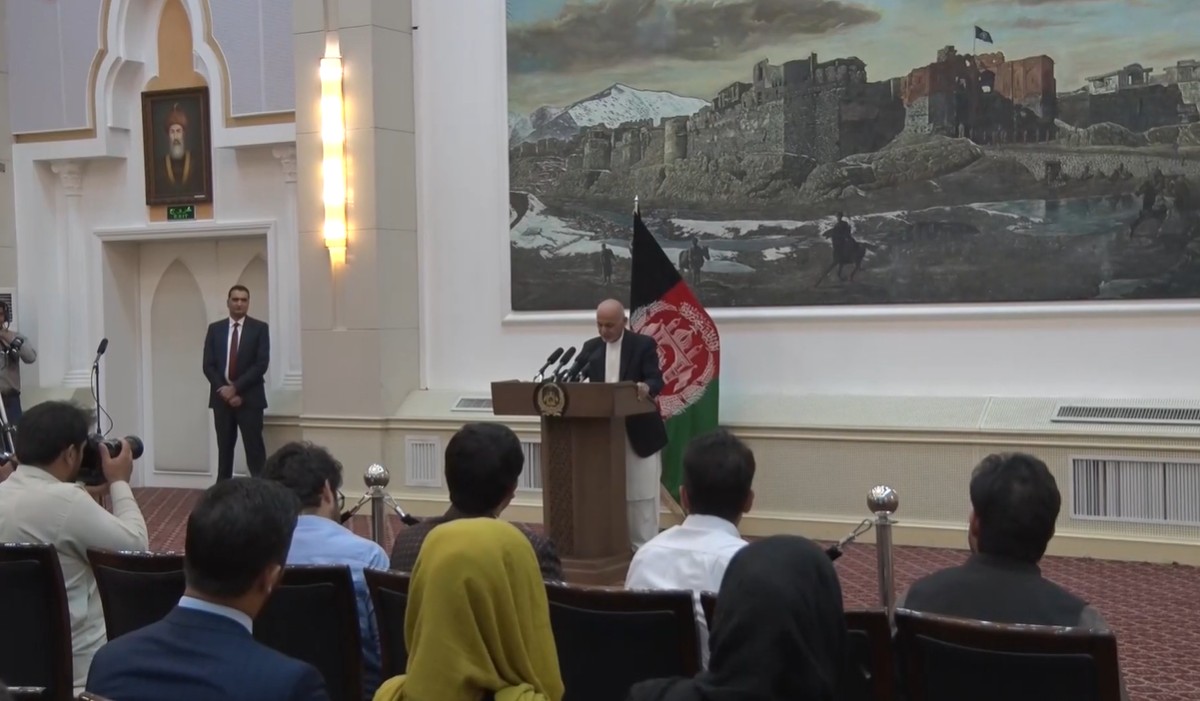
Press Conference on Peace and Ceasefire - ARG
Keypoints:
- National Consultation: Peace needs broad public consultation.
- Inclusive Consensus: Peace is the demand of all citizens.
- Religious Legitimacy: Scholars guide and legitimize peace.
- Controlled Ceasefire: Ceasefires create space for dialogue.
- Transparent Negotiation: Peace follows law and clear strategy.
- Regional Cooperation: Neighbors must support lasting peace.
- People-Centered Approach: Citizens’ safety is always priority.
- Gradual Implementation: Agreements need careful execution.
- Economic Stability: Development supports durable peace.
- Accountability & Sovereignty: Afghan interests guide talks.
In the name of Allah, the Most Gracious, the Most Merciful.
Dear Journalists, welcome.
I am pleased to share key national messages with our great nation today through you, the esteemed members of the press.
First, I pay tribute to the souls of all our martyrs—especially the martyrs of the Security and Defense Forces and the martyrs of freedom of expression—who sacrificed their sweet lives. Their names will remain eternal in the history of Afghanistan.
Dear Compatriots!
Since the beginning of the National Unity Government, I started consultative meetings regarding peace with various strata of society and strove to consider everyone’s perspective on achieving peace. The current international, regional, and national consensus regarding peace in Afghanistan has passed through various repetitive and continuous stages. Now, Alhamdullilah, it has transformed into a nationwide national consensus and demand.
This consensus on peace is the result of consultations with diverse social groups and the entire nation. Just as the epic of the Afghan Jihad does not belong to any single monopoly and belongs to all people, no one has the right to monopoly in the peace process either. Everyone has been consulted; there is a collective consensus on peace, and peace is the demand of all Afghans.
This is a land of consultation. In the holy month of Ramadan alone, I met with thousands of my compatriots, and on Eid day, I greeted approximately 4,000 others; I shake hands with everyone. Ninety-five percent of these people who came told me: "We want peace." During Ramadan, reciters (Qaris) from 34 provinces and Directors of Hajj and Religious Affairs came to the Palace, and they all demanded peace.
The first promise of my election campaign was peace. I told everyone that my first task would be to bring peace. My policy was and is peace. Peace with Hizb-e-Islami was the first step in fulfilling this promise, which succeeded after ceasefire negotiations. Now we move forward. Every step we take for peace is based on a plan and strategy; it is not hurried or emotional.
The next step is the creation of frameworks for peace negotiations. Regional consensus on peace has largely been formed. There is no regional consensus for war. Contrary to the past, regional countries have promised us cooperation for peace. We did not want the region to be embroiled in Afghanistan's war.
Four years ago, member states of the Shanghai Cooperation Organisation (SCO) had concerns regarding the situation in Afghanistan. We addressed those concerns. Now the situation has changed. You saw last month that all SCO member states unanimously supported peace in Afghanistan and assured us of their cooperation. This step by the SCO regarding Afghanistan was unprecedented.
Dear Fellow Citizens!
Consultation is of particular importance to us as a principle, especially consultation regarding peace, which is rooted in our Islamic values. Because we have a great tradition of peace, we strive to achieve it through the continuity of our Islamic values. Our discussion regarding peace is within the framework of the holy religion of Islam and pertains to the conduct of the Prophet (PBUH); his life is a prominent model for us.
The authorities and responsibilities of the President are clear and explicit in the Constitution. It is clear who represents the people, and it is evident which authorities should declare war and peace. Just as we defined the opposing side of the war—knowing whom we are fighting—we can now define the side of peace: whom we are making peace with.
Legitimacy is not by proxy. If someone speaks on behalf of the nation, it must be clarified where their legitimacy stems from and under which law and mechanism they have the right to speak for the nation.
The epic of Jihad is the pride of the scholars and the nation of Afghanistan; the current system and government are the heritage of the righteous Jihad of the Afghan people. Just as the pride of the Jihad belongs to the nation, decision-making regarding peace also belongs to the nation. Therefore, we must clearly know that our decisions are not based on personal taste or whim.
In the U.S. Strategy for Afghanistan and South Asia, the goal of using force is peace, and the objective is a stable and secure Afghanistan within a stable and secure region.
Three factors led us to accelerate the peace process:
-
The gathering of 2,907 religious scholars from across the country in Kabul, who expressed their clear view and unanimous Fatwa according to Quranic commands regarding the necessity of peace.
-
Our religious scholars had two choices: war or peace. They chose the path of peace according to Quranic rulings, as peace is the Sunnah of the Prophet (PBUH), and this discussion has deep roots in Islam.
-
To turn the peace discussion into a point of trust, we had the intent, will, and readiness for a ceasefire. The sanctity of the holy month of Ramadan, Laylat al-Qadr, and Eid al-Fitr led us to announce this ceasefire early. After the ceasefire ended, out of respect for life, we extended it.
Despite the existing consensus on peace, no active movement regarding a ceasefire and peace was visible. If we had waited for a peace treaty to be signed first and then a ceasefire to occur, we would have had to wait indefinitely to stop the bloodshed. We were in a deadlock, like two cars coming from opposite sides of a bridge where neither wants to temporarily back up so both can pass. The ceasefire broke this deadlock and created momentum.
This was a controlled experiment; the war was ongoing, and we responded in case of attack. All security and defense forces were and are in a state of high alert. After the ceasefire, the atmosphere changed. When I went to the Helmand Peace Convoy at Chaman-e-Hozori and they requested an extension of the ceasefire, I accepted their request right there on the spot. Our sincerity, independence, and the government's will were proven to the Peace Convoy. It became clear to everyone that no one else can bring us peace; only Afghans can bring peace, prosperity, and security.
Corruption, lawlessness, and crime are legacies we have inherited from past decades. We have a firm will to ensure that the monopoly over peace is dismantled. Responsible action requires accountability, and there will be no compromise on this; no one has the power of veto.
Regarding the peace consensus, humility, courage, and will are required to listen to the voice of the people and act upon their instructions. The interests of the nation must always be preferred over the interests of a limited few—with all due respect to their freedom and thoughts.
Where is the worry and concern?
On behalf of the people of Afghanistan, I ask: how many more Afghans must perish with the continuation of war? How long must this war and killing continue? I cannot forget the story of Mahgol.
Mrs. Mahgol, who had recently returned from Iran to her homeland with great hopes, lost one young daughter in a terrorist incident during ID card distribution, while her other daughter and husband were wounded. In the Emergency Hospital, Mahgol told me: "Give me back my daughter!" What kind of heart wouldn't melt upon hearing such a plea?
Afghanistan is an open society. A peace treaty cannot be made in secret. Afghanistan's peace policy is a policy of openness and negotiation. Our ceasefire announcement had religious and Islamic legitimacy; that is why it was warmly welcomed by the people and the world.
Consultation is one thing, and decision-making is another. We must distinguish between the consensus and the peace plan. The peace plan will be discussed later during negotiations. It is essential to differentiate between a ceasefire, peace, and a peace treaty. The day we reach a peace treaty, insha'Allah, it will require confirmation and ratification.
The internal dimension of Afghan peace has three sides: the people, the government, and the Taliban. The people demand peace and an end to war from both the government and the Taliban. The government has accepted this demand; it is time for the Taliban to give a positive response. Now the Taliban are facing the nation, the religious scholars of Afghanistan, and the scholars of Indonesia, Pakistan, Makkah, and Madinah. This pressure was also on the government, but the government, as a responsible entity, fulfilled its duty in the face of this pressure. Now the Taliban must decide how to handle such pressure for the sake of peace.
My first duty is to prevent bloodshed. First comes security, and then prosperity can follow. This is a stage of reconsideration and preparation for the start of intra-Afghan peace talks.
Every concern is valid. In consultative sessions with politicians, political parties, civil society, women’s networks, youth, and all strata, I have requested not only a list of concerns but their written plans. I announce again from this podium that we want those plans. It is hoped that organized, logical, and coherent ideas will be shared in writing and become part of the national discourse.
I assure you that at the start of negotiations, the views of all strata will be considered. Since the events of April 27 (7th of Sawr) until now, unfortunately, no practical plan for resolving the crisis that achieves national consensus has been presented.
The legitimacy of the system is continuous; our society and laws are democratic. My tool in every action has been the law, and every step for reform has been taken based on principles and laws, for which there are numerous examples.
Our nation is great, and it showed its greatness during the ceasefire. I am proud of my people, who showed their capacity and restraint; instead of expressing anger at the Taliban, they met them with humility and affection. Our political class must also learn from the people how to show patience. Respecting the people's feelings is important and necessary; we must not stand against the feelings of the people.
Corruption is the work of a small minority. The nation’s wish is to eliminate corruption, and actions are being taken to fulfill the nation's desires. Despite all inherited problems, we are moving in a positive direction. We are resolving issues. The first demand of the people is the end of war and the establishment of peace; peace is a blessing and a grace.
Talib! Come and make the will for peace. This is Afghan pressure, not foreign. It is the demand of the scholars, the people, and the women. Decide! The scholars hold the Quran before you. The people hold their children before you. Now you must decide: will you kill the nation, or will you give the nation a positive answer?
Questions and Answers
Mujib Mashal, New York Times Reporter: Thank you, Mr. President. I would like to ask in English regarding the creation and launch of the ceasefire. What will be the framework for negotiations? Statements from U.S. officials indicate their readiness to take a more direct role in negotiations. Is your government comfortable with a greater U.S. direction in talks with the Taliban, or are you firm against it?
President Ghani: [Translated from English] Thank you. We need to think in several stages.
-
Stage One: We must talk about the negotiations; we are currently in this stage. The goal is to break deadlines and enter into dialogue as soon as possible, having ideas that break barriers and allow us to begin.
-
Stage Two: This is the intra-Afghan stage. We must reach a list of key issues divided into two sections: those related to the Taliban and those related to the government. Then, we arrive at a serious discussion to resolve them. A negotiating team will be appointed by the High Peace Council, supported by the government regarding logistics and necessary consultations. This team will definitely include representatives of Afghan women, and we are mindful of the achievements of past years. The second part of these negotiations will include the roles of both sides—the region, the United States, and NATO. The U.S. has explicitly stated that the duration and mechanism of its presence in Afghanistan are under discussion. Similarly, we must obtain strong and reassuring guarantees from our neighbors for achieving a lasting peace, not just a peace on paper.
-
Stage Three: This involves ratification. This also has two parts: national ratification and international endorsement. At the national level, we must agree on an acceptable mechanism based on the nature of the issue. This could occur within the three branches of government or through a Loya Jirga. The ratification mechanism must be national. As I told you, Afghanistan is an open society; no peace agreement happens behind closed doors. The second part is endorsement at the regional and international levels by governments, where we must detail and demonstrate our commitments.
-
Stage Four: This is the implementation stage, which also has two parts. The first is the timetable for reaching a peace agreement. Initial implementation will face much criticism because trust-building involves several issues: transitioning the Taliban from a military organization to a political one, etc. The second part is the "peace-building" phase—a true reconciliation where all people involved in the war and those living in the country embrace one another and reach a shared vision and a common program of actual action.
The United States is our key partner. I want to refer to our fundamental partner and repeat that the goal of the U.S. Strategy for South Asia is strong support for us. I thank them for creating an environment to reach a stable Afghanistan in a secure and stable region.
Question: Mr. President, during the peace negotiations, it is mentioned that some areas called "Safe Zones" might be handed over to the armed Taliban. This plan was previously proposed by several political parties, suggesting that areas in perhaps six provinces be given to them. Are these six areas included in the peace negotiation process? And will you extend the ceasefire with the Taliban or not?
Zabihullah Dorandish, Khurshid TV Reporter: Mr. President, you announced the ceasefire for another ten days, which ended yesterday. Will you now order the security forces to observe a ceasefire again, or will you allow them to target the Taliban? Many districts are facing security threats. Also, during the Eid ceasefire, many Taliban entered Kabul...
President: You’ve reached your second question! Continue.
Reporter: What is the security forces' plan to identify these individuals? It seems a serious threat still exists in Kabul. It is unclear if these Taliban are interested in peace or will continue their movements; for example, the former commander of Paktia was killed in Kabul yesterday. Thank you.
Baes Hayat, Ariana News Reporter: Regarding the handover of "Safe Zones" to the Taliban, I wanted to ask under what plan this would occur? There is a major concern: until today, we say Pakistan is a sanctuary for the Taliban; let it not be that Afghanistan turns into a sanctuary for the Taliban. Who proposed this plan? Also, I had a 30-minute interview with the Governor of Maidan Wardak, who said the Taliban abused the ceasefire and caused 13 checkpoints in Jalrez to fall by coming in the guise of the ceasefire. Was there abuse, and what was the cost to security forces during this ceasefire?
President: The "Safe Zone" plan is not a government plan. There is no political consensus on this. Any proposal or rumor in this regard is an individual plan. I met all 34 governors last week. Each had 15 minutes, and then I spent hours with them in four groups. There is no general consensus for a "Safe Zone" in the way it is publicly pictured. Those are later discussions or suggestions. The government is one government with one flag. We are not handing over any area to anyone.
The plan is: how do we expand social services, especially in the context of drought, floods, and unemployment? A child of a Taliban member must have the right to go to our hospital. The sick wife of a Taliban member is an Afghan woman; we must provide health services to her. But as for areas turning into specific bases—the geography of Afghanistan is sacred and unified.
I hope this is clear: the ceasefire is over. Our security and defense forces are permitted to conduct their operations. The reason is that this peace plan was proposed from a position of strength, not weakness. All 34 governors requested that I conduct coordinated and organized operations. However, the start of operations coincides with the extension of the political process. The political process will continue. What is clear now is that many Taliban want peace; they showed they are tired of war, and we must respect that.
Dear Brothers and Sisters! If this had been any other nation and these Taliban had entered the cities or districts, how many of them do you think would have been killed or assassinated? How many would have been chased out with brooms? We must learn from the nation. The nation showed it is ready for reconciliation, and this is the greatest achievement. Therefore, we do not deviate from the goal of peace, but it was clear that the ceasefire was a controlled experiment at this stage. Now, the people must pressure the Taliban to come to a ceasefire. Whenever the Taliban want a ceasefire, I am ready. The people’s demand is a ceasefire. Let them determine the duration with us—whether they want ten days or one year. But if there is an attack, the response is with force. The Presidency is one part of my duty; being Commander-in-Chief is another.
The ceasefire was 98% successful, which is comparatively unique. Look at hundreds of peace treaties; the most difficult issue is the ceasefire. The actions in Maidan Wardak were answered with full force. The forces had operations yesterday, and wherever actions against the state occurred, I authorized operations. Declaring a ceasefire was not an announcement that we would tie our hands behind our backs; it was a clear signal that we want to reach a compromise. By the grace of God, all 34 governors have an absolute consensus that the ceasefire changed the political and battlefield atmosphere. In two provinces, there were serious concerns because the Taliban took no steps toward a ceasefire there: Sar-e Pol and Faryab. In the remaining 24 provinces, they assessed the situation as very positive; in others, it was average. Security forces had instructions from day one to be vigilant. The work of National Security (NDS) did not stop in any city. There was no ceasefire against terrorists in the cities. Information has increased, awareness is higher, but we must understand that we live in a dangerous environment. The forces are fully aware, and a first-degree state of alert for our security and defense forces is necessary and has been implemented.
Zabihullah Khurshidi, Shamshad Reporter: We want to know the result of the recent talks with Pakistan and the exchange of delegations. Thank you.
Hadith Pardes, Radio Azadi: Unfortunately, whenever the topic of peace is mentioned in Afghanistan, the name of Pakistan is mentioned alongside it. What promises has Pakistan made, and how much can these promises be trusted?
Karim Amini, Tolo News: Thank you. Mr. President, the people expected you to give two messages today: First, the bad news, which is unfortunately the continuation of the war imposed on the people—and I think that was given. Second, the good news, which would be the end of the war and the positive results you gained during the ceasefire so that negotiations could begin. Much has been said about negotiations and plans, but the important thing is: have you received a green light, a message, or a sign for the start of negotiations, or are these just plans we have in our own pockets?
President: Thank you! Our plans are not "in our pockets," with all due respect. If our plans were just in our pockets, the Afghan people would not have had "two Eids" this year. For any of you under forty, this Eid was the first time you truly experienced an Eid. I hope your judgment is fair and based on logic. The Afghanistan I inherited versus the Afghanistan of today is—in terms of national, regional, and international consensus—a very different Afghanistan.
Was the world running away or not? Were we in isolation in the region or not? If our plans were just in our pockets, we would not have reached this regional and global consensus today. Had you heard the voice of peace and support for the Afghan peace process from the Two Holy Mosques in the last forty years? Peace is not a process like a 20-kilometer movement from one fixed point to another; it is not one-sided. Especially Afghan peace, which is multi-dimensional. Therefore, focus on the goal, renewing consensus, and flexibility in achieving the goals are required. The point of hope I have proven in practice to the nation is that the movement is positive. However, something we have not yet reached cannot be declared a success. Success is the day we celebrate the implementation of a peace treaty. This is a wish and a hope that is not achieved in one step. We must clearly understand that difficult negotiations lie ahead. This nation must decide; this nation must reach a conclusion on the fundamental differences that exist. We must bring the region into the framework; we must bring the world into the framework. This isn't like me being a teacher giving a lecture from start to finish. The Presidency of Afghanistan is a heavy burden that requires precision; it is a movement in the midst of floods and must not go under.
Regarding Pakistan: First, our relations with Pakistan have three different dimensions. First is how Afghanistan and Pakistan will live together once, insha'Allah, the Taliban issue is resolved. For forty years, no fundamental work was done on this. A major part of our work now is to understand how Afghanistan, as the "Crossroads of Asia," can prove beneficial to Pakistan. I will give two examples:
The World Bank published a report stating that Pakistan will have two scenarios for its centenary in 2047. If it moves as it did 30 or 40 years ago, it will be a very poor country. But if it takes fundamental actions, it might reach a middle-income level economically. A major reason for this is how it engages in regional cooperation. To this end, do not forget that in that same year, Afghanistan will celebrate the 300th anniversary of Ahmad Shah Baba, and we must also know what we have done in 300 years.
For the second scenario to be realized, Pakistan needs 75,000 megawatts of electricity, which cannot be met internally. Therefore, transferring electricity from Central Asia to Pakistan is a vital issue. We can do this; we can prove it practically. Right now, $1.5 billion in private sector investment is under discussion to bring several thousand megawatts of electricity from Turkmenistan to Pakistan through us—and this is just the beginning.
Second, Central Asia. Who can compete with Kazakhstan in wheat production? If we want to get Kazakhstan’s wheat to the Gulf, what routes will we use? Today, the plan is the railway. Uzbekistan has stepped up, and I especially thank His Excellency Mirziyoyev, who is investing $500 million of his own money in this railway; we provide $500 million of our own, and they provide the rest.
If Pakistan wants Gwadar to stand on its feet, is there any other profitable way besides connecting this port to Central Asia? So, a major part of our discussion is how we live with each other. Brothers and sisters, this discussion is new and it is a successful one because Central Asia has entered the fold very strongly. Our goal is not just Pakistan; we want to link Central Asia to India. The TAPI project is an example of this, and we will have other projects, insha'Allah.
The second point is that in our relations with Pakistan, the Taliban issue must be resolved. What has happened and what is needed? For the first time, an agreement has been reached on paper. The framework for negotiations between Afghanistan and Pakistan has been put on paper; now, serious actions are needed. We want progress in these actions. But it doesn't mean a policy that lasted seventy years—and especially forty years—must change overnight. We must be prepared for the stages of change and have the patience and focus.
I have neither a foreign friend nor a foreign enemy! I am the representative of Afghanistan's interests! I don’t play favorites. Afghanistan’s interests are my criteria. My criteria, the criteria of our national interests, govern all negotiations. This is not emotional; we have shared culture and languages, but the basis is mutual respect—specifically the independence, territorial integrity, and sovereignty of Afghanistan. Our progress is much better compared to other times, though it has not reached the stage where we can truly call it successful. But the direction is positive. It’s about who you talk to. If you are brothers in a house or if you are neighbors, there is a greater need to talk to the neighbor with whom you have a dispute than the one you are on good terms with. The point is for us to talk to each other; there is no logical way other than talk. We must have continuous dialogue and have confidence in ourselves—and we do have that confidence.
What is the example? Did the scholars of Afghanistan and Pakistan meet in Indonesia or not? Did the scholars of Afghanistan come with emotion, logic, and reason or not? We must represent ourselves and we must not have fear.
What is the third dimension? The issue of terrorism and extremism. On this, we must reach a clear agreement on how we will cooperate in the future and how we will prevent other movements. There is a fear among the people: if we negotiate with the Taliban, will another movement be supported by another country tomorrow? We want the root of the insecurity problem to end. Peace negotiations are a means to create a secure Afghanistan; the negotiations themselves are not the goal. Peace treaties are of two types: 50% fail in the first five years and lead to intensified insecurity; the other 50% have relative to total success. We clearly want to reach a peace plan and agreement that results in security. We saw these three days—weren’t the restaurants in Kabul open five or six hours longer? Didn’t thousands of people go to their villages for the first time?
Drought! In any other country, our drought would be the primary topic of discussion. Drought knows no language, religion, or ethnicity; it is a matter of humanity. My request is that we must reach clear agreements on human issues and work on them.
So, our conclusion is that negotiations have moved forward; the "paper" has progressed. This will continue, and we are hopeful it will bring results. Without clear results that the people of Afghanistan are convinced of, we will not be satisfied, and until then, we will continue our stance and our negotiations.
Long live Afghanistan!