
Economic Self-Reliance through Private Sector Growth, Domestic Production, and Strategic Investment
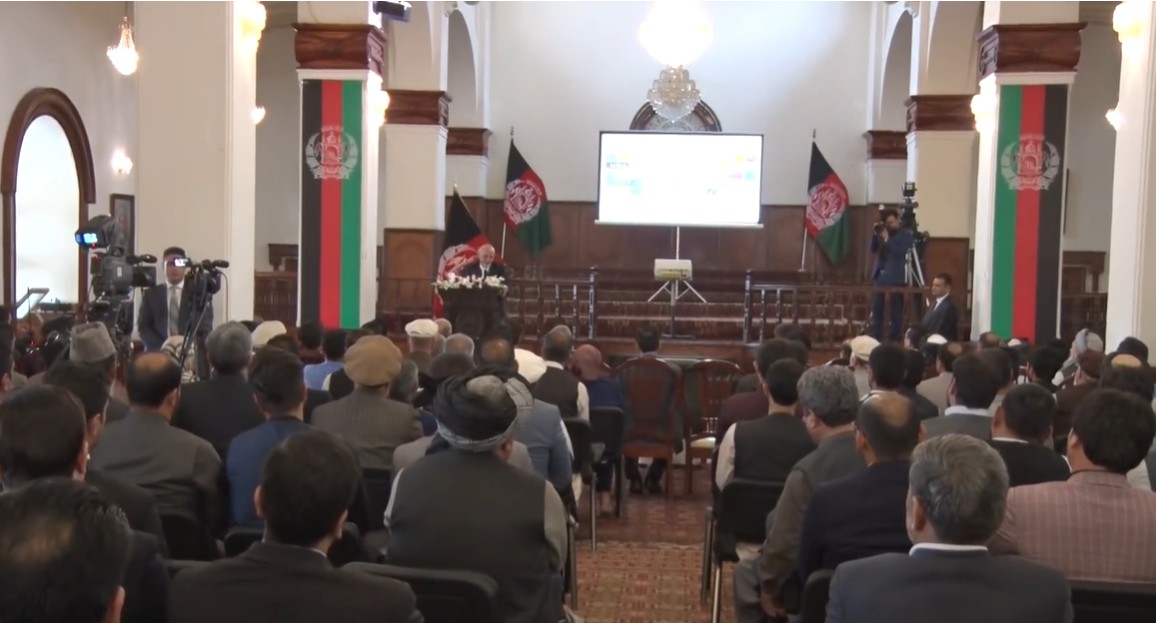
Speech at the “Celebration of Industry and Investment Week
- Economic Self-Reliance: Building a production economy.
- Private Sector Partnership: Government enabling private business.
- Industrial Growth: Industry and agriculture driving development.
- Domestic Production Priority: Supporting Afghan-made products.
- Investment Promotion: Encouraging national investment.
- Trade Balance Reform: Reducing imports through production.
- Consumer Responsibility: Choosing Afghan goods.
- Bureaucratic Reform: Simplifying systems and procedures.
- Infrastructure Development: Expanding power and industry.
- Accountability and Results: Ensuring responsibility and performance.
Salam Khana Palace
In the name of Allah, the Most Gracious, the Most Merciful.
Dear industrialists, esteemed investors, respected brothers and sisters, Mr. Kaminzada, Mr. Alokozay, Mr. Wafiq, all distinguished guests, Minister Durrani, Deputy Ministers, and Mr. Masjidi; first of all, I offer you the greeting of the Leader of Humanity: Peace be upon you, and the mercy of Allah and His blessings!
My remarks are divided into several sections:
Congratulations, Appreciation, and Recognition
First, I offer my congratulations, a warm welcome, and my sincere gratitude and appreciation. I congratulate you all on Industry and Investment Week. This week carries a message of hope—the hope that Afghanistan is moving from dependency toward self-sufficiency. Instead of relying on others, we will rely on ourselves, and you, the distinguished attendees, are the primary vehicle for this transformation. Achieving this goal is impossible without you; with you, it is within our reach. Therefore, I thank you.
My gratitude is genuine. Each of you who has invested here has accepted significant risks and faced various obstacles. While investing elsewhere might be a matter of convenience, investing in Afghanistan is an act of self-sacrifice. You think with a national mindset, and I thank you for your national commitment and welcome you here. As Mr. Alokozay, Mr. Kaminzada, and Mr. Wafiq mentioned, a tripartite alliance—as mandated by our Constitution—is the key to our prosperity.
The private sector, particularly the sectors of industry, agro-industry, and the manufacturing economy, is the engine of development. The government does not produce. My colleagues shouldn't take this the wrong way, but unfortunately, many of our government counterparts act as obstacles to production. I hope Mr. Masjidi and the rest of you listen to this; the industrialists are telling you this. They are very polite people—they tell you, they tell Mr. Shams, and they tell all these deputy ministers. Is it not so? They don't tell me; they tell you.
Fundamentally, partnership is the basis for a country's progress. The government is not an obstacle; the government is a facilitator, a provider, and a protector of the private sector. Above all—and I want all levels of the bureaucracy to hear this—the government is the servant of the private sector.
If there is no agriculture, industry, or trade, how many days could you survive? Do you produce bread through red tape or through investment? I want to speak clearly because the nation needs clarity. Today, medals are being awarded to Mr. Kaminzada, Mr. Wafiq, and Mr. Alokozay; however, the formal presentation will take place at the next High Economic Council meeting. This recognition is well-deserved because you have raised the problems and grievances of the private sector with me with great sincerity and honesty. I thank you for acknowledging that progress has been made and a partnership has emerged. But the problems must be solved. I heartfully thank you for your courage and commitment to the private sector, industry, investment, and women’s development. These must be celebrated. The medals were delayed only because I was held up elsewhere yesterday, but you will receive them at the next session; they are your right.
Our Objective is Clear
Our goal is clear. While we lose martyrs every day in an imposed war, in the economic sphere, it is our own incompetence that causes our imports to be seven times greater than our exports. Do not blame this on anyone else. This is purely due to the incompetence of the state; there is no other reason. Why?
Look at our housing. Why did people build on the hillsides? Because in previous years, the Ministry of Urban Development lacked the capacity to even draw plans for a few buildings or distribute land equitably. The Ministry of Commerce and Industry was unable to finalize and activate industrial parks despite having tens of millions of dollars. There was no shortage of money; there was a shortage of will and understanding. We didn't know how to create opportunities for the people. People earned money through the sweat of their brows in the Gulf, they returned from Pakistan and Iran, but no one gave them even two biswas (units) of land legally. Is it not so?
Domestic Preference
Third, until my arrival, who even used the phrase "domestic preference"? The state was spending billions of dollars, but did it ever say, "We will prioritize domestic products"? Without domestic preference, how can you compete? Is the playing field truly level? Look at our neighbors; if we are to compete with them, we must level the field. So, why do some officials commit treason within that 25% domestic preference by selling foreign products to the army, police, and government under the name of domestic production? This is unacceptable.
Direct Procurement
Fourth, why do we not buy directly from the producer? Why is the producer forced to go through a contractor? I will give you the example of rice, and I thank those who brought this to my attention. Mr. Wafiq mentioned it—last year, I asked if Afghanistan produces rice or not. All the ministries, which are the largest buyers, came and said, "No, sir, there is no production; it isn't enough." Do you know where they had gone for their information? To the Mandawi (wholesale market) in Kabul. That was the extent of their intellect.
I told them there is rice in Kunduz and Nangarhar. They came back with a hundred more excuses, saying it’s not there and it’s imported from abroad. I sent delegations, officials from the Ministry of Agriculture and other sectors, until it was verified. We initially bought 5,000 tons. Production was stimulated and rose to 35,000 tons. And do you know what they did then? They gave the contract to a middleman so the producers would have to give 20% or 30% of their profit to him. How can a producer survive then? I removed all of them and gave the contracts independently. My request to the Chamber of Commerce and Industry, the Women's Chamber, and all other chambers is to unite and eliminate the middlemen.
If an Afghan industrialist invests in any production sector and the government does not utilize it, the government has, in truth, committed treason against the nation. This is unacceptable.
The Choice: The Virtuous vs. The Vicious Cycle
Let us come to the main point of our objective. We have about seven billion dollars in imports; in previous years, it was even higher. Does the Afghan consumer realize they are part of a vicious cycle? Brothers and sisters—especially sisters, since the purchasing power is in your hands—ask yourselves daily: do you want a virtuous cycle or a vicious cycle?
The vicious cycle is when we wear foreign clothes, use foreign jewelry, eat foreign bread and milk, and even consume foreign eggs and poultry. This cycle hands the key to Afghanistan’s dependency to others.
Conversely, look at the virtuous cycle. We complain about unemployment; all our youth complain about it, and I complain more than anyone. But the key lies with the consumer. If a family and a consumer union are formed in Afghanistan that declares "It is excellent because it is Afghan," we can change everything.
Dear compatriots! Do you think Japan made high-quality goods from day one? When I was young, the phrase "Made in Japan" was a joke. Does anyone laugh at Japan now? China’s quality used to be second or third-rate; how did it reach first-rate? Because the consumers of those countries decided that this is a virtuous cycle. If you want to eliminate unemployment, spend your money on your own products. It is okay if, in the initial stages, the quality is slightly lower.
Have you seen my second coat? I live with just one or two coats. Reduce your consumption a little and, for the sake of God, increase your production. This is the only way forward.
They mentioned several fundamental problems, and there are a few additional matters I wish to present to you.
The Bureaucratic Mindset and Private Sector Partnership
The first issue is our bureaucracy, which has truly turned into a chronic disease. While fundamental changes have been made at the levels of Deputy Ministers and some Directors, the mindset of our bureaucracy remains a rigid "state mindset." Their recurring habit is to either compete with the private sector or keep it under their thumb. We cannot build this nation with such a mentality. The private sector is neither anyone's servant nor anyone's rival. The private sector is our partner, and we can only move forward through partnership. You are all witnesses—has anyone ever said I asked them for something personal? Your demands are legitimate. I do not work on your requests because they come from person A, B, or C; I work on them because they are the demands of the sector, and we must fulfill the sector's needs.
Therefore, my request to the private sector is that in future meetings of the Economic Council, you give me a "report card" and a score for every ministry head who acts as an obstacle to you. We need to understand what the real issue is. We must stop speaking in riddles and start speaking plainly. If they are creating even more obstacles in the provinces, let us find a solution.
Accountability and Legal Reforms
Regarding laws, we know they are not always aligned, but Mr. Ajmal Ahmadi has taken the greatest share of the work in this area with me. I thank Mr. Ahmadi, but I must apologize, Mr. Masjidi—aside from you personally, we have seen no benefit from the rest of your ministry regarding laws. All the things I mentioned, I worked on them myself; if I hadn't, nothing would have come from your side. It is with great regret I tell you that after the High Economic Council decided you must take action, the final report showed you still haven't established the Service Center. From now on, whenever a ministry becomes an obstacle to the private sector, I will announce to the entire nation that they are a barrier with problems—let the people judge them! Either remove the obstacles yourselves or give me the authority to remove them. These ministries cannot be run on personal connections; there must be fixed regulations.
I have an idea: if you agree, I will instruct Mr. Nader Nadery to form a specific group within the Administrative Reform and Civil Service Commission. We should identify young men and women who have the competence to work with the private sector—people like those working with Ajmal Ahmadi or Dr. Qayoumi—so we can appoint them to the agencies that work directly with you.
Enterprises are not managing all of this. My promise is that we will discuss this fundamentally in future High Economic Council meetings to ensure this capacity exists. Mr. Masjidi and Mr. Shams are working on this so that more youth can come in to lighten their load and get the work done. In this way, God willing, we will succeed.
Infrastructure and Results-Based Governance
In the electricity sector, you clearly saw that nine provinces received electricity in three years. It will reach Nangarhar in a few weeks; I will go there and inaugurate it. Tomorrow or the day after, we will have an inauguration in Logar. Within two years, you will see all provincial centers connected to the national power grid. However, this is not the result of the Ministry of Energy and Water's work; it is the result of Dr. Qayoumi's efforts. If it weren't for Dr. Qayoumi, not a single one of these tasks would have been completed, because there are serious problems within that ministry and our domestic power production has not stood on its own feet. All dam projects have stalled, and I hope the nation judges this, as the government has only one year left. We cannot afford to be lenient with everyone. They must either do the work or answer to the people; I will no longer defend anyone.
Is there a single day where I haven't worked sixteen or eighteen hours, eventually being forced to write the papers myself? You saw it today, and you likely saw it the other day, but the point is that we must arrive at a single mindset. The main change needed in the bureaucracy is simplification. Every time, the fundamental problem of our bureaucracy was corruption. Corruption is being resolved—though unfortunately, it still exists—but our most difficult problem is that we still lack a problem-solving mindset. Every time we give an instruction—for example, to give land to Mr. Wafiq—they come back with ten problems. Brothers and sisters! If there were only problems, how could I solve the massive issues? On the day I became President, did you expect to stand here today and speak with honor and respect, or did you think this country would, God forbid, be destroyed? If we all do not have a problem-solving mindset, the problem won't solve itself. The definition of a problem is the path to its solution. A precise definition of a problem is its own solution.
Sectoral Investment and Executive Oversight
My final point concerns the decision-making process of the High Economic Council and other councils. I have reviewed all the projects submitted for partnership over the last three days—proposals amounting to billions of dollars. My suggestion to you is to divide these by sectors. Based on these sectors, we will determine clear investment conditions and principles for each, and you will then tackle them project by project in an orderly fashion. This way, our priorities will be within a clear framework.
For instance, tens of millions of dollars of investment are needed for electricity, and we will simplify the work there. This means for certain things, investment requires a specific type of government assistance—such as land, which is within our control, or changes to laws and regulations, which is within our power. Another part involves risk analysis or the government’s commitment to purchasing your goods. In this way, I believe we can solve the fundamental problems.
Alongside that, my proposal is that every time after we discuss the sectors, we define five or ten problems and their solutions clearly, with specific deadlines and defined responsibilities for each government agency. Regarding your suggestion to have an executive committee within the President's Office: consider it done. I will establish this in the Office of the President because we cannot keep running after every individual. You know that for every single electricity project, I have made at least ten phone calls. Do you think it is the job of the President of Afghanistan to follow up on every single power project or investment?
The End of Inefficiency (CBR and Foreign Travel)
I say clearly from this hall: the CBR program (Capacity Building for Results) will be canceled again. We created the CBR program and high salaries so that colleagues who gained eligibility through government investment could solve problems. If they haven't solved the problems, why should they have salaries ten or twenty times higher than others? I want to see results for Afghanistan's growth from the CBR program within six months. If we don't have results, it isn't necessary to pay them those salaries or have them driving in expensive cars.
Furthermore, any official at the Deputy Minister level who wishes to travel abroad must first visit two provinces; only then may they travel abroad, otherwise, they will not be permitted.
I have traveled the whole world and worked throughout the world, but I found my knowledge among my own people and my commitment among my own investors. My honor is in this soil; you have no honor outside of this land.
Conclusion
So, I thank you, and I congratulate you once again. From the bottom of my heart, I want us all to find a single spirit. Currently, the problem with our bureaucracy is that every time you ask them to solve a problem, they bring a piece of paper; it takes six months just to define the problem, and then they want another six months for the state to make the initial investment and manage it. This is not the solution! The solution is for the bureaucracy to become small, effective, truly join hands with the people, and create an atmosphere of partnership with the investor.
God willing, this will happen. I am certain that this commitment and fundamental mindset exist in the new generation, but it is necessary that all the problems they face in the offices be solved clearly and transparently. It must be clear who is responsible for what, from whom we expect responsibility, and to whom we should give authority.