Empowering Afghan Women: Upholding Justice, Strengthening the Nation
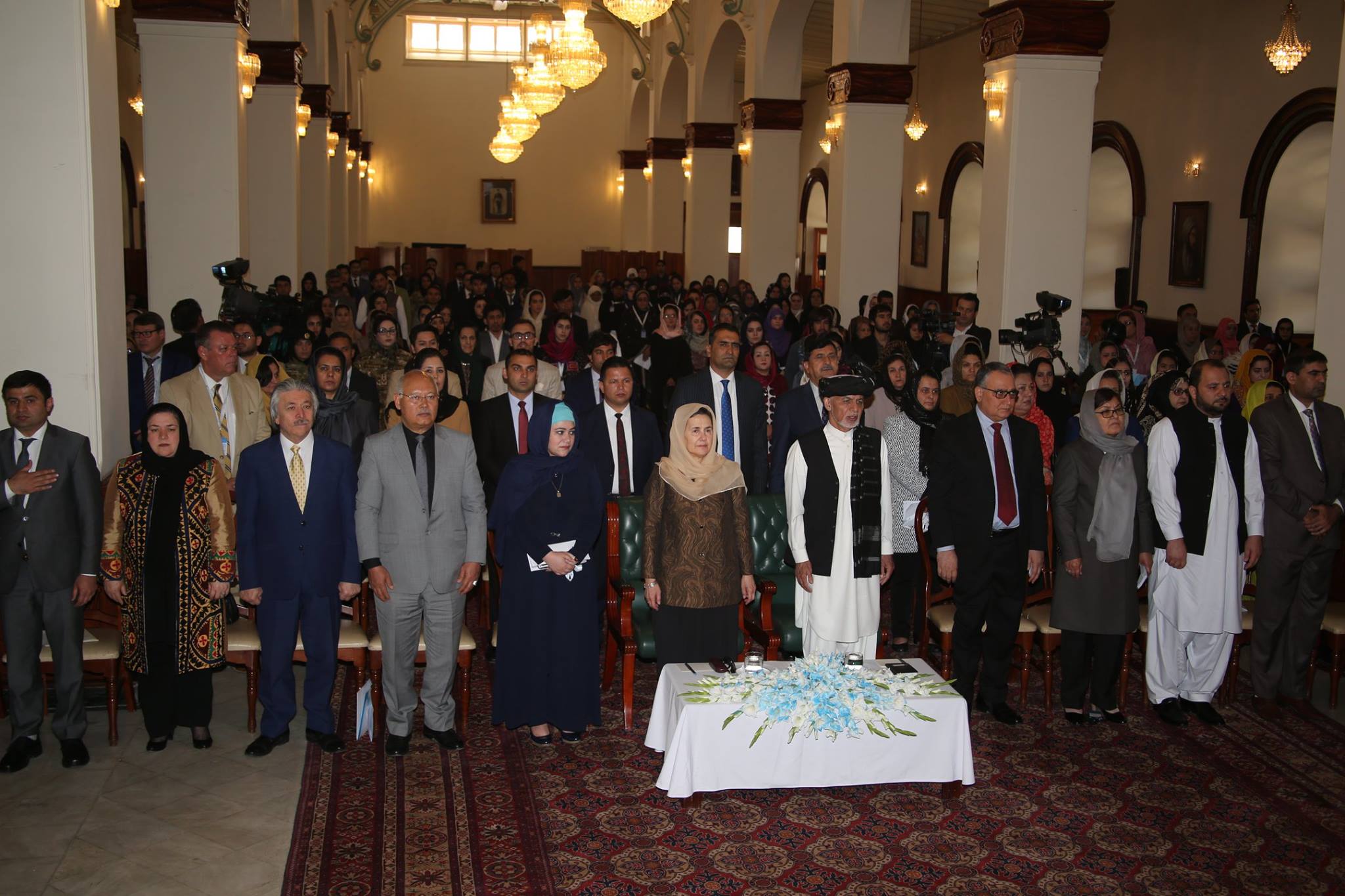
Speech at the 5th National Symposium on Afghan Women
Keypoints:
- Citizen Responsibility: Active participation in civic duties.
- Rule of Law: Fair implementation of the Constitution.
- Women’s Empowerment: Full inclusion for progress and equality.
- Social Cohesion: Unity, moderation, and cooperation.
- Ethical Governance: Transparent and accountable leadership.
- Education & Capacity: Investing in women and youth.
- Economic Justice: Reducing poverty and ensuring opportunity.
- Sustainable Peace: Social peace alongside political stability.
In the name of Allah, the Most Gracious, the Most Merciful.
Honorable First Lady, esteemed members of the Cabinet, Dr. Sima Samar, Dr. Habiba Sarabi, Mr. Sultanzoy, all elders, Mr. Rahimi, honorable Ambassadors, our distinguished guests Ms. Pamaloni and Ms. Brunisach Kenz, and especially the dear sisters who have traveled from all corners of Afghanistan: first and foremost, I offer you the greeting of the leader of humanity: Peace be upon you, and the mercy of Allah and His blessings!
Condolences and the Struggle for Stability
Our entire nation is grieving due to recent terrorist attacks; therefore, I begin by offering my deepest condolences and sympathies to the great people of Afghanistan. The attacks in Nangarhar, Kabul, and Khost demonstrated that these assaults are strikes against our independence, democracy, and freedom—not against a specific class or group. These attacks are an aggression against all our national and Islamic values and serve as a sign of the enemy’s malicious intent to prolong forty years of instability in our country. Have no doubt: the enemies of Afghanistan are the enemies of Afghanistan’s stability, development, and liberty. They are not at war with a single specific Afghan; they are at war with the Afghan nation, with Afghan rights, and with Afghan freedom. These attacks are carried out by people who hold no positive vision for the future of this country. If they have a vision, let them bring it to the field!
Killing and destruction are not acts of responsibility; they are examples of irresponsibility and sedition (Fitna). In our Islamic culture, sedition has a specific meaning—it is the cause of instability. Those occupied with sedition are the enemies of the entire Ummah and the whole nation.
The Responsible Citizen and Accountable Government
My dear compatriots! The discussion of the "Responsible Citizen, Accountable Government, and Healthy Society" is the best possible theme for this point in time. I thank all the active women and the Women’s Union of the country whose initiative made this fifth symposium possible. I also express my appreciation to the First Lady and her colleagues, who successfully oversaw the third and fourth symposiums. It is my hope that the respect I hold for the First Lady becomes the standard for every husband in Afghanistan toward his wife, and I hope every Afghan man finds the courage to say he has learned much from his wife. I also thank our international partners, the ambassadors of friendly nations residing in Kabul, and Mr. Yamamoto, the Special Representative of the UN Secretary-General, for their warm presence.
To all of you, I say welcome. Khosh Amadid, Shaghlast, Uz Opingizge Khosh Geldingiz. Welcome to your home, the Arg Presidential Palace; your presence is an honor to us.
The Definition of Citizenship
What is the difference between a citizen and a non-citizen? I saw a very good example of this five years ago at the Dubai airport. We always travel without bodyguards. I was sitting there when some friends arrived from Saudi Arabia. For many years, before Afghanistan had a Constitution, we felt a sense of disorientation. But the day we returned to our country, one person at the airport asked us something and another on the road asked: "What are you doing?" We replied, "What are you doing? You are my servant; answer to the nation!"
The first point of citizenship is ownership of the country. First, God Almighty is the owner of this land, and second, the great nation of Afghanistan is its owner. It is the great nation of Afghanistan that has always preserved this soil. Citizenship is a commitment and a social contract—a contract in which we all have equal rights and obligations. I thank you from the bottom of my heart for giving Bibi Gul and me the honor of serving you from this position for these days or years. Your participation in the elections is what allowed your compatriots—who possess a "mad love" for this country, though some have simply called them mad—to come into your service.
A Message to Terrorists
I specifically thank the women who have come here from various provinces. Welcome! Your presence here is a clear and bright answer to the terrorists: it shows that the dignified, patriotic, and capable women of Afghanistan are engaged in discussions about stability, freedom, responsibility, harmony, and cooperation. Your existence here is the most vivid response to the terrorists. The Afghan woman does not go backward. You cannot trap the Afghan woman in spiritual or material poverty again. You cannot force the Afghan woman back into hiding, creating secret study circles under the guise of embroidery or handiwork. The Afghan woman is present, and her presence is permanent.
The Price of Instability
Our fundamental issue is the matter of instability versus stability. From the oath of Ahmad Shah Baba to the ratification of our Constitution, we have lacked the rules and principles of the game for a stable system. Every generation, or every generation and a half, we have veered toward instability. The great nation of Afghanistan has always paid the price for this instability. Our last major period of instability between the 1978 coup and the creation of the Bonn Process cost the Afghan nation $240 billion in damages. Study our economic growth compared to our neighbors during those decades; those who had continuity, even if they did nothing else, moved forward. We, however, had absolute negative growth.
Because of this, although every generation of Afghans was born into this soil and committed to it, they could not fundamentally plan for the future of subsequent generations. Five of our generations have been affected by war. Instead of the positive result of harmony, we have experienced the experience of deprivation. Which Afghan family is not grieving? Which Afghan family has not seen blood, experienced migration, or felt its pain?
The Constitutional Foundation
Therefore, the first principle of citizenship is having a Constitution. Without a Constitution, other points do not yield results, because the principles and rules within which a political system takes shape can only be formed in a Constitution. Secondary, tertiary, and quaternary laws are all necessary, but the foundational point is the creation of a Constitution. Our Constitution has solved the fundamental issue of stability. Why? Because the Presidency and the National Assembly are established based on the free will of the people. The term limits on the Presidency are among the best guarantees of our freedom. Power is not individual; today, the power in your Presidency does not come from the sword; it comes from your will.
Categories of Citizens' Rights
In this region, our Constitution is the most Islamic law and, at the same time, reflects all the values of the Universal Declaration of Human Rights. The rights of citizens can generally be divided into four parts:
First, Civil Rights: The first right is to "have rights." The right to have rights is the most fundamental right. We have the right to have rights and to fundamentally secure our civil rights within the framework of the courts. But if the courts are not just, if decisions are not made with fairness, the entire order of society faces danger. Therefore, the guarantor of our civil rights is an impartial and independent judiciary. On the other hand, civil rights carry obligations, the most central of which is the social contract among the people themselves. You in this hall today are a sample of the social contract of Afghanistan. Regardless of which village or province you come from, none of you is less than the other. However, it is necessary for the responsible citizen to preserve these civil rights. Without the active participation of the responsible citizen, civil rights cannot be sustained.
Second, Political Rights: Until a hundred years ago, many women in European and other countries did not have the right to vote. Most political rights were not granted; they were seized through much struggle. No one "gifted" us civil or political rights. Political rights cannot be sustained without the active participation and contribution of citizens. Rights that exist on paper in our national document must be transformed into clear political rights. This is why political movements, political parties, and especially nationwide political networks exist. Most importantly, what is the definition of a nation? It is a people engaged in a free debate to determine their own future, to review their past, and to use the present to create a shared future. This happens through political freedom.
Third, Economic Rights: This is the most difficult issue for us because at least one-third of our people suffer from hunger. When the poverty line is above 50 percent, how can this society remain sustainable or reach stability? Poverty is the fundamental enemy of Afghanistan's stability. Anyone who thinks that the current artificial extremism is the key or the prescription for stability must think again. A friend of mine in Nepal said it best; he was a millionaire, yet he said: "I prefer to be a member of the middle class in a country with a strong middle-class foundation than to be a billionaire in a country that has five billionaires and 99 percent of the people in poverty." Therefore, our economic discussion is a fundamental discussion of citizenship.
Cultural Rights and Balanced Development
The fourth pillar is our cultural rights. The diverse identities and languages we identify with are all enshrined in the Constitution. Most importantly, our Constitution emphasizes the principle of balanced development. Balanced development means that all geographical regions of Afghanistan—women, men, the elderly, and the youth—must stand together within a clear and balanced framework.
What is the conclusion of this part of my remarks? The form of our system and our future direction are determined by the Constitution. Therefore, our debate is no longer about what kind of Constitution we should have; the century-long struggle for constitutionalism, which began in 1896 and concluded in 2003, has reached its fulfillment. Our Constitution is the end of a hundred years of disputes and conflicts. Now, our only duty is the implementation of the Constitution. Our fundamental task is to turn the Constitution into the "rules of the game" and apply it to ourselves.
Barriers to Progress: Misogyny and Nepotism
The goal is clear: the issue is how we implement it. So, the question is, what are the obstacles? The first obstacle is that our political and administrative culture does not yet align with the Constitution. One small example is that our state culture is still misogynistic. A state culture that is misogynistic does not contribute to Afghanistan's stability or gender equality. It must be unacceptable to view the Afghan woman as a "second-class" being. The Afghan woman has a first-class personality, and I am proud of her.
Another issue is the legacy of allowing personal relations to override regulations. Why did regulations fall under the influence of personal ties? Because when the state collapsed, people found their "insurance" in personal connections. This wasn't unnatural—it happened because governance vanished. Until transparent governance based on the Constitution is established, personal ties will dominate. A responsible citizen is one who does not accept the superiority of connections over rules. If the entire nation raises its voice at once to reject the rule of personal connections, those ties will flee and hide from you.
Politics as Service, Not Trade
Another obstacle is that politics has become a business. Politics is about belief, faith, and commitment; it is not a trade. If our goal is to use politics as a tool to get rich, it is better to spend that talent in trade and investment, not in the political arena. If politics is treated as a toy or a tool for profit, it stands in direct contradiction to the spirit and text of the Constitution.
The Constitution demands responsible and ethical politics from both the state and the citizens. If we want the Constitution—our national covenant—to ensure our stability for the next five hundred years, we must define political ethics and prevent the extremes of both the left and the right. We must not give extremists the opportunity to darken the political atmosphere in the same way they attempt to terrorize us. They must be held accountable.
Politics is not about opportunism; it is a commitment to current and future generations. Every mistake we make today will be paid for by future generations, just as every commitment we fulfill today will allow future generations to build grand structures upon it. A major obstacle is that we are destroying our own home. If you think you are digging a pit for another Afghan, you will fall into it yourself. The culture of hypocrisy and division (nifaq) must end. Citizenship means that a culture of unity and cooperation must emerge.
The Responsible Citizen: A Local Example
I will give you an example of a woman in Ghazni whom I have unfortunately not met personally. She heard on the radio that electricity is produced from water. All the men of the village were either in the army, the police, or outside the country. She organized the women, made all the arrangements, and brought electricity to her own village. This is what we call a responsible citizen.
We often say that "work should be given to the capable", but we must ask: who is giving work to the incapable? A debate must emerge in this society. Citizenship responsibility means asking: when incapable individuals are appointed to positions, what is the reason, and why should we accept it? This is a national discussion; it does not belong solely to me, but to the entire great nation of Afghanistan.
Positive vs. Negative Freedom
What is the responsibility of citizens? I submit to you the distinction between two types of freedom: Positive Freedom and Negative Freedom.
-
Positive Freedom is the freedom used to expand social and cultural capital and strengthen relations without harming anyone. When you call for unity, cooperation, and harmony and take the initiative yourselves, that is positive freedom.
-
Negative Freedom is that which harms others. We understand the "wound of the tongue" in our culture; when we humiliate, insult, reverse the truth, and hurl baseless accusations, that is not freedom—it is the abuse of freedom.
By the grace of God, I have the patience for this. While I may have a reputation for lacking patience, I calmly endure billions of insults. This is like water passing over my head—just as water passes over a fish, it passes over me—because I leave the judgment to the Afghan nation. However, political ethics do not involve using negative freedom. Some whose predictions fail time and again still present themselves as "experts." What kind of expertise is that? Those who spread widespread distrust—what kind of hope is that? Where are you going? If you spread distrust, where will you find a path forward?
I recently finished a book—a series of letters between Mr. Fakhri and our major writers. You can see the atmosphere of despair in that text. Even the best writers spent months in refugee camps but lacked the strength to even participate in a few magazines. They understood nothing of the language of the land they were in and had no access to Dari literature. Do you want to repeat that situation? Is that responsibility? It is not the state's responsibility to censor negative freedom—censorship is ineffective. It is the citizens' responsibility to stand against negative freedom. When the loud voice of Afghan men and women is raised against negative freedom and encourages positive freedom, the society moves toward stability. There is a Pashto proverb: "Your tongue (mouth) can be your fortress or your calamity." I do not speak much because, for me, the mouth is a fortress, and I do not want it to turn into a calamity—I have enough calamities already.
The Scales of Justice and Participation
A responsible citizen must hold the scales of justice and fairness. Is it fair how we determine our direction, or is it not? Another feature of a responsible citizen is participation. Without your contribution, sisters and brothers, politics will not find its direction, the economy will not move, and civil society cannot be strengthened. Being a citizen means that rights must be turned into action. A right that is not used remains idle. The beauty of social and cultural capital is that, unlike financial capital, the more you use it, the stronger it becomes.
Unity and Integration
Most importantly, citizens must be connected. If every citizen turns themselves into an island, an ocean cannot exist. If every citizen does not consider themselves a drop, a river cannot form. Our potential power lies in the connection of citizens with one another. Women's networks are a major vehicle for this connection. Instead of one woman always speaking as a representative, this power exists within all Afghan women.
Secondly, you must be integrated. Whether we were born in migration or here, we want to live in this country and ultimately return to God in this country. If that is the case, is there a need for us to be integrated or not? Individually, we can do some things, but the power that exists in the collective does not exist in the individual. Unity and integration are what will break the "political gatekeeping" .
I have no gatekeepers; do not allow others to create closed doors. The Arg is open, and you should make it even more open. But the necessity isn't just for the Arg to be open—it is for the entire state to be open, and for all levels and strata of society to be open to one another. If our guests and personal relations are not "Afghan-inclusive," we cannot think "Afghanistan-inclusive." We must think of the East, West, North, and South all together, for we are all—by the grace of God—necessary for one another.
The Equality of Women
In conclusion, I come to the role of women. My humble suggestion is this: if we want to compensate for the damages of the last forty years, we must accept the rights of women as equal Afghans with both eyes open. A country as advanced as Japan has concluded today that if the participation of women increases, all development improves. We, who have lost forty years, cannot afford to keep half of this society in a corner. It is neither fair nor just to think of division.
Gender Harmony and Constitutional Equality
Women and men must be in harmony; conflict between genders carries a heavy price for us. A culture of misogyny is costly, as it causes the man himself to undermine the very foundation of life. In my view, the values of the Constitution cannot be implemented without the nationwide participation of women. This Constitution does not differentiate between men and women; it enshrines equal rights. If our goal is to clothe the Constitution in the garment of action, it is essential that we understand this fundamentally.
Women as Architects of Social Peace
Women play a massive role in bringing peace. I thank the First Lady, all colleagues, and the women's networks for organizing last year's symposium. Previously, focus was placed on "productive peace." Political peace will come, God willing, but social peace is a necessity. Sustainable peace cannot arrive without social peace and the role of women. The active role of women in creating a culture of forgiveness and moderation is impossible without mutual acceptance.
Elections and Political Representation
There must be coordination regarding the participation of women in elections. Last week, unfortunately, the rate of voter registration for women was only 24 percent. My request and plea is that you bring the registration and participation of women to its peak. If our negotiators are told during peace talks that they represent only 24 percent of Afghan women, what will their answer be? If they are asked why the President takes the stand that women's rights are non-negotiable based on only 24 percent support, how do we respond? These elections—both parliamentary and presidential—are vital because tomorrow, decisions will be made regarding rights. We must end the war, but based on what principles? The role of women here is vital. Historically, the message of women in this society has been one of moderation. I have seen very few extremist women; by the grace of God, their numbers, like those of corrupt women, are very small.
Education and Quality Reform
This is the year of education. I express my heartfelt gratitude to the people of Afghanistan who decided through councils that their daughters must go to school. If anyone thinks the people of provinces like Khost, Paktia, or Zabul do not want their daughters to be educated, let them go and ask. In Helmand, where some claimed women were invisible, over 800 women sat for exams. In Herat, the number of women testing for teaching positions exceeded the men. This is not the old generation. We now have enough educated women, and society has resolved that every girl must go to school.
Now that there is demand, we must provide the supply by raising the quality of education. We must not repeat the past where we left people illiterate in multiple languages. Global experience shows that investing in one woman or girl changes five generations. I am a living example of this; if my grandmother had not been educated, I would not be standing before you. Afghan women must organize in the sectors of education, health, and public rights. Our village councils should move toward a true 50-50 representation. Even if mothers are not literate themselves, they can exercise oversight.
Governance, Corruption, and Reform
The system we desire based on constitutional values has not yet been fully created; that is our future work. We suffer daily from the infringement of fundamental human rights and the use of force. Our enemies want us to remain perpetually unstable by involving us in hypocrisy and secondary issues to distract us from our core objectives: the four types of citizenship rights.
An accountable government focuses entirely on establishing and strengthening rights. Reform is not for the sake of reform or because I am a teacher who wrote a book on it; reform is for the peace of the people and the institutionalization of democracy. This country has no other path. We have experienced dictatorships and dynastic systems, and they do not work here. Only the will of a free nation can bring stability, and that is achieved through elections.
Corruption is the result of personal relations overriding regulations and giving work to the incapable. Compare the results wherever work has been given to the capable; the difference is clear. Those who sabotage elections sabotage stability. We must make voting simple and easy. Terrorist attacks target transparent elections and our political stability. Therefore, citizens must fulfill their responsibility in ensuring security and participating.
Economic Self-Reliance and Ownership
We must reach a consensus on reforms. Elections are the opportunity for candidates to explain their vision and competence for Afghanistan's future. Remember, the Afghan nation has a "doctorate" in political consciousness; they can easily distinguish between empty words and real work.
Why is reform mandatory? Because the current state of economic dependence and growth is not a formula for stability. I convinced the international community to invest, but in six years, those commitments will end. Assistance will not continue at this scale. We must stand on our own feet. We are grateful to our partners—the United States, the European Union, Japan, Australia, Canada, and forty other countries—but they must see that Afghans have ownership of their future.
The most important indicator of citizenship is a sense of ownership, which brings a sense of responsibility. Ownership is not about constantly asking for more; it is about how we produce wealth ourselves through unity. Reform is a natural process. Just as we are born and grow old, generations must transition. The new generation and the women of Afghanistan must fulfill their ownership and responsibility.