Advancing Justice, Protecting Women, and Strengthening National Institutions
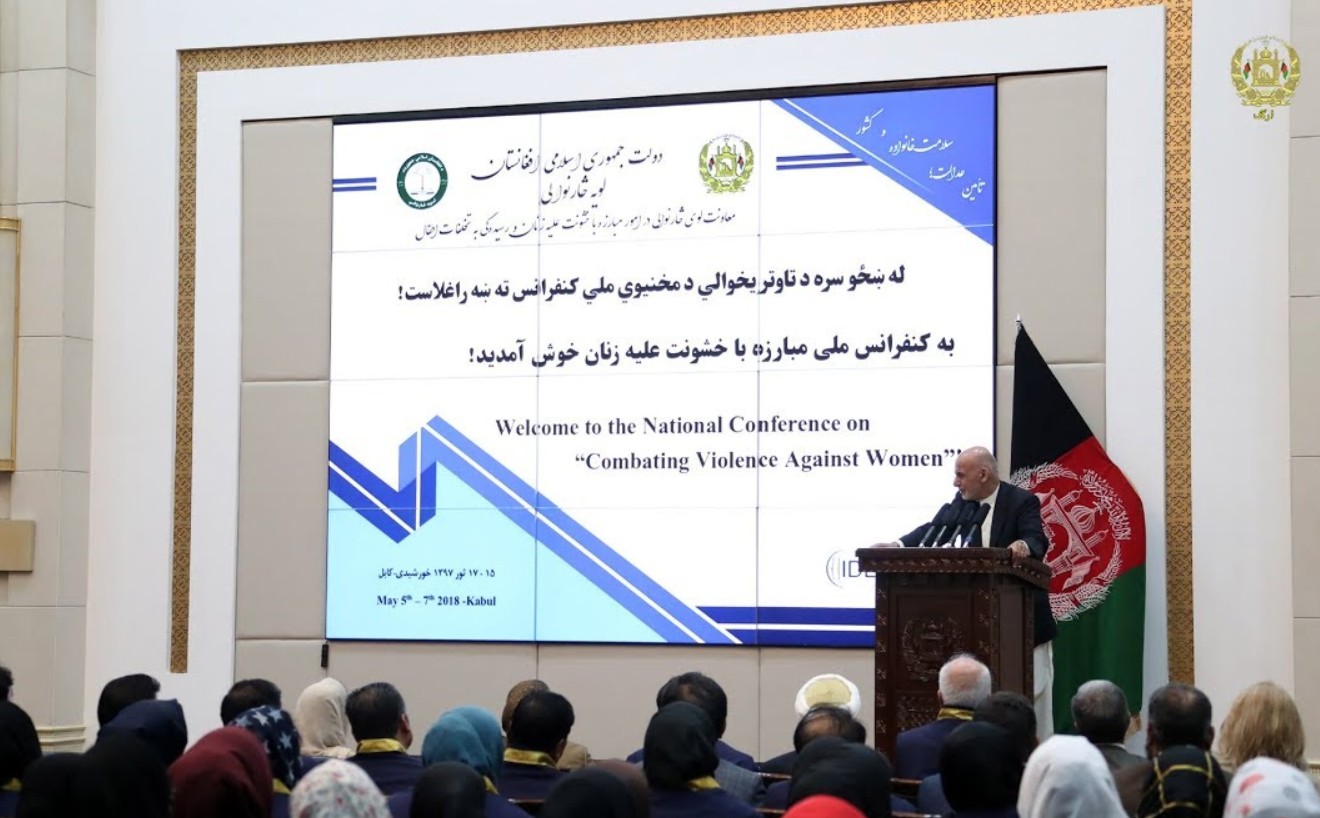
Speech at the Closing Ceremony of the National Conference on Combating Violence Against Women
Keypoints:
- Women in Justice: Empower women to fight violence.
- Nationwide Justice: Expand prosecutors to all regions.
- Judicial Independence: Strengthen judiciary autonomy.
- Rule of Law: Ensure justice underpins governance.
- Combat Violence: Address crises and empower women.
- Unity & Cooperation: Men and women act together.
- Modern Afghan Identity: Blend Islam, nation, and law.
- Next-Generation Leadership: Prepare youth for stability.
- Civic Participation: Promote free and fair elections.
- Family Support: Recognize families’ role in public service.
In the name of Allah, the Most Gracious, the Most Merciful.
Honorable First Lady, Honorable Attorney General, Deputy Attorneys General, Honorable [Mawlawi] Kashaf, all prosecutors—especially the 242 newly appointed prosecutors who are among us today—and all attendees: Peace be upon you, and the mercy of Allah and His blessings.
I begin with congratulations and gratitude. Congratulations to the 242 members of the Attorney General’s Office who were commissioned as prosecutors today; the newly appointed graduates and specifically to our 93 dear sisters!
Today is a day that I celebrate for the women and men of Afghanistan—a day when not only 93 women will take an active part in the fight against violence, but 242 Afghan men and women, with a shared vision and without discrimination between genders, will stand together against violence.
I congratulate the provinces, and specifically the 24 districts where our sisters will be serving. Expanding the circle of justice to the most remote corners of the country is a fundamental goal of the Islamic Republic of Afghanistan. It is hoped that this great step by the Attorney General will be followed by other major strides until the day comes when prosecutors in general, and those specialized in combating violence against women in particular, are present in every point of Afghanistan.
I thank the Attorney General, the Deputy Attorney General for Combating Violence, and all deputies and colleagues who support the Attorney General's Office. Specifically, I want to express my gratitude to the Attorney General for his commitment and iron will in ensuring justice, the rule of law, and transparency. Thank you, Mr. Attorney General.
Independence of the Judiciary and the Attorney General’s Office
The second topic is the independence of the Attorney General’s Office and the Judiciary. Today, you received the greatest gift: the first part of that gift is the Holy Qur'an. Some may think the Qur'an is merely kept on a desk for difficult moments, but I refer to it every day. Because I refer to it daily, the enemies of Afghanistan are unable to break our collective will.
Today, you newly appointed prosecutors are not merely employees of the Attorney General's Office; you are the officials responsible for implementing Islamic justice and the mandates of the Afghan Constitution. The foundation of the holy religion of Islam is built upon justice. In other societies, force or the sword is seen as the instrument of power. But in Islam, the sword has never found legitimacy without the Holy Qur'an and Sharia. Without justice, there is no agriculture, no trade, no order in the army, and no public discipline. All of these rely on justice—it is the foundation, and if justice breaks, the order of the universe breaks. Therefore, it is vital that you do not see yourselves merely as representatives of the prosecution, but as representatives of the State, the President, and the special representatives of Afghanistan.
The independence of the Attorney General’s Office is key to the prosperity, stability, and security of Afghanistan. A hundred years from now, when historians judge us, they may or may not appreciate other things we did during the National Unity Government; but it is hoped that they will look with appreciation at the investment we made in the independence of the prosecution and the judiciary of Afghanistan. This will be our lasting legacy; for when the prosecution works independently and the judiciary decides independently, justice is ensured. And when justice is ensured, war and conflict are sidelined.
The Fight Against Violence and the Role of Women
The third topic is the fight against violence. For 40 years, across four generations, we lost opportunities and lived in crisis. The Afghan woman is the engine of movement to compensate for these 40 lost years. I believe in your ability to rectify these 40 lost years within four or ten years and serve the nation.
The Afghan woman is a factor of harmony; standing shoulder-to-shoulder with the Afghan man without prejudice or superiority, she ensures our national unity—which must be valued above all else. Today, I am proud that you are here from different corners of Afghanistan, especially from those districts where the intensity of war still prevails. You, men and women, signify that you have broken from the past and will draw the future based on our brilliant several-thousand-year history, God willing.
Furthermore, the Afghan woman represents a New Afghanistan—one rooted in our national and Islamic values, yet in alignment with our Constitution, which is the most Islamic law in the region while incorporating the values of the 21st century. Our Constitution is a means of dialogue between civilizations. We have deep roots, and those roots have always positioned Afghanistan as the crossroads of civilizations. A country that is the crossroads of the region and whose future prosperity depends on being the regional hub must understand the entire world without losing its own values. Values belong to humanity, not just one corner of it. In this regard, it is necessary for the Afghan woman to be a representative of progress. Ultimately, you are the generation of transition: from war to stability, from poverty to prosperity, and from violence to coexistence and cooperation.
The burden on your shoulders is not light, but I am certain that you can carry the trust we have given you to create a stable, prosperous Afghanistan free of war and violence. The secret of your victory lies in your unity and in the networks you build and strengthen over the coming decades of your careers.
The Art of Listening and the Purpose of Conferences
My final point is that your conference is beginning. A conference is not a mere formality. Conferences are not held just to deliver speeches that put people to sleep, leaving them with nothing when they walk out the door. Conferences are for learning something fundamental. We have many great qualities, but in my view, we have some room for improvement—specifically in the art of listening (Ghor). One thing I learned through great difficulty and experience is that one must first listen attentively.
The Attorney General and [Mawlawi] Kashaf will tell you that in all high councils, I do not speak first. Whether a meeting is one, two, or three hours long, I listen to everyone. By listening, the pains of all of Afghanistan reach my desk, but along with them, all of Afghanistan's opportunities reach my desk too. We must listen to one another. Listening is not just about hearing words; it is about asking: "What was new in this person's speech? What obstacle did this colleague clarify so that we might learn something?" Seminars serve this purpose, and they are the means for you to become friends and understand each other. They are the means to create a national commitment. Based on this commitment, when you return to your districts and provinces, you must create a new discourse in society.
The Rule of Law and Elections
What is this discourse? First and foremost, it is the Rule of Law. Our survival lies in the rule of law. From my side, assure all the people that elections will 100% take place; they are mandatory. Ask the whole nation to participate.
Why are elections essential? Why are the rule of law and elections linked? Because if the authority of the Presidency is not determined by the will of the people, where will the legitimacy of the Attorney General’s Office come from tomorrow? How will the law have legitimacy? The law must first be applied to the President, the First Lady, the Attorney General, Mawlawi Kashaf, and the Minister of Women’s Affairs. If you do not start from the top, the rule of law cannot be established from the bottom. Where officials are above the law, that country is not a country of law. Therefore, elections are mandatory so that the people know they are voting with a free and transparent will. Furthermore, the role of the prosecution is to ensure that if there is a violation of the law, the citizens have the means to cast their great trust—their vote—freely.
Commitment to Service and Family Support
In conclusion, I want to express my gratitude to all of you who joined the prosecution, especially the 242 of you. In the past, there was a tradition—with due apologies—where if someone was asked why they were joining the prosecution, they might say it was to get rich quickly. You have not come here to get rich; you have come here to serve.
I thank our 93 sisters, and I especially want to thank their families. Families who have raised such daughters and sons—who are committed to the rights of the Afghan people and believe in the active role of Afghan women—and who support them. I saw two children here today [accompanying a female prosecutor]—their will must be strengthened by their mothers and society at large. I am confident that you will fulfill the trust placed in you with complete integrity.