Electronic ID: Foundation of a Transparent and Accountable Digital Afghanistan
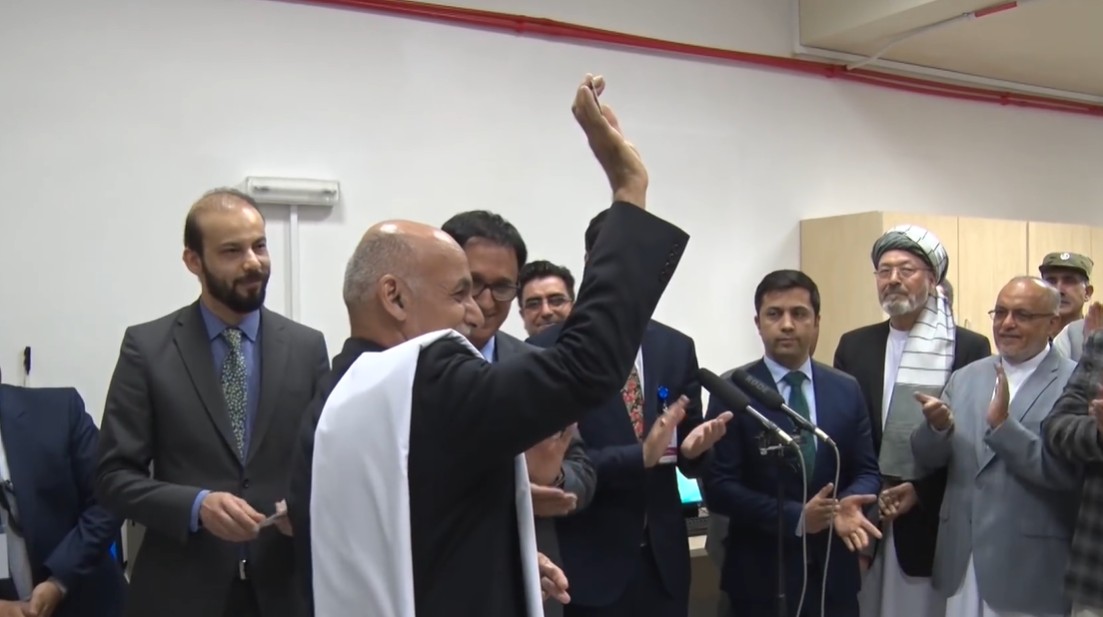
Speech at the Launch of the Electronic National Identity Card (e-Tazkira) Distribution Process
Keypoints:
- Secure Identity: Biometrics ensure every Afghan’s identity is verified.
- Transparency: Data-driven systems reduce fraud and irregularities.
- Accountability: Government and institutions can track actions and resources.
- Efficiency: Quick, simple processes replace lengthy paperwork.
- Inclusive Governance: All citizens can access services and participate in elections.
- Economic Growth: Reliable data supports planning, investment, and development.
- National Unity: One identity reinforces Afghan pride and shared citizenship.
In the name of Allah, the Most Gracious, the Most Merciful.
Dear sisters and brothers, esteemed compatriots, elites of the Afghan nation, Professor Danish, Mr. Ibrahimi, Mr. Muslimyar, Mawlawi Sahib Kashaf, the Chief Justice, the Attorney General, Engineer Mohammad Khan, all honorable members of the Cabinet, representatives of the private sector, Mr. Mujaddedi, Batur Dostum, and all sisters and brothers: Peace be upon you, and the mercy of Allah and His blessings.
Why are we starting this process today? The remarks by Mr. Mohtat and the excellent film shown demonstrate that in the 21st century, governance, economy, and especially service delivery cannot function without information. The necessity for information that can be gathered quickly—providing us a general picture of the country with the use of a few computers—is vital.
The second point is convenience. When verifying a marriage certificate can take up to 13 days, with this electronic ID, it can be resolved in a few minutes. This applies to our other fundamental issues as well. However, the most critical factor for me in choosing to start today was the recent terrorist incident. Again, I offer my condolences to the families of our security and defense forces, the families of journalists, and all civilian martyrs of Afghanistan. There is an extremely high probability that the suicide bomber utilized a forged ID card.
Therefore, the most important decision for me is the security of the Afghan people—so we can know who is Afghan. Biometrics can clearly prove in all documents exactly who someone is, where they are from, and what their background is. It is a necessity that we are able to identify this.
The martyr [Ahmad Shah] Massoud said with pride, "I am an Afghan and a Muslim." This is our national and popular identity; it is our point of unity. No matter where we are from, we can easily obtain this ID card.
Another point: starting the electronic ID process does not mean stopping the paper-based IDs. On the contrary, these are two parallel processes moving forward simultaneously, especially for the sake of the elections. It is necessary to understand that both processes are managed by the Population Registration Authority with the utmost integrity. However, the electronic ID offers significantly more conveniences, as explained by the global community, Mr. Mohtat, and the presentation.
This is a fundamental step toward state-building. It creates a system that can implement the constitutional mandate for balanced progress. Balanced development means being able to collect data on geographic locations, gender, and different social strata so that we can plan based on information. One of the most important results of this will be budget expenditure that effectively meets the needs of the Afghan people, God willing.
I want to repeat these points in Pashto, as this is a vital day for our country. The electronic ID is built on the foundation that information is gathered fundamentally without fraud or interference, establishing the identity of every Afghan. Every Afghan is a source of pride and value to us; therefore, we must know their identity. The identity they personally acknowledge—their village, their location, their province—will be verified. We need the "big picture." There are still discrepancies between provinces and ministries regarding population counts, age demographics, and where people live. These issues will finally be put to rest, God willing.
What does this mean? From the perspective of governance, economy, growth, and specifically services, Afghanistan will enter the 21st century.
Second: Simplicity. We need a single identity on this card, rather than requiring 50 pages and 50 signatures. When we present this card, everyone will know who you are; the process becomes simple and questions will cease.
Third: Security (The most important reason for today). Terrorists and extremists use forged IDs, which puts the security of all our citizens at risk. Protecting the life and property of every Afghan is the fundamental duty of the state. As the martyr Massoud said, we take pride in our "Afghan-ness" and our "Muslim-ness"—this is the shared aspect of all Afghans. This pride must be documented.
My final point is that the paper ID cards are not being discontinued. They will continue for voter registration. These are two parallel processes that will eventually merge. The electronic ID—a term all Afghans are now familiar with—utilizes biometrics. I usually avoid using English terms, but this is the first time I find no alternative [laughter]. People have become accustomed to "biometrics" because a person’s eyes and fingerprints are highly reliable. The electronic ID completes this task.
In conclusion, I call upon the great nation of Afghanistan: this is a symbol of our National Unity. We all stand in one rank to achieve this.
However, take the elections seriously! In a democratic system, elections are the tool for change—achieved through the people’s vote without force or compulsion. It is essential that all Afghans obtain their ID cards, have their identities verified, and participate in the elections.
My final request to all the people of Afghanistan is to take an active part in the elections. The elections belong to the nation; the will of the nation builds the state. A state founded on the people’s will must necessarily conduct elections so that we may determine our own future.
I congratulate Mr. Mohtat and all his colleagues, as well as the staff of other departments who worked with them. I assure them of my full support to successfully complete this national project. Just as you made Afghanistan equal to the best countries in the world in cricket, achieve the same with the electronic ID.