Honoring the Legacy and Vision of Sardar Mohammad Daoud Khan
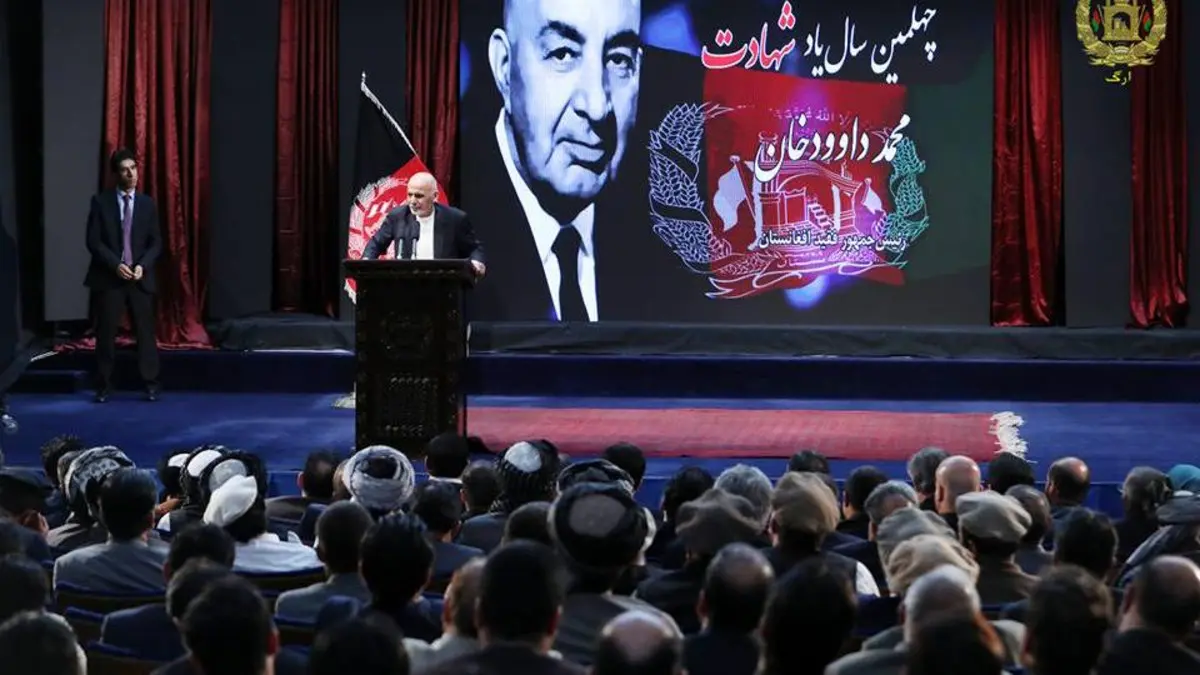
Speech at 40th Anniversary of the Martyrdom of Sardar Mohammad Daoud Khan
Keypoints:
- Leadership Virtues: Emulate integrity, courage, and vision in action
- The Unfinished Chapter: Past reforms failed due to personal focus
- Institutional Governance: Shift from top-down rule to consensus
- Economic Sovereignty: Achieve $8B revenue to end aid
- Intellectual Independence: Build the future on Afghanistan’s history
- Consensus for Peace: End 40 years of conflict through unity
- Democratic Accountability: Safeguard freedom of expression and diversity
- The 2047 Vision: Mobilize youth to complete nation-building
In the name of Allah, the Most Gracious, the Most Merciful
Honorable Nadir Naeem, esteemed members of the Cabinet, distinguished guests, youth, scholars, members of Parliament, and patriots who love this land—first and foremost, I offer you the greeting of the great leader of humanity ﷺ: Peace and blessings of Allah be upon you!
Shahid Daoud Khan and his family were the first victims of the Saur Coup, and forty years after their martyrdom, the blood of Afghans continues to flow. This bloodshed must stop; peace is our vital necessity. We have a national consensus for peace, and we will accept no obstacles on the path toward it.
Let there be no doubt about our national will for stability, prosperity, and justice through a democratic system. This country can only reach stability and prosperity within the framework of the Constitution based on democracy.
With your permission, I would first like to speak about five unique characteristics of the martyr Daoud Khan, and then present five challenges inherited from his time to the next generation and the generation of Mr. Liwal for further research.
First was his personal integrity. There is a famous story that his children were not allowed to use state vehicles. One of his daughters had gone to the hospital where Mrs. Nawaz was the director. After the check-up, it was late in the day. Daoud Khan was the President. He told her, "Niece, I will give you my car to go home," but his daughter was trembling with fear [the President gestures to show shaking]. I wish this culture were practiced throughout all of Afghanistan. Not for one day did Daoud Khan treat the public treasury as his personal property, because the treasury belonged to the nation. After the Saur Coup, no matter how much they searched his house to find evidence of misappropriation, they found nothing.
Second was his courage. I remember vividly how he would come to Logar in his white Toyota. He would drive to Parwan himself, sitting at the steering wheel with his wife beside him. A single Jeep would follow behind, but even that was not allowed to come closer than fifty meters. Daoud Khan did not fear his people, and we do not fear our people. We stand among our people and raise our voice from their midst to say: stop the bloodshed.
Third was his decisiveness. One day he went to Bagram to inspect the airfield, the foundation of which he had laid himself. Hundreds of our trained pilots lacked barracks and apartments—General Abdul Hamid and other generals, do you remember? Please, General—at that very moment, he ordered that the Air Force pilots in Bagram be given apartments. Before he was martyred, all those apartments were completed. This required a specific kind of attention. This country needs such principled decisiveness. These are the traits and messages that must remain with us.
Fourth, Daoud Khan was intimately familiar with the geography of Afghanistan. Once, while sitting in a plane with his colleagues, he described the villages below to them. He knew every point of Afghanistan and clearly understood their specific characteristics.
Fifth was his management of security and infrastructure. During Daoud Khan’s time as Prime Minister, nationwide security prevailed; we could move and travel to any corner of Afghanistan. Furthermore, on the day he became Prime Minister, paved roads were limited to only four or five kilometers within Kabul city. By the end of his premiership, he had laid the foundation for a principled infrastructure to connect Afghanistan. By the end of his presidency, our highways were superior to those of most neighboring countries.
These are the aspects that must continue. When we speak of "Continuity and Change," those parts of our history and the figures who became examples are worthy of great respect.
First, regarding your two proposals, before I move to the next section: we honor General Pacha Mir a thousand times. May God protect you for preserving this historical secret. I will grant you great honor, and we will arrange a special ceremony for him. Please, General Pacha Mir¹!
Second, the monument to honor martyrs is in the final stages of design. I had appointed a committee; we are in the final selection phase, and as soon as possible, we will lay the foundation to honor our martyrs and begin the registration of their names. All of us are grieving on this day, including myself. My uncle, General Shahpur Khan, was among the martyrs. My entire family—the men of my family—were either in solitary confinement or under specific restrictions in Pul-e-Charkhi. The memory of Pul-e-Charkhi is unforgettable for any Afghan, and the value of these martyrs is a national value.
There are methods of governance today that require revision: decision-making was individual-centered and not institutionalized. It is clear that in the current situation, decision-making must be institutionalized, and we must build institutions. A major reason why neither Ghazi Amanullah Khan nor Shahid Daoud Khan could finish the "Chapter of our Aspirations" was that the type of decision-making was individual-centered and top-down. Consensus did not reach the grassroots level, Mr. Liwal!
Second, censorship was pervasive. Speaking as someone who spent his childhood and youth during the era of the late Daoud Khan—we did not have the right to freedom of thought; we were always under the surveillance of the intelligence services (* ضبط احوالات*). It is necessary to look at this aspect. If freedom of speech had been allowed in both eras, the foundations of the system would have been significantly stronger. A small minority was able to stage a coup because the majority had become distanced from their leader. This requires re-thinking. In the two stages where the 7th and 8th Councils saw the voting method become public and a political class was emerging, political parties were taking shape. Both times, elections were suspended by the martyr Daoud Khan. Therefore, from the perspective of the growth of a democratic culture, there was a pause in both eras, which led to various extremists taking the stage and the isolation of society. There is a very clear modern necessity for the people of Afghanistan to understand that we must trust the Afghan people.
The people of Afghanistan today hold "PHDs" in politics; they can all make their own judgments. It is essential to think about this. Creating a democratic system requires political patience. If there is no political patience, no tolerance for opponents, and no real political debate, then a system cannot be built solely on top-down consensus.
One very bitter part is this: Mr. Liwal mentioned the aspirations of the constitutionalists (Mashroota), but the constitutional system was suspended. A constitutional system could only have emerged if the Constitution had been respected and political parties and freedoms were made public. I am certain that with the purity, sincerity, and intent that Daoud Khan possessed, the nation would have stood with him. However, we must reflect on why, in both eras, limited circles perhaps changed his path. Therefore, we must ask: was a coup a tool for transformation? This is a fundamental question for the people and thinkers of Afghanistan. Do we always want change to come through force, or through the law? This experience must be researched deeply so we can reach conclusions.
In conclusion, I want to suggest the necessity of a historical debate for the new Afghan generation. I thank the commission members, the ambassadors, the Secretary General of the Red Crescent, and others for their presence.
Daoud Khan, like other history-making figures, was a multi-dimensional personality. Judging him on only one dimension would be a mistake. We must weigh both the conditions of the time and the dimensions of his character. When Daoud Khan took responsibility, the world lacked a democratic consensus. If decision-making was individual-centered, this was the policy of almost the absolute majority of countries then known as the "Third World." Therefore, a deep historical inquiry is needed. I thank Mr. Liwal, Mr. Hewadmal, and Mr. Rafi!
What is clear at the start of this debate is that this nation and this political class must be "Country-Centered." The system is for this land; this land is not for the system. The system is a tool for the people; the people are not a tool for the system. We must have this clarity, and it means our full independence must be achieved.
I will speak on one dimension: how can you call yourself independent when your entire development budget is part of "charity"? We must have goals. For example, if we want economic independence, we must have at least $8 billion in revenue. Currently, we have $2.2 billion, which does not even cover the expenses of the army and police.
Second is intellectual independence. The basis of everything is intellectual independence. And what does intellectual independence require? We must understand the five-thousand-year history of this land. If we do not fundamentally understand our five-thousand-year history—especially the last six hundred or one hundred years—we cannot imagine our future. In the year 2047, Pakistan will be one hundred years old; we will be celebrating the 300th anniversary of the great Ahmad Shah Abdali.
Come and bring a picture of what the Great Ahmad Shah Baba did and what we are doing. Was it right that we had not yet taken the homes of Ahmad Shah Baba or Mirwais Nika as national assets? The other day, I opened the house of Ahmad Shah Baba; this week, I will open the house of Mirwais Nika. We must know ourselves.
The other day, a person came from a very wealthy country. When he looked around the Palace (Arg), he said: "We do not have a history like yours!" Do we understand the value of our history? This is the lesson Shahid Daoud Khan gave us. The lesson of Shahid Daoud Khan is that this land needs love—a "mad love" (Lewani Mina). Our hearts must be full of love, and in that state, they may call us "mad for the motherland." I accept this madness with pride.
My final word: two great figures of the 20th century, Ghazi Amir Amanullah Khan and Shahid Sardar Mohammad Daoud Khan, tried to fundamentally transform Afghanistan. Both times, these chapters remained unfinished. The fundamental and practical point for all people of Afghanistan—especially our young generation and the past generations who understood these experiences through blood, prisons, sacrifice, and martyrdom—is this: today, let us reach a national consensus on completing this chapter by 2024, and achieving fundamental prosperity for Afghanistan by 2047. This consensus is necessary for us to honor the value of this martyr and all martyrs on the basis of an independent, democratic, and elected system within the framework of the aspirations and mandates of this Constitution. The blood of Daoud Khan will be repaid only when his hope is realized.
I am certain that with this step we have taken today to necessarily commemorate Shahid Daoud Khan, we can once again return to the fundamental goal of realizing his vast aspirations. Within the framework of our Constitution and with a renewed national consensus, we can revive the glory of Afghanistan and, God willing, fulfill the dreams that the people of Afghanistan have always held.
Long live Afghanistan! Yashasin Afghanistan! Zendeh bad Afghanistan!
¹ General Pacha Mir: The individual who discovered the graves of Shahid Sardar Daoud Khan and his family.