Merit over Connections: Professionalizing Diplomacy and Economic Governance
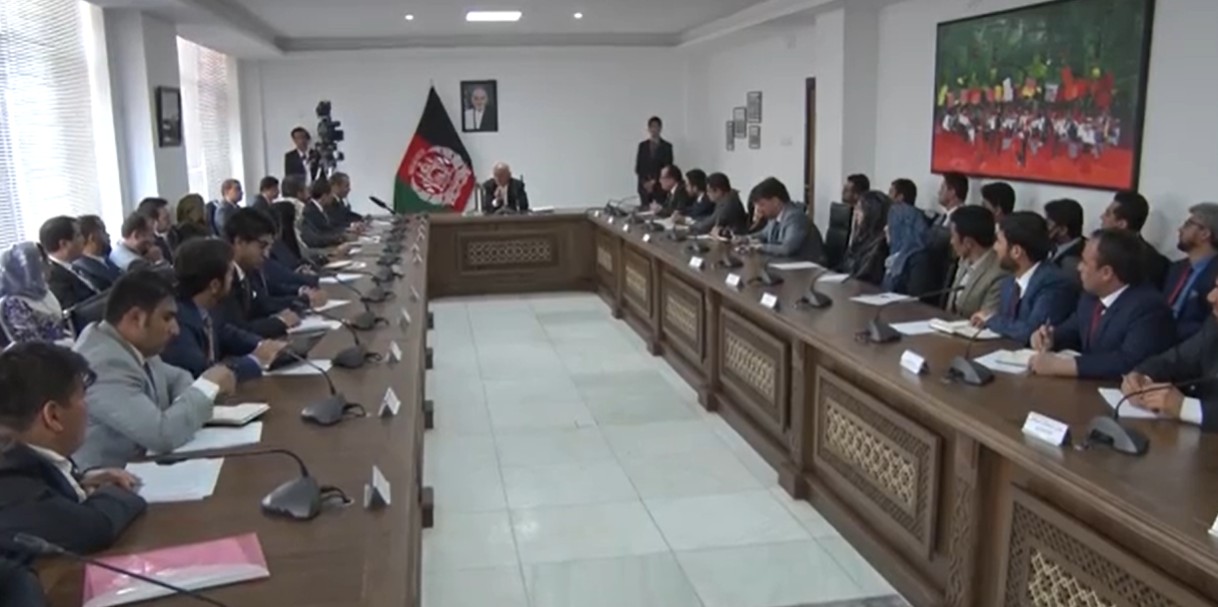
Remarks at the Induction Ceremony for Newly Appointed Commercial Attachés and Procurement Officials
Keypoints:
- Merit Over Connections: Prioritizing law over personal patronage.
- Trade Rebalancing: Boosting domestic production and exports to reduce the deficit.
- Heart of Asia: Positioning Afghanistan as a Eurasian trade and transit hub.
- Value Chain Growth: Shifting from raw materials to finished products.
- Institutional Transparency: Strengthening the civil service to rebuild trust.
- Regional Connectivity: Serving as a key energy link between Central and South Asia.
- Social Accountability: Tying diplomatic success to improved livelihoods.
- Unified Representation: Ensuring officials serve the state, not personal interests
In the name of Allah, the Most Gracious, the Most Merciful
Honorable Mr. Naderi, esteemed members of the Commission, Honorable Mr. Rasa, and all respected officials of the Ministry of Industry and Commerce, Honorable Mr. Hotaki, Honorable Mr. Fazli, all those present in the gathering, General Ibrahimi, peace and blessings of Allah be upon you all! Ms. Sadaf Dashti, Mr. Abdul Qayum Bassam, Ms. Khatira Norzai, Mr. Hafizullah Baha, Ms. Samina Wadir, Mr. Jawid Joya, Mr. Abdul Nafi Sarwari, Mr. Fawad Arash, Mr. Maiwand Mangal, Mr. Mohammad Riaz Sadat, Mr. Mohammad Mustafa Jamal, Mr. Ahmad Zia Sayedkhili, Ms. Widi Hotak, Mr. Arif Hairat, Mr. Abdul Karim Naseri, Mr. Mohammad Mansoor Sahak, Mr. Faizuddin Ghiyasi, Mr. Ruhullah Rafiqi, Mr. Mirwais Ahmadzai, and Mr. Baryalai [Commercial Attachés]; I congratulate you all. I also extend my congratulations to Mr. Naderi and his colleagues, especially the two colleagues he mentioned, and the members of the Commission.
The Victory of Merit over Connections
Today, we are witnessing a cultural change in the country. Those who represent Afghanistan outside of its borders are solely and purely Afghans selected based on their competence. Today is the day we celebrate and honor the victory of merit over personal connections (Zawabit over Rawabit). I congratulate Mr. Rasa¹ and his colleagues. The Ministry of Industry and Commerce is one of the most difficult institutions in the Afghan government; it is hoped that today the foundation is laid for this ministry to be transformed into one of the most successful state institutions. I thank you, the esteemed attachés starting your work today, for believing in the process and cooperating with trust; without the cooperation of the candidates themselves, the process would not have reached success. This process is a great and successful achievement.
Civil Service Reform and Youth Opportunity
In the year that the Independent Administrative Reform and Civil Service Commission has worked under the very wise and active management of Mr. Naderi and the cooperation of the esteemed commissioners, it has achieved clear results. I congratulate you, and especially the nation and the youth of Afghanistan, on these achievements. Our youth were in a state of hopelessness; they possessed capacity, but recruitment processes acted as a barrier to using their capacity as a national asset. In any department where the recruitment process is ambiguous or based on personal relations, that department will never be reformed. If you invest $100 billion in an office where appointments are made based on connections, the result will be zero; because all of it will be spent on fashion, cars, and equipment, not on services.
The State as a Vehicle for Aspirations
Therefore, it is necessary for the people of Afghanistan to understand that the state is a vehicle for the realization of their aspirations. A state that provides no services is not a state; rather, it is a tool for instability and lack of coordination. The meaning of being a state and being active is that the Constitution of Afghanistan must be taken seriously and implemented in all dimensions of our lives. We have no instructions outside of the Constitution. The Constitution was built absolutely for the conditions of the 21st century with a deep understanding of our several-thousand-year-old culture. Especially since it is aligned with all our Islamic beliefs, there is no conflict between the mandates of the Constitution and our culture. The meaning of citizenship rights is not the changing of our fundamental beliefs; on the contrary, it is their reinforcement. This is because justice, integrity, and the preservation of public treasury are our great Islamic values; and the equality of one Afghan with another is a fundamental value of our society. The reason we can be a democratic society is that every Afghan considers themselves equal to another. Which Afghan is it that does not debate with me or usually give me a half-hour lecture to make me a "Mullah" first? I welcome this; because it represents a democratic culture where equality exists in all parts of Afghanistan.
Addressing the Trade Imbalance
Today, we take a step toward one of the most fundamental problems of Afghanistan, which is the imbalance between imports and exports. A country whose imports are twelve times its exports cannot call itself a stable country. Particularly a country where at least 80% of its imports can be produced domestically; we have replacement production, but fundamental thought was not given to production in past years. The vicious cycle is broken only when our balance of trade moves toward the positive side and continues to grow. Therefore, the clear necessity of this society is to set clear goals regarding how much it reduces imports and increases exports each fiscal year.
Accountability to the Nation
How does this relate to the people’s dastarkhan (dinner table)? The fundamental point, brothers and sisters, is not that you represent the government; your primary duty is to represent the nation. Forty percent of the people are below the poverty line, and one in three Afghans goes to bed hungry. For you, who are given the best privileges, you are accountable for ensuring the living conditions of these people change. We do not provide the best salaries under the "CBR" (Capacity Building for Results) because you are "special"; it is because you must have a "special" commitment. Since you proved your initial capacity through examinations, I congratulate you again; but your fundamental exam is: how do your services change the lives of our people? Consider a nomad whose livestock lacks a value chain—wool produced and purchased by another country is transformed into products used in carpets, yet the carpet itself is not completed here. We see the result. One criterion for the success or failure of the Ministry of Industry and Commerce is: how much has it changed our carpet industry? Until now, in these three years, it has not changed at all. This is just one clear example of a value chain provided to you. Hundreds of thousands of Afghan women are occupied in this; but bureaucracy and the lack of a unified vision have hindered progress despite decisions made. It is now a clear necessity that we fundamentally calculate the remedy for the problems we understand.
The Heart of Asia and Regional Opportunities
In this regard, what is the fundamental point and hope? God Almighty (SWT) has bestowed the greatest mercy upon Afghanistan. Our sister, Ms. Dashti, said we are land-locked—change your perspective; we are not merely land-locked, we are the Heart of Asia and can be the Roundabout of Asia. If you ask the five countries of Central Asia today, each of them sees their future in connection with Afghanistan. Thus, it is also necessary for our young generation to truly understand the opportunities, not just the limitations. We are becoming the largest point for energy transfer from Central Asia to South Asia and one of the most important centers for transport and services. Also, our other resources, specifically mines which we discussed today—Talc has changed and fundamentally shifted from small-scale to large-scale mining, and the most important types of investment in Talc and Marble are being implemented. A clear map for the use of our minerals has been prepared and is under implementation.
Standardization and Industrial Growth
Only on Thursday, a $15 million investment was made in the marble sector, where for the first time two factories were built and activated based strictly on Italian and all European environmental and water consumption standards; and the happiness is that it is 97% complete. The necessity is for opportunities to be clearly identified so that value chains take fundamental shape. The issue is that what we have is smuggled out at the first opportunity. Last year, we had at least $250 million in pine nut production; but a specialist for pine nuts existed neither in the Ministry of Agriculture nor in the Ministry of Industry and Commerce. The necessity is clear: the type of knowledge we demand and that has been invested in you must have a clear connection to the lives of our people. If we want to bring change to the people’s table, the type of market management must fundamentally change, which God-willing, will change.
Unified National Representation
The essential matter with which I want to end my message: From today, you do not have an individual identity. Every one of you, whichever country you go to, represent Afghanistan. Represent a unified nation, a cohesive state, and a nation that has the aspiration and firm will to emerge from the bitter legacies left by forty years of war. Represent a private sector that, while having the problems Ms. Dashti mentioned, also has vast ideas. There is no day now where I do not see innovation in the private sector. Therefore, it is necessary for all attachés to be aware of what passes through the High Economic Council. A clear mechanism must exist so that decisions made, policies changed, and the types of changes coming to our environment are understood. For example, the extent to which laws have changed—the Law on Corporations has changed, and all criteria under "Doing Business" indicators are under a unified agenda for change.
Obligations and Directives
Overall, the clear necessity is that the image others have must first be shared with the Ministry of Industry and Commerce, the Ministry of Finance, and the High Economic Council so that we may remove obstacles. Your duty is to provide an analysis of the obstacles without omission—every bad, appropriate, or neutral image—and second, to specifically calculate the opportunities. If the ministry is not responsive, refer to the High Economic Council; I give you permission. Because some ministries lack clear coordination; when proposals come from the outside to their offices, they are not read. The clear direction for the Ministry of Industry and Commerce is that when the commercial attachés contact you, have a clear framework. Today, Minister Rasa, issue an instruction that any letter coming from them must be answered within a few days so that a clear type of connection exists, allowing both sides to understand that the evaluation at the end of the six-month review is a fair one.
Closing Remarks
In the end, I first want to congratulate all colleagues. It is hoped that in the near future, Mr. Naderi, you perform the same work you did regarding the commercial attachés for the entire Ministry of Foreign Affairs and other representations. The people of Afghanistan must understand that whoever represents them has been appointed based on a transparent, free, and believable process. The more the regulations (Zawabit) are strengthened, the more national unity and trust between the nation and the state—and especially trust between the private sector and society—is generally secured between the state and the nation. This work specifically gives a message to our people that the services we spend on you have results for them. Wishing you success, may you live long.