From Projects to Programs: A New Framework for NGO-Government Partnership
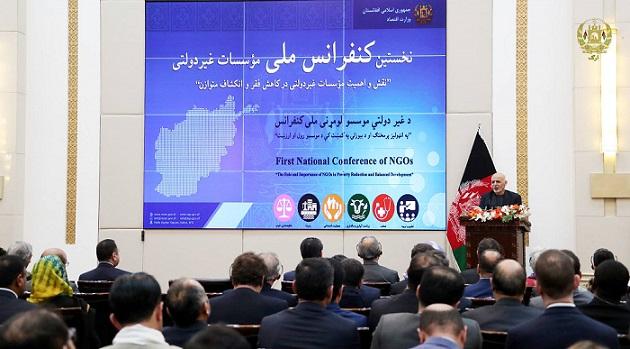
Speech at the First National Conference of Non-Governmental Organizations: The Role of NGOs in Poverty Reduction and Balanced Development
Keypoints:
- Accountability: Spending must yield clear, measurable results.
- Programs: Focus on large, effective, scalable initiatives.
- People-First: Prioritize citizens; follow “do no harm.”
- Youth: Young people drive social and economic growth.
- Women: Women lead and actively shape development.
- Economy: Invest in production and exports over aid.
- Governance: NGOs must comply with law and align strategy.
- Strategy: Plans must define problems, opportunities, and goals.
- Sustainability: Expand and replicate proven successes nationally.
ARG
In the name of Allah, the Most Gracious, the Most Merciful.
Dear sisters and brothers, esteemed members of civil society, members of non-governmental organizations, members of the cabinet, ambassadors, international guests, Mr. Mastoor, and Dr. Qayoumi, peace and blessings be upon you.
First of all, I welcome you all—welcome!
I congratulate Mr. Mastoor for organizing a structured discussion on such a vital topic. The results of this discussion hold particular importance for the people of Afghanistan, the state, and our society. Therefore, I ask everyone to participate comprehensively and examine all issues fundamentally.
The Role of NGOs as Key Players The fact that your organizations spent $851 million in 2016 shows that you are significant actors. In this country, $851 million is not a small sum. Specifically, you are our partners in the MDG and SDG sectors. It is my hope that the failure we experienced regarding the Millennium Development Goals (MDGs) is not repeated with the Sustainable Development Goals (SDGs). This is the first point: despite all your activities and expenditures, we failed in the MDGs. Our goal must be to succeed in the SDGs. I do not need further statistics to judge the outcome. Had we succeeded in the MDGs, we would be applauding each other today; however, it is clear that while we have achievements, we also face serious problems. Since you are spending these resources, accountability, balance, quality, effectiveness, efficiency, equity, sustainability, and transparency must be considered. These are the criteria you repeat every day. They are the fruit of your discussions and international debates; I hope we now move from discussion and slogans to measurement and mutual accountability. Was that $851 million used effectively? Was it spent in a balanced manner? You know the rest. However, first, as a citizen and as the President of Afghanistan, I want to express my gratitude for the short-term and medium-term impacts.
Achievements in the Health Sector I will take a few sectors as examples, though the examples could be much more numerous. First, in health, what Emergency Hospital performs daily is truly one of the great achievements of the non-governmental sector for the people of Afghanistan. We pray for the souls of all the martyrs of the non-governmental sector, the security forces, and especially our civilians. The activities of Emergency Hospital have saved thousands from death, and this is commendable. Similarly, the FMIC hospital, where the French people and the Aga Khan institutions are active, has brought changes to the lives of thousands of children and women; this is another prominent example. I cite these two because they are not just hospitals; they have turned into sustainable institutions. There is a clear demand for these services, currently in Kabul, to exist elsewhere. For this reason, the Minister of Finance agreed that the government would contribute $1 million from its budget last year and this year specifically for Emergency Hospital. In these areas, our partnership is not just verbal; we are ready to put more facilities at their disposal. I also want to thank Médecins Sans Frontières (MSF), especially for their decision to return to Kunduz. In the last cabinet meeting, land facilities were provided, and the people of Kunduz are counting the days until this important, neutral institution resumes its health services for the people of Kunduz, Takhar, and Baghlan. We also wish to thank the networks of Afghan doctors in Europe, America, Canada, Australia, India, Pakistan, and Iran. Dr. Taher Homayoun has been helping a clinic in Kalakan for years. Dr. Babery dedicates several weeks every year with a group of doctors from America. Dr. Qudratullah Mojaddedi spends two or three months every year in the most remote provinces under the harshest conditions without fail. Likewise, Dr. Rahim Karim from Germany and others; specifically, I wanted to thank my cousin, Dr. Tamim Karim. When he visited last time, before I was President, he didn't have two weeks to see me because he is a neurosurgeon and was constantly performing surgeries. I thank this national spirit of Afghan migrants from the bottom of my heart, and we hope Dr. Feroz [Minister of Public Health] and Dr. Mastoor can provide more facilities for them.
Impact in Agriculture and Reconstruction In the field of agriculture, first, I want to thank PMS. Dr. Nakamura has had an impact on this land that hundreds of other organizations have not. For colleagues who are unaware, 12,500 hectares of land that was dry or absolute desert has been transformed into three-season irrigated land; 750,000 trees were planted with a 98% survival rate, benefiting 650,000 people—all at a cost of $4 million. For 20 years, Dr. Nakamura and the group of Japanese doctors have been our dear colleagues in Kunar and Nangarhar. As Dr. Nakamura says in first-class Pashto: "A wild river will be tamed by wild Afghans." They tamed it, and we thank them. I also specifically thank the mine-clearing agencies—a large part of whose leadership was borne by Mr. Fazel and others—for creating the conditions for reconstruction, especially in clearing mines from agricultural land. Additionally, "Seeds of Hope" has done positive work in Shomali and other areas.
Economic Empowerment and Entrepreneurship In the economic sector, I want to thank Zardozi. You all know the impact of embroidery in Kandahar, but more than that, I want to thank "Half of the World" (Nisf-e-Jahan). When international aid to Zardozi was cut, Afghan women activists did not settle; they reorganized everyone who needed help. Today, Nisf-e-Jahan is truly one of the prides of Afghans. Women who had never left their homes are now producing and have created a great economic momentum. A sector that is not present today but should be is our apprenticeship (Ustad-Shagerdi) system. The apprenticeship system provides a living for one million young people. The largest job producer in this country is the apprenticeship system. These form the real part of non-governmental organizations, and in this regard, I want to specifically thank our traders' Zakat system. We have heard a lot about micro-credit, but I don't know how many colleagues know that our traders have created a specific type of Zakat where they give goods to young entrepreneurs and take them under training. It starts from 1,000 or 2,000 Afghanis and can reach 100,000 Afghanis in credit by the end of the year. It is a unique and effective system with significant results, and its potential will hopefully grow daily within our customs and culture. I also want to specifically thank Manizha Wafeq and her colleagues for establishing the Women's Chamber of Commerce and Industry. National Procurement has decided to allocate 5% of all contracts to women entrepreneurs.
Education and Cultural Heritage In education and cultural heritage, I first want to thank Marefat High School, as well as Mr. Sherjan and others who have worked hard in this sector. Marefat is truly a model institution. Mr. Royesh has created something where Afghan boys and girls interact with today's world with a specific self-reliance. Shinkay is in Helmand, and Dr. Kochi, who is now in California—he is not my uncle, he is another Kochi from Helmand, so that no conflict of interest is mentioned—it was destroyed repeatedly, but Dr. Kochi persisted because he was raised in Shinkay, then went to Beirut and became a doctor in California. These actions show that education has been served even at a personal level. Regarding education, I specifically want to thank the Swedish Committee. There was a time when the Swedish Committee performed the work of the Afghan Ministry of Education and Ministry of Public Health. It was among the committees that never left Afghanistan after the fall of Dr. Najib's government. Their continuity and efforts, especially during the Taliban era when they helped thousands of Afghan teachers, will always be an honor in our history. I also want to thank Integrity Watch Afghanistan for attending the High Council of Rule of Law and the National Procurement Committee.
Migration and Regional Reintegration In the refugees sector, the activities of the committees from Canada, Denmark, Holland, the Red Cross, Norway, the UK, and other institutions have always been significant. The return of eight million Afghans to the country's embrace would not have been possible without their active participation and assistance. I hope the names I mentioned represent my limited knowledge rather than the extent of your activities, as I named those I knew better. My hope is that Mr. Mastoor and his colleagues reach a structured book documenting the specific achievements of all institutions so that we can expand our gratitude.
The Big Picture: Challenges of Imbalance and Dependency The "small and medium" picture, as we said, has many achievements, but allow me to move to the big picture. In the big picture, unfortunately, fundamental progress has not been made. Despite 17 years of generous international aid, by every SDG and MDG metric, we are at the lowest level. This is a collective failure of the government, the people of Afghanistan, and our non-governmental partners. The small picture must connect to the big picture. Second, regarding balance, development was unbalanced. Kabul is not Afghanistan; Wazir Akbar Khan is not Kabul. Afghanistan is Afghanistan. With the utmost respect, security has become an excuse rather than a sense of initiative. Mangal and Jaji are two of the safest districts in Afghanistan; which NGO has set foot there? There must be a fundamental discussion about our perception of security versus the actual conditions of security. How much insecurity is there in Daikundi? We must discuss the nature of security and where our initiatives lie. I give you the example of the Sasaki firm: for 17 years, all UN agencies and non-governmental organizations could not help us create a livable city in Kabul. Where were the ideas? I waited two years just for UN-Habitat, but they did nothing except express concepts. We hired Sasaki, and today, God willing, within three to four years, you will witness fundamental changes in the life of Kabul and nine other cities in Afghanistan.
Moving Beyond the Project-Based Model Everything does not depend on money; active thought is also required. The second point is that the mechanism of non-governmental organizations has been project-based. When there are 5,198 projects in 2016 alone, is managing this effective? Is it possible to build a country project by project? Show me one country in the world where reliance on non-governmental organizations resulted in the eradication of poverty or fundamental progress. Is this way of working, based on small projects, correct? What is the administrative cost? Who measures these results? What is the degree of duplication? We need a fundamental discussion. Furthermore, is this model sustainable? Compare the most important non-governmental sector: look at the work of the Ulema of Afghanistan. At least 165,000 mosques were built in Afghanistan through public donations, and a significant number of these are congregational mosques. This shows a vast level of participation. Have our non-governmental organizations found a sustainable economic base in our society and economy? If international aid ends—and it will end—where will the reliance be? Our commitment with the international community is the "Decade of Transformation," which ends in 2024. We must have progress; therefore, the type of model must be discussed by all colleagues. Efficiency must exist, especially in areas where non-governmental bodies work with the state. I was one of the founders of these national programs when I held that responsibility, but after 10 years, is there a need for a review or not? One thing that requires attention is that the volume of health programs for women in the most deprived provinces has decreased, not increased. Is the measurement scale clear and documented, or is the assessment done in Kabul? How is the role of the people reflected in the assessment?
Transparency and Global Context The transparency of expenditure must also be discussed. NGOs have always advised the government on transparency, and we have accepted their advice wholeheartedly—especially this year's budget, which was the most transparent we've had. But do NGOs have a unified budget? The government has a unified budget. The UN will present a unified budget in a few days. When will a unified budget for NGOs be created? Since 2002, the Afghan government's request has been for NGOs to come with a unified budget. Are we partners? And if we are partners, how do we work together and how do we mutually measure effectiveness? Allow me to move to the international context. The 1980s were the "Golden Years" for NGOs. It was a golden decade because the belief then was that both the state and the economy had failed, and the answer lay in NGOs. In 1945, the total number of global NGOs was less than 50; by the 1980s, it exceeded 100,000. It was a very receptive environment. However, in the 1990s, especially Mary Anderson in her important book Do No Harm, started a clear point of discussion. The criterion that the Minister of Economy and all colleagues propose to you is: has the "Do No Harm" principle been observed? The intention is pure—I have no doubt about your intentions—but in the results, is the "Do No Harm" principle (which is the first principle of doctors) observed or not? A sense of dependency is itself "harm." Do we create a sense of initiative and independence, or a sense of dependency? We must have clarity. Haiti was a turning point. As much as Haiti has been studied—I wrote a long paper in 2008—no other country has been so examined. What it showed was that non-governmental organizations cannot take the place of the state. Until a clear system of state-building exists, non-governmental organizations cannot be successful. The duties of the state and the nature of its partnership must be fundamentally defined; without state-building, NGOs cannot fill the vacuum.
Defining a Positive Identity In this regard, the essential point—with all due respect—is that after thirty years, the word "NGO" is still used. Non-governmental organization—what is the positive definition? I know you don't want to be a government, but what are you? Necessary to governments or non-government? What is the positive message? "Non" is not a positive agenda, with enormous respect. So what is your positive message? In the 2000s, a clear review took place where all three dimensions were in balance: what tasks does civil society perform, what tasks does a dynamic market perform, and what tasks does an accountable state perform? I want to give some current examples to weigh the value of money, facilities, or initiative. You might not have heard the name "Khan Steel." Khan Steel is the first steel production factory in Afghanistan. $35 million was invested; it cut 33% of Afghanistan's steel imports, using scrap materials that are now turned into steel. Can you show me examples where $100 million spent by you has fundamentally healed a pain or brought such changes? We must understand the importance of money. Another example: in the procurement law, we have introduced a 25% preference for domestic products. As a result, 19 of our industrial sectors have reached self-sufficiency, and 11 others are on their way. Can you propose examples that have this kind of policy result from your discussions?
Economic Diplomacy & Infrastructure
We faced a grave challenge where, every year, our fruit exports were under threat. Eight hundred and eighty-five thousand dollars were invested in establishing an air corridor to India. The result was a $30 million increase in our exports, and the outcome is that the gardeners and farmers—Mr. Durrani and his colleagues with whom you work—have fundamentally established value chains. Most of the investment in processing and related sectors is currently occurring in Kandahar, Kabul, and other provinces. From an economic perspective, how do we create the impacts of a value chain? The people of Afghanistan do not want charity; they want value. From the perspective of economic diplomacy, this is not about money; it is about focus, and your constructive ideas are needed. $7.5 billion is being invested in TAPI. For the first time, Afghanistan’s position as a connecting corridor between Central Asia and South Asia has been solidified, which is why all the people of Afghanistan celebrated. How do we measurably assess the impact of the CASA program, electricity transfers, or the railway? Mr. Mastoor and his colleagues must have a comparative table of these impacts. Money is limited; now, what has the greatest impact on the eradication of poverty and the creation of development conditions? If the international framework has changed, I would like to present some material regarding the change in the national environment.
Demographics & The Youth Transformation
As a society, we are a young society. The latest figures from the Central Statistics Office, supported by Mr. Launder and the United Nations, show that 57.50% of our population is under the age of 20. 57.50% of our people are below 20. 74.15% of our people are below the age of 30. As a result of the assistance and actions you have taken, especially in the health sector and in reducing mortality, we are dealing with a young society. Is the image presented of Afghanistan that of a young society or that of my generation? Afghanistan is undergoing a fundamental transformation of rejuvenation. The number of people over the age of 60 is less than 5%; but it is clear that our generation has emerged, and now the capacities and the changing roles that this new generation plays must be understood. Every day that I see this generation, this 74 percent, my hope truly increases a hundredfold. There is truly not a day where individuals belonging to this generation, both women and men, do not show initiative. And what is the most important change in their perspective, dear sisters, brothers, and colleagues? They are not consumers; rather, they are a productive generation. In Herat, I spent four hours with young people, each of whom had very specific views on how the productivity of land and water should increase. How should our type of usage be? How should we create work conditions? This generation of ours is not a dependent generation; it is a self-reliant generation that wants to make progress.
The Fundamental Role of Women
Second: The role of Afghan women has fundamentally changed. These women—whom I had the honor of being with during the March 8th ceremony where Mr. Safi was also present—are women who can speak for themselves; not only can they speak, but they do speak, and they understand both the problems and the solutions with clarity. The role of the Afghan woman is not decorative or symbolic; it is principled. Please, do not look at the Afghan woman anymore merely as a sister, mother, or daughter; see the Afghan woman as a woman, and work with her as a woman and as a major driver of social and economic mobility. Those complexes we had, God willing, have been set aside; one day we shall discuss them from a historical perspective, but for now, understand the current capacity of women.
National Identity & Poverty Alleviation
Our most important point as a society is that we have become believers. This land belongs to us and we are responsible for it. We are responsible for both the problems and their solutions. Our sense of ownership has risen. Second, from an economic perspective: Please do not look at us as a country permanently afflicted by poverty. The habit was that it lasted 17 years, and perhaps it might last another 40 years. Poverty is not natural and it is not acceptable. It is not acceptable to us that every night one-third of our people go to bed hungry. The discussion of poverty has, unfortunately, been pushed to the margins, and the debate on poverty—with all due respect—has turned more into slogans than practical programs. Let us understand poverty. With the possibilities that technology provides, how is it that our poverty assessments are presented two years late? If poverty is serious, why can we not do it every six months? If we take poverty seriously, why do we not measure the impact of every project, program, dollar, and every Afghani on the eradication of poverty? My most important message in the economic sector to everyone is this: Almighty God has given us everything. Our location is turning into gold. Whichever way you look at the map of Asia, Afghanistan is not situated in its heart without reason. The easiest way to reach any part of Asia, or from one part of Asia to another, is through us and Central Asia. After 117 years, we are proud to have become an inseparable part of Central Asia. We are a point of connection, not a landlocked country, and these initiatives must be part of our general discourse. If we speak of our cities, in 21 provinces of Afghanistan, we either have a border or are located on the Durand Line; all these 21 provinces must be centers of connection, not separation. They are points of unity.
Resources & Revenue Goals
Second, our water has become vital, both in terms of risk and in terms of management opportunity. Third, the possibilities of our minerals, oil, and gas. How can a country that possesses 240 billion tons of iron and 220 billion tons of marble not turn into an exporting country? From this perspective, our fundamental point is that we must target two things as a state. One, in the coming few years, Afghanistan's revenue must reach $8 billion; if we do not produce $8 billion in revenue, our situation will remain as it is. I do not want to always go to the world with a begging bowl; we want investment, not aid. Aid is necessary for social programs, but our core point is that we must transform into an investing country. I specifically express my gratitude to the Minister of Finance and his colleagues for increasing Afghanistan's revenue by 33% under the most difficult conditions; but now our clear goal must be that our revenue sources are specified. These sources are not meant to put pressure on everyone, but to develop the economy. With 3.5% growth, we will get nowhere; our growth must reach at least 8% and thereafter increase further so that we can address the population issue.
State Reform & Institutional Integrity
Second, we cannot be an importing country, as you mentioned, Mr. Mansoor, that our imports are nine times our exports, and specifically our tragedy is that most of our imports are agricultural and manufactured goods—things we can produce ourselves. Therefore, in this environment, it is clear that the image of your partner in the government must also change. This means that for years you dealt with a government that was not willing to admit that corruption was prevalent; the Government of National Unity understands its problems and their solutions. We have changed the types of decision-making. Our focus as the legacy of this government is not what we did as individuals, but what kind of institutions we created. Look at all the High Councils: the participation of the private sector, the participation of civil society, and the free debate between ministries. And our colleagues should understand the generational shift; today, 49% of the Afghan cabinet is under the age of 40. Our administration is not an incompetent one; it is an administration that today possesses specific competence, and I am proud of my female and male colleagues. This administration is not in conflict with non-governmental organizations; it seeks a sense of partnership and coordination. However, it is an administration that possesses a development agenda. With the utmost respect, NGOs have so far been unable to present a development agenda for Afghanistan; your opportunity is to present a development agenda in this assembly so that we may see the extent of your intellectual strength, readiness, and organization. I repeat again that women are decision-makers and are in key ministries, and they will come to key ministries—especially now that we have presented the peace proposal, the role of our women in administration and society will grow stronger day by day.
Strategy & Effective Implementation
The most important issue for us is the distinction between a bad strategy and a good strategy. A bad strategy is not the absence of strategy; it is a bad strategy because there is ambiguity between the analysis, the proposed solution, and the goal. I read one of the documents; once they had written for the High Peace Council, the word "strategy" appeared in both paragraphs. If the word "strategy" appears in every two paragraphs, it does not mean strategy. My request is that we remove this word from our lexicon for a few months and execute practically. A good strategy is very simple: What is the problem? What are the obstacles? What are the opportunities? What is the roadmap? What is the goal, and what must we do to reach it? Drafting strategies has turned into a money-making strategy; they come to write the strategy and then say, "hire us." Brothers and sisters, the way money is spent in Afghanistan must fundamentally change; the quality of spending must go up and the cost of expenditure must fundamentally come down, not increase. We are focused on the entirety of the government and the state, and we want to implement reform programs. One example of this is a fundamental change in Afghanistan's municipalities; I selected 28 mayors previously and four others yesterday based on a fee competition and a great momentum. The youngest mayor in Afghanistan, in Qala-e-Naw, has provided the most assistance to women entrepreneurs, dedicating a 400-room building specifically for them. We are seeing a new generation of leadership in the provinces and in the center.
Accountability & The NGO Framework
What is my proposal to you in the end? An agenda proposed for discussion. My first proposal to you is to fundamentally and strictly examine these 17 years: how much have NGOs spent? What are the results? What are the achievements? And what conclusion do we draw from this? How much did they spend on themselves, how much was spent in total, and specifically, how much was spent on removing poverty? And second, how can those services and achievements that are effective be expanded? For instance, how can things like the Emergency Hospital be turned into a network? There is no province in Afghanistan today that does not request an Emergency Hospital. Or in the cultural sector, there is no province that does not want the Ikhtiyaruddin Citadel, the Garden of Babur, or a combination thereof, and we are ready to cooperate in these areas. To what extent can the points that have yielded positive results be expanded without creating pressure? The second proposal is that the government and the state make their budget transparent and be held accountable. All hidden items in the budget were removed; the entire budget will be transparently available to the nation and international organizations. And the United Nations agreed that ultimately, we will move toward a "One UN" where their budget is also transparently placed at the disposal of the people of Afghanistan and the world. Now, our call to the NGOs is that your $850 million budget, or whatever it may be, should be transparently placed at the disposal of the people. Five coordination bodies are good, but a website that transparently holds everything is far better. The third proposal is that we move from projects to programs. National programs have yielded results, and the methodology of programming has been successful, especially regarding our cultural heritage. Our cultural heritage is being lost; dozens of citadels, hundreds of our mosques and tombs have become the subject of various claims. Another point is: what is the strategy of non-governmental organizations and civil society? What are the goals? What achievements should be clearly determined beforehand, and what is the roadmap to reach them? Therefore, our discussion on strategy must be based on results: which result are we achieving and by what method? What kind of cooperation is needed so that we can hold each other accountable? In what clear form does the result manifest? And the final point: please, give priority to the people first and do no harm.
Conclusion & The Rule of Law
I would like to thank you, my conclusion is very simple. Please put the people first and act on the principle of do no harm; if that is achieved, the rest will go forward. I would like to thank all of you for your years of engagement. A lot of you have become Afghan in heart, so you carry two hearts, not one; we highly respect that. Our people are delighted when one of you says upon leaving—which is, thank God, not permanent—that you come back because you have left your heart in Afghanistan. There is nothing that moves us more on behalf of a very grateful people. Let me acknowledge your contributions, let me state that we look forward to the partnership, but a partnership that truly takes that current context of global uncertainty into account; old ways of doing business will not do. Seeking exemptions on NPA (National Procurement Authority) is not a good idea. It really stretches credibility. Why do we need to take the agents of brain drain from the government? Please think twice. On taxation, the Ministry of Finance will work with you on a task force, but we need to know wheat from chaff. A blank amnesty I will not give unless there are specific reasons. I am willing to entertain, but it really shocked me that several hundred of the NGOs are not willing to give reports; that is unacceptable. In that regard, I will take action and I will close them down; that is my obligation and duty. If people do not respect the government, they have no place here. Yes, of course, the government has a lot of problems, and on the NGO law, I will order that it be given priority; we want to work with clear, transparent rules of the game, but rules of the game that are mutually respected. Nobody is above the law. This country has got enough people who do not adhere to the rule of law; we do not want the NGOs to become another part of a non-compliance culture, so please take compliance seriously. Long live Afghanistan!