Toward Lasting Peace and Stability: Afghanistan’s Vision with NATO and the United States
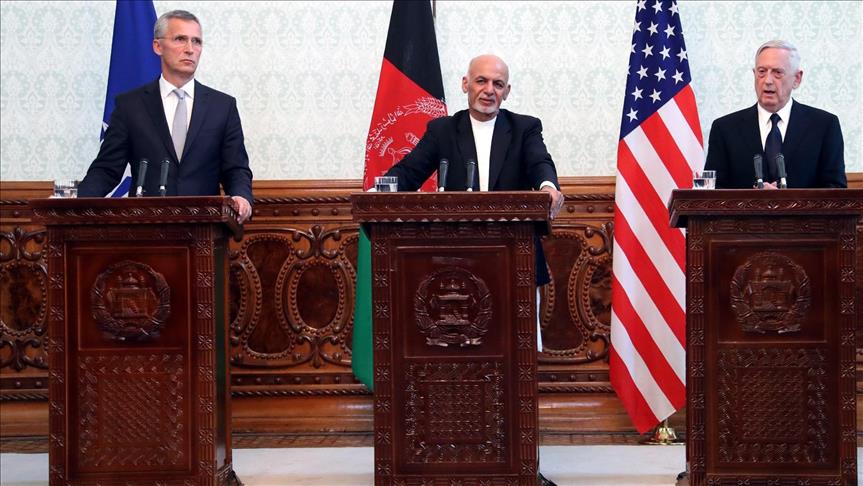
Joint Press Conference with U.S. Secretary of Defense James Mattis and NATO Secretary General Jens Stoltenberg
Keypoints:
- Security and Defense: Build capable, self-reliant Afghan forces.
- International Partnership: Strengthen ties with NATO, the U.S., and allies.
- Peace and Reconciliation: Pursue Afghan-led dialogue with insurgents.
- Protection of Civilians: Prioritize civilian safety in all operations.
- Governance and Resilience: Strengthen institutions and public trust.
- Regional Stability and Development: Link peace with growth and cooperation.
In the name of Allah, the Most Gracious, the Most Merciful.
I would like to extend a very warm welcome to the NATO Secretary General and the Honorable U.S. Secretary of Defense, General Mattis, on their arrival in Afghanistan.
First, I wish to express my gratitude for the sustained and enduring support of the 39 NATO member nations, who have shouldered the greatest number of sacrifices to ensure security and combat terrorism in our country. In particular, I express my profound appreciation and thanks for the continuous sacrifices made by the United States of America.
Furthermore, in my capacity as the President of Afghanistan, I wish to express my gratitude for the valor [corrected from 'hospitality'] shown by our security and defense forces over these many years. I also thank the Honorable Minister of Defense, the Minister of Interior, Mr. Atmer, and all other officials who, through their mutual cooperation and selfless dedication to the motherland, have consistently made sacrifices to protect this soil, uphold this Constitution, and safeguard the Word of God. I thank you.
It is also fitting to thank General Nicholson for his effective role in supporting our security and defense forces.
At this juncture, on behalf of the people of Afghanistan, I must also express my gratitude to President Trump and General Mattis, who finalized their strategy regarding Afghanistan. By doing so, they have provided the space for success in the confrontation with terrorism and created a political atmosphere for an enduring and stable peace. Furthermore, by announcing this strategy, they have removed the veil of ambiguity that hung over Afghanistan and the region.
I also wish to express my gratitude to the NATO Secretary General, Mr. Stoltenberg—our long-standing friend—for his continuous support of the Resolute Support Mission in Afghanistan and his tireless efforts to secure the country.
Now that the strategy of the United States and NATO toward Afghanistan has gained clarity, and Secretary Mattis has decided to deploy additional fresh forces to Afghanistan, I hope that other NATO members will also respond positively to the proposal of the Secretary General and General Nicholson regarding the support and training of the Afghan security and defense forces.
I wish to thank all my colleagues within the Government of National Unity, specifically Dr. Abdullah, for fostering an atmosphere of trust and confidence, enabling us to move toward our objectives and undertake a sophisticated, strategic movement to achieve them.
Specifically, I am indebted to the heroic people of Afghanistan, upon whose shoulders the primary burden of this war has rested. Despite the sacrifices they have endured due to the crimes of the Taliban and other terrorist groups, they have exhibited immense patience and fortitude, consistently standing in support of their democracy and their Constitution.
The Taliban and other terrorist groups utilize our civilian population as human shields during combat; however, the fundamental duty of our security and defense forces is the preservation of our people's lives. I have issued stringent instructions to all security forces of the country to work jointly with our international partners to ensure that the preservation of civilian lives remains a primary objective during military operations—as they have done in the past—and to exercise the utmost caution.
We request the international forces who are training our troops to continuously evaluate the situation from this perspective, ensuring that the preservation of civilian lives remains their absolute priority. The central axis of our four-year security strategy, which was developed by the Afghan government and endorsed by our international partners, is the protection and security of the civilian population of Afghanistan.
Our comprehensive security strategy—developed by the state, and for which I specifically thank the National Security Advisor, Mr. Atmar, for his new collaborations—has earned the endorsement of the international community. Its essence is to ensure that our future is secure and free of strife, and it is for this reason we have made sacrifices: so that the future of our children, mothers, sisters, and brothers may be one of prosperity.
The four-year security plan and the reforms that follow it will prepare our security forces to be a well-equipped, national force aligned with our national and religious values. At the conclusion of this process, we aim to be self-reliant and the guardians of our own security, territorial integrity, and national sovereignty. The preliminary implementation of this four-year plan during the summer season demonstrated that our forces are developing the necessary strength to weaken the enemy, defend the nation, and support the people. I express my gratitude to the Minister of Defense, the Chief of Staff, the Minister of Interior, and all their colleagues, whose successful management this year demonstrated our strength to the enemies and showcased their sustained efforts in protecting our people.
I hope that the upcoming elections provide an opportunity for the people of Afghanistan and the political class of the country to contribute effectively to the further maturation of the government’s strengths.
The changes that have occurred in the environment surrounding Afghanistan dictate that we must not remain captive to the past. We must instead utilize the new opportunities provided for peace, particularly the shifts in global policy regarding this region. Currently, the groundwork for regional stability has been laid, and our objective is for this regional stability to take its final shape. This provides us with an opportunity to seek the peaceful resolution of conflicts.
We seek to pursue peace along two axes: The first is peace with Pakistan, which will be achieved through state-to-state dialogues, especially based on the view that stability in Afghanistan is not to the detriment of any other country; on the contrary, a stable Afghanistan can provide the foundations for the economic development of the entire region.
The second axis is the intra-Afghan peace. Today, it has been proven to all that no one can impose their will upon the people through war and violence. Without a doubt, the best solution is negotiation between Afghans, and the Afghan government has always possessed—and continues to possess—this readiness. My request to all parties involved in the conflict is to perceive the new conditions and utilize this opportunity with wisdom.
By the grace of Allah (SWT), our security and defense forces are growing stronger day by day, and their capacity to protect the sacred soil of this homeland is expanding. History will judge those individuals and groups who seek peace. This is a supreme opportunity; this opportunity must not be squandered.
Furthermore, peace will pave the way for a stronger confrontation with international terrorism and allow us to focus on development programs, the eradication of poverty, and the provision of public welfare. For the sake of regional stability, I call upon our neighbors—both near and far, from India to Russia—to participate in renewing a regional consensus, especially as the threat of terrorism has not vanished but has, in fact, become more grave.
An effective struggle against terrorism requires both regional and global consensus, and this danger must be taken seriously. If the peace process with the Taliban reaches a conclusion, the international confrontation with terrorism will find its most effective direction.
The Taliban now stand at a decisive crossroads: they can either continue to remain in the service of foreign policies and accompany international terrorism—in which case they are condemned to destruction—or they can decide to end the war and violence and participate in the peace and prosperity of their own country.
We are on the front lines of the struggle against terrorism, and Afghanistan is the primary bastion and the first line of defense for freedom against terror. In this regard, I once again thank Secretary Stoltenberg and General Mattis for their unwavering support, for their immense efforts in strengthening this defensive line, and for standing with us on this path toward a stable, peaceful, and joyful Afghanistan.
Once again, I welcome you