Transforming Afghanistan: Regional Connectivity, Economic Opportunities, and National Governance
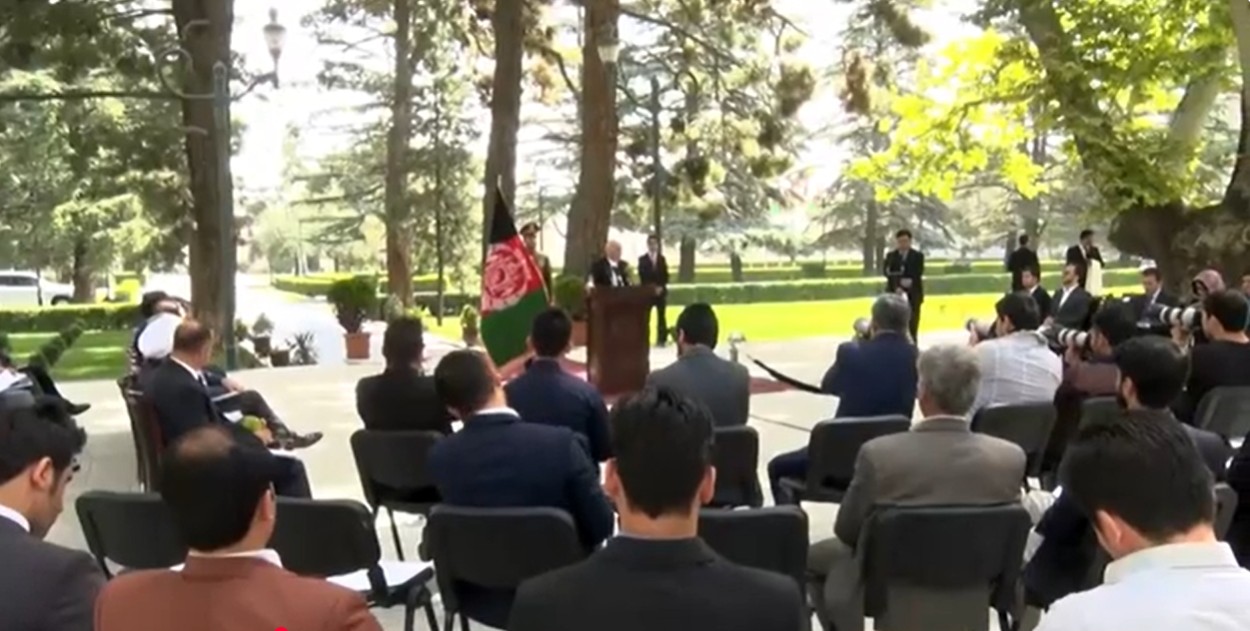
Press Conference on the Achievements of Visits to Kazakhstan, Turkmenistan, and Tajikistan
Keypoints:
- Regional Connectivity: Strengthen ties. Turn challenges into opportunities.
- Infrastructure: Build energy and transport. Boost economy.
- Trade: Improve trade and ports. Reduce costs.
- Governance: Promote dialogue. Ensure transparency.
- Security: Strengthen defense. Work with allies.
- Human Development: Improve education and jobs. Empower youth.
- Anti-Corruption: Fight corruption. Ensure transparency.
- Strategic Vision: Use location and resources. Ensure growth.
Char Chinar Palace
In the name of Allah, the Compassionate, the Merciful.
Dear compatriots, esteemed members of the Cabinet, members of the private sector, distinguished Ulema, and especially dear journalists; thank you for the opportunity you have provided today.
In my statement yesterday, I said that we are in need of a "National Discourse." To that end, my proposal is that we organize 20 press conferences in the coming months based on your suggestions. Each conference will pertain to a specific subject, and all questions must be raised fundamentally so that a comprehensive national discourse can take place. My request to you (the media), as a major power for the consolidation of democracy, is that you share all your questions with the Arg website so that the type of press conferences, their order, and the major topics can be discussed.
To begin, once again, I offer prayers for the pure souls of the martyrs of Afghanistan in general, and the recent incidents in Kabul in particular. We are still in the bed of illness; we wish a speedy recovery for the wounded. We are all in mourning. But grief must be turned into joy, and for that reason, our focus must be on changing the lives of the people.
Today is a good opportunity as the Afghan Cricket Team is playing in the most important cricket field in the world, England. (Switching to Pashto) > I congratulate everyone. This is a very big opportunity from which we should take a lesson. An Australian has written a very good book about the history of Afghan cricket. For the Afghan team to achieve these "fifties" and "wickets," initially, charity money was collected for them. Think about it; from that day until today, this is an example that must be shown everywhere. In the private sector, the government sector, and all other places. So, on one hand, I congratulate the cricket team, and on the other, I congratulate the entire nation of Afghanistan.
My focus today is on this major subject which I have repeatedly presented to my dear compatriots: The location of Afghanistan must be transformed from a challenge into a great opportunity. My recent trips to Kazakhstan, Turkmenistan, and Tajikistan—and our future trip to Uzbekistan—are among the most important actions that will, Insha’Allah, transform the geography of Afghanistan from a prison and a challenge into a massive opportunity. Therefore, allow me to speak for a few minutes on this subject.
First, the Wakhan Corridor: Wakhan is among the most deprived points of Afghanistan and one of the coldest points in the world. Our discussion with the honorable President of China in Kazakhstan was about how the fiber optic network should be transferred through the Wakhan Corridor, and following that, how we can cooperate on direct connectivity between China and Afghanistan through various routes. The provinces of Badakhshan, Takhar, Kunduz, Balkh, Jawzjan, Faryab, Badghis, and Herat will, in the first instance, see the results of these travels. On our northern border—I hope it has become clear to everyone—in these two and a half years, dry relations have been transformed into extremely warm relations. China will not only oversee the fiber optic network but, for the first time, will fundamentally review the Kunduz-Herat railway. The honorable Minister of Finance and his colleagues, and the honorable Railway Authority, have done fundamental work on this. What is our goal? Our goal is to transform our location into both an opportunity and a source of revenue. And the most important subject is: how do we change the lives of our people?
The second subject raised in these relations is Electricity. Today, in Kabul, we live by the grace of imported electricity from Central Asia. Two things must be said regarding electricity:
-
Before the arrival of the National Unity Government, there was absolutely no plan to produce domestic electricity; the plan was that for another ten years, we must rely on imports.
-
We had not created a fundamental plan for how to involve all Central Asian countries in a framework for the import and subsequent transit of electricity.
What is the goal in this sector, sisters and brothers? First—Electricity is the infrastructure of infrastructures. If electricity is not continuous, neither agriculture will stand on its feet, nor industry or services. Look at the difference between Nangarhar and Herat. Herat is active; by the grace of God and the blessing of the fact that we secured its electricity continuously, both through the creation of Salma (Dam) and imported electricity. But Nangarhar, which has the same human capacity and financial capital, does not have work. (Switching to Pashto) > You know this, and for this reason, it is necessary that we bring electricity quickly.
Our fundamental point is that today, Turkmenistan, Uzbekistan, and Tajikistan have all prepared to place the vast electricity they produce at our disposal. Second—even more than that, they are producing new electricity because a reliable market has been created inside Afghanistan. Third—most importantly of all, we are making electricity a tool for generating revenue.
Let me give you an example: the great CASA (1000) project, which was the final subject of our discussion in Tajikistan. I express my gratitude to the colleagues at the Ministry of Energy, especially Mr. Ghalib, Mr. Kargar, and the honorable Ministry of Finance. In the CASA project, Afghanistan is the only country that is six months ahead of its schedule. 550 kilometers of the transmission line passes through Afghanistan; we brought the price down, and it will cost 224 million dollars, which is ready for contract. We have finished its contract through procurement and everything. The other three countries must either commit to doing their work, or the World Bank must give us a commitment. In two to four years, we can recover this entire investment through its transit revenue. It was necessary to transform something that was on paper for ten years into a great opportunity and a practical program. (Switching to Pashto) > And it won’t stay like this; it doesn’t mean we aren’t investing in domestic production. We are investing in Kunar, in Kajaki, and other places. We are also talking with China on how to quickly turn the Kunar River into electricity. But the point is that the transit of electricity will, Insha’Allah-Ta’ala, have as much revenue in five years as the customs bring in today.
That is to say, the amount of one billion dollars from electricity transit revenue is not an unrealistic figure; but it is necessary to think about it fundamentally. This is the essential point.
In this framework, the districts of Qarqin and Khamyab in Badghis province, which are again among the most deprived places, were under our serious attention during the trip to Turkmenistan.
Let us look at another subject. Were we always in need of a port or not? Whenever a port was closed, was a sense of public unease felt in Kabul or not? Look today at what has occurred. First; Chinese cargo reaches Hairatan directly. This year, a number of trains are directly transferring cargo from China to Hairatan.
Second; Aqina was just a point on the map. Today, Aqina is in the process of being transformed into one of the most important ports of Afghanistan. Behind Aqina, the work is on how Torasheikh in Badghis should be transformed. Now, our other axis of attention in the Turkmenistan trip is Torghundi. Thirteen kilometers of railway between Afghanistan and Turkmenistan is being built at a point called "Sarhad" (Border); we are funding it ourselves so that Afghanistan’s import points are fundamental and axial. I express gratitude to Mr. Ramin and his colleagues in Parliament, especially in the Economic Committee, who accompanied us on this trip.
What is the goal and what is the connection of this to our lives? Have Afghanistan’s prices not always been in flux, brothers and sisters? Ask Mr. Kaminzada. An Afghan contractor cannot perform work on time; because imports are not reliable. Mr. Murad (Minister of Economy) has much experience. Therefore, what are we in the process of? Turkmenistan, Azerbaijan, Georgia, and Turkey are our alternatives for the purpose of imports and exports to Europe. A five-way agreement is in its final stages; Turkey will be connected to Azerbaijan by rail in September, reducing a 28-day distance to 2 days.
Now look at the subject of our connection with Kazakhstan. Kazakhstan is the primary center and country for wheat production. Three years ago, our trade with Turkmenistan was around 24 million dollars; last year it reached 240 million dollars, and this is the primary reason we do not have a wheat shortage.
The upcoming trip to Uzbekistan will fundamentally open the Uzbekistan railway route. His Excellency Mirziyoyev, like His Excellency Berdimuhamedov and His Excellency Rahmon, has become our fundamental partner; just as Azerbaijan and Georgia are. On this basis, the impact of these programs does not remain limited to Northern Afghanistan—which is the first point of development—it is Afghanistan-wide.
But regarding Northern Afghanistan, especially at this point, what is our goal? Zaranj. I hope you have visited Nimroz, especially those brothers and sisters who visited Zaranj before the Bonn process. The population of Zaranj was around six thousand; the Governor of Zaranj says today that its population is three hundred thousand. People have come to Zaranj from all 34 provinces of Afghanistan. Zaranj is the third-highest source of customs revenue for the Ministry of Finance. Why? One; we created a bridge; the Silk Bridge. Second; we built the road from Zaranj to the Ring Road. Third; we created the best customs facilities. My goal is for the experience of Zaranj to be repeated across our North and West. Meaning, instead of bringing people to the cities, we concentrate people at the borders; and make the borders the primary point of cooperation. We must show that our northern border is a fundamental border.
On this basis, what is the fundamental word? For 119 years, Afghanistan and Central Asia were separated from each other. In 1898, the Tsarist Empire imposed a specific tariff to disrupt trade between South Asia and Central Asia. Until two years before that, ten thousand camels would carry only tea from India to Central Asia. The point we have reached, brothers and sisters, is that Afghanistan has today become an inseparable part of the economy of Central Asia and the Caucasus. The Secretary-General of the United Nations had come (to Central Asia); he spent a week there, and what he shared with us (Switching to Pashto) > was very interesting. He said all the Central Asian Republics are looking south, and the honorable President of Turkmenistan explained clearly, saying Afghanistan is that nation and that state which has not delayed for a single day its payments for electricity or fuel. I especially thank the President of Turkmenistan and others for counting on our future.
Central Asia has counted on the future of Afghanistan, and here the formula is absolute win-win. Their electricity was idle; but with us, it is transformed not only into money and connectivity but also causes other investments. For this reason, our regional policy brings both prosperity and stability.
The subject that is raised and I want to give assurance on, is that reports on these projects must be given to you continuously. For this reason, my instruction to the honorable Cabinet is that every two months, a clear report of the progress of these projects be shared with journalists, the media, and the nation. Because we must see the results.
At the same time, the Air Corridor created with India must, for the first time, create reliability so that our exports do not remain idle. I first thank Mr. Kaminzada and his colleagues who, last year when Spin Boldak was closed, made a temporary proposal. The private sector, like civil society, is a partner for a democratic state. Therefore, I express gratitude for the good views of Mr. Ramin and Mr. Kaminzada, as we are always seeking to expand Afghanistan's opportunities.
The first flight (to India) carried five million dollars in exports, and the second plane from Kandahar carried two million. This causes, for the first time this year, Afghanistan’s fruit exports to be reliable. I hope that with everyone, we can set a clear goal for next year in the amount of Afghanistan’s exports. Until now, we could not set these goals; because every time the issue was where our imports were stuck and who was obstructing our exports. Regarding the western sector, I will speak with you in one of the future conferences.
(Switching to Pashto) > Brothers! The main issue is that Afghanistan's location is gold, and specifically, the focus is now on pipelines. TAPI has moved well forward and now we are in negotiations on others. But between an idea and action, there is a need for time and management. For this reason, this discussion of the economy and Afghanistan's connectivity must change from a government discussion into a national discussion. Why couldn't we do this before? Because until you have created the opportunity, you cannot tell people to give their views. (Laughs) Mr. Majidi, I hadn't seen you. Mr. Majidi had also gone, I thank everyone. Now, this—like the Afghan National Assembly, the media, the Afghan private sector, Mr. Jora from the Ulema, sisters and brothers—all of us must gather together to see how our lives, especially those of the youth, women, and the poor, are changing. Now, life does not change by ideas alone; life will change by action. I thank you for giving me this opportunity. Now I will answer your questions.
Response to Questions:
Question (Bashir Qasani, 1TV): Many political opponents believe economic development is only possible when political development occurs. You remember the UN representative’s statement about needing changes in political management. Now, General Dostum, Mr. Mohaqiq, and Atta Mohammad Noor are dissatisfied and have formed an alliance. What is your view on this alliance? Second, the government has a "record" of acting officials (surperasty). Most ministers are acting. Also, the Finance Ministry reports only 15% of the development budget was spent in the first six months. What is your view on this and the ministers who haven't spent the budget?
President Ghani: Thank you for your very comprehensive and major question.
First; Afghanistan has its third and final opportunity with the international community and its own people. We have been able to secure 30 billion dollars in commitments from the international community in 2.5 years. You, as the media, judge: 2.5 years ago, did you think this was possible? We organized the international forces to strengthen the Afghan defense and security forces. Did you and the majority of your commentators think this was feasible? We transformed the regional situation with most of our neighbors from negative to positive. Therefore, I hope we can have a clear discussion on limitations and judgments.
The second point; whoever has a proposal for reform: “Da Gaz, Da Maidan” (Here is the yard, here is the field/the challenge is set). My proposal for these very colleagues whose names you took is: come and secure a 500-million-dollar project. Come with a clear proposal on how you will positively change two provinces of Afghanistan. Let them sit with the private sector, discuss with the Ulema of Afghanistan, and also with the youth and women. What is the point? In a situation where politics is limited, is it sustainable with two fingers, or should the entire nation of Afghanistan participate in politics? I put this fundamental question to the nation.
Is the Constitution our national document and the rules of the game or not? If the talk is of reform, who has a record of reform? I have published every qiran (penny) of my assets and explained its source. My demand is: anyone who enters the political field, like me, should place all their assets at the disposal of the nation so we can undertake a rational policy.
Second; political patience is necessary. From the day I became President, I have lost my personal freedom; because the reliability and burden of the nation and the great trust the nation has given us leaves no room for emotions. Therefore, you have heard no word from me against the political personalities of Afghanistan and you will not; but when major legal and constitutional issues are raised, the authority lies with the Attorney General and the Chief Justice of Afghanistan. These issues must be discussed fundamentally within the framework of Afghanistan’s laws.
The third subject is the spending of the budget. I thank you again for raising one of the most important national questions. A hundred countries cannot spend their budget, and I had analyzed these hundred countries. You know that my life (career) was made through these tasks at the World Bank. The major point is: the key duties of the state and ministries must be known. What is the main issue? You cannot, on one hand, make small political choices and, on the other hand, demand rational budget spending. For this reason, the talk is: should we accept vast reforms without them becoming individualized, and reach a consensus on them or not?
Today, where is the opportunity? The human power of Afghanistan, of which you gentlemen (journalists) are a part, is truly a matter of pride. But this power is not in the government today. We must reach a consensus on how to bring this human power that exists in Afghanistan into the government transparently. The Electronic Tazkira process is one example. I clearly want a political consensus to emerge; because national participation is essential and necessary—have no doubt about this. But when there was an open exam, people from 33 provinces were successful; of course, Zabul needs attention and must be attended to.
The subject of "Acting" (Surperasty) has two dimensions. One dimension is that it should have been clear how the National Assembly used its authorities, which requires a clear discussion. Our respect for the National Assembly is absolute. I do not want conflict; I see all three branches with one eye. Second; today, even if you bring angels, if they belong to one province or one place, can they be accepted? Consider the limitations as well; consultation is needed. But my clear commitment is that the Cabinet and all "Acting" posts must be finished in the next six months; I do not want "Acting" status to remain anywhere.
The point and the discussion we have started is: the principles and rules of the game must be clear—what is the balance between participation, continuity, and reform? Afghanistan does not have the luxury of losing the opportunity. We must reach a conclusion on reforms—reforms that are deep-rooted and irreversible. What is an example of an irreversible reform? Afghanistan itself was a prison; and within Afghanistan, Central Afghanistan was a prison. After the Yakawlang-Dara-i-Suf road is built, and the Gardan-Dewal road is completed, and Bamyan, Uruzgan, and Kandahar are connected, and Kabul and Maidan are connected—can anyone turn Central Afghanistan back into a prison? But the work of the Ministry of Public Works, in terms of structure and capacity, must be fundamentally re-examined. My point is that your questions are absolutely well-placed. These questions must be transformed into a national discussion, and my request to you, the honorable media, is to turn this into an all-encompassing national discourse.
Journalist (Asadullah Lodin, BBC): Thank you, Mr. President. Two short questions: First, during your trip to Tajikistan, you met with Pakistan’s PM Nawaz Sharif, and a decision was made regarding joint operations on both sides of the Durand Line...
President Ghani: Under no circumstances—this is wrong. At no time did we talk about "Durand." We only spoke about trilateral economic negotiations.
Question (Continued): Is there hope that the door to these closed talks with Pakistan will open? Can you assure the people that Pakistan’s cooperation will yield results? And second, regarding the alliance and the legal issues you mentioned—the legal case of Mr. Dostum itself remains unanswered. Judicial organs aren't giving a clear message. How much progress has been made in this case?
President: We met in Astana, Kazakhstan, and there our basic topic was that the current situation is not acceptable and we must arrive at a comprehensive discussion. What I have said before, I repeat again: We want peace with Pakistan as "State-to-State." Because today it is the white and black flag (Taliban/ISIS); if we do not reach a fundamental peace with Pakistan, tomorrow another flag will arrive. One must distinguish between the "Cause" and the "Effect." The people of Afghanistan want peace, but a lasting peace. Not that we make a temporary peace today and another insecurity arises tomorrow.
A comprehensive discussion is needed here, and for this purpose, the honorable President of China sent his respected Foreign Minister to both Afghanistan and Pakistan. Our discussion has begun. This is a fundamental discussion and we must bring it to a result. However, it is not easy to finish in one day. Look at history; our neighbor does not move quickly. But today they are under world pressure, and this is positive; we must continue the discussion here. The goal is this: whatever we do, whether it is electricity transit or railways, ultimately Pakistan is dependent on us to be connected to Central Asia. Without us, can Pakistan be connected to Central Asia? So we must look at our own interests. Without us, can Pakistan reach stability and tranquility? And vice versa. We have a positive regional policy. Our neighbor must fundamentally reach the conclusion that a strong state based on the will of the nation and the authority of the Constitution is in the interest of the whole region.
The discussion we had was a trilateral one: can there be transit between Tajikistan, Pakistan, and Afghanistan? Our position is that we move forward only within the framework of the WTO, where we have the right to free connectivity. Today, we are not ready to reach an agreement [otherwise]. Fundamentally, Afghanistan must have a route to India; this is our basis in the WTO. We took WTO membership for this very reason and we are pursuing it, because free trade is based on principles. It cannot be that one day they close it and one day they open it.
(Answering the second part of the question regarding General Dostum): The judicial and legal organs will provide you with information; there is progress. I do not speak on behalf of the judicial organs, but the consensus is this: an issue that is legal and judicial should be pursued by legal and judicial organs.
Question (Ali Asghari, Ariana News): My question is regarding the concern of John McCain, Chairman of the US Senate Armed Services Committee, who said America has no new strategy for Afghanistan and the current program is in a fragile state. If the US program fails, is this a failure of Afghanistan against terror groups and their state sponsors? What hope do you give the people? And second, politicians—especially those who were by your side but have now turned away—accuse you of the "monopolization of power." How do you reject this? Have you actually monopolized power inside the Arg?
President: Thank you. Regarding your second question: Mr. Kaminzada is a member of the High Economic Council meetings, and Mr. Ramin is also a member. (Pointing to them) Is this a monopoly? At no time in the history of Afghanistan have decisions been taken collectively to the extent they are being taken today. Look at the Security Council. Were those very people who criticize not members of the Security Council?
Which security decision was taken outside the Security Council, and which economic decision outside the High Economic Council? Which decision on fighting administrative corruption was taken outside the High Council for the Rule of Law, and which decision on water and land was taken outside the High Council for Water and Land? Can Afghanistan be monopolized? Can you bring a monopoly into a home, brother?! Think for yourselves. Look at the character of Afghans; within a family, with your children and those of you who have grandchildren, can you create a monopoly without bringing in consultation?
The Afghan system is consultative. With which major political segment of Afghanistan, from the youth to the Ulema, have I not consulted? Ask Mr. Jora. In your lifetime, was the Seerat-un-Nabi or the Revelation of the Holy Quran ever celebrated in the Arg? Mr. Jora, is there a day that the Ulema of Afghanistan do not have access to me? But what is the talk of the Ulema? They want to have an open discussion with you (the media). Are you ready to debate with the Ulema of Afghanistan? The accusation of "monopoly of power" is against the media—what answer do you give to this? They [the Ulema] say you accept your own freedom, but you do not accept the freedom of others. Thus, the necessity is for the "Culture of Discussion" to become clear.
Second—regarding consultation within the framework of the National Unity Government: does continuous consultation not take place? Regarding major appointments, did continuous consultations not occur? My point is this: let the voice that is raised or the accusation that is made be investigated. I again request all honorable journalists to send your representatives; see in all these Councils, outside the Security Council, how decisions are made and what the nature of the decisions is. After "In the name of Allah" and the welcome, we go to the discussion. On every subject, a summary is not made until the last person has spoken—the summary is mine. When the consensus of the meeting is that more research is needed, there is research. When the consensus is to follow up, it is followed up.
Afghanistan is not a country of monopoly. A monopoly can only arrive when the state is extremely strong and separate from the people. I tell you to investigate the appointments of various ministries which are within the authority of the Ministers. Is the complaint against them [the Ministers] or me—as to whether participation has been observed or not? Truly, investigate. I have not appointed anyone from my own family. Ask how many advisors others have from their own families. My silence was not out of fear; my silence was for the sake of unity and creating an atmosphere of reliability; because the office of the Presidency is not a place for squabbling. In this historical opportunity, the Presidency must be the point of Connection (Wasl), not the point of Severance (Fasl). But my point is that the entire foundation of decision-making is through consultation.
Point One—The US strategy regarding Afghanistan is extremely positive. Look at the action! First; $860 million was allocated by President Trump for our Air Force. In 2018, you will witness the Afghan Air Force being fundamentally equipped with American aircraft, and in 2020 this force will be completed.
One fundamental limitation we had initially was that because our pilots were trained in the Russian and former Soviet system, the United States made purchases from there. After the US Congress imposed sanctions, that avenue became impossible. Now the system is fundamentally changing and several hundred of our pilots are under training.
Second—the authorities of General Nicholson were renewed. Today, there is war, but where is the good point? Our casualties have decreased by 30%. Go and ask General Siavash, the health commander and head of the 400-bed hospital.
Three—in the first six months of the war, when the most intense threats existed, our security and defense forces emerged successful by the grace of God. In the past six months, compared to the last ten years, we have had the lowest casualties in Helmand—Gosh-i-Shaytan Kar (Knock on wood/may the devil be deaf)! This is not to say threats do not exist; but our forces, especially the Ministry of Defense and the Afghan National Army, are in a state of development.
Four—decision-making authorities were given to the US Secretary of Defense, Mr. Mattis. Mr. Dunford, the US Chairman of the Joint Chiefs, came and final decisions are being made. Senator McCain is a very old friend of mine; Senator McCain’s request is that more help be given, and it is obvious we welcome "more." But the direction is not negative; the discussion that is made for the sake of our strengthening should not be misinterpreted. I had a continuous meeting with five honorable US Senators; colleagues were present, and the current direction is relatively major. What is the most important issue? In the last 60 years, such a fundamental discussion on regional policy and the stability of Afghanistan has not taken place. This discussion is in the final stages of decision-making; we respect that decision-making as always. Again, in the last telephone discussion I had with the US Vice President, Mr. Pence, the direction is very positive.
But what is the point? The opportunity is international; we must pull ourselves together. If we do not pull ourselves together, do not bring fundamental movement, and do not implement the practical program of reforms, it is obvious the world will lose trust in us—and most of all, our people.
My final point to you is that the world does not want anything from us that we do not want for ourselves. Is widespread administrative corruption acceptable to an Afghan? (Switching to Pashto) > Do you accept it? Do women accept it? Do the youth accept it? This has been left to us as a legacy, but now we must gird our loins to finish it.
Question (Karim Amini, TOLOnews): I want more details on your talk with Nawaz Sharif. After the Chinese Foreign Minister came to Afghanistan, reports leaked that both countries agreed to exchange intelligence. Is this true? Also, regarding General Dostum, the First Lady said he was under house arrest before going to Turkey. If his case is legal, why hasn't he been in his office for 5 months? And your talks with Atta Mohammad Noor stopped—why did they fail?
Question (Dorandish): President Rouhani of Iran said dams in Afghanistan, like Salma and those in Helmand, are not acceptable to them. How does this affect Iran-Afghan relations and the Chabahar port? Also, yesterday Mohammad Mohaqiq said that when the President holds meetings, he "screams" (Jigh mezanad), and even told Foreign Minister Salahuddin Rabbani to resign. Is this true?
Question (Javid Hassanzada, Radio Azadi): The Election Commission announced the date for parliamentary elections. What is the government's preparation for budget and security?
President: Thank you for the questions. We will go from the last question to the first.
Elections are an obligation of the government and a duty of the state. In setting the date, I did not interfere in any way. Full authority was given to the Election Commission to set the date based on their independent reviews. Now that the timetable is arranged, regular meetings are held to provide material, financial, and security requirements.
For elections—not just the parliamentary ones but the future presidential elections—fundamental arrangements must be made. Clear arrangements are being made in terms of international aid. Therefore, have full certainty that the Commission will continuously provide information to the media and especially to the nation; my request is that all institutions, Ulema, civil society, women, youth, and especially the media, monitor. A country-wide monitoring is necessary so the election is transparent and credible. From my side, there is absolute neutrality. I am not seeking to build a specific party or Jamiat. Elections must be based on the clear will of the people.
[Answering] the questions of Mr. Dorandish. I hope you go back and see who "screams," and at the same time, you judge who lacks discipline? Is it government discipline for members of the National Security Council to go to the media? Governance requires discipline. The legal authority of the President to appoint and dismiss ministers is enshrined in the Constitution. Did the Constitution give me the authority to dismiss or not? Did I dismiss anyone or did I show patience? You judge for yourselves. Every time a person lacks a practical proposal, they should not turn the issue into a personal situation.
Who pursued the major projects of Central Afghanistan? For the Yakawlang-Samangan project, I personally held at least ten meetings, otherwise, it would have taken another two years. When a person wants to participate, they should participate positively. My request to the entire political class of Afghanistan is again this: after we reach stability and peace, Insha’Allah-Ta’ala, there is plenty of time to squabble and criticize. There is no problem with criticism.
If I were "screaming," I should have insulted every civil movement that occurred until now. Did you ever see a day where I insulted a civil movement in Afghanistan? I hope you judge my political ethics, and the nation judges; so that a clear account exists. The necessity of our discussion, especially with the support of the honorable members of the National Assembly, is that a Code of Ethics must exist regarding which discussions are within the framework of Afghanistan’s national interests.
At this time when we have the opportunity—I come to the question of Mr. Rahimi—to resolve our fundamental issues with Pakistan and the region, what should our focus be at this moment? My request to the political class is that we prioritize. What do we want? By what method do we want to achieve our goals? Do national goals have priority, and is the stability of Afghanistan axial? I have no political family or political heirs. The criterion of my service is that I want it to be judged fifty years after my death. Because this burden of responsibility and this great trust requires focus, and every day my focus is on how the people's lives can be better. How can a refugee be absorbed? How can the pain of the displaced be soothed? How can our children become first-class educated citizens? These are the aspirations that must be discussed, not personal tastes.
Your other question, Mr. Rahimi, had two parts. Ustad Atta is among the prominent politicians of Afghanistan; I hope as a prominent politician, he acts responsibly. Beyond this, no comment is necessary.
Regarding the First Vice President, the issue is legal and judicial. The claim is between two individuals, and in that regard, the state is neutral. General Dostum traveled with the permission of the Attorney General. Afghan law is clear about someone who is under suspicion but has an illness. He had a fundamental illness and traveled based on the order and decision of the Attorney General of Afghanistan. I never speak on judicial and legal issues.
On two fundamental issues, first Mr. Dorandish! The Helmand Treaty is an internationally accepted treaty. Our water is our honor (Abru), dignity, and standing, and it is being managed. At the same time, we have a clear commitment to implement the Helmand Treaty; this is the basis of our relations.
Salma [Dam] was started before the Friendship Dam. The fact that Afghanistan could not complete Salma for forty years was the problem of those in the past. The Salma and Kajaki dams were completed; Bakhshabad, Kamal Khan, and all major dams of Afghanistan will be completed. 18 billion cubic meters of water is our national capital, and these 18 billion cubic meters, Insha’Allah, by the command of God and our national will, will be harnessed. Harnessing water provides the ground for international cooperation, not international conflict. We have created a plan for comprehensive negotiations with Iran to create lasting friendship. The first step regarding the committees has been taken and this continues. Like all our national issues, every time a national decision is required, consultation takes place with elected institutions and the jihadi and political personalities of Afghanistan. This has been our tradition and it continues.
Chabahar and our other relations are not at risk. Various interpretations were made of the Iranian President’s statements; you saw their Ambassador’s interview. The problem is not our problem. We are determined. Water, after geographical location, is our second national capital. I hope that by now, all the people of Afghanistan have reached the conclusion that their First Servant and President was focused on essential resources; but much work is needed and we are moving forward.
The last question of Mr. Rahimi was regarding the discussion with Pakistan. So far, we have reached no agreement; but the major topics of conversation are under attention. The talk must take place at several levels.
-
First; at the high level. What is the purpose? Emphasis on prioritizing State-to-State relations between two independent states. This is our fundamental issue. Afghanistan is neither anyone's sphere of influence nor can it be anyone's sphere of influence. Afghanistan is not anyone's gift to the Afghans; Afghanistan is the result of the sacrifice of a hundred generations, especially the great generation of Jihad and the defenders of Afghanistan. Therefore, have absolute clarity. This issue is not about who is President. An absolute national consensus exists in this regard. Whoever sits in the Arg is obliged to defend the historical and national interests of Afghanistan.
-
The second subject is the issues of dispute. These must be discussed fundamentally so we can transform disputes into opportunities for cooperation. I hope it has become clear that Afghanistan is not under influence in terms of economic pressure. We have created regional cooperation. Previously, Pakistan saw Afghanistan as a marginal point—that if Karachi port, Spin Boldak, and Torkham are closed, "screams and laments" (Jigh-o-faghan) will break out. The time for screams and laments is over, brothers.
Tolerance, commitment, and implementation transformed our opportunities; but these opportunities are for Pakistan as well. Now think, it must be a choice: if Pakistan cooperates with us, a major portion of Central Asian trade will focus on South Asia. As a result of this, the lives of at least 40 to 60 million people will fundamentally change. Do you want to focus on this opportunity or on the continuation of conflict? Thus, an atmosphere must be created for the fundamental points of cooperation. An atmosphere of cooperation requires an atmosphere of trust, which pertains to the first point.
The third point is War and Peace. I mentioned yesterday, and I repeat again: the Taliban used to say that they have the "Time" and the Westerners have the "Watch." Today, with all respect, from the perspective of the voice of the nation of Afghanistan, I say that the Taliban do not have time—let them go get a watch. Someone who martyred our children in the state of Friday prayer and with Wudu (ablution) must be held accountable. Terror is terror; and terrorism is terrorism. There cannot be good and bad terrorism. As I mentioned to you before, the "Factory of Interference" in Afghanistan must be closed.
Creating peace is the other point. The first peace we want is peace with Pakistan. Peace with the Taliban is the second. Because the nature of creating peace with Hezb-i-Islami showed that an intra-Afghan peace is possible. (Switching to Pashto) > And if they don't do it, we will do it village by village. We will do it district by district and province by province. We must distinguish between peace and Pakistan. Those dimensions that are internal, we must talk about them.
The fourth point is: Terrorism! Transnational terrorist networks have been strengthened, which is today an international danger, as are transnational criminal networks or the criminal economy. In this sector, a shared global responsibility exists. Our interpretation versus the world's interpretation has a fundamental difference. From the outside, it is interpreted that this is a "war of Afghanistan"; my point to you is that this is a war upon Afghanistan.
It is a war between two alternatives. One is that, God forbid, they turn Afghanistan into a base for international terrorism and put at risk all the opportunities we created with Central Asia, China, the Caucasus, and others. Think about what kind of horror the existence of one Osama bin Laden caused—now if thirty or forty international networks come here, what horror will it be? Second; is our vision that Afghanistan is a base for stability and prosperity. Therefore, our discussion must be about the positive direction on one hand and the perspective of dangers on the other.
My conclusion is that you and I have a fundamental discussion ahead. This discussion is not behind hidden curtains. At every stage of progress, consultation is made and we move forward precisely. I hope we move forward with the inclusion of China in the framework of quadrilateral relations, and in addition, the "6+1" formula is a fundamental formula. The entire region are positive partners, and in creating a positive atmosphere, the formulas of consultation and strengthening must be fundamental.
The progress of the Kabul Conference was that the region in general is reaching a fundamental consensus on the stability of Afghanistan, and the country of Pakistan—it is hoped—will make a positive choice.
Thank you, have a good day, and stay safe!