Afghan Women: Ambassadors of Peace and Pillars of National Progress
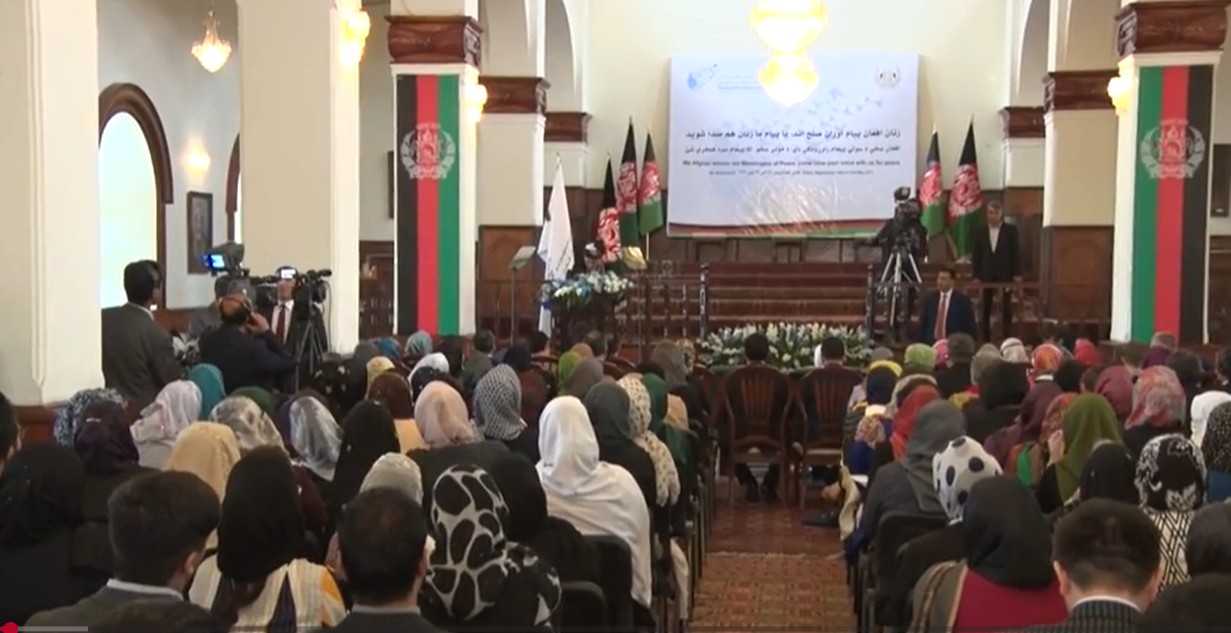
Speech at the 4th Afghan Women’s Symposium: ‘Women as Ambassadors of Peace’
Keypoints:
- Peace and Security – Women as advocates and builders of lasting peace.
- Rule of Law – Upholding the constitution and justice.
- Gender Equality – Equal rights and dignity for women.
- Education Access – Ensuring girls’ and women’s learning opportunities.
- Social Participation – Active involvement in politics, economy, and culture.
- Cultural Values – Respecting Afghan traditions and heritage.
- Religious Principles – Guided by Islamic teachings on justice and equality.
- National Unity – Strengthening society through civic engagement and reconciliation.
In the name of Allah, the Most Gracious, the Most Merciful.
First Lady, honorable members of the Cabinet, the honorable Minister from Indonesia, the representative of the British Parliament, Dr. Habiba Sarabi, Dr. Akram Khpalwak, Dr. Sima Samar, the Governor of Helmand, General Nicholson, members of the diplomatic corps, sisters and brothers: Peace be upon you all, and the mercy and blessings of Allah.
Welcome! (In Uzbek, Pashto, and Dari). Especially to our sisters who have traveled from the provinces, a very warm welcome; welcome to your own home, the Arg. Those who reside in this house do so for a limited time, solely based on your will. I congratulate you on the 32% female voter turnout; Inshallah, this year in the parliamentary elections and in a few years during the presidential elections, you must bring this figure to 50%.
Acknowledgments of Organizers and Partners
First of all, I thank all the institutions and individuals who organized this symposium under the title "Women: Messengers of Peace" and convened this vital meeting. I thank the Office of the First Lady, the Ministry of Women’s Affairs, the Ministry of Foreign Affairs, the High Peace Council, the Afghan Women’s Network, the Sanayee Development Organization, and other agencies for their participation. May your homes be prosperous! Likewise, I thank the embassies of Norway and the United States in Kabul, and the European Union, for their assistance with this symposium.
The Prerequisites for Lasting Peace
The importance of this gathering lies in the fact that peace and tranquility are the most vital desires of the people and the most fundamental need of Afghanistan. You witnessed in recent days that a great step was taken on the path to peace. In the gathering for peace with Hezb-i-Islami, I stated that reaching peace requires will and intention, diagnosis and judgment, and the observance of the law as prerequisites.
It is an Islamic principle that without correct intention, one cannot perform correct work. Furthermore, a realistic understanding and a correct diagnosis of the situation are essential. However, even if correct intention, real will, and realistic understanding exist, if the peace process is not compatible with the law, the result will be nothing but failure.
The Constitution as the Ultimate Framework
Our Constitution is the most important document and the covenant of national unity, national and Islamic identity, and the fundamental rights of our people. Without any doubt, true peace is realized and sustained only when the people of Afghanistan—both men and women—feel their fundamental rights are secure from violation. We have an absolute commitment that we will reach sustainable peace only within the framework of the Constitution and the preservation of the rights of our people.
Fortunately, we are followers of a religion in which human beings are not divided into first and second class; rather, men and women are equal in terms of human dignity and are introduced in the same degree and position. Every Afghan, whether man or woman, is equal to every other Afghan.
Historical Precedents of Female Leadership
In the history of Islam, we see that Muslim women, by virtue of the rights granted by the holy religion of Islam, played an active role in social, political, cultural, and economic life. No one can deny the great role of the pure Mothers of the Believers in the early days of Islam. In the history of Afghanistan, we also see that whenever women found opportunities for education and work, personalities like Goharshad Begum and Nazo Ana emerged.
It is a historical marvel that both the mother of Mirwais Nika and the mother of Ahmad Shah Baba were educated, yet today we deny education to our girls. The successes achieved by Afghan women in the last fifteen years are primarily due to the opportunities provided by the Constitution. It is the blessing of these legal rights that Afghan women are more active than ever in social, economic, and cultural life. Unfortunately, we are still behind the aspirations of our Constitution regarding women's rights, but there is no doubt that we are moving toward its full realization. The consensus of this entire nation is that the Constitution must be implemented. We have no other ideology; we stand solely upon the Constitution.
The Impact of War on Gender Inequality
The most significant cause of gender injustice is the continuation of war and insecurity. The number of women deprived of literacy in Afghanistan is three times that of illiterate men, and the primary cause is this imposed war with which our country is grappling. If war and violence did not exist, millions of girls in this land could have been doctors, engineers, nurses, teachers, and social activists, rather than spending their nights and days in deprivation and suffering.
Women are the primary victims of this ongoing imposed war. They are not the instigators of war, but they are its martyrs, its wounded, and its displaced. In Kunduz, a woman told me that because of the wars, she was displaced three times and lost all her belongings. She asked: "When will the time come that I can keep my home and my belongings?" This is the pain of every woman in Afghanistan, and an end must be put to this pain. You are gathered here today to answer this very question, and this is a sacred and human goal.
Women as the Cultural Defenders of Peace
The discussion of peace by women is natural and necessary because women are, by nature and history, the servants and defenders of life. In our own culture, the literature created by women strongly opposes violence. From Landays to stories, the literature of women is the voice of justice, peace, and life. In our society, it is a common tradition for women to hold the Holy Quran before killers to stop the killing. It is women who take the Quran to the house of the deceased to prevent the family from seeking revenge.
Naming this symposium "Afghan Women: Messengers of Peace" is a response to Islamic guidance and a continuation of our national traditions. Just as women have been the true supporters of life for centuries, it is now necessary to hear their views on peace and listen to their concerns. I request that the participants of this symposium present their specific proposals for peace to the government and the nation. From my perspective, understanding women’s views on national life and various fields of governance is of fundamental importance.
Institutional Support for Future Symposia
Today, we are grateful that the Afghan woman can represent herself, and this symposium is the result of sixteen years of continuous effort. Therefore, it is my hope that next year, this symposium will be organized entirely by Afghans, and the government will provide the funding. Despite the obstacles created by followers of ignorance and war over the last 16 years, Afghan women have made proud progress. They now have a clear stance and their own voice. Their capacity is much greater and their experience more vast than before.
Their opposition is not limited to the sedition of the imposed war; their stance against other social evils, such as addiction, is also worthy of great praise and respect. In this regard, I want to thank the Deputy of the High Peace Council, Dr. Habiba Sarabi, as well as Dr. Khpalwak, Palwasha Hassan, Hasina Safi, and Mr. Raz Mohammad Dalili, who has provided education for many. Nargis Nehan told me that if it weren't for Mr. Dalili, she would not know English today. Thank you, Mr. Dalili.
I also want to thank the First Lady, who, with a very small office, provided a place for listening and dialogue; she does not engage in politics, she is at your service. I am certain this meeting will help strengthen the culture of peace and will carry clear messages for the nation and the state.
Conclusion: Cultivating a Culture of Tolerance
Because we have spent forty years in war, we need the culture of peace more than anything else. The government will do its part, and the High Peace Council will fulfill its duties, but within this nation and society, we must truly find the tolerance to respect one another, so that the answer to every word is not a frown or a fight.
We must make the state and society so strong that we can convince those individuals who have spent years and decades in war to come to the field of politics and dialogue—the field of legality. This is the path to the salvation, survival, and prosperity of Afghanistan.