Strengthening Afghanistan’s Security Forces: Strategy, Coordination, and Future Readiness
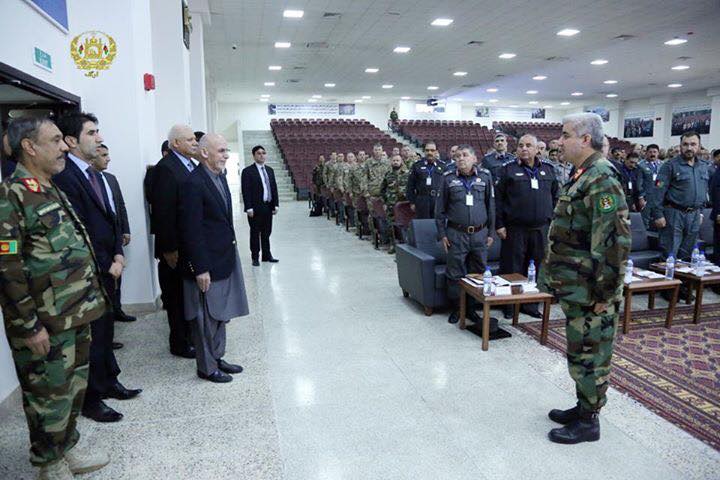
Speech at the Joint Leadership Conference of the Security and Defense Organs, Commanders of the National Army, National Police, National Security, and the Resolute Support Mission
Keypoints:
- Honor & Sacrifice: Respect and gratitude for fallen soldiers and defenders.
- National Support: Unified public backing for security forces.
- Defense & Stability: Military and police as pillars of national stability.
- Operational Readiness: Planning, flexibility, and rapid response in war.
- Force Protection: Reducing casualties and improving troop safety.
- Recruitment & Retention: Strengthening and sustaining personnel.
- Intelligence & Threat Assessment: Accurate, proactive threat detection.
- Logistics & Resources: Efficient supply, budget use, and equipment.
- Leadership & Discipline: Clear hierarchy, promotions, and accountability.
- Adaptability & Future Planning: Preparing for long-term success and resilience.
In the name of Allah, the Most Gracious, the Most Merciful.
Honorable Minister of Defense; Honorable Minister of Interior; Honorable Mr. Stanikzai; Honorable Chief of the General Staff; Honorable Senior Deputy Minister General Khaliq Khan; Honorable General Nicholson; Commanders of the Army Corps; Commanders of the Police Zones; Generals; Colonels; and all brothers—Peace, mercy, and the blessings of Allah be upon you all!
The Debt of the Nation
Thank you for giving me the opportunity to be a partner with you in this valuable conference. First, I send my prayers to the pure souls of the martyrs of the security and defense forces of Afghanistan! When the history of this country is written, it will be stated with certainty that the loyal children of this soil secured its survival at the price of their blood. All of Afghanistan is grateful and indebted to its security and defense forces. Every drop of their blood has guaranteed the dignity, status, territorial integrity, the rule of law, and the continuity of the Constitution in Afghanistan.
Neither the achievements of the Warsaw Conference, nor international strengthening, nor the Brussels Conference would have been possible without the sacrifices of the soldiers, non-commissioned officers, sergeants, officers, generals, and the administrative levels of the security and defense forces of Afghanistan. The world has clearly understood the sacrifice of the Afghan forces, and for this reason, we are changing from short-term pacts to a medium-term—and God willing—a long-term partnership. Therefore, as your Commander-in-Chief, I want to personally take pride in each and every one of you.
National Consensus
The second point is that I hope it is known to all of you that today, the majority of the Afghan nation speaks with one language and one consensus in support of their security and defense forces. In the past hundred years, I do not think you have witnessed such a cross-cutting national consensus in the strengthening of and trust in your forces. Because I have spent time with each of you, I see the results of your work daily, and I am in continuous contact with you, I know with what seriousness and strength of faith you work.
At the same time, I want to express my gratitude to General Nicholson and our international colleagues who have truly stood shoulder-to-shoulder with us. Their speed of movement, especially in the past month—which was the first time that all six Afghan Army Corps and the 111th Division were simultaneously busy in important battles—I express my gratitude for their cooperation and the leadership of Mr. Stanikzai, Mr. Jahed, Mr. Habibi, the Chief of General Staff, and all the commanders of the corps and zones.
The Goal: The Monopoly of Force
What is our goal? A security and defense force that is the axis of stability and prosperity for a dynamic Afghanistan. Do not think that your work ends with victory in war—which, God willing, is certain. The security and defense forces must be the axis of a stable Afghanistan; and that "being the axis" means that the legitimate monopoly of force belongs solely and only to the security and defense forces of Afghanistan within the framework of the Constitution. Our security problems are not limited only to war; our threats, from the criminal economy to kidnapping and so on, are not threats that disappear all at once. Therefore, all officials of our security forces should be assured that I, as President and Commander-in-Chief of the Armed Forces, am completely committed to the protection and fortification of the security and defense forces.
Review of 1394 and 1395
I have words for you in four other sections: First, the review of the past two years. What kind of year was 1394 (2015) and what kind of year has 1395 (2016) been so far? In 1394, "Ambiguity" was our cross-cutting problem. When this grave duty was transferred from Mr. Karzai to me for the first time based on the will of the people, if you remember, the majority—perhaps more than 90%—of domestic and foreign observers were under the vain suspicion that the Afghan forces would not have the endurance to resist. Today, I hope the people ask those same observers: Are you ready to apologize to the security and defense forces of Afghanistan? Are you ready to say you understood incorrectly? [Addressing the observers:] You had not understood these heroes of the country; you had ignored the national feeling of the Afghan forces. From the heroic pilots to all our soldiers, they clearly showed that we have the capability to defend this soil.
But our war in 1394 was a war for our survival. Based on my estimation, we have passed through at least six stages of war. I will not say the stages in detail, you are more involved in them; but if you remember, the first attack took place on Dangam and it took three weeks for us to give the answer. We were scattered and there were other problems; but at the end of 1394, you were performing fifteen to twenty operations daily. I witnessed a clear qualitative change and improved cohesion. The ambiguity was in the fact that our international relations were under question; we were actually progressing with a six-month commitment from our international partners. But at the end of that year, we were able to make the space wider and prove that Afghanistan can again be a pivotal point.
And at the end of 1395, you saw that contrary to the expectation of the entire region and observers, first the United States of America—for which we will always be grateful to President Obama—and then the whole world took up the very clear commitment to fund, equip, and train the Afghan forces at the Warsaw Conference. Because of this, the year 1395, unlike 1394, was an "Organized Defense." In 1394, we showed reactions to events; here, I thank the type of management you showed. In a state where we manage the war reactively, one type of management is required. From every battalion of ours, the voice rose for "air support," but sufficient air support did not exist. We were forced to adapt ourselves to the conditions.
At the end of 1394, what happened? The enemy was not able to achieve even one of their two strategic goals. What were these two goals? Their first goal was the collapse of the system of the Islamic Republic of Afghanistan—there is no doubt about this. Their second goal was the division of this sacred geography into two political geographies; their goal was for other flags to be raised over at least three to six provinces of Afghanistan. You were able with strength to make them fail in these two goals. If they judge impartially, your will, intention, and management must be taken into comparison. With whom do we compare? First, with the existence of 130,000 international forces. 130,000 of the best-equipped international forces left; but you, with your courage, were able to prevent the state of collapse that was predictable or the evil will that our enemies had. Second, compare it with Iraq, Syria, Libya, Yemen, and other countries. Judgment must be fair. I do not want a commitment from the observers, I only want fair judgment. I assure you that the people of Afghanistan and your Commander-in-Chief will always be grateful for your sacrifices.
In this period, I hope it has been proven that you have a Commander-in-Chief who is in harmony with you every moment. I am proud that my third duty is the Supreme Command of the Armed Forces of Afghanistan. Therefore, taking care of the improvement of the situation of every soldier to our highest general is my primary obligation. No gap can exist between the Supreme Command and the Armed Forces. This means the Supreme Command does not do the daily commanding; it creates the atmosphere of trust so that each of our officials can perform their work with freedom, capacity, and professional judgment.
At the same time, we had problems, but before we go to the topic of problems: the speed of the 1395 war was significantly more intense than the 1394 war. Again, so far, we have passed through six other stages of war this year. Last month was the most intense stage of the war imposed on us, but what causes hope? That which we performed in 1394 in two or three months, we now perform in 1395 in three days to one week. Your speed of action, decision-making, and use of force has fundamentally changed. Why? Because we predicted the year 1395; for the 34 points that were vulnerable, we made organized plans. Operation "Shafaq" had grand achievements; the fact that the war went from one state to another more intense state does not mean Operation Shafaq was not successful. On the contrary, Operation Shafaq was a very successful operation; but in every operation and planning, flexibility is required.
Future Outlook and Alliances
The discussion I had two months ago with the Ministers, the Chief of General Staff, the Senior Deputy Minister, and the National Security Council was that we must take preparation for the unpredictable situation. Fortunately, with the discussion we had with General Nicholson, complete preparation was brought into existence. Based on this, the deployment of international forces alongside you took place in a fundamental way. The next three weeks will still be hard weeks. we need complete preparation because this state of war has changed from an undeclared state to a declared state of war, and we understand its dimensions and are working on it very effectively on an international level. In 1394, we were in isolation; today, be certain that the sworn enemies of Afghanistan are in a state of isolation and Afghanistan is again the focus and axis of international attention. Why? Because we are in the right and we created relations that showed our being in the right based on "logic" and "sacrifice." If it were only sacrifice or only logic, it would not be enough; but the combination of sacrifice and logic caused the atmosphere of trust.
We had problems; one of our fundamental problems has been that after our Army was able to take back every district of Afghanistan by the grace of God, our Police did not have the strength to hold it, and it is necessary that fundamental thought be given to this. Because the Police started eight years later, and this is a fundamental discussion that you must perform among yourselves.
The Air Force performed infinitely many heroic acts; General Wahab and other pilots—we will always be grateful to our pilots. In 1394, we were forced to change the Mi-17 transport helicopters into combat helicopters, and if the three M-35 helicopters had not come from India on time, perhaps the situation would have been worse. But in 1395, after 40 years, you witnessed that the new Air Force of Afghanistan is being created, which provided the possibility that your decision-making regarding air support changed into an internal decision-making. Still, RS (Resolute Support) support is needed, but the fundamental points remain.
The Three-Year Plan for Success
Now, what are we faced with? If 1394 was the year of survival and 1395 was the year of organized defense, what should 1396 be? Fundamental Mobility. And until 1398, what is our goal? The creation of conditions for victory and consolidation. We can say this because we must be goal-oriented, and it is in this framework that your very important conference becomes of very, very special significance.
But today you saw that not one person has decreased and the need for a very clear plan existed. Together with General Nicholson, a very clear three-year plan for the creation of conditions for success is at hand. Conditions for success—not conditions for survival. You have secured survival. Now we must think fundamentally about the conditions for success.
The Nine Priorities for Winter
I come to the current situations: Winter preparations. We have at least 9 major subjects that must be thought about seriously:
-
Lessons Learned: The major characteristic of a human is that they learn from both their successes and their mistakes. Therefore, what are our positive lessons? When I speak with various candidates, I ask them: what are the successes, problems, and failures? There is consensus among you, but this consensus must come onto paper. Whether from officers at the level of Lieutenant General or Major General, or our new officers at the level of Colonel, when this question is asked, they have an answer. I hope these answers come onto paper. We must say in a cohesive way why some events repeat—for example, why did Kunduz repeat? The answer to this needs cohesive thought; not because we can change the past, but because we can change the future. It is a very clear necessity to make the future different, because the people do not have the patience to be displaced again and again. You understand? The amount of financial damage from the perspective of displaced persons alone is two billion Afghanis. So it is a clear necessity that we take our lessons clearly.
-
Reduction of Casualties: I offer condolences to all of you for the tragic event of Ghorak. The amount of our casualties is infinitely high. As a brother of yours, as someone who must call the families of these martyrs and offer condolences, I believe that organized attention to reducing casualties can lead to the decrease of losses. Our fortifications in some places had serious problems; our Police have given many sacrifices and we are grateful to Mr. Jahed, but the prevention of casualties must change into a fundamental principle. What can we do to preserve the lives of these heroes of ours? I hope you are aware that I personally examine the files of the martyrs of all three organs in an organized way. Someone who becomes a martyr must not be forgotten by us. In this section, I want to express gratitude to General Siavash and General Nawabi, especially for the changes that have come to the Sardar Mohammad Daoud Khan Hospital, which is today a cause of peace for my mind. Three years ago, the security forces and the National Army did not have trust in our hospital. The Police hospital needs significantly more attention. Today the difference between these three hospitals is very great and a cross-cutting cohesion must exist. If it is necessary for the Police hospital to be taken under guardianship for a period to reach the same level, it will be a positive step. Between the Police, Army, and National Security, in the section of injury and treatment, there should be no difference.
-
Recruitment and Retention: The necessity of this is very clear. Especially that conditions be created for the recruitment of our children, who are all volunteers, and how the duration of their contracts can be extended. I again express infinite gratitude to the Special Forces and General Waziri; but the recent casualties of our Special Forces have shaken me. Our Special Forces must not be forced to do the work of the Police on the highways. [Pashto:] A hard state came upon you, you performed your duty, thank you; but this special force is special, and it is the arm and the fist of the state. Every Army Corps on this same basis, and every Police zone and command, must have a cohesive plan in the section of preventing casualties and improving recruitment.
-
Transparent Analysis: I want the result of this conference to be that we hear from you in a very transparent way. Army Corps commanders, General Waziri, General Yaftali, General Ghouri, General Katawazi, General Ahmadzai... [Pashto:] My demand is that you present an analysis without any shortcomings. General Ziai, General Gul Nabi Khan and all, let us present a fundamental analysis without any additions or omissions. What are our strengths, weaknesses, and problems, and how do we see the solutions?
-
Information Sharing: The point I want to assure you of, brothers: share the bad news with me first; give the good news to the people. Good news reaches everyone. The duty of your Commander-in-Chief is to have an all-encompassing review of the situation from your perspective. Ask the major questions and say what is necessary so that our sacrifices and our soldiering become more effective. In this section, my second request from the honorable Ministers and central officials is that you review the provinces and the provinces also review you. Is the type of planning, supplies, provisions, and use of budget sufficient and on time? And what are the problems? We are all in one house; as members of one family, we must see the problems from different perspectives. We have those in the leadership who have always been at the front and have the big picture. Let us speak plainly. Tell me if the supplies are "ghost" (imaginary) supplies. If there is a shortage in your formations, say clearly what the real formation is. We must have a clear image on the basis of which we can determine the priorities of winter and then the priorities of our next three years.
-
Intelligence (Kashf): First, from Mr. Stanikzai and all the directors of National Security, especially for the past month, I express gratitude. We have reached a state, brothers, where 90% of National Security predictions were diagnosed at least one week before the attacks. This is a very good change in capacity. It is also a point of hope that in the year 1395, the amount of senior leadership of the Taliban who have been eliminated is more than the entire past 15 years. This type of joint work of National Security and the Ministries of Defense and Interior creates a clear hope. But Intelligence! Especially in the section of Ghorak, I want fundamental investigations. After this, if I observe this type of casualties, I will take significantly more serious actions. Why? We must answer the question "Why" to the children, sisters, and brothers who entrust their children to us. You saw that I had the honor to carry the coffin of a general on my shoulders and I will always be at your service, but in the same way I am responsible for every soldier and sergeant of Afghanistan, and there must be a prediction of casualties. It is not acceptable for a large number of our Humvees and equipment to fall into the hands of the enemy.
-
Threat Classification: Everything used to come to you as a threat; I have sympathy with you as commanders because on my table it also came as: this is a threat, this is a threat. A human is a human, but the types of threats must be categorized. The progress that has occurred is that Mr. Stanikzai and National Security can now truly differentiate the threats.
-
Support Systems and Corruption: Our calorie amount for the Army and Police is 400 calories more than the U.S. Special Forces; but our systems do not work. I personally led more than 74 procurement meetings because the guardians of this country must have their food, clothes, water, and facilities reach them. In this section, there are problems in the center and provinces. These problems are not tolerable. At the end of winter, a clear system of procurement and fortifications must exist. Corruption is one part, but effectiveness is significantly more important. I created a special line that is active 24 hours in the Supreme Command, but I am truly ashamed that sometimes I first hear from my forces that they have passed fifteen or twenty days with only rice or dry bread. What is our intelligence and information doing that people call me or the media? [Pashto:] I want order! I want these complaints removed. This is not a request, this is not a guidance, this is an order! It will be implemented! And if someone does not implement it, I want changes here. The system must be reformed. These facilities did not come for stealing, because over there, they are shedding their blood. So a clear audit must be done.
-
Budget and Infrastructure: The Air Force is at the top of our work, but the whole system of our budget use must be fundamentally reconsidered. Is it effective? What kind of consumption? Many times in past years, these two very large ministries of ours were not able to spend their budget. We must create a system. In the next four years, we must complete the physical infrastructure of the security and defense forces for the next forty years. This is a grand opportunity that will not come again. After all the help that has been given, our police commanders are still living in old forts (Qalas).
The Generational Change
In this section, one of the very major points is appointments and promotions. Clear systems are being created in the Supreme Command so that we can quickly diagnose who should be appointed when a vacuum is created. We are dealing with a generational change; it is a very clear necessity to invest in the new generation. Therefore, my request is that all brigade and battalion commanders be reviewed by you, because it is a matter of leadership.
Our generals must be assured that their orders are obeyed by the Majors, Lieutenant Colonels, or Colonels. This culture of not accepting the orders of our experienced generals is not acceptable to me. Be assured, and assure everyone, that if your legal order is rejected by subordinates, that is the day of their resignation or they will be court-martialed. The Army and Police do not work only on "Yes, sir." Hierarchy must exist and be implemented. I understand you have suggestions here; please share them. We must change the state where a commander does not have the authority to say a person sent to them lacks capacity. Brothers, you are clearly trusted by me, and the trust is mutual.
The Reserve Forces and Year 1396
Last year, our major goal was how to rebuild the "215 Maiwand" Corps. This time, the Army alone is not enough. The Minister of Interior has given much attention to the Police; the reconstruction of the Police must be fundamentally in our view. We must think about the reconstruction of all three (National Police, National Army, and National Security). What we need are your ideas regarding the creation of Reserve Forces.
The final subject is preparation for next year, which has four points:
-
Prediction of the Enemy: Our war is multi-dimensional. One thing is not here: The war in Afghanistan is not internal! Therefore, we must have the definition of the enemy with clarity. If, God forbid, you were in their place, how would you see your current weaknesses and strengths? Where are our points of vulnerability?
-
Effective Planning: You are the teachers and experts; what is the most effective type of planning?
-
Effective Use of Force: We have used force again and again. From 2006 to 2016, we have fought a great war in Helmand every time and at the end of the operation we said the threats are gone, but they were not gone. So now there is a necessity to know: what is the "effective use of force" so that the use of force is not needed again? What do we want from Special Forces? From National Security? From Police? At what level?
-
Flexibility: In war, one cannot calculate every prediction. We must have the capability of flexibility. If two months ago we did not calculate that a day might come where all six Army Corps are at wars that need their full attention... Commanders like General Ghouri! The 207th Corps did not have this problem in past years, but you were faced with very different states. We must think fundamentally about the necessity of flexibility.
Conclusion
In the end, I want to thank you again. My first request is that you present my gratitude from the bottom of my heart to every soldier, sergeant, officer, and general. Second, this gratitude is not only mine; it is the gratitude of the entire state and the National Security Council. Mr. Atmar is not present; he has taken more than enough trouble. But most importantly, this is the gratitude of the people of Afghanistan. The people of Afghanistan believe in you for a very simple reason: you are all the sons of the people. No one was forced to perform this sacred duty; you yourself decided to perform it.
I was at the Qargha Academy on the day young boys and girls graduated. On that day, I saw the signs of belief in the future of Afghanistan. Each of these youth could have gone and done a civilian job. Two weeks later, these same youth were in Helmand and Uruzgan. Today, some of them are in shrouds—in red shrouds—but I saw no doubt in their will, because you have become the example for them.
This National Army, this National Police, and these National Security forces are the pride of Afghanistan and they will gain fortification. Today we are in war; tomorrow in peace, we need you even more than this. Therefore, your seminar is extremely important. Believe me, I will read every paper that is sent to me after you reach your result with precision. I thank you again. May God be your protector and helper.