The Inter-Afghan Roadmap: Formalizing the Peace Agreement with Hezb-e-Islami
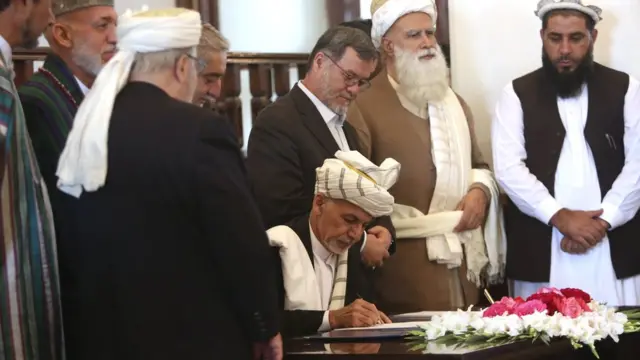
Speech at the Peace Agreement between the Islamic Republic of Afghanistan and Hezb-e-Islami
Keypoints:
- Divine Peace: Peace stems from Islam’s sacred “Salam.”
- Generational Duty: Elders must end war for youth.
- Afghan Ownership: Conflicts resolved by Afghans, not foreigners.
- Constitutional Rule: Constitution guides all rights and politics.
- Choice for Opponents: Armed groups must choose peace or isolation.
- Political Transition: From guns to institutional politics.
- Protect Achievements: Safeguard women, students, and civil society.
- National Reintegration: Support the honorable return of refugees.
- Global Responsibility: Partner in fighting terrorism worldwide.
In the name of Allah, the Most Gracious, the Most Merciful.
Dr. Abdullah Abdullah, National Leader Karzai Sahib, Mr. Danish, Mr. Rahimi, Mr. Muslimyar, our highly respected Jihadist leader and Chairman of the Peace Council Pir Sahib, the bastion and fortress of our national beliefs Professor Sayyaf, Chairman of the Ulema Council Mr. Kashaf, Engineer Karim Sahib, Mr. Baheer, other esteemed members of Hezb-e-Islami, members of the Supreme Court, members of the Cabinet, Ulema, and all elders, sisters, and brothers:
Assalamu Alaikum wa Rahmatullahi wa Barakatuh!
I also welcome the foreign representatives to this historic day, which will, God willing, conclude in goodness and peace for the people of Afghanistan.
Respected attendees and dear compatriots, I am profoundly happy that today we are gathered in a most auspicious meeting—a meeting for peace. We meet on an occasion that is the deepest aspiration and the consensus of the Afghan people; a matter tied to the prosperity, stability, honor, and progress of Afghanistan. Peace is a command of God. The word "Islam" itself is linked to "Salam," meaning peace and tranquility. "Salam" is one of the names of Allah, and offering it to another is, in reality, offering them peace, safety, and rest.
The Generational Burden of Peace
Today, we are gathered for the signing ceremony of the peace agreement with the esteemed leader of Hezb-e-Islami, Hekmatyar Sahib. The effort to reach this sacred Islamic, national, and human goal was not easy.
-
The Difficulty of Peace: As Hekmatyar Sahib noted in his speech, if peace is not more difficult than war, it is certainly not easier. Great efforts were made by both sides.
-
Resolve Amidst Conflict: In recent months, these efforts intensified and took their final shape at a time when, unfortunately, an imposed war was at its peak. Pursuing peace in the heat of battle represents the firm resolve and wisdom of both parties.
-
Generational Duty: The shared duty of my generation and Hekmatyar Sahib’s generation is to stop the war, rescue Afghanistan from dependency on others, and help it stand on its own feet. The fire of this war was not lit by the younger generation or today’s youth; it was lit several decades ago. Therefore, the duty to extinguish this fire rests primarily on the shoulders of the older generation.
-
The Collective Home: Nowhere in the world has real peace been achieved without a price. It cannot be a case of "everything for me and nothing for others." Afghanistan is the shared home of all compatriots, and we must all accept one another within it.
I have said it repeatedly, and I say it again: for the sake of peace, I am even willing to sacrifice my life. I say this because peace has a price; it is not obtained for free.
Recognition of National Consensus
I must thank all parties and personalities who strove to fulfill this great national, human, and Islamic goal: Pir Sahib, Professor Khalili, other leaders of the Peace Council, Hazrat Sahib, and Professor Burhanuddin Rabbani, who gave his life as a martyr on this path. I thank Professor Sayyaf, and specifically Mr. Karzai, who called for the Peace Jirga and laid the foundation for national consensus. I thank Dr. Abdullah Abdullah, First Vice President General Dostum, Second Vice President Mr. Danish, Engineer Mohammad Khan, Professor Mohaqiq, Professor Atta, the respected Habiba Sarabi, and other members of the High Peace Council.
I also thank the Ulema Council, the leadership and negotiating team of Hezb-e-Islami, civil society, both houses of the National Assembly, political activists from Jamiat-e-Islami and other parties, and indeed the entire nation. Special thanks to National Security Advisor Mr. Atmar, who supported Pir Sahib with great commitment. If peace were not the demand of the nation and if there were no national consensus, reaching this agreement would have been impossible. I also thank the international community and friendly nations for their cooperation.
A Message to the Armed Opposition
Thirty-eight years of Afghan blood has been shed. This means Afghans understand the value of peace more than anyone else.
-
The Crossroads: This is now an opportunity for the Taliban and other groups opposing the government. They stand at a crossroads and must show their choice: Will they stand with the nation and join the caravan of honorable peace, like Hezb-e-Islami, to help build and advance the country? Or will they stand against the nation and continue a war whose profit goes entirely into the pockets of foreigners?
-
The Judgment of History: Our people have sufficient understanding and will judge those who have dedicated all their power to the destruction of the country. War against the Afghan people will lead only to isolation, defeat, and disgrace.
-
The Divine Answer: According to the teachings of Islam, even if the Taliban believe they are right, they have no answer to the divine command in the 61st verse of Surah Al-Anfal: "If they incline toward peace, you must also incline toward it." We will make their faces and the faces of their supporters clear to the world.
The Pillars of the Inter-Afghan Process
This agreement has distinct characteristics:
-
Completely Inter-Afghan: This was a purely Afghan effort. This is a land of Jirgas, and the purpose of a Jirga is not to create war, but to resolve conflicts. This proves that if we are left alone, we can live in peace and harmony. I have always said we do not want peace from Pakistan, but peace with Pakistan, because we are capable of reaching reconciliation among ourselves.
-
The Kabul Center: These talks took place in Kabul, the heart of Afghanistan. Kabul is our shared home and the center of our history; it was the most appropriate place for these discussions.
-
Constitutional Supremacy: The Constitution of Afghanistan held the central position. There is not a single point in this agreement that contradicts our Constitution. It is our national deed and the axis of our agreement. Our Constitution is a document that pays more attention to Islamic values than any other in the region.
-
Democratic Transition: The Constitution grants the people the right to transfer power through general elections, not through bloodshed. It guarantees the rights of all citizens—men and women—to work, education, and political activity.
Justice and the New Generation
We have shown that we have the will, the authority, and the competence for peace.
-
The Jihad of Politics: Transitioning from war to political and civil activity is the "Great Jihad" (Jihad-e-Akbar) that our society desperately needs today. Countries progress through peaceful coexistence, not unrest.
-
The Rights of the Future: Two or three generations of ours have been victims of war. It is now the right of the new generation to witness stability. We cannot let our fate be forever tied to the gun.
-
Protecting Achievements: Negotiations were based on protecting the achievements of the last fifteen years—the education of our sons and daughters, the investments of our traders, and the guidance of our Ulema.
International Responsibility and Migration
To our international partners: our fight against terrorism—a common threat to the Islamic world and the globe—will continue. We remain committed to defeating this destructive phenomenon. Unlike those in the region who use terrorism as a strategic tool, we are committed to a constructive, peace-oriented approach.
Finally, I must address the return of our refugees. Their return is accelerating, and we expect it to increase next year.
-
The Incomplete Society: I have often said our society is incomplete without its migrants. We are only whole when they return home.
-
Sharing our Bread: We must be prepared to share our bread with our returning loved ones. The Constitution gives them the same rights as every other Afghan to live with dignity and happiness.
Conclusion: A New Beginning
I thank the entire nation for welcoming this peace process so warmly. I hope this day is the beginning of greater progress in silencing the fire of war. With each other’s help, let us turn the ruins of war into a flourishing land so our children can stand proudly in the world of the future.