Afghanistan National Citizenship Charter: Unity, Accountability, and Inclusive Development
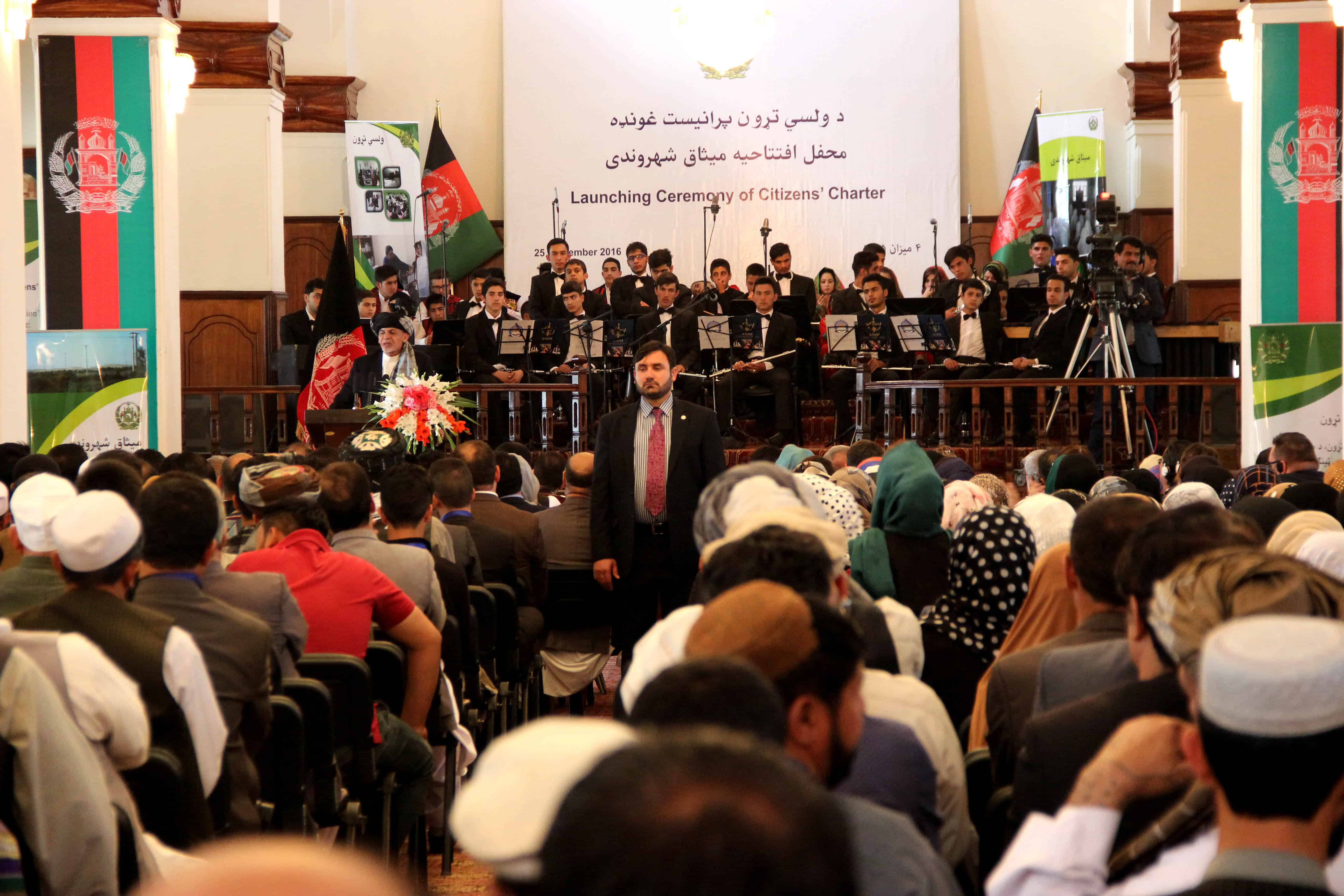
Speech at at the launch of the National Citizenship Charter, Kabul
Keypoints:
- Unity: Ensure national cohesion across all regions.
- Rule of Law: Uphold constitution as supreme social contract.
- People-Centered Governance: Government actively serves all citizens.
- Accountability: Ensure transparent resource use and projects.
- Inclusive Development: Promote equal participation for all groups.
- Citizen Empowerment: Encourage responsible and active public participation.
- Poverty Alleviation: Prioritize support for the most vulnerable.
- International Cooperation: Strengthen outcomes through global partnerships.
- Service Delivery: Provide efficient, fair, and monitored public services.
- Cultural Shift in Governance: Transform government from privilege to service.
In the name of Allah, the Most Gracious, the Most Merciful.
Excellency Dr. Abdullah Abdullah, esteemed members of the Cabinet, Dr. Qayoumi, international partners, diplomatic representatives, specifically the representatives of the People’s Councils and other colleagues: Peace be upon you and the mercy of Allah and His blessings!
Khosh Keldig! Khosh Amadeid! She Ra-ghlast! (Welcome!)
Welcome. It is by your will that today the leaders of the National Unity Government have the honor of serving you. Thank you for participating in the elections. Since this government was formed, we have been committed to fulfilling the aspirations you voiced during the campaign.
My remarks are divided into four sections: Gratitude, Congratulations, and Recognition.
Gratitude and Institutional Recognition
First, I thank the representatives of the National Solidarity Councils who clearly shared their dreams, requests, and criticisms with us last year. I hope today serves as proof that you have a government that listens. We heard you, and based on your aspirations, National Solidarity is today being transformed into a National Charter, allowing you to work with confidence across all of Afghanistan.
Second, I thank my colleagues in the Cabinet—Excellency Dr. Abdullah Abdullah, the Minister of Finance who made exceptional efforts to fund this program, all members of the Cabinet, and specifically those ministers from different sectors who worked together. For the first time in Afghanistan’s history, ministers were willing to set aside their differences.
Brothers and sisters, this was not easy. You know the reality of the villages yourselves. I want to congratulate these ministers for truly prioritizing national interests over sectoral interests, all working with unity and agreement. This is a very good and positive example for other ministries to follow so they may achieve results.
I especially want to thank our very active Deputy Ministers. A group of Deputy Ministers worked day and night to bring this program to success. I ask the Ministers of Finance, Rural Development, and other ministers to grant First-Grade Commendations to all these Deputy Ministers.
Through the activity of these Deputy Ministers, I became convinced that Afghanistan possesses an administrative cadre capable of fulfilling the demands of the Afghan nation. My generation is, by the grace of God, being succeeded by a much younger one; we can rest easy knowing we are handing the future of Afghanistan to a responsible generation.
Inclusion and International Partnerships
Fourth, I thank our sisters who participated in National Solidarity. Previously, you stated your wishes clearly; today, for the first time, the constitutional mandate regarding the equal participation of men and women in councils is being realized. There were obstacles, but congratulations to you: 50/50!
Fifth, I express my gratitude to our international partners, especially the World Bank. On average, they spend 18 months moving a project from concept to action. A major reason for this is that they often lack national internal partners to pressure them. This time, our Deputy Ministers and Ministers broke the record. From now on, a six-month timeline is the goal. They worked together within the ministries, within the government, and sometimes with our international partners. Working together is like cooking Qurma (stew); the start is always with the onion, isn't it? Onions bring pain and tears to the eyes. If it doesn't result in a meal quickly, only the pain remains in one’s memory. We want to reduce the pain of the onion and increase the benefit of the stew.
Sixth, I want to express my gratitude to the Security and Defense Forces of Afghanistan and your children who sacrifice day and night. When this great trust (the Presidency) was placed upon our shoulders, the survival of Afghanistan was at risk. The absolute majority of observers in the region and the world—and even domestic pessimists—thought that, God forbid, Afghanistan and its statehood were on the verge of collapse. The survival of Afghanistan has been secured through the sacrifice of its brave soldiers, officers, and generals. From the bottom of my heart, I thank all of you, sisters and brothers, from every village and city, for sending your honest children into the ranks of the security and defense forces. Every one of them is a volunteer; no one was forced to join. Their sacrifice allowed the international community to regain its trust in us.
When you have the resources yourself, project-making is one thing; but when you act on a promise where you must first find the resources, that work is ten times more difficult. I especially thank the Minister of Finance for his efforts in this area.
A Common Language: The Meaning of the Charter
The most fundamental issue for which I thank everyone present is the creation of a "Common Language." Today, everyone spoke with one language throughout the discussion; the voice of the government is united, and the voice of the government is one with the nation.
What does "Charter" (Misaq) mean? The meaning of the Charter, in the first instance, is that our Constitution is our National Deed. The social contract of Afghanistan is reflected in its Constitution. This is our national document. An Islamic Constitution as comprehensive as that of the Islamic Republic of Afghanistan does not exist in the entire region. I challenge anyone to tell me otherwise! In our Constitution, the best attention has been paid to the holy religion of Islam. Read its first, second, and third articles. In Afghanistan, every Afghan has equal rights and obligations. This is our common language: No Afghan is less than another, and no Afghan is greater than another.
The National Charter looks at all of Afghanistan with one eye. It makes no difference which village is in Badakhshan, Helmand, Herat, or Paktika; all Afghans come within the framework of one national program. We assure you that we will reach insecure areas; insecurity is not a reason for us not to provide services.
The second principle reflecting the Constitution is that the people are the principle, and the government is the tool. When crises hit Afghanistan in the 19th or 20th centuries, who defended the homeland? The people created the epic of this nation. Enemies and pessimists have always ignored the strength and unity of this nation. Therefore, the unity of this nation is first the result of our faith in God, and second, our own solidarity. This solidarity, which existed in our consciousness, was not previously implemented as a practical program.
Previously, programs led some to say attention was paid to one place and not another. The Constitution is clear: balance must be observed and attention must be nationwide. Today we are witnessing the largest step; for the first time, one of our programs does not only include the rural areas but the entire country. From now on, the commitment of your National Unity Government is that every program of ours will, God willing, be inclusive of all Afghanistan.
Trust and Accountability
The third point is that a mutual trust exists between us. You trusted us, and now we are giving you the funds. Is there a greater trust in Afghanistan than giving someone money? When I was young and visited villages, if I said "thank you," they would ask: "Should I eat your thank you or wear it?" There was a great philosophy in that—it meant "What are you actually doing for us?" Now that you are given the right to make decisions, it comes with a sense of responsibility. I am very grateful for the way you, sisters and brothers, expressed this responsibility.
Account for every penny; but also, God willing, an account will be taken from you for every penny. Why? What is Afghanistan's greatest shame? The daily accusation of corruption. If it weren't for the efforts of your National Unity Government to convince the world that we truly have the intent, will, and plan to fight corruption, do you think the world would have agreed with us on a billion-dollar program? Therefore, we are all in a test to ensure transparency nationwide. Furthermore, for every Afghani that comes through this program, your energy should turn it into twenty. Solve the problems yourselves—if youth are idle for four months of the year, they should volunteer to perform parts of the work. Please move away from this "NGO culture" of waiting for someone else to clean the stream or repair the mosque. The more we do ourselves, the more we prepare the ground for greater tasks.
The fourth point is service delivery. The greatest corruption, from our perspective, is that which forces a destitute individual to take a loan to secure services; there is no greater oppression in the world. Whether it is a doctor giving low-quality medicine or a rural development official building a bridge improperly—service delivery requires mutual oversight. There must be clear public oversight, joint government oversight, and third-party neutral oversight. Without oversight, we cannot ensure transparency. This is the meaning of mutual accountability.
Changing the Culture of Governance
The primary work this program performs within the "Citizens' Charter" is changing the culture of governance. In the past, a legacy remained where anyone who became a government official thought they were superior to others. I am your first servant. All government employees are your servants; they have no rights over you, but you have rights over them. It is essential that within this national program, the culture changes to one of service and cooperation. Every citizen who goes to a clinic or office should be welcomed as if the President or Chief Executive has arrived, because we sit here today based on your will. We represent you and are responsible to you.
The biggest problem we face is "Deprivation." The play you performed here last year is one I share with the whole world. You showed the real image: who in the village eats three times a day? Who eats twice? Who eats once? And who dies waiting for bread? Eradicating this poverty is our Islamic and national duty. We must focus most on the poor. I thank you for focusing on the participation of internally displaced persons, returnees, and nomads (Kuchi). These are the most deprived segments of society. We want this program to be a means for the honorable reintegration of returning refugees. They are not strangers; no one should look at a returning refugee as a stranger. They have the same rights as us.
The Brussels Conference
Regarding the Brussels Conference: it is a renewal of the contract between the people of Afghanistan and the international community. Two years ago, did you think the world would still be interested in Afghanistan in its sixteenth year? At the Warsaw Conference, we gained a clear commitment to equip and strengthen our forces. Today, Afghanistan is at the center of global attention while our enemies are in isolation.
In Brussels, your government represents every segment of Afghanistan. The Citizens’ Charter is a covenant between generations. The world will re-commit economic resources in Brussels to ensure not only this program but our other commitments to eradicate poverty and create a stable Afghanistan are fulfilled. Brussels is not just a conference to be forgotten the next day; after Brussels, we must all roll up our sleeves and work together.
Today, city and village are linked. How much of our village produce is wasted before it reaches the city? I ask you, brothers and sisters, to make this a fundamental program—convince the whole nation, especially the women who make the decisions, to prefer Afghan products. Afghan fruit is wasted while you buy foreign fruit. I have no problem with foreign fruit, but it lacks the taste of ours. Fashion is not in imported bottled perfumes. We need to work with the private sector to create value chains.
The Kite Metaphor
I will conclude with an example. The President of Afghanistan is like a kite. No matter how high it flies, the string is in the hands of the people. You can bring us down to earth very quickly. My request is this: Trust your National Unity Government. Give us the string necessary to fly high with honor, but demand accountability from us. Let that accountability be based on how sincere and serious our efforts have been in the service of the people.
Another major project is in preparation and will be placed at your service one after the other. In the last two years, foreign policy was vital because our survival depended on ending our isolation. Today, we are not tied to a single port; dozens of ports are at our service.
I congratulate you all and thank you from the bottom of my heart. I ask you to continue with the same sincerity and will to achieve this great goal.
Yashasin Afghanistan!
Zenda bad Afghanistan!
Tal de wi Afghanistan!