
Investing in Human Capital: Reform, Education, and the Future of Afghanistan
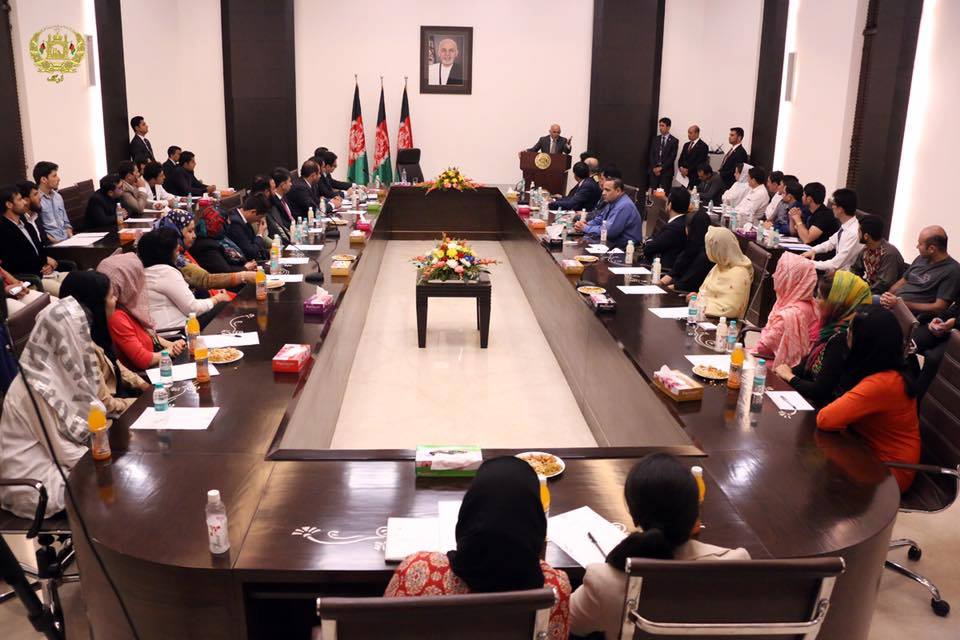
Speech at the Meeting with Afghan Students in India
- Human Capital Development: Youth are Afghanistan’s greatest asset.
- Education Reform: Universities must improve quality and relevance.
- Public Administration Reform: Government hiring must be merit-based.
- Economic Development: Infrastructure and investment drive growth.
- Technical Training: Vocational skills create jobs.
- Leadership and Governance: Vision and management enable progress.
- National Service: Educated Afghans must serve the nation.
- Fair Scholarships: Scholarships should be merit-based.
- Student Support: Embassy should assist students.
- National Connection: Stay aware of Afghanistan’s needs.
- Return and Serve: Graduates should help rebuild the country
In the name of Allah, the Most Gracious, the Most Merciful.
Dear students, Mr. Ambassador, colleagues, and the delegation that has arrived from Kabul: First and foremost, I offer you the gift of the Leader of Humanity; Assalamu Alaikum wa Rahmatullahi wa Barakatuh!
To the esteemed members of the private sector, may God keep you always. First, Eid Mubarak to all of you. I hope it passed peacefully and without incident.
Let us start with the final points mentioned; I have signed the decree. I hope your school will be funded. I express my gratitude for your very constructive views, the identification of problems, and your proposed solutions.
Regarding the questions raised by Mr. Hazouri: First, the issue of recruitment. Mr. Nader Nadery is the new Chairman of the Civil Service Commission. Our recruitment process was complicated, convoluted, and meaningless. Complicated in the sense that the Ministry of Agriculture announced about 341 posts, and after 13 months, the Civil Service Commission had not selected a single person. From now on, I will personally manage the recruitment of all government officials, especially the CBR (Capacity for Results) posts. I hope this process transforms into a very transparent one, free of personal influence or intermediaries—just as the Procurement Commission, the High Economic Council, and the National Security Council were transformed. It is my hope that we can fundamentally utilize the young and educated cadres of Afghanistan.
The recruitment process must be reduced to 52 days. Every stage has been re-mapped. The examination methods had absolutely no relevance to the duties or the hiring needs. The questions were designed for the 19th century, not the 21st. I am speaking plainly to you so you don't get angry later! Just as in Kabul University they used to give you your grandfathers' old notes, in this process, they should not use outdated methods; they must go and research.
The money paid for pensions is the same as salary money. They must say goodbye to using influence and "wasila" (connections) to reserve teaching posts for their grandchildren, sons, and daughters.
On Cadres and Human Resources
The issue of cadres is very serious, and your grievance is justified. I hope my reasons are also justified. You know I spent 17 years of my life teaching; when I am finished with this duty, God willing, if life permits, I will be a teacher again.
The most difficult part of our reform process is in human resources. The Ministries of Education and Higher Education have very serious problems, and our universities have even more serious ones. What our universities produce is of no use to the nation; what the nation needs, our universities do not produce.
Therefore, the reform process has several parts: First, I must define the core functions of the ministries. Perhaps only three ministries in Afghanistan can explain 70% of their core duties to me; the rest do not understand their own functions. Unfortunately, our embassies do not understand their duties either. This is not the Ambassador's fault; it is the fault of the embassies and the Ministry of Foreign Affairs, because we have not identified the core tasks.
There are no criteria for who is necessary. Our Ministry of Foreign Affairs is full of political appointees through "wasila." It will be reformed, but I need time. You know whether the majority of Foreign Ministry employees came through merit or connections. How many have the capacity? How many can write in English? How many can speak English? How many have passed the TOEFL exam? They haven't. I cannot fix all of this in one day. Understand my limitations as well. My first duty was to ensure the survival of Afghanistan. When I took office, the world had two feet out the door and was looking to borrow two more. Sisters and brothers! In Afghanistan, foreign policy is domestic policy. If we hadn't convinced the world to stay, all investment in our human resources would have yielded no result. Now, Afghanistan's security future is secured.
Economy and Infrastructure
Do not doubt that we are under general attack, but we will prevail. A medium-term vision has been created—ask the private sector. Second was the creation of "bread" (sustenance). In forty years in Afghanistan, had you seen the inauguration of a single dam? I hope in the next three years you witness the inauguration of more dams than in the past 250 years. In this sector, the type of connectivity and creating an economic base for Afghanistan was vital.
Third is the Rule of Law. I won't list all the other sections. There is a Chinese proverb: If you want to eat for a year, plant wheat; if you want to invest for five years, plant a fruit tree; and if you want a harvest for fifty years, think about education.
You are the human capital of Afghanistan, which requires serious thought. The inherited obstacles we face are extremely serious, which is why your analysis is absolutely correct. I have instructed the Minister of Higher Education to change the entire Document Evaluation Committee; this committee truly does not understand what documents are or how to evaluate them. Among the refugees returning from Pakistan, we have 700 doctors, and not one person knows how to verify their credentials. This "paper-chasing" (bureaucracy) must stop.
Management and Leadership
Mr. Hazouri! Your fundamental points are absolutely correct, but the issue is that we need time. If I promise you "in two days"—well, the administration of Afghanistan is not one where the President commands and it is implemented the next day. They have to make forty phone calls to follow up on one issue. Why? Because we do not know management.
I’ll give you an example. The Gulkhana Palace was my office. They came to change the windows—because I cannot work in a dark room and I work 16 hours a day—first they installed heavy glass, then they painted the building. It has been two weeks and the smell of paint won't go away! I told you this, right? The reason is they don't understand management.
Eighty percent of your infrastructure ministries absolutely do not understand the fundamental management of projects or hierarchy. Why does every building project take so much time? Because they don't place orders simultaneously. We have a fundamental capacity problem; we haven't measured this capacity fundamentally because core duties aren't defined. My message to you is that the High Council for Human Resources has been created for this reason. We will start work fundamentally, just as we did with procurement and the economy.
Vision and Education
What is the vision? Who provided it? Dr. Humayun Qayoumi prepared the draft of our vision. Who is Dr. Humayun Qayoumi? The President of San Jose State University and one of the best thinkers on higher education in the world. His "problem" is that he was my roommate in university! Just as your friendships continue—and I hope a few marriages happen among you too [laughter]—Dr. Qayoumi met his classmate there, a poet named Najia Karim.
Dr. Qayoumi resigned from his university presidency and came to the country. He manages both infrastructure and human resources. The first plan has been shared. What kind of administration is the Afghan administration? 66% of the civil service has only a 12th or 14th-grade education. Do you think you can manage Afghanistan with that? But now we must create a clear system so that we don't make these people unemployed.
The key point is that if we fundamentally replace ten thousand people in the middle and upper levels of the Afghan administration, we can quadruple Afghanistan's economic growth. This is our core challenge. In higher education, we must establish a clear order. Only 25% of university professors have a Master’s degree. Most are Bachelors, and the percentage of PhDs has decreased. If a database has been prepared, I thank you; share it with me and I will follow up. But again, I tell you, this work will take 6 months if we think realistically, because every day a security crisis is created, and the ill-wishers of Afghanistan make me spend at least three to six hours on security.
Rethinking Higher Education
The best job I ever had was at Kabul University. I was with you young people all day and I was happy; whatever you said, I looked for ways to implement it. Now there are other problems, but my main point to you is that I will manage universities fundamentally. I am faced with some very difficult choices here. The quantity of universities! They have named every four rooms a "university," especially medical faculties. A medical faculty needs at least 100 million dollars; otherwise, it trains "butchers"—don't be offended, isn't that right? [Joking] They used to say the butcher is an acquaintance; now they say the doctors are acquaintances.
My point is: our commitment and focus must be on the Bachelor's degree. You should not be forced to go abroad for a Bachelor's, and at the same time, we are not ready to grant PhDs and Master's—they are faking it. For example, I trained dozens of PhD students at Johns Hopkins University. Johns Hopkins was the first university in America to grant a PhD; before that, they went from America to Germany. It had billions of dollars; they were given a 5 million dollar budget in 1867.
The types of education and fields of study are changing. Most of what you study here is of no use to the people of Afghanistan. This is not your fault; it is the fault of the state, which lacked a clear human resources policy. In the restructuring of ministries next year, especially in winter, it will be explained to you clearly which fields are needed to run the state and economy of Afghanistan.
Another change: from now on, I will send the poorest people of Afghanistan for technical education to India—unskilled individuals. Today, my discussion with the Prime Minister of India was not about PhDs; that comes later. It was about technicians and effective mechanics. Do you know how long it takes in Afghanistan for someone to go from apprentice to master mechanic? Six years. Here in India, it takes three months. 1.1 million of our youth are fed by these trades. My fundamental focus, in agreement with the private sector, will be on these individuals.
Ask the private sector—do they not have more than 60,000 Pakistanis doing such jobs? They will work for them, but they cannot give you the work you want. My point is that there must be a fundamental change in our university curriculum. The nature of knowledge has changed. Ask an American student where Afghanistan is; 80% still can't answer. But it takes 35 seconds for them to find where it is. They aren't stupid; their memory doesn't need to know where Afghanistan is because they can find it in 35 seconds. You cannot think you can run a country just by memorizing four words.
Leadership and the People
Sisters and brothers! Assess the conditions of Afghanistan: what is needed for the future? First, without understanding the economy and logical relationships, do you think you can manage the future? I'll give you an example. Mr. Kampainzada is present. The Pakistanis closed Spin Boldak. What did they expect? They thought I would pick up the phone and say, "For God's sake, I'm coming to plead with you, don't block our grapes!" Did I not send them to India in two days? Why? The idea wasn't mine; it was this man's idea, Mr. Kampainzada's. But I had the sense to tell him to implement it in 24 hours. I swear by God I won't let a single minister block it. They said planes aren't available; I said charter them. They said Ariana has problems; I said do it by tomorrow. It doesn't work like that—you must know how to make decisions.
You must learn the difference between "Leadership" (Za'amat) and "Management." The difference is understanding your people. The fundamental problem of the educated class in Afghanistan is one word: "Intellectual" (Roshan-fikr). This "intellectualism" and the claim of being "intellectuals" destroyed the country. The educated Afghan thinks of himself as the "elite." With the utmost respect and humility, as your colleague, please do not call yourselves intellectuals or elites! The ones who have looked after Afghanistan are the uneducated and the poor of Afghanistan who have continuously sacrificed. All of us, especially I, am the servant of these people. 39% of Afghan people are "martyrs of their second piece of bread" (struggling for their next meal). Therefore, you must be prepared to eradicate poverty. Plans are important and vision is fundamental; but if you don't have management, all your plans remain on paper.
The tragedy of Afghanistan—I have said this several times—is that from the perspective of resources, it is one of the richest countries in the world, but it has been turned into one of the poorest peoples. It is your generation that must pull Afghanistan from poverty to prosperity and from instability to stability. I am a passing and transitional President—transitioning from one generation to another, from one chapter to a connection, and from division to unity.
Action Items and Scholarships
Let's conclude. I will present the problems regarding your return with a fundamental plan. I have taken brief notes on your views; within six months to a year, I hope to see fundamental solutions. But we will take the first steps with you in the High Council. My suggestion is this: sit down with everyone and prepare these issues for a video conference for the High Council—Mr. Hazouri and a few other representatives—or share them with me in writing. I have taken notes, but the other way is that via Skype and such tools, you can easily hold a video conference.
Regarding your other issues—thank you, Mr. Zaher, for the fundamental points mentioned—the first point is that there has been no system or order for scholarships, and your complaint is justified that a large portion of them were given through connections. Aside from this strategy, we are seeking to create a system to solve this.
Where has progress been made? Last year, for the first time, the Afghan Kankor (entrance exam) was acceptable to the 12th-grade graduates. People got into universities who would never have gotten in before. To create that atmosphere, we imprisoned members of a provincial council and I warned all governors: "If one of you interferes in the Kankor, you will be removed from the province the next day." The first step has been taken; but there is still no fundamental arrangement for a transparent process for distributing scholarships. We are working on it. You speak of India, but many Japanese scholarships were not used. Preventing the waste of scholarships is a fundamental process. Again, Dr. Qayoumi is working on this. One of your colleagues who won a gold medal is now an advisor to Dr. Qayoumi. Last year, an Afghan boy who came to study at his own expense won a gold medal; I paid for his final year's expenses along with his computer. Now he is an advisor. So you have an internal person who understands the situation in India; help us ensure a transparent process.
Fields of Study and Quality
Third, the required fields of study. I told you that fields will be prioritized. Please do not repeat my early stages of education. [Jokingly] Do not study political science or law; we need a few hundred people in those areas, but not in the way you were trained. What we need is the law of treaties, mining, and water—fields to which the economic and political future of Afghanistan belongs.
The second point is to go to first-rate universities; do not study at third-rate universities here, please do not waste your life. I understand India; I have traveled one-third of India by car. I was here through the World Bank and worked on India for five years. There were people who came out of engineering faculties but didn't understand the volume of water in a well. Please do not repeat this. I haven't seen "stupid" people in Afghanistan; please, let no graduate return from India who is not capable.
What is needed here is a systematic list of reputable universities to work with. You know our relations with His Excellency the Prime Minister of India are extremely good. Our discussion today was on this, and I will follow up to ensure the field categorization is based on human resources needs. We also discussed with the Indian private sector how to find practical work opportunities for you. This is very necessary, not just in engineering, but in all fields. We will follow this up. India pledged one billion dollars in aid today, which is not a small amount. But most of this will be spent on infrastructure and the dignified return of refugees. I want every Afghan refugee to become a homeowner and live with dignity.
I was very pleased that you studied genetics. Especially if a gene bank for Afghanistan's major agricultural products is prepared—this is one of my dreams.
Final Technical and Administrative Points
The highest technology capacity we have today is in the Ministry of Agriculture. A top-tier team has been created; their problem is that they don't have coordination yet. I appointed 34 directors of agriculture myself; after their work was stuck for thirteen months, I read all their files myself. 70% of them have Master's degrees and one has a PhD. I asked each for a plan; five had top-tier plans, and among them is the gene bank.
We solved Homa's problem. No need for further discussion. [Joking] If my signature still carries weight, I hope money will come to you now.
Ambassador, much of this depends on you. Why can't the SAARC privileges be given to Afghanistan? We want a diagnosis from you. Who should follow this? It's being followed here, in the Ministry of Foreign Affairs, and at my level. Tell us where the problem is. Because unfortunately, in the Ministry of Higher Education, there isn't enough capacity to understand what is happening in India. So the SAARC issue must be raised. Another issue is students who want to travel within India; they should not face problems. If there is a plan, share it with me so that National Security Advisor Mr. Atmar can follow it from a security perspective. Let the criteria be clear. Those who fight, cause conflict, or behave immorally—expel them! But do not look at everyone with the same eye. Yes, there are threats.
Understand clearly that India is under threat. Because corruption in Afghanistan is extremely high, we cannot guarantee that someone with an Afghan passport is actually an Afghan. Take this point seriously. There have been at least two or three incidents where people got an ID card and then a passport within 24 hours, which could lead to a bad reputation. But there must be very clear conditions for visas so that students who are healthy, working, and striving do not have problems.
We have promised the money for books, and write to me directly about the salary issue. Mr. Chakhansuri! Follow this up with the Minister of Higher Education. They can't spend 22% of the budget in six months, yet they stop the students' money—that is not logical.
Afghan ministries are among the most ineffective in the world. When we ask them why I'm intervening, they scream to the heavens; but the reason we can't spend is that we don't know resource management. To this day, as your President, no one can tell me exactly how many teachers and active schools we have, or how many kilometers of road we build per day.
I ask you to come forward with how we can help you. The current company assigned to help you is clearly incompetent. Can we create this capacity in the embassy or consulate? What are your alternatives? It is clear from your words that no preparation was made for you in the Indian environment. You should not be learning English here; you can learn enough English in Kabul. You can learn languages anywhere. This can be solved there.
This is part of Dr. Qayoumi's proposals. When I was a university president, I was a strong supporter of creating a "Year Zero." A Year Zero means that specifically for boys and girls coming from provinces where conditions aren't good, the capacities that provide the infrastructure for education must be prepared. What are these? First, Algebra. Someone who understands algebra can predict and understands logic and management. There is a one-to-one correlation between algebra and general understanding. Second, language, writing, and speech. Third, general knowledge. Fourth, a foreign language. One point we must decide on: we cannot conduct higher education only in Pashto, Dari, and Uzbek—it is impossible. I am ready to make a large part of higher education in English. If we move toward English, fiber optics—a core of our investment—will solve many problems. At the same time, it is necessary to understand the holy religion of Islam, as well as our culture, history, and languages.
I thank you all again. Ambassador, take notes. Write a specific note for me related to the High Council, the National Security Council, and the Cabinet. I will look at my own notes, but my request is that you sit down again in an organized manner. Remove repetitive points. Divide it into stages: What should happen before arrival? Second, how should you be helped when you arrive? Which universities should you go to? Third, what should happen during your studies? Fourth, when you graduate, what assurance should you have? Fifth, when you come back, what is the contract with you? How are top graduates honored?
One more thing I've realized is that when you are here, you are like a kite in the air—your connection and information about your own land, Afghanistan, is low because we don't have people on the other side in contact with you to paint a continuous picture of the university and general environment of the country.
Again, thank you. May God keep you all. I hope for your victory in your studies and general success, and especially that with a very constructive national spirit, we can create a united, stable, and prosperous Afghanistan.
Thank you. Good night.