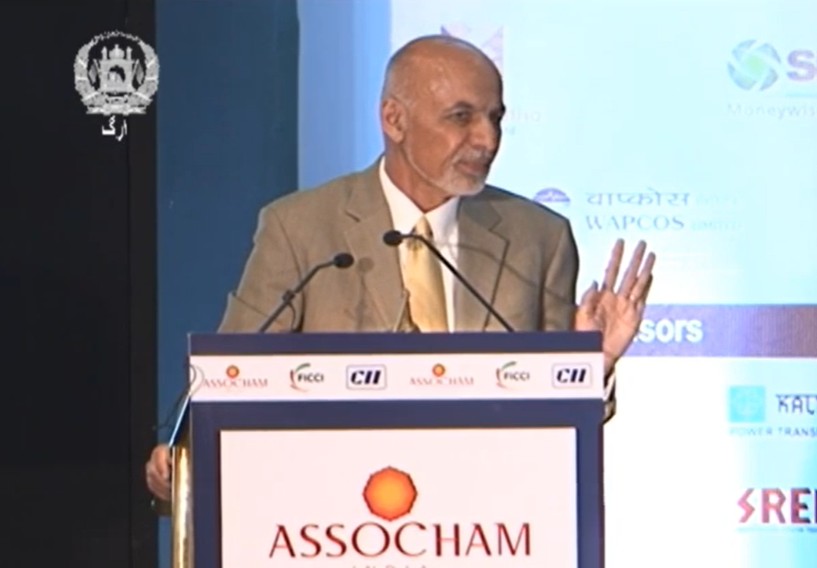
The Great Roundabout: Transforming Afghanistan into a Continental Trade Hub | Speech at India FICCI, CII, and ASSOCHAM
Keypoints:
- Condolences & Regional Cooperation: Deepest sympathies to Nepal. Disasters ignore borders. South Asia must cooperate to prepare and rebuild.
- Private Sector & Investment: Indian businesses can transform Afghanistan into a hub for trade, ideas, and industry. We welcome their partnership.
- Infrastructure & Energy: Railways, rivers, power, gas, and fiber optics are top priorities. Industrial clusters will drive growth efficiently.
- Transparency & Governance: No corruption, no middlemen. Investors will deal directly with government. Policies will be clear and reliable.
- Skills & SMEs: Focus on training, small businesses, and women-led industries. Standards and labor skills are essential for growth.
- Minerals & Mining: Afghanistan has copper, iron, gold, lithium, and rare earths. Sustainable contracts ensure economic independence.
- Exports & Trade: Goal: turn Afghanistan into a net exporter. Connectivity, clusters, and government procurement will support industry.
- Legacy & Vision: Build a system for generations, not just today. Partnerships, imagination, and bold planning will shape Afghanistan’s future.
New Delhi
Dr. Suri, Mr. Agarwal, Mr. Amitabh, Ambassador, Senate, Minister, all honorable members of the chamber, ladies and gentlemen. First of all, is it okay? Slightly. Okay. Thank you.
First of all, my deepest sympathies to the people of Nepal with whom I’ve interacted through two decades and know their beautiful valleys firsthand through walking, not just from air. Our hearts go to them. I hope that all of us will find the imagination, the will, and the compassion to deal with natural disaster in South Asia through a coherent, holistic, and anticipatory framework. Tragedy focuses the mind and it's one of those moments when the public-private partnership in dealing with such crisis can become part of social responsibility.
It's an immense opportunity not just for the government of India where Prime Minister Modi has taken the lead, but I hope for the Indian private sector to rise to the occasion, not just with assistance but with ideas on reconstruction that would result in a much more sustainable Nepal and a dynamic South Asia. I’d like to express my deepest thanks for this opportunity.
What is our objective? Our objective in Afghanistan is to enable any amount of Indian money that is willing to be invested in our country to be invested. Let me repeat: we see the Indian private sector as a key partner in transforming Afghanistan from an area shadowed by conflict to a hub. A hub where, in my phrasing, it becomes a roundabout where goods, ideas, people flow in all directions and it brings back the level of connectivity that enables Asia to be transformed from a geographical notion to a continental economy.
What are the obstacles? The obstacles fall to several levels. First is the physical infrastructure. We do not yet have the railways, the fiber optic systems, the irrigation, the dams, the generation of power that is required. So our first priority with you is to arrive at a cluster approach towards development of infrastructure.
Let me highlight some of the possibilities so then we can deal one by one. Afghanistan has the potential to generate at least 26,000 megawatts of electricity from hydro. The approach hitherto worldwide with few exceptions has been a dam at a time. Our conception is to go a river at a time. A system. If we take a systemic approach, we will be able to produce an assembly line approach to production of power that is the central driver of connectivity between South and Central Asia.
But let's drop that approach. So what do we need? First-rate engineering companies that arrive with us with feasibility and detailed design and private-public partnerships that would be able to share in the production, transmission, and distribution. This is the first priority.
Next to hydro, of course, is the immense gas potential in gas here. You know while transmission lines are spatial and we have a framework for transmitting with the pipelines from Turkmenistan to Afghanistan to Pakistan to India—but I invite you to another opportunity. TAPI will take five years. I invite the Indian industry to join us in production of fertilizer in a chemical industry based on supplies of gas from Turkmenistan and Afghanistan's natural gas.
You know the global fertilizer industry is facing a huge problem of insured supply chains. Our own gas is improving by the day, but Turkmenistan's gas is available. If we don't tap it, we are likely to lose it to other opportunities. So I am proposing a shortcut to you, and his honorable the Prime Minister is interested in this approach. We need you to come together to turn Afghanistan into a center of both fertilizer and chemical industry. The power in this conception would be a byproduct rather than the primary driver. You see there's a win-win proposition that is extremely important.
The third area is fiber optics. We've used the phone as a means of exchange of information. But Afghanistan does have 22 million phones. We had 100 mobile phones when I had the honor to push the sector forward, and they thought it was one of my craziest ideas. But it's paid off. The telecom sector is the second largest contributor to taxes. But our conception is to turn the telecom sector into a generator of growth, not just [revenue].
So here there is an immense possibility to partner to think through the second and third generation of telecom. Phone connectivity should be free. We should find the conditions for the growth of a telecom industry that really does the second and third generation. And the possibilities of Afghanistan becoming a hub of connectivity is immense. What Singapore derived from its spatial advantage vis-à-vis the time of banking, Afghanistan has the potential with telecom. There's an immense set of possibilities between Central Asia, East Asia, and West Asia.
So here is another. Then there's the railway and next to that—I mean rail—without a railway we really cannot function. The bulk of other goods that we are going to produce are going to be heavy. Without the logic of railways, we cannot work. But I have good news for you. Don't think about immediate contiguity. Use Afghanistan as a launching path to reach Central Asia immediately. You can produce in Afghanistan and export.
Afghanistan is an unbelievable advantage that has not been paid attention to. We have 99% tax exemption in India, 97% in China, and you count it across the world. As one of the 10 poorest countries, we have tariff advantages that would not be granted to a middle-class or an upper-middle-class country. So joint venturing with our private sector allows you not to just think in terms of the framework of the Afghan market but regional and global market. So a whole set of industries that otherwise might not occur to you at first, like pharmaceutical production, can give you a base for export.
Let us bring together our imagination to work. This is in effect one of the largest subsidies available to Afghan-based industries, but it has not been grasped.
So to summarize here: first, in terms of the infrastructure, we would be able from the state side, we are going to tackle this by drawing the first National Infrastructure Plan of Afghanistan. What would be the difference in the way of preparing this plan? It is going to be coordinated with the Afghan private sector and our regional private sector partners. It is not going to be driven by military needs or by administrative needs. It is going to be driven by the economic conception of what we have. And as part of this, we're willing to create special investment zones along our borders with Central Asia and Iran to create the easiest points of export. So I hope that the first issue is understood and the nature of the partnership that we are willing to can be then discussed in detail.
The second problem—and let's get straight to it—is corruption. It has been a fundamental obstacle. You have faced the question that government officials have asked you to become hidden partners, sleepers, whatever you name it. I chair the National Procurement Committee myself. We want to assure you that if you want to invest in Afghanistan, nobody is going to shake you down.
Come to us. Anyone who invests more than $50 million will be able to have a private discussion with me. Anyone who's willing to put $200 million will get to stay in our ancient palace, the first building built in the current ARG complex, and will have a direct interaction with all the ministers. And anyone who asks you for money, payments, partnership—share the names, we will dismiss them. We want to give you a transparency and accountability guarantee. This is crucial. Without that, we are not going to function.
The third obstacle has been reliability of policy. You need reliable policies, laws, regulatory environment—from the law to the regulations. We invite you here to do a diagnostic with us. Get to the understanding of the obstacle. Minister Rasa, the Minister of Commerce, would be your focal point. This cannot be done one-sided. You're the critical stakeholders. The Afghan private sector is the other critical stakeholder.
They can tell you that I've arrived at the format with them where every week they discuss two of the obstacles that have prevailed from 13 to 36 years. Then I meet with them for 2 hours. We reach consensus and then I take it to the Cabinet so that there's a full consensus. We would like to propose similar types—the same type of arrangement with you. Engage in seeing where is the gap in authority and gap in understanding so we can establish a common understanding.
Today the problem is some of us think we are playing chess and some of us we think we are playing rugby and others think that we are engaged in a horse race. The private sector cannot function with such ambiguity of rules and regulations. So our promise to you is partner with us to create rules of the game where we have understanding. Without these rules of the game, the field of maneuver becomes tactical. We want to stabilize the rules of the game so we can plan medium and long term. We want to take the whim out of this policy environment, and I hope that this will result in a common understanding and in a partnership.
The other obstacle has been that the purchasing power of the government has not been harnessed to support the Afghan private sector or the regional private sector that is willing to invest in Afghanistan. The Ministry of Interior and the Ministry of Defense are the largest economic actors in Afghanistan today. So regarding your third proposal—second proposal—Mr. micro, small, and medium in the sectors that you outlined. I'm very grateful to this, but I want to now assure you: we've given 15% preference to locally produced goods.
Locally produced goods means any capital that is invested in Afghanistan to produce. So whether it's dairy—you know, our Ministry of Agriculture will tell you we have the tragic situation that we are [out of] balance, we are importing more than around $4 billion of foodstuffs, milk. We are going to use the purchasing power of the government to create a virtuous circle. So come, and we will change the budgeting system in Afghanistan to a four-year system to the end of my term. And in this environment, your investment will be linked to the purchasing power of the government. So we can create the stability for you.
Intermediaries will again be taken out because I chair the committee and Dr. Abdullah Abdullah, my dear colleague who sends his regards, and other Vice Presidents are chairs of this. Directly the decisions are made so we take out the intermediaries. Harnessing the purchasing power of the government is really key to the support of the industry.
The other obstacle is that our merchants are not investors. I don't blame them. But what we want to engage in—and Mr. Rasa, Mr. Hakimi, our Minister of Finance, and our other key policy group are going to make sure to create the conditions where our merchants can turn their money into capital. This is our greatest problem. They have money. Afghanistan, fortunately or unfortunately, is washing money, but it's not capital. That money is mobile, insecure, and wants to move.
Afghan merchants are capitalists in Uzbekistan, in Turkmenistan, in Iran, and particularly in Dubai. But they are merchants in Afghanistan. And our key goal with your assistance in partnership is going to be: take their money with your know-how in capital so we can create those conditions. This means building the mechanisms of the market economy.
So the related set of issues that have not been discussed—insurance, banking, financial services—we have $4 billion of liquid money in our banks that are not being invested. It's sitting there. One bank alone is $1 billion in cash. Yet our industrialists are paying the highest interest rates. So here is the opportunity to get those instruments.
Risk, which is the next issue. A key obstacle with Afghanistan is that the perception of risk, the reality of risk, and risk management instruments have not been tackled. So we want to come with a very transparent framework with you. Come at assessment of risks, put a premium on it, let's develop risk management instruments, and then with the change of the risk environment, change the premiums.
So if you think there is—but do this not countrywide, do it in specific parts of Afghanistan as well as countrywide. Those investments that require, we will enter into partnership with you to purchase the right guarantees. For instance, if you're worried about risk of political stability, the World Bank has guarantees for that. If you're worried about economic risk, United States OPIC—I, when I was Finance Minister, I was able to persuade President Bush to bring OPIC. So, American investment in Afghanistan is guaranteed.
What we propose to you is to join efforts with us to ask the Indian government to come with instruments where your investment in Afghanistan get to be guaranteed and we will work with our private sector whose investments are not guaranteed to be able to develop instruments. So MIGA in particular, a range of others. We need to get out of a beggar mentality; that's our fundamental problem. We need to get to the enabling climate and deal with this.
Oh, yeah. The... don't put a former teacher in front of a mic. The other issue—so I will not go on with the obstacle, so I can come back for a discussion—is the brand. I want to thank Tagore. Tagore has given us a brand with Kabuliwala that is worth about $10 billion of advertisement. I hope that you will—[Applause]—Afghanistan has a good name in India and India has a great name in Afghanistan and that is because of Nehru, Maulana Abul Kalam Azad, Mahatma Gandhi and others and current figures.
So I think what we need to work together is on the mutual brand. Afghanistan is not a source of risk, of danger, of mayhem. Afghanistan will be stable. We will become prosperous. We need this partnership to change the image. Look around you. These entrepreneurs are survivors. And survivors know how to deal with you. And we will facilitate the dialogue in the possibility.
Let me come now to the specific set of suggestions. First, I'll be delighted to endorse the concept of a joint task force and a roadmap. The Afghan private sector and the Indian private sector should arrive together. But let's make it time-bound. I'll propose a four-month maximum period that you come with this roadmap. We can assure you that the relevant ministers and myself will be available for detailed discussions of what is required from us.
Put five main things this year from the government. Don't ask us for 40 things. Put five meaningful things to test our political will because if you ask for 40 things it becomes apples and oranges. But the roadmap should identify the key obstacles that the government poses and what can the government do to solve those.
The second is the India-Afghanistan Business Forum. We welcome this. We've just created excellent facilities in Paghman, and Paghman is very cool during summer. So if you want to skip the heat of Delhi, Paghman's new facilities offers two huge halls, one for 600 and one for 800. I'll make it available for this forum's discussion. But if you prefer the safety of Delhi compared to the cool weather of Paghman, we're willing to shift that too. So either way, you don't have to go to Simla. You can come to Paghman or Kashmir.
The second part, which is on micro, small, and medium sector, is vital for us. Absolutely centrally vital because it's the small and medium and micro that moves. Here our first emphasis was in unemployment for women. Afghan women have been working extremely hard but their labor is unpaid. So we would like—whether it's the textile or jewelry sector or the dairy or fruit processing, traditionally women-centered activities—to become the foray. There's a lot that we can learn, a lot that can be transferred fairly rapidly, and it's really important to focus on this part.
But more importantly, the dynamism of the economy is measured by small and medium. The fundamental obstacle to this is your third proposal. Skill development does not exist. I cannot find 10 plumbers who are certified in the entire city of Kabul. I've discussed this with the honorable Prime Minister and the members of the government, the President and Vice President. We would like a major partnership based on India's experience on skill development. We will put government resources.
Minister Urail, one of our brilliant activist—she has managed hospitals; she's won the award for courage globally—she is now Minister of Labor and Social Affairs, Martyrs and the Disabled. And we ask for a major partnership with that ministry and Ministry of Education. And we would reorganize any amount of reorganization that is required internally to focus on skills development—we are there—but let's arrive at a [plan]. We are willing to have a national plan on skill development, but in terms of implementation, we need private sector implementation. Our sad situation is the following: what our industry needs our skill development organizations do not produce, and what they produce the industry does not need. So that change both in focus will be extremely important to fill this gap.
Those—to go back to number two—those sectors for which there is an immediate government demand in public demand will allow us to change our balance. Put terrorism, instability, natural disaster aside. Afghanistan's greatest risk today is our balance of imports to exports. A country—the statistics again are a problem—but my calculation is that, or guesstimation is that our imports are 30 times our exports. This is a recipe for collapse, simply put.
So our goal in the next four years is to become an exporting country. I put the goal not as import substitution because then you go for lower standards. What is critical for us is to be able—because we have a greenfield advantage—to focus on standards of labor training, skills development in industry that meets ISO standards. Because otherwise the even experience of China and Korea at the beginning was problematic because they did not focus on standards. The standard base is crucial for us. So we can shift—and again with the strategy that I suggested to you that with connectivity not needing to await full South Asian integration, the possibilities are really there.
Last point: Cluster development. Any clusters are vital in terms of our infrastructure. Our concept is clusters. So in a discussion I had with Turkmenistan prior to my discussion, the idea was that power would come to northern Afghanistan then across the Hindu Kush to Kabul and will be shifted, looped back to Kandahar in the south. We changed the direction completely. We're going to bring power from Turkmenistan to Herat to Farah to Helmand to Kandahar on a straight line. Next to it would be TAPI. Next to it would be railway and next to it would be fiber optics and then a series of dams.
This cluster is critical. The obstacle has been that the government has made it impossible for the private sector to have access to land. We've unified all land into one authority. Now there's a single source. Any of you in joint venturing with the Afghan private sector that want industrial parks, we will allocate the land. But the concept that we would like from you are industrial parks as clusters of growth because that spreads both the opportunities and the risks, and the security provision becomes much easier for us.
These clusters can be guarded much more easily and we will bring about simultaneously, as I brought to your attention, dry ports in Afghanistan. Special investment zones are a major opportunity. We have three dry ports and one riverport that are in need of a major overhaul. I've asked Minister Rasa to re-examine these so that the entire management and capabilities will change.
In terms of the global logistic index, all of us in South Asia are doing extremely poorly. The infrastructure exists but the soft side of governance is poor. We want to work with you as partners to indicate our areas of failure so we can address them systematically, coherently, and comprehensively. Because if our vision to become a hub for the power trade, for the transit trade, for oil and gas and for mineral development becomes possible, then we need to deal with this.
Then the points that Mr. Agarwal raised. So let me deal with a couple of those and first in terms of obstacles on visa regime. I've instructed our embassy to facilitate—multiple visas will be at the disposal of any businessperson that wants to invest in Afghanistan. A 19th-century attitude towards visa needs to disappear. We are in the 21st century. If people want to destabilize Afghanistan, they don't need visas. Only those who want to stabilize Afghanistan come with visas. And you're welcome, right?
So let us not... our diplomatic service is being reorganized under Mr. Rabbani's leadership. It's going to become an instrument in service of economic prosperity. They're not going to have attitudes of superior-than-thou. We have a problem in Afghanistan. The problem, frankly, is that despite our millennia-old dependence on business for survival, we've not taken business as partners.
The cultural shift that we are going to bring is not just private-public partnership—a private-public compact. The private sector are our partners in a compact and as such they both have rights and obligations, and equally the government is obligated to them and we want to enshrine this. We had it between 1932 and 1953; we thrived. The banking sector including the central bank was the product of the private sector. All industries were developed in a cluster model. We had a genius of a man called Zabuli and we want to return to that spirit.
So the idea is not just an enabling environment. The idea is to fundamentally create market-functioning market institutions with state support, and that I hope will assure you.
The second point that you mentioned is our mineral wealth. The figures apply to only 33% of the surveyed [area]. I was Finance Minister and I asked all our international partners to undertake to help us take a geological survey. Every single one of them refused me. They said there's nothing but rocks in Afghanistan. "Ashraf Ghani is really mad." It's a label that's been applied to me often and and I take it with pride because later on it's they who are sorry, but about [not me]. I stole money from the budget—from the regular budget—to hire the US Geological Survey, $25 million. I can confess to that kind of stealing. Afterwards, everybody was lining up to support the geological survey.
So the news actually is much better. One, that 33% has been plotted. So we need the rest. Once this changes, our natural wealth could easily go to 6 to 10 trillion. Second, 60 miles along each one of our frontiers because of international rules has not been surveyed. This means that 60 miles along the Amu River, which is likely to be the largest source of oil and gas, is still not surveyed fully. The situation in gas is looking much better every day and the prospect of oil are improving.
But the key areas that you mentioned: in the next 10 years, Afghanistan will have the potential to become the largest producer of iron in the world, the largest producer of copper in the world, a very significant player in the global gold market. In construction material, our marble alone will last the entire region 400 years. We have 14 of the 17 rare earth materials. In terms of quality, we are described as the "Saudi Arabia of lithium."
So here our core is showing. I'm delighted that our Minister of Mining, Dr. Saba, is a graduate of Mumbai University. So the first major payoff from our investment in education in India has resulted in one of the most significant portfolios being occupied. But we want to focus with the best of the Indian institutions in this regard so that a cadre of people who have a comprehensive view can be developed here.
This year we want to go very thoughtfully because we do not want to rush. 10 contracts for 10 mines will guarantee Afghanistan's budget self-sufficiency and it is extremely therefore important for us to develop a sustainable framework. We invite you again in this sector, but we would like to create a partnership of value in an equal playing field. It is very important that we have an equal playing field.
Let me conclude again by thanking the leadership, by thanking every one of you, and by thanking my colleagues from the Afghan private sector—both sides, the traders and the industrialists. We are in a momentous moment in history. On the one side, the next 10 years and the next four particularly, where we have responsibility for now, can pave the way for a system that would last hundreds of years.
My criteria of judging myself and my colleagues is Sher Shah Suri. In five years he laid the basis of a system that then thrived. It took Sher Shah's imagination to link Kabul to Bengal. We in our cluster approach and our cooperation must marshal that type of imagination. The criteria that we judge ourselves on a daily basis is not our approval rating, but what would we leave behind for our successors?
We in this part of the world, with the exception of India and in a lot of developing countries, faced a fundamental obstacle. We've always thought that we are going to live, and because of that we engage in small-scale manipulation. My attitude is that I might be gone tomorrow. So therefore my actions today need to provide the ground for generations to come.
This is an immense prospect. It's an awesome responsibility. But with the partnerships, with partners like yours, I'm confident that we will overcome the past. But much more importantly, our focus will be on building a future, not just the tragedies of the past. The future is what is for us to shape, to grasp, and to deliver. In the hope of that, I look very much forward to intense interaction with you. Thank you.