Post-Warsaw Press Conference: Afghanistan’s Security Support and Vision for Peace.
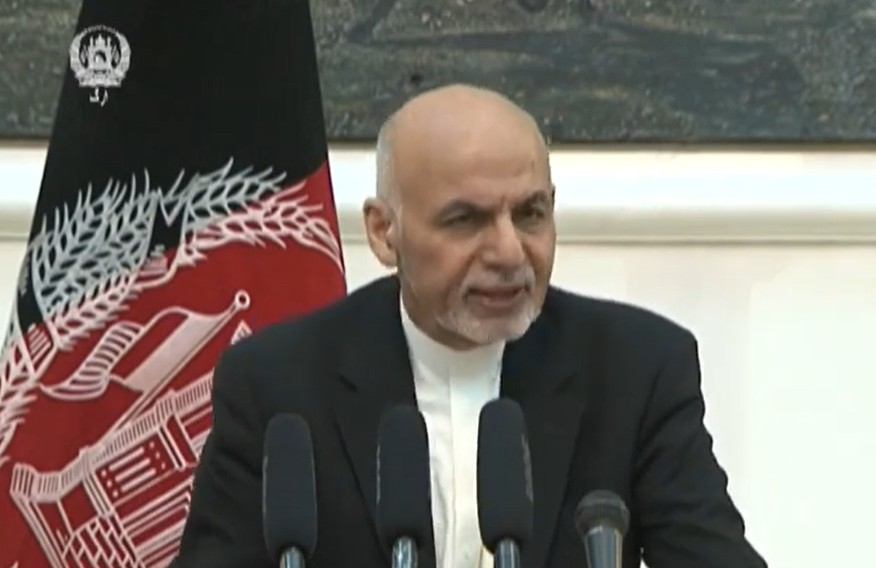
Press conference after returning from the NATO Warsaw Summit
- International Support: Global backing for Afghanistan’s stability and security.
- National Sacrifice: Honor for sacrifices of forces and citizens.
- Security Funding: Continued financing with no troop reduction.
- Military Development: Stronger forces and expanded air power.
- Counterterrorism: Afghanistan part of global anti-terror fight.
- Democratic Unity: Governance under the constitution and equal rights.
- Conditional Peace: Peace within constitutional framework.
- Security Reform: Professional army and police reforms.
- Anti-Corruption: Legal action to build trust and transparency.
- Women & Children: Protection of rights and safety.
- Economic Self-Reliance: Reduce dependence on foreign aid.
- Regional Cooperation: Call for action against terrorism support.
- Youth Investment: Focus on education and young generation.
- Economic Transition: Move toward sustainable national economy.
In the name of Allah, the Most Gracious, the Most Merciful.
Dear compatriots, esteemed members of the Cabinet, sisters, and brothers!
I am pleased that Afghanistan has returned successfully from the NATO Leaders’ Summit. I congratulate the entire nation, and specifically our security and defense forces. It has been a week where our youth are taking the lead. This is a sign of great direct confidence in the great people of Afghanistan, our security and defense forces, and our politicians. Therefore, it is necessary to first thank the world.
Forgive me if I say that in this world, standing with one's nation is called honor. Previously, some individuals believed that the international community would not stay even for a day, that they would decrease their support, and eventually leave Afghanistan. This gathering in Warsaw was a council of trust for Afghanistan's friends and a message to its enemies. Over the past twenty years, our people—our blooming youth, our sisters, our elders, and our esteemed scholars—have made great sacrifices; they have been martyred.
There has been grief in our home at all times, but this nation proved it possesses resolve and will; it feels the pain of its homeland. God willing, anyone who thinks Afghanistan will collapse or fall into the hands of others will take that hope to the grave. I am grateful that the world looked upon our sacrifices with respect. Despite facing major economic challenges since 2008, the world decided in these limited circumstances to provide life to Afghanistan. A third of the aid that could have gone to China, India, Africa, South Sudan, or Latin America was prioritized for Afghanistan. This is the result of the endurance of the democratic system and the fruit of our sacrifices and hard work.
I want to thank the United States government and its President. I also want to thank the "Framework Nations":
-
Germany: Under the leadership of Chancellor Merkel, they will support the northern region.
-
Italy: Continuing their work in Herat.
-
Turkey: Continuing their support in Kabul.
-
United Kingdom: Reaffirming their commitment.
Our objective was to have a clear message of global support for our security forces and the Afghan nation.
Key Indicators of the Warsaw Message
-
First: Until 2020, our security and defense forces will be funded with the resources currently provided. In 2013, it was suggested that our forces be reduced by 100,000; today, 352,000 forces remain with full confidence, and no reduction will occur.
-
Second: Equipment and the Air Force. The Air Force has begun operations, resulting in fewer ground casualties and increased speed of action. We have a three-year plan to fully stand the Air Force on its feet.
-
Third: Training. Our academies are the best in the region. UK assistance in training and advising will help us expand officer courses.
-
Fourth: Troop Numbers. Previously, the US planned to reduce its presence to 800 people at the embassy. Today, we have a commitment of 8,400 US troops and a total of 11,000 NATO troops to strengthen our forces.
Security Analysis and Regional Context
I was responsible for the transition process. The original hypothesis was that reducing international forces would bring the Taliban to the table. However, the enemies declared full-scale war. We had to prove that Afghanistan would not collapse into "feudalism" or become a haven for terrorists.
Today, terrorism is a global phenomenon affecting four continents—Brussels, Paris, America, and Istanbul. Our struggle is not just a local one; we have turned the fight against terrorism into a global cause. Afghanistan is now at the center of international consensus.
Domestic Reforms: 1. Sacrifice: Our forces proved their will to defend the country. 2. Management: We streamlined leadership and implemented a retirement system to bring in a new generation. 3. Transparency: We saved 2 billion [Afghani] in food procurement alone. 4. Revenue: Despite hardship, the Ministry of Finance increased revenue by 22%, meeting our Chicago Conference commitments.
The Path to Peace
Our nation has a consensus on peace—but a peace that is lasting and within the framework of the Constitution. Every Afghan must decide: will they be a tool for others, or will they work for stability?
The two alternatives:
-
A united Afghanistan with an accountable government using resources for the people.
-
Conflict, division, and personal interest.
The world demands that our security institutions remain effective and transparent. Our police need extensive reforms to ensure the rule of law. We have established an Anti-Corruption Justice Center to take legal—not political—action. Furthermore, we stand by the rights of women as guaranteed by our Constitution and our values. We want for our women the rights held by Bibi Khadija [RA]; these are not "imported" demands.
It is painful that children are abused or recruited into forces. This is absolutely unacceptable to me. We must ensure our resources create wealth so we become self-sufficient. After 15 years, the world is still with us, but we must use these next three years to ensure our government can answer our future needs. Finally, I thank the Parliament for the vote of confidence given to Mr. Stanekzai and Mr. Habibi, which signals that our leadership has the nation's backing.
Long live Afghanistan!
Question and Answer Session
Journalist: Is this $20 billion aid a result of the world's necessity or Afghan capacity? President: The world has no "necessity" to help us; they could focus on Syria or Libya. We convinced them through analysis. When I said ISIS was a global threat, people laughed. But our analysis was correct. President Obama is a logical person; he was convinced by our actions and our national consensus. Our neighbors were all approached, and we built foundations. Our analysis and actions convinced the world that Afghanistan is worth the investment.
Journalist: What is the world's view on Pakistan's "good vs. bad" terrorist policy? President: We proved our good intentions with state-to-state outreach. Now, those who do not cooperate are in isolation. Afghanistan is not the "strategic depth" of any country. My message to Pakistan is:
-
Respect our sovereignty.
-
Do not provide sanctuaries. We can prove with documents that attacks are planned from other soil.
-
We want state-to-state cooperation, not just words. Terrorism has no parents or religion. After the attack on Medina, it is clear that extremism is a shared threat. We have heard good words for two years; now we need Action! Action! Action!
Journalist: Who is the "Acting President" when you travel? There are concerns about power sharing and a lack of a clear supervisor. President: The answer is in the Constitution. It is completely clear and needs no further debate. If an accident occurs, the law has predicted everything. My administration is based on consultation and strategic patience. Our relations with the National Assembly and the Judiciary prove this.
Journalist: How can Afghanistan pay for its own forces after 2020? President: Afghanistan is a rich country with a poor population. We will utilize:
-
Location: Turning geography into a political economy (Chabahar, TAPI, CASA-1000).
-
Water: Managing our resources with 10 large dams to ensure agricultural growth.
-
Capital: Encouraging the $18 billion Afghan capital in Dubai to return.
-
Youth: Investing in our 70% population under age 30 through professional education.
-
Minerals: Tapping into $3 trillion worth of mineral wealth. We will lead administrative reforms ourselves to ensure merit-based appointments without favoritism.
Journalist: Are the 352,000 forces real or "ghost" soldiers? And why did Pakistan react so harshly to your comments? President: The Tashkil (authorized strength) of 352,000 will not be reduced. We are implementing a transparent identity system for all soldiers and teachers. Our soldiers are volunteers, not forced recruits. To those who ask why neighbors are angry: I leave that to the people to interpret. But I hope the anger of certain neighbors is a source of national pride for us.
Thank you, be well!