Afghanistan at the Crossroads: Stability, Cooperation, and Regional Connectivity in the 21st Century
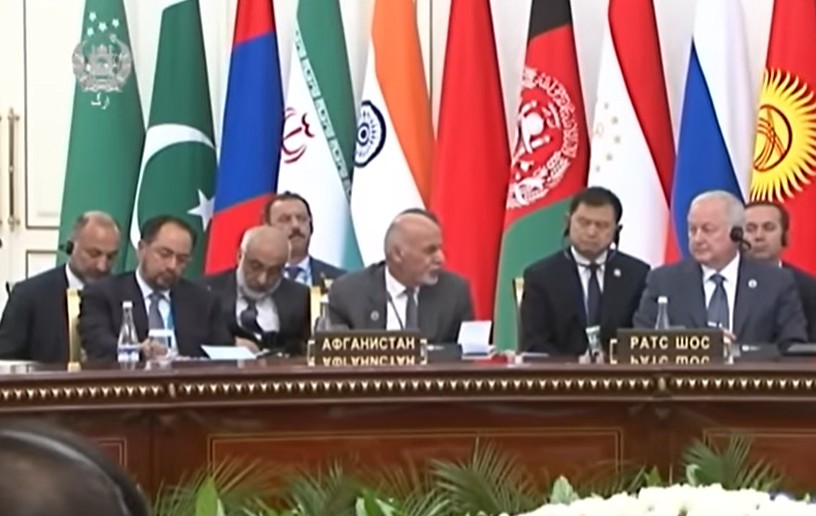
Speech at Shanghai Cooperation Organization (SCO) Summit in Tashkent, Uzbekistan
Keypoints:
- Creative Change: Afghanistan and SCO members shape the 21st-century Eurasian economy.
- Shanghai Spirit: Central Asian leadership ensures regional stability and cooperation.
- Silk Roads Revival: Afghanistan is the hub connecting Central, South, and Middle Asia.
- Political Violence: The fifth wave of terrorism threatens regional and global security.
- Conflict Definition: Afghanistan faces organized terrorism, not a civil war.
- State Responsibility: All states must reject “good” vs. “bad” terrorism.
- Four-Fold Action: Solutions require national, regional, Islamic, and global coordination.
- Regional Cooperation: Partnerships with neighbors boost stability and prosperity.
- Acknowledgment: Gratitude to Uzbekistan and President Karimov for hosting and leadership.
In the Name of Allah, the Merciful, the Compassionate
President Karimov, heads of states and governments, and international organizations, excellencies, ladies and gentlemen;
Our context is one of constant change that is multi-dimensional and threatens stability, but also changes that enhance stability and cooperation. I would like to briefly differentiate between creative change that enables us to cooperate, and destructive change that is a threat to our way of life, to our values, and to our ability to cooperate.
Creative Change: The Eurasian Continental Economy
As part of the creative change, one of the greatest transformations in human history is the emergence of the Euro-Asian continental economy, and the Shanghai Cooperation Organization represents this future, which will be irreversible. Around this table are sitting leaders who are shaping the 21st century and its impact. Your impact will affect every citizen of the world.
The Spirit of Shanghai and Central Asian Stability
In this, the second point of the creative change is the "Spirit of Shanghai." I want to congratulate the founding members of the Shanghai Cooperation Organization on leading and managing gradual but systematic change; a change that has always had results, that has moved from solving the problems of fifteen years ago to tackling the problems of today. With this period of mutual understanding and the stability which the leadership of Central Asia has brought, confronting difficult changes, Central Asian leaders have brought a stable framework to their people, and we congratulate them on overcoming those threats because the stability they have created both gives us hope and provides the possibility of cooperation.
Reviving the Silk Roads: Afghanistan as a Roundabout
Our greatest common project is the revival of the Silk Roads—the "One Belt, One Road"—but the Silk Road was not one road. It was many roads sub-zoned under a single name, and we in Afghanistan particularly look upon ourselves as the place and the roundabout that connected Central and South Asia and the Middle East. So, we welcome every step that is being taken for the realization of the Silk Roads.
Destructive Change: The Fifth Wave of Political Violence
The second part of change is the destructive change. I would argue that we are confronting the fifth wave of political violence. Extremism and terrorism are manifestations of a much broader phenomenon. The previous four waves started with anarchism, and we need to understand this destructive wave that threatens everything about stable relationships, about values of cooperation, about dialogue between cultures and civilizations, and calls them into question. If we do not grasp it in its entire complexity, our solutions will be partial and subject to lack of success or only partial success.
The Scale of the Threat and the Criminal Economy
Equally, it is important to understand the scale, scope, and intensity of this fifth wave. The wave is not going to, unfortunately, leave any of us alone. Related to this wave is its embedding in a deep criminal economy. The narcotics economy is one component of this, but there is a deep criminal economy that threatens our common peace and stability.
Afghanistan’s Potential: A Hub for Regional Cooperation
With this background, let me focus on Afghanistan—first to thank you all for your attention and for your valuable comments. Afghanistan has two sides: one is the potential, the other is the threat.
In terms of potential, we are fast transforming ourselves into a regional hub of cooperation. I would like to thank Turkmenistan, Uzbekistan, Tajikistan, China, India, and Iran for being such wonderful partners in the process of transformation that we have undertaken. Since Ufa, regional cooperation has moved forward, and the intensification of this regional cooperation is renewing hope among our people and confidence in our future. We would like to thank Russia and our other neighbors for engaging with us very productively. All people and organizations around this table are our partners in prosperity and stability.
Redefining the Conflict: Beyond the "Civil War" Label
Regarding the threat: first, what we need is a correct definition of the problem. The war in Afghanistan is not a civil war. Forces of terrorism that have converged on our country need to be defined correctly. There is no political framework in history that makes a nationally-elected government deal with destructive individuals and organizations whose agenda is the overturning of regional and global cooperation.
State Responsibility: Ending the Distinction of "Good" and "Bad" Terrorism
Secondly, these organizations have support or tolerance. The responsibility of all states to fulfill their obligation in not differentiating between "good" and "bad" terrorism is essential. States that differentiate between good and bad terrorism will pay the price and will suffer. So, it is important, I think, that instead of engaging in an environment of destructive debate, we agree on a common framework.
A Four-Fold Strategy for Action
We invite all members of the Shanghai Cooperation to join forces with us in defining the problem, bringing consensus in the intelligence community, the security community, and the political community as to what its dimensions are.
Levels of action are four-fold: national, global, Islamic, and regional. At the regional level, what is extremely important is to agree on common mechanisms of cooperation, common mechanisms of verification, and the tackling of actors that support this.
Conclusion and Acknowledgments
In conclusion, let me express our deep thanks to the people of Uzbekistan, to the people of Tashkent, and to you, President Karimov, for being such a marvelous host and for the excellent arrangement and chairmanship.