Reviving Darul Aman: Urban Renewal, National Vision, and Afghanistan’s Future
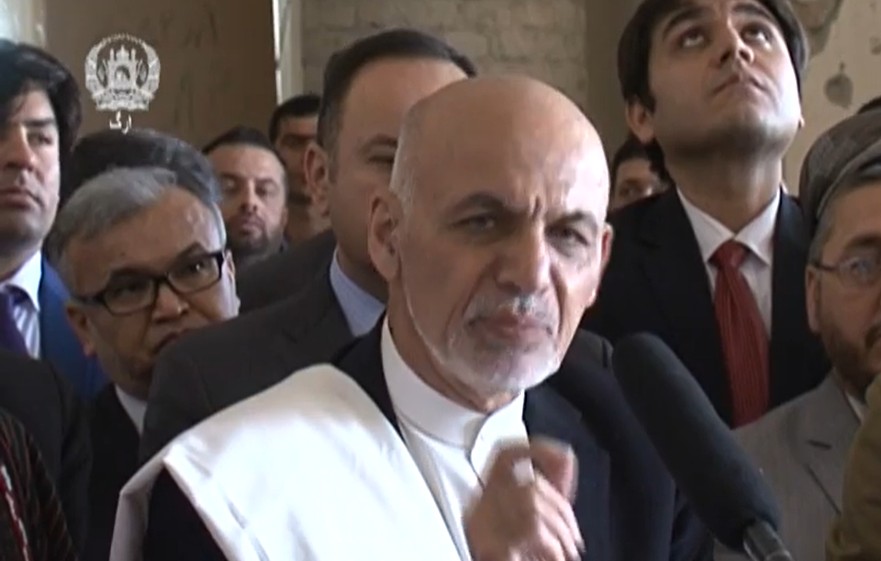
Speech at the inauguration of the Darul Aman Palace reconstruction project
Keypoints:
- Historical Legacy: Reviving Darul Aman honors Amanullah Khan’s vision and heritage.
- Urban Planning: Long-term planning ensures modern, livable cities.
- Governance: Restoration reflects government accountability and leadership.
- Property Rights: Secure ownership builds trust and investment.
- Public-Private Collaboration: Projects combine government and private efforts.
- Infrastructure: Restoring buildings strengthens services and identity.
- Transparency: Oversight ensures responsible use of resources.
- Sustainable Vision: Short- and long-term strategies guide city development.
- Citizen Engagement: Heritage restoration fosters pride and participation.
- Economic Growth: Restoration supports tourism, investment, and development.
Part I: The Vision of a New Kabul
In the name of Allah, the Most Gracious, the Most Merciful.
Honorable Dr. Abdullah, Mr. Ibrahimi, Haji Sahib, honorable members of the Cabinet, Deputy Speaker of the Meshrano Jirga, members of the Wolesi Jirga, brothers, deputy ministers, and all officials of independent directorates; today marks a return to a vision and a new beginning. When King Amanullah Khan proposed the vision of creating a "New Kabul," this concept was still fresh even in the East and most Western cities, and its commencement was rapid. The entire Darul Aman project was transformed from vision to reality within six years.
This was managed through a specific type of leadership. Nuruz Khan, who later served as the Minister of Finance and Speaker of the National Assembly of Afghanistan, oversaw the management of this project. Alongside this, there was immense cooperation with the Afghan private sector. Several companies were established specifically for this project, and they provided all the logistical requirements of that time. Regarding planning, the initial plan was proposed by a French engineer, followed by the arrival of one of the most important technical groups in Kabul—including the Deputy Mayor of Berlin, after whom the "Harten Bridge" is still named. Six hundred youths who had completed the sixth grade were trained with high technical proficiency. All of this was codified into regulations known as "Nizamnamas" and progressed under excellent management. Unfortunately, events intervened, and the vision of Darul Aman fell into isolation.
Today, we return to this vision and initiate a new beginning under the Government of National Unity for the city and citizens of Kabul and all cities of Afghanistan. I welcome you all.
Part II: Strategy and Urban Development (2016–2025)
In the name of Allah, the Most Gracious, the Most Merciful.
First, I express my deepest gratitude. Over the past eighteen months, programming studies, organization, and coordination have been established. Therefore, I congratulate each colleague individually, and specifically the Minister of Urban Development as the general official in charge.
Second, where are we and where are we going? In 2016, the historical heritage that has reached our cities must be comprehensively documented. We must have a clear and bright conception. This building [referring to Darul Aman Palace] is a benchmark—so that future generations clearly understand what the Government of National Unity inherited and where we are taking it, ensuring we have a definitive vision. Second, what is our vision for the end of 2025? Our programs are clear. General objectives must reach a nationwide conclusion so that we can fulfill our role in every city. Both the people, civil society, and especially the National Assembly—who hold the right of oversight—must clearly understand how the money spent from the public treasury is accounted for and presented transparently to the public.
I will not go into details, as our subsequent discussions will certainly consolidate these matters. A few important points are worth noting. Today, public property is not secure. One of our primary goals ten years from now must be that every Afghan individual living in any city of Afghanistan possesses a Sharia-compliant, credible, and secure property title. Global experience shows that when property transitions from informal to formal status, the volume of public investment increases fourfold. This is a massive step.
Furthermore, our cities have developed but lacked direction. Land use has perhaps been one of the most exploited resources; there must be clarity regarding land use and the public resources we possess. One objective is for the Afghan people to clearly understand what percentage of city property belongs to the state, what percentage is public, and what percentage is private. This must then lead to a clear classification so that we have shared information.
The emergence of sustainable revenues indicates that a new urban leadership is being formed, but the need to move forward in this sector is very clear. Your proposals are approved and will be formally processed in the next session. Again, I thank you for your initiatives regarding the location of this meeting; it is a day reflecting the will of the Government of National Unity to restore a historical monument using Afghanistan's internal resources, restoring the dignity and grandeur essential for a nation. Especially now that the Parliament building next to it is complete, and other sections like the Supreme Court will also be moved here. I thank you all and hope you will proceed with the second part, which is the ribbon-cutting ceremony. Thank you.
Part III: After the Inauguration of the Restoration Project
In the name of Allah, the Most Gracious, the Most Merciful.
Excellency Dr. Abdullah, the Speaker of Parliament, the Deputy Speaker of the Meshrano Jirga, Honorable Haji Sahib, members of the Cabinet, the Mayor of Kabul, all elders, sisters, and brothers; Peace be upon you all!
Today we are witnessing a return to the past and the commencement of laying foundations for the future. A return to the past in the sense that we take pride in standing upon a structure that bears witness to the will and vision of a national hero of Afghanistan, Ghazi Amanullah Khan.
This is an unfinished chapter of our history. The vision emerged at that time but was unfortunately interrupted. Repeatedly, we have been unable to establish the stability and vision necessary to create cities that are liveable and models of progress in the region and the world. Today, the Government of National Unity is proud to begin a balanced, long-term vision coupled with immediate and practical short-term actions.
The restoration of Darul Aman Palace is the realization of the nation's will. Thus, it will serve as a venue for high-ranking state guests and for special national ceremonies. It will be a center where the most important commercial and professional services, and specifically the lives of the people, are refined. Those points will be explained to you in detail.
Once again, I pray to God the Almighty for the prosperity of the entire Afghan nation. We hope that with this step, we lead the unfinished chapter inherited by us toward completion. I hope all compatriots consider this a beneficial step and support it. I emphasize that we are providing the resources for the repair of this palace from our own internal means because we must value our history and believe in our future. Our will is firm, and may God grant us the strength to implement this.
Long live Afghanistan! Tel de wi Afghanistan! Zende bad Afghanistan!