Chabahar: A New Era of Connectivity and Economic Integration
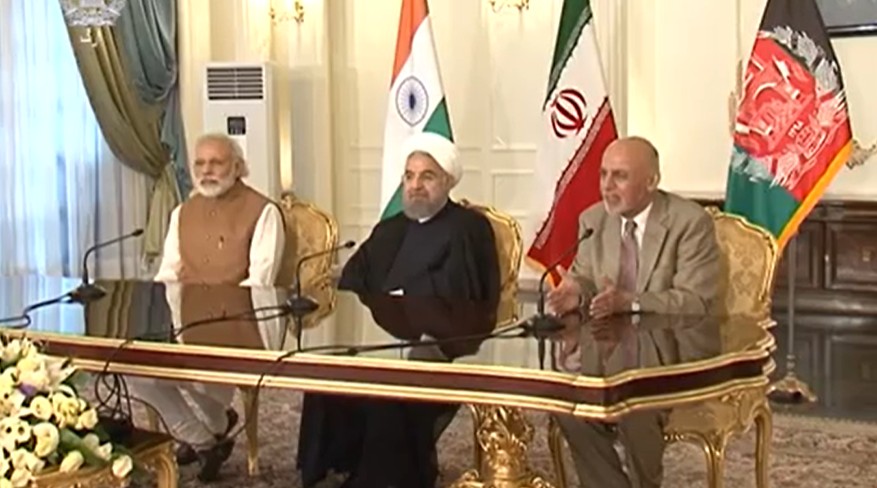
Speech at the signing ceremony of the Chabahar Port agreement - Tehran
Keypoints:
- Regional Cooperation: 3 countries promote partnership for development and connectivity.
- Chabahar Corridor: The agreement creates a new regional trade route.
- Economic Development: Infrastructure and trade aim to increase prosperity.
- Changing Geography: Cooperation can turn geography into opportunity.
- Regional Stability: Economic collaboration supports peace and stability.
- Open Partnership: Other regional countries can join cooperation.
- Youth Opportunities: Integration creates jobs for young people.
- Cultural Ties: Shared history strengthens regional relations.
- Countering Extremism: Economic growth helps reduce extremism.
- New Connectivity Era: The agreement begins deeper regional integration.
In the name of Allah, the Most Gracious, the Most Merciful.
Excellency Rouhani and Excellency Modi, first and foremost, I express my gratitude for the excellent hospitality on behalf of the government and people of Afghanistan. Thank you for hosting this great gathering in Tehran. Thank you, Excellency Modi; from the first day we began discussing our relations, Chabahar was its symbol. Today, the conversation we first started in Kathmandu has reached fruition, and I express my gratitude for your commitment, vision, and follow-up.
Our past is a past of connectivity. Every city in Afghanistan had a Chaharsu (crossroad) and four gates, and the names of these gates were symbols of the cities of Iran and India. Today, I want to emphasize a few points: Vision, Will, and Message.
My vision is that Asia is transforming into an economic continent, and the great momentum existing in Asia will lead to international stability and prosperity. Asia is still home to the world's poorest people, and as the elected leaders of these people, we are obligated to fundamentally change the lives of the majority living in poverty and deprivation. Today, our decision is that geography is not destiny; geography is changeable, and will changes geography. Our will today begins from Chabahar, but its end will be a comprehensive and nationwide economic and cultural development. Our will will be implemented in action because this project will be transformed into a comprehensive joint transit corridor and road as soon as possible.
"Zaranj," the point of connection, was the capital of Rostam—we shall return to Rostam—and today, Zaranj will once again be a "point of gold" (Nokta-ye Tala), not a backward place as previous centuries had made it. In that regard, I express my gratitude for India's investment in the Zaranj-Delaram road and to the Islamic Republic of Iran for the construction of the Silk Bridge. In the coming years, about $60 trillion will be invested internationally in infrastructure, and a vast portion of it will be in Asia. Infrastructure requires management, and our will is for infrastructure to be managed in a fundamental and comprehensive manner.
Finally, what is the message of today and of Chabahar? First, the nation of Afghanistan expresses gratitude to the nations and governments of India and Iran for believing in the stability and future of Afghanistan. Some people in the region export terrorism; however, the export of our three nations is hope, confidence, and cooperation. At the same time, our message is that the entire region can participate in this joint cooperation and connectivity. Central Asia, Europe, and China can all be included in this shared vision and will.
Furthermore, Russia is another point that can be part of this vision and a good economic partner for us. Our message to the youth is that our future is one of economic cooperation, mutual understanding, and a technical and technological future. Again, Excellency Rouhani and Excellency Modi, I express my gratitude for your shared vision, will, and message.
A hundred years from today, it is hoped that historians will welcome this as a turning point and regard this day as the beginning of regional cooperation and joint actions for peace, stability, and comprehensive prosperity. Thank you!
Speech by Hassan Rouhani, President of Iran
I offer a warm welcome to the Honorable Prime Minister of India, Mr. Modi, and also to the Honorable President of Afghanistan, Mr. Ashraf Ghani.
Today is significant for us as an important and historical day in the development of relations between our three countries. Today, from Tehran, Delhi, and Kabul, the message to the region and the world is that the path to progress for regional countries lies in the sphere of joint cooperation and utilizing regional opportunities. Of course, the symbol of this cooperation is the word "Chabahar," which is a "Spring" (Bahar) for all three countries. In the area of joint investment and activity in Chabahar, we can connect India to Afghanistan and the countries of Central Asia and the Caucasus through a reliable route. Therefore, through the agreement and document signed today, there is a message for all entrepreneurs in the three countries and the region that they can organize their future plans based on this new international corridor.
Today's document is not merely an economic document; it is a political and regional document. The message of this document is that regional countries must use regional opportunities for the development and strengthening of the entire region. In this trilateral agreement, the space is open for the presence and activity of other countries, and other nations can join this cooperation document in the future.
Today's decision and agreement are not against any country, and the activities of these three countries will benefit the entire region, especially peace and stability. In the meeting held between the leaders of the three countries before the signing, it was decided that each country would appoint a minister responsible for continuing the work. The Minister of Roads and Urban Development is announced by Iran. Mr. Modi also announced the Minister of Road Transport and Highways. It was decided that Mr. Ashraf Ghani would soon announce the relevant minister so that these three ministers can hold regular joint meetings, review the progress of the work, and report to the leaders of the three countries.
Today, the 3rd of Khordad (Jawza), which has historically been a blessed day for the people of Iran, can be declared as the "Day of Cooperation" between the three countries and "Chabahar Day." Once again, I thank and appreciate the Honorable Prime Minister of India, Mr. Modi, and the Honorable President of Afghanistan, Mr. Ashraf Ghani.
Speech by Narendra Modi, Prime Minister of India
Excellency Dr. Hassan Rouhani, President of the Islamic Republic of Iran; Excellency Dr. Ashraf Ghani, President of the Islamic Republic of Afghanistan; Honorable Ministers, Ladies and Gentlemen!
The famous Persian poet, Hafez, said: The day of separation and the night of parting from the friend is over / I consulted the omen; the star passed and the work is done. This means the days of separation have ended, as have the nights of waiting. Our friendship will continue forever. Today, we are all witnessing history being made—not just for the people of our three countries, but for the entire region. Establishing links and connectivity is one of the most fundamental human needs. Today, we intend to fulfill this need. We are grateful to Excellency Rouhani for hosting this unprecedented and unique event. President Ashraf Ghani, thank you very much for your presence here.
Being here is a source of pride and honor for me. Excellency Rouhani, President Ghani, and I have just discussed various issues in detail. The economic partnership program is clearly among our priorities. We stand together for a common goal. Creating new secure paths and achieving success is our shared objective. We want to connect with the world, but achieving better connectivity among ourselves is also a priority.
Excellencies! Iran, Afghanistan, and India are fully aware of the richness and reality of their ancient connecting routes. For centuries, art and culture, thoughts and ideas, knowledge, language, and customs have bound us together. Even during turbulent periods of history, our societies never lost their bond with one another. Our meeting today will be the beginning of a new chapter in our partnerships.
Excellencies! The recently signed agreement to create a trilateral transport and transit corridor can change the course of history in this region. This agreement lays the foundation for a new path of integration among the three nations. Launching this corridor will remove obstacles to economic flow across the region. The influx of capital and technology into Chabahar will lead to new industrial infrastructure in the region, including facilities for gas-based fertilizers, petrochemicals, pharmaceuticals, and information technology.
The main foundation of this corridor will pass through Chabahar in Iran. This very point at the mouth of the Sea of Oman is of high strategic importance. With the start of this corridor's operations, Afghanistan will gain access to a reliable, effective, and friendly route for trade with the rest of the world. The crescent of economic benefits from this agreement will shine beyond the territories of these three countries. Its reach can extend deep into Central Asian countries. Once connected to the International North-South Transport Corridor, one end will link to South Asia and the other to Europe. Based on studies, this corridor will reduce the cost and time of maritime trade with Europe by approximately 50% compared to traditional sea routes.
In time, we can even connect this to the robust land and sea routes built by India in the Indian Ocean region and Southeast Asia.
Excellencies! The 21st-century world has provided rare opportunities, but it also imposes its own specific challenges. The nature of global partnerships today requires an approach suited to the needs of the current century, not the mindset of the past century. In the current era, the keywords for the model of bilateral relations are trust, cooperation, and inclusivity—not suspicion, dominance, and isolation. For the Chabahar agreement, these same elements are the guiding philosophy and driving spirit. This will be a corridor of security and success for our people.
Furthermore, these agreements will remove existing barriers between our countries and encourage our people. It will help us finally achieve what we need and deserve: friendly and beneficial neighborliness.
Excellencies! The world around us is changing fundamentally. A lack of easy connectivity is not the only challenge limiting our national progress. Political instability and economic pressure are constantly expanding in Western Asia. In the Indian and Gulf regions, political competition and economic opportunities place pressure on the current situation in Asia.
The global economy has not yet fully emerged from ambiguity and weakness. Our current progress and future success are threatened by the spread of extremist ideologies and physical terrorism. Amidst this landscape, our three countries are fortunate to have the most talented people: the younger generation. Approximately more than 60% of our population is under thirty. They are an asset and capital for our national and regional progress. We desire for them to walk the path of knowledge and industrial skills, rather than becoming prey to guns and violence. I am confident that the economic benefits of the Chabahar agreement will expand trade and create a suitable place for investment. It will also build infrastructure, advance industries, and bring job opportunities for the younger generation. This agreement will add to our collective talent and cooperation to confront forces whose only goal is to harm and kill the innocent. The success of this agreement will be considered a positive path for the security and stability of the region.
Excellencies! I firmly believe that transit routes will only be the starting point of our journey toward broader connectivity. In my view, the entire scope of connectivity between Iran, Afghanistan, and India should include the following: it must connect culture to trade, customs to technology, investment to IT, and people to politics. In a way, this is a commitment to understanding the necessity for better connectivity—to establish security and stability, to achieve economic success, to shape new commercial relations, to quell extremism, to end the shadows of terrorism, and to remove barriers while expanding familiarity among people.
I commend Excellencies Rouhani and Ghani for their leadership and guidance regarding this initiative. Thank you all, thank you very much.