Shared Heritage, Democratic Values, and a Vision for a Rising Asia | Speech at the Indian Presidential Palace
Keypoints:
- Deep Ties: India and Afghanistan share centuries of culture, trade, and learning.
- Cultural Heritage: Our lands hold shared temples, shrines, and historical links.
- Inspiration from India: India’s democracy and leaders inspired Afghan generations.
- Afghanistan’s Struggle: Decades of war, invasions, and Taliban rule caused immense loss.
- Progress & Stability: First peaceful power transfer, unity government, and growing resilience.
- Regional Partnership: Working with India, Afghanistan aims for peace, prosperity, and regional integration.
In the name of God, the Most Gracious, the Most Merciful
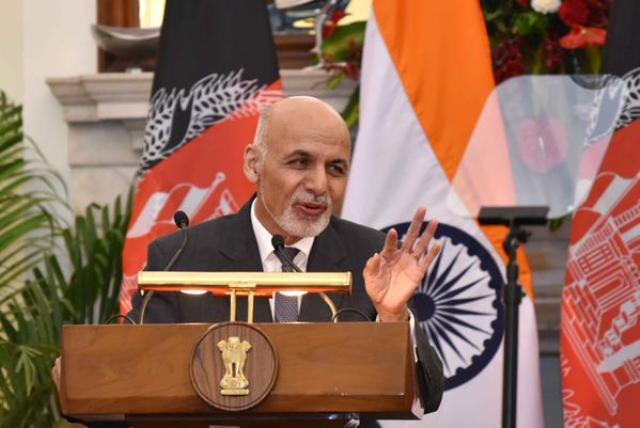
Honorable President Pranab Mukherjee, esteemed guests, ladies and gentlemen, I am grateful for the opportunity to address you this evening. For two nations with such long and intertwined histories, any introduction is almost unnecessary—yet I stand here to acknowledge a truth: there are no two countries on this planet that need so little introduction to each other as India and Afghanistan.
Our shared history is carved into the lands we inhabit—from the repeated visits to empty courtyards where the Buddha of Bamiyan once stood, to the remnants of Hindu temples across Afghan territories, to Sufi shrines, mosques, and tombs—these are all part of a shared cultural heritage. We know India well. For centuries, millions of Afghans left our serene mountains to seek their fortune in India, sometimes as traders, sometimes as warriors, sometimes as refugees. The paths they forged became arteries connecting South Asia with the Middle East, Europe, China, and beyond.
Indian mathematics—mistakenly called “Arabic numerals”—astronomy, literature, philosophy, scientific knowledge, and even cuisine flowed from our region to Baghdad, Cordoba, Cairo, Venice, Kashgar, Samarkand, Moscow, and other centers of civilization.
For many Afghans growing up in the 1950s, India was not a distant land. It was a living example of values, history, and the commitment needed to build a free and just nation. My own grandmother grew up in exile in Dehradun and Lahore, passionately studying literature, before returning to Afghanistan with a lifetime commitment to education. I can say with confidence that she did not spend those years without reading Tagore and Sumit Chandra Bose.
Scholars have long studied how democratic India has united one of the world’s most diverse societies. For Afghan children of the 1950s, leaders like Gandhi, Jawaharlal Nehru, and Maulana Abul Kalam Azad were not distant figures—they were sources of inspiration, showing a generation of Afghans the principles of freedom, justice, and resistance to colonial oppression.
India’s struggle for independence is instructive not only as resistance to oppression but as a model of democratic success. Unlike many countries in Asia, Africa, and Latin America, where colonialism was replaced by authoritarian rule, India emerged committed to democracy, civilian supremacy, accountable governance, and the rule of law.
Today, India is a source of pride—not just a rising Asian power but a major global actor, leading in science, technology, and economic growth. Its achievements inspire us, but India also faces challenges familiar to many nations: persistent poverty, gender inequality, and social injustices that demand attention. Yet, India addresses these problems openly and constructively, guided by its democracy, free press, and civil society.
Afghanistan’s history, by contrast, has been fragmented and turbulent. While colonial India was shaped by economic exploitation for European industrial interests, Afghanistan was intentionally marginalized, caught between the ambitions of great powers. Our three-thousand-year history as a crossroads of Asia has been punctuated by invasions and disruptions, leaving us isolated from the modern infrastructure and institutions that neighboring countries benefited from.
The Soviet invasion of 1979, followed by civil wars and the rise of the Taliban, compounded this legacy of suffering. Millions were killed, displaced, or forced into exile, and even as global tensions eased, Afghanistan continued to endure conflict and instability. The cost to our people has been immense, with countless innocent lives lost. We grieve, and we cry for peace.
Violence cannot be answered with more violence. We need to assure our children that their lives will be defined by safety, opportunity, and hope, not fear and destruction. Afghanistan is rising again. Our society possesses resilience, a commitment to equality, and the determination to build sustainable democratic institutions. We have completed the first peaceful transfer of power among our leaders, established a unity government, and transitioned from an international battlefield to a stage where Afghans themselves can assert control over peace and stability.
We live in a historic moment. Asia, once divided by colonial powers and artificial borders, is reconnecting through trade, ideas, and people. Afghanistan, at the heart of the continent, can be an active partner in building an integrated Asia—through railways, pipelines, highways, fiber networks, and human connections linking Central, South, and West Asia with global markets. A stable, prosperous Afghanistan would provide the foundation for a peaceful and thriving regional economy.
India does not need Afghanistan to prosper, yet we remain a natural partner. Thousands of Afghan students study in India, and Indian support in health, education, and cultural exchange strengthens our nation. Together, we can foster democracy, development, and security, and create an Asian partnership that benefits both our countries.
We are connected by centuries of shared history and millions of memories. Tonight, we celebrate not only our friendship but our shared vision for a rising, peaceful Asia. Let us write this history together, shaping our region into the next global center of prosperity, stability, and respect for rule of law.