Amir Ali Shir Nava’i: Cultural Unity, Intellectual Heritage, and Civilizational Renaissance
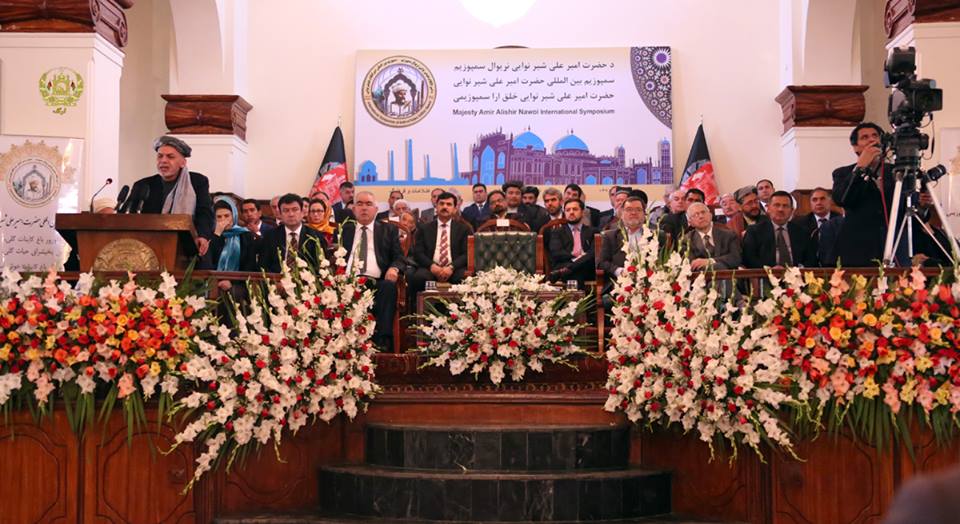
Speech at the International Symposium on Amir Ali Shir Nava’i -ARG
Keypoints:
- Cultural Heritage: Afghanistan’s rich literary and cultural legacy highlighted.
- Literary Contribution: Nava’i celebrated as poet, thinker, and arts patron.
- Cultural Diversity: Equality of languages and ethnicities emphasized as strength.
- Civilizational Unity: Shared Islamic and regional values connected communities.
- Historical Renaissance: Timurid era shown as a golden age of knowledge and art.
- Role of Knowledge: Respect for scholars and education as key to progress.
- Justice and Governance: Nava’i’s teachings promoted ethics and fair leadership.
- Cultural Revival: Past cultural achievements encouraged for modern development.
- Youth Inspiration: Young generation urged to value cultural roots.
- National Identity: Cultural figures honored as symbols of unity and pride.
In the name of Allah, the Most Gracious, the Most Merciful.
[Speaking in Uzbek] Honorable guests and dear compatriots, welcome to your own home! I am profoundly grateful for your presence at this scientific symposium dedicated to the great thinker, Amir al-Kalam, Ali Shir Nava'i.
[Resuming in Dari and Pashto] Your Excellency Al-Haj Abdul Rashid Dostum, First Vice President; Your Excellency Sarwar Danish, Second Vice President; esteemed members of the Cabinet and the National Assembly; honorable Ambassadors; distinguished guests and scholars; and the members of the Organizing Commission for the Amir Ali Shir Nava'i Symposium! Peace be upon you all!
I am delighted that we have gathered to introduce the efforts, works, and thoughts of a towering figure of Afghanistan and the entire region. We honor a man who not only holds a great claim over the people of Afghanistan and this region but one to whom the entirety of human civilization remains indebted for his services and endeavors. Nava'i belongs to us, yet he belongs to the whole world.
The Pillar of Turkic-Uzbek Identity and National Equality
As a writer, poet, political visionary, and a great architect of development, Amir Ali Shir Nava'i benefited all of humanity and earned a high station in the history of Afghanistan. In our Uzbek-Turkic language and in contemporary history, he holds a position similar to that of Khushal Khan Khattak.
[Speaking in Pashto] In the history of Pashto language and literature, we have Khushal Khan Khattak; just as Khushal Khan is a turning point in Pashto literature, Amir Ali Shir Nava'i is the turning point for all Turkic and Uzbek literature—the herald of a new era.
[Resuming in Dari] Turkic-Uzbek literature in our country holds the same importance as Dari and Pashto literature. Unfortunately, it has not always been recognized as it deserves and has occasionally been neglected. However, it will never be relegated to oblivion again. Our cultural flourishing is the product of the intertwining of great talents from various ethnic groups and languages, all of whom have played a role in shaping the national civilization of this sacred land.
Fortunately, our Constitution emphasizes the equality of all citizens—regardless of ethnicity, language, or region—and has paved the way for national solidarity. Our commitment is to the equality of every Afghan and the equality of one language with another.
The Timurid Renaissance: A Model for Public Welfare
Figures like Amir Ali Shir Nava'i did more than leave behind enduring books and a treasury of wisdom; their lives, deeds, and historical roles are themselves like precious volumes. By reading them according to the needs of our time, we can gain new insights and use their legacy to smooth our path through today’s intellectual and cultural challenges.
[Speaking in Pashto] The ninth century Hijri is a brilliant era in the history of Afghanistan's culture and literature. We can say with confidence that Amir Ali Shir Nava'i’s contribution to the growth of culture and literature during this period was greater than anyone else’s. He was not only a great poet and man of letters but also a major patron and encourager of artists and writers. As a benevolent and philanthropic soul, he contributed to the construction of numerous mosques, madrasas, hospices, hospitals, reservoirs, baths, bridges, and other public welfare buildings, helping to improve the lives of the people.
Intellectual Synergy: The Relationship Between Nava'i and Jami
[Resuming in Dari] Think for a moment: if Nava'i had not existed, could Behzad have worked with such freedom? If Nava'i had not existed, would Herat—the city where Babur spent two months and praised so highly—have flourished? The name of Nava'i is immortal in every corner of Herat and Khorasan. Consider the greatest historian of Herat, Mirkhwand; at whose request and in what style did he write? He wrote at the request of Nava'i and in simple language, so that history would be accessible to the common person.
Therefore, Nava'i did not just make himself possible; he made an entire intellectual culture and a comprehensive movement possible. This culture was formed by the "stars" of that era, specifically the relationship between Amir Ali Shir Nava'i and his mentor and like-minded peer, Maulana Jami, within the Naqshbandi order. Let us not forget that Nava'i exerted the greatest influence on the Naqshbandi path and created the most extensive endowments for them. The Naqshbandi order is one that has always stood in the front lines of the Jihad for Afghanistan's freedom.
Shared Values and the Vision of a Just System
Ladies and Gentlemen! Our current culture is the product of thousands of years of effort by the various ethnic groups of this land. The presence of diverse ethnicities, classes, religions, and languages within one civilization allowed for a dynamic space where abilities combined to realize high ideals. This shared culture manifests in common values which, inspired by the holy religion of Islam, were depicted in the works of our masters of science, literature, and art.
A review of the poetry of greats such as Sanai, Saadi, Jami, Nava'i, Rahman Baba, and Khushal Khan—as well as our great sisters from Rabia Balkhi to Nazo Ana and Zarghuna Ana—shows that they all belong to the same cultural and civilized sphere. At the heart of these values sits the ruler's commitment to justice and the rights of the people. In his various works, Nava'i provides ethical counsel, reminding rulers to observe justice regarding their subjects and to avoid oppression. This is the eternal need of humanity for which we have always strived.
My book, A Window into a Just System, is inspired by Nava'i and other great figures. Our goal in this government is to create a just system that brings Nava'i’s righteous aspirations to life.
Unity Over Division: The Harmony of Languages
In addition to justice, these figures focused on brotherhood and solidarity. They sought to show through word and deed that they came "to unite, not to divide." Religious leaders like Maulana Jami were famous for their avoidance of religious prejudice. Amir Ali Shir Nava'i himself composed poetry in both Turkic-Uzbek and Dari. The absence of linguistic divides and the presence of exchange between them are remarkable phenomena of that age. These elders were the very models of that "one-heartedness" and harmony.
The Secretary of Success: Stability and Intellectual Meritocracy
The era of Amir Ali Shir Nava'i was a golden age, often called the "Renaissance of the East." We must examine what elements contributed to this. How did such a great literary and cultural movement begin?
To understand the secret of such geniuses, we must know the conditions that aided them. In the 9th century Hijri, Herat in particular, and Afghanistan and Central Asia in general, witnessed unprecedented dynamism. Every city was an intellectual circle, and people moved freely between them. For example, Maulana Jami pursued his studies in Samarkand and returned to Herat, while Nava'i studied in Herat and several other cities. The society enjoyed stability because political, cultural, and religious leaders had reached a consensus. They knew that by avoiding tension and helping the community stay calm, better conditions could be achieved.
Respect for knowledge and art by the rulers of the time is another hallmark of this period. When Behzad, Kashifi, or Abdullah Lutfi produced a work, they were noticed and encouraged. Rulers associated with scholars and sought their counsel. It is impossible to advance great ideals without listening to the experts and sages of society.
Cultural Legacy: "Solitude in the Crowd" and Global Impact
The comprehensive cooperation between religious sciences—which formed the general worldview—and the secular sciences of the day laid the foundation for cultural cooperation. It was because of this that Timurid Afghanistan set the standard for calligraphy, painting, music, and literature for five centuries across the Turkic, Persian, and Pashto-speaking worlds.
Another characteristic of the Naqshbandi class is the concept of "Solitude in the Crowd" (Khalwat dar Anjuman). This means one pursues the affairs of the world in an organized and comprehensive manner. Centuries before Protestantism spoke of "sincerity" and work ethic, the Naqshbandi order arranged the relationship between religion and the world in the most beautiful way.
Honoring figures like Amir Ali Shir Nava'i is honoring the splendor of our civilization. Nava'i is significant because he is both a point of connection and a turning point. He was a point of connection because he was fully versed in the literary traditions before him and opened windows of interaction between linguistic cultures. He is a turning point because his influence on the Turkic languages has lasted for five centuries and will likely last for five hundred more.
Conclusion: A Call to Reclaim Civilizational Grandeur
We must remember that the rich culture of the Timurid era was damaged by the wrong policies of certain rulers. We must return to our civilizational foundations. Inspired by those brilliant historical periods, we must once again strive for the flourishing of science and the fertility of culture.
Today, in honor of the great personality of Nava'i, I announce that the Government of Afghanistan will strike a special medal in the name of Amir Ali Shir Nava'i. Furthermore, as Nava'i was a man of both the hospice and the palace, and since you do not see his portrait in this hall today, I declare that his portrait will henceforth be displayed here.
Our youth must understand their deep cultural roots. For this reason, the "Salam Khana" hall will not just be for "saluting" (ceremonies), but for saluting our great cultural figures.
I thank you once again for attending this scientific symposium for the great thinker Amir al-Kalam, Ali Shir Nava'i.
Long live Afghanistan! [In Pashto] Tal de wi Afghanistan! [In Dari] Zenda bad Afghanistan!