Strengthening the Afghanistan–United States Strategic Partnership for Peace, Security, and Reform
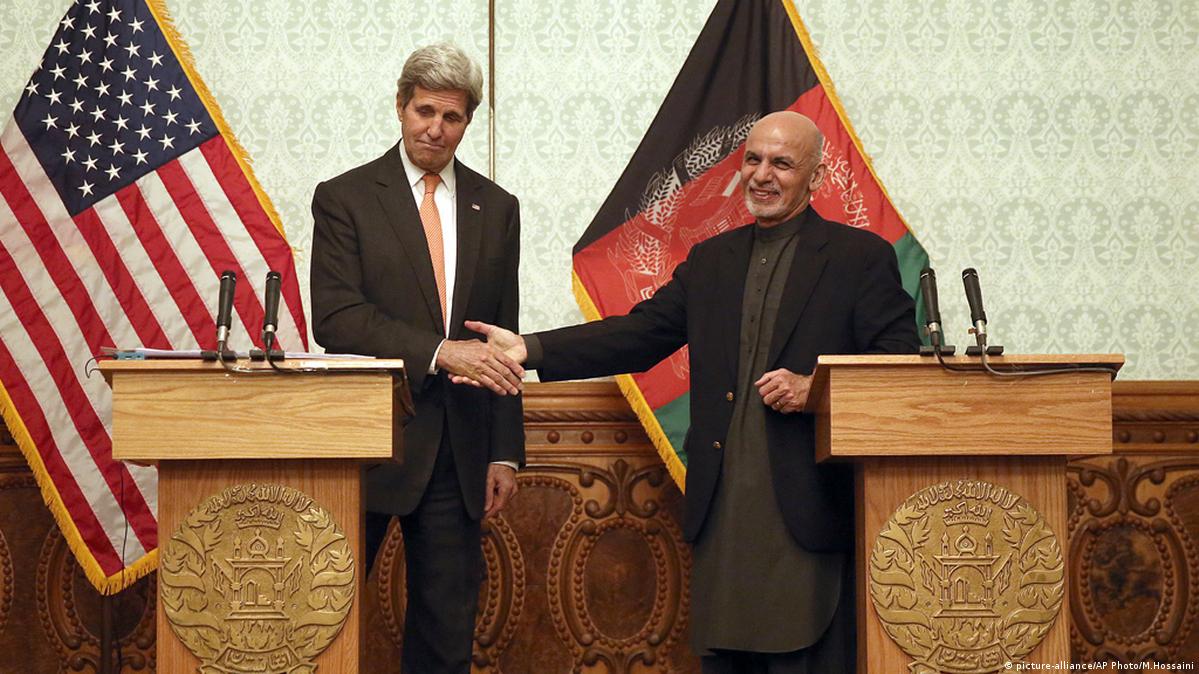
Joint Press Conference with U.S. Secretary of State John Kerry - ARG
Keypoints:
- Strategic Partnership: Strong Afghanistan–U.S. alliance reaffirmed.
- Security Cooperation: U.S. support strengthened Afghan security forces.
- Peace and Stability: Peace remained a national and regional priority.
- Counterterrorism: Terrorism remained a shared security challenge.
- International Conferences: Afghanistan aimed to show real reform progress.
- Reform and Anti-Corruption: Government committed to reforms and anti-corruption.
- Economic Assistance: U.S. aid supported development and vulnerable groups.
- National Unity: Political unity supported long-term stability.
- Judicial Reform: Legal reforms aimed to build public trust.
- Recognition of Sacrifice: Afghan and U.S. sacrifices were honored.
In the name of Allah, the Most Gracious, the Most Merciful.
Honorable Secretary of State John Kerry and your accompanying delegation, welcome to Afghanistan! Respected colleagues of the Cabinet, sisters and brothers, welcome!
[Speaking in Pashto] Mr. Kerry! You have been coming to Afghanistan consistently for fourteen years. You are not only one of this country’s best friends, but your enduring interest in Afghanistan and your special relationship with me, Dr. Abdullah, and all of Afghanistan’s political leaders is truly unique.
I want to thank you on behalf of both the nation and the state, and welcome you once again. Your visit this time has a specific objective: the Bilateral Security Agreement (BSA) required the establishment of a special commission. Your visit has laid the foundation for this commission and provides us the opportunity to look toward the future.
[Resuming in Dari] The United States of America is the core partner of the nation and state of Afghanistan. Our shared interests, especially over the past fourteen years, have evolved into a deep and extensive strategic relationship. Common threats—specifically the threat of terrorism, which has now taken the form of a "fifth wave" of violence—provide us with shared interests.
Peace is a vital necessity for the nation and state of Afghanistan. The United States, and you personally, sir, have always been our partner in creating an environment for regional peace and stability. You understand the fundamental and urgent need of our people for peace and stability; at the same time, your emphasis on a stable Afghanistan is a cornerstone of regional stability, which we support and find reassuring.
Simultaneously, I wish to express my gratitude for the sacrifice, cooperation, and enduring support of the United States. Thousands of your fellow citizens and children—young Americans—have made the ultimate sacrifice in Afghanistan. I hope you will convey our deepest condolences and sympathies to their families. As someone who is today the top diplomat of the United States, you were also a war hero and understand this personally; your background has proven your deep commitment to the American defense and security forces. Therefore, I hope you will convey our messages of condolence and gratitude to them.
On behalf of the Afghan National Defense and Security Forces (ANDSF), I express my gratitude for the sustained assistance of the United States and especially for the historic decision by His Excellency the President of the United States to extend the Resolute Support Mission. History will judge that this decision was truly a turning point for us and the region, and with this assurance, we can look ahead and think in the medium and long term.
Furthermore, on behalf of the people of Afghanistan, I thank the United States for its extensive economic aid which has reached all segments of Afghan society, particularly the assistance for women and the impoverished. Your continuous attention to this has been, and will remain, vital. Your visit is one focused on the future.
Our extensive discussions today centered on several vital topics, which I will summarize briefly:
Preparations for the Warsaw and Brussels conferences: following the U.S. decision to extend Resolute Support and NATO’s endorsement of that mission, we can now plan for the medium term. However, Afghanistan’s commitment to comprehensive reforms—to improve our security forces and for the success of the Warsaw and Brussels meetings—is steadfast.
We do not wish to rely merely on words or promises; we want to have clear achievements to present at the Warsaw Conference, and likewise in Brussels, so the people of the world and our own people realize that fundamental transformations are being implemented. To this end, I want to assure the people of Afghanistan and the world that our political will for reform and the fight against corruption is comprehensive.
In this regard, reform is not just for the sake of better foreign aid. Self-reliance constitutes the core of our economic and governance philosophy. All Afghan people emphasize reform and the fight against corruption. Corruption is a cancer that the political and economic body of Afghanistan can no longer tolerate. At the same time, our compact with the world is based on values and the legal protection of rights enshrined in the Constitution for all Afghans.
Final point: our strength lies in national unity. I first want to thank the Wolesi Jirga (House of the People) today for confirming the Attorney General and the Minister of Interior with a decisive vote.
[In Pashto] I thank the members of the Wolesi Jirga for their national stance! The selection of the Attorney General today gives us the confidence that fundamental and comprehensive reforms will be brought to the Prosecutor’s Office and implemented as soon as possible. Similarly, fundamental reforms will be introduced in the Ministry of Interior, which will reassure the nation that we can move forward and that the rights of individuals will be implemented based on the Constitution and other laws of Afghanistan.
[In Dari] National unity and empathy, and specifically the responsibility of our political class at this stage, needs to be emphasized. The political class of Afghanistan does not just carry the responsibility for a six-month or one-year vision; we carry a hundred-year responsibility. Therefore, all of us in the National Unity Government must consider the historical necessity of focusing on the implementation of the people’s hopes and aspirations—and we have done so.
I also wish to thank the Judiciary of Afghanistan for undertaking a series of basic reforms. The future steps of our judicial system’s reform will increase public confidence; however, my most important thanks go to the security and defense forces and the people of Afghanistan. I thank the ANDSF for proving today that they are ready to defend this homeland, which has thousands of years of history, with their blood and lives.
Seven months ago was a day of special pride for me. 549 young people graduated from the Afghanistan Security Academy—an institution you helped greatly to establish. Thirteen of them were women. Women alongside men, and daughters alongside sons—each could have made a different choice, but they chose to be in service to this country. This choice by the younger generation and their faith in Afghanistan's future carries the faith of the entire nation with it.
The patience and political will of our people, who have both endured all this violence and fought against it, knows no bounds. Last night, I was at the Emergency Hospital with individuals who had been brutally attacked in Siah Gird district. A two-year-old child’s hand had been hit by a bullet and amputated.
[In Pashto] The mother asked me, "I wanted to see you, and today the opportunity arose: how will this horror end?" I told her, "Sister! We did not want war; war was imposed upon us, and this is the will of all the people of Afghanistan." After that, I saw other soldiers and officers lying in other beds, but the will of all of them was that we must reach stability, peace, and a sustainable movement.
[In Dari] For this reason, the year 1395 will be the year of momentum, movement, and comprehensive reforms.
In conclusion, I thank you for your presence. The visit was very productive and, as always, comprehensive. Our friendship is enduring. You are very welcome; please come again.
Thank you.