Sweden and Afghanistan: Strengthening Diplomacy, Security, and Human Dignity
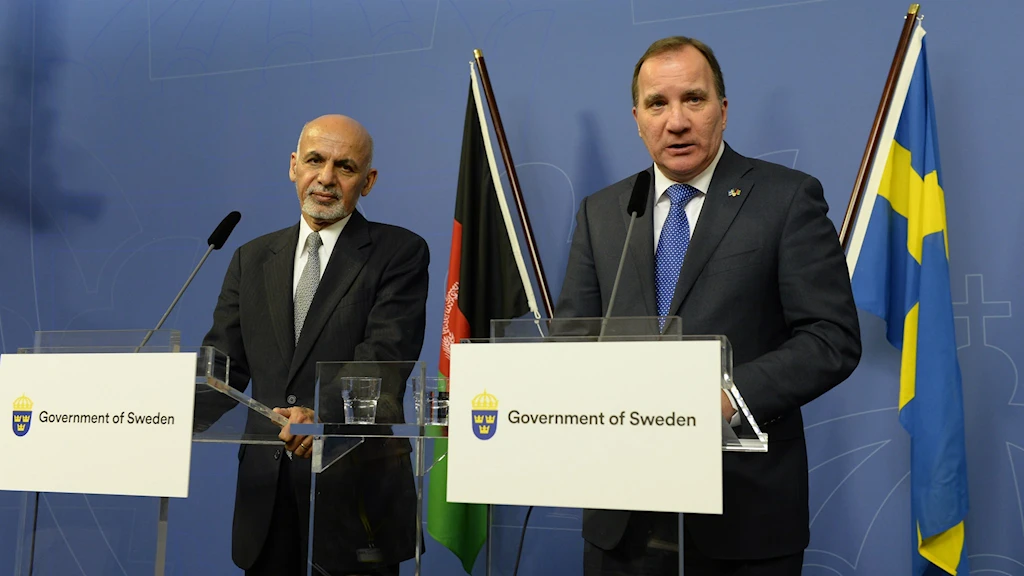
Joint Press Conference with Prime Minister Stefan Löfven Stockholm, Sweden
Keypoints:
- Sweden’s Support: Sweden provides long-term aid and development.
- Funding: 8.5 billion SEK committed over ten years.
- Human Rights: Focus on women and girls’ rights.
- Democracy: Support for elections and anti-corruption.
- Refugees: Cooperation on returns and “Jobs for Peace.”
- Security: Swedish forces aid NATO missions in Afghanistan.
- Reforms: Afghanistan advances rule of law and governance.
- Development: Education, jobs, and entrepreneurship build stability.
Opening Remarks by Prime Minister Stefan Löfven
It is a pleasure to be here today with His Excellency Dr. Ashraf Ghani, President of Afghanistan. His visit is an approval and a testimony to the long-standing and friendly relations that we have between our two countries. We have had productive, positive talks, and I would also like to highlight a few important points that we have discussed.
First: Sweden's engagement with Afghanistan is very broad. It includes military, political, and police support, and of course, humanitarian aid. It is a long-term development cooperation. I also underlined that our commitment is long-lasting. Afghanistan is, in fact, the largest receiver of Swedish bilateral aid, and Sweden has committed up to 8.5 billion Swedish kronor over the next ten years.
Second: To further strengthen our relations, we have today signed different development cooperation agreements. These agreements include a deeper dialogue on human rights—particularly the situation and the rights of women and girls—as well as on democracy and anti-corruption. The people of Afghanistan have Sweden's full support in the pursuit of peace and democracy. When President Ghani took over about a year ago, it was the first peaceful transfer of power in more than one hundred years, and Sweden supports President Ghani’s commitment to the peace process.
Third: An important part of our talks was, of course, the refugee situation. Many refugees coming to Sweden are from Afghanistan. Many of them are unaccompanied minors; this year, 20,000 minors—primarily young men—have come to Sweden. This is, of course, a serious challenge for both our countries. We have both agreed today to start negotiations on a readmission agreement. Such an agreement will facilitate returns, but it is also important for both countries to discuss the so-called "push-pull" factors. For example, we are fully supporting the "Jobs for Peace" process that the President has initiated.
Fourth: We have also discussed security issues. The international security support to Afghanistan is the largest international cooperation since the Second World War intended to promote peace, security, and reconstruction. Since 2002, almost 10,000 Swedes have contributed to this operation, helping to improve the security situation in northern Afghanistan. The Swedish government has recently presented a bill to the Parliament to extend our support to the current NATO-led Resolute Support Mission over the next year.
Fifth and lastly: I would like to emphasize that Sweden is closely following the very ambitious reform program of the Afghan government. The Afghan government has committed to free and fair elections, respect for human rights, the rule of law, and strong anti-corruption measures. Many reforms will strengthen the situation of women and girls, which is very welcome. I believe that the Afghan government is genuinely committed to taking the country forward, and some results have already been achieved. Sweden supports these plans, and we do not hesitate to believe that further progress will be made. I believe, Mr. President, that our constructive dialogue today and our new cooperation agreement reflect our shared commitment to the future.
Please, Mr. President.
Remarks by President Ashraf Ghani
Thank you, Mr. Prime Minister. It is a great pleasure to be received so warmly during the cold weather outside. The warmth inside contrasts very sharply with the cold outside, and this warmth gives us confidence. We have just celebrated the 75th anniversary of our friendship. We look forward to many decades of deepening and brightening this partnership and friendship.
Let me first pay tribute to the eight Swedes who paid the ultimate sacrifice of losing their lives as a part of their love for strangers and defense of the idea of liberty. Mr. Prime Minister, I call on you and all the media, on behalf of a grateful nation, to please convey our sincerest thanks and deepest sympathy to the families of these heroes of the struggle for freedom and rights. I would also like to thank all the 10,000 members of the Swedish forces that served in Afghanistan. I hope they carry memories of Afghanistan with them. We look forward to the day that we welcome them back to our country as tourists and civilians.
Let me say I am delighted and very proud to support Sweden’s candidacy for the UN Security Council. Sweden serving on the Security Council will always be an asset to the voice of peace, the voice of reason, and the voice of engagement.
Let me also take the opportunity to thank Swedish society, and not just the government. We are delighted with our governmental cooperation, but what gives us special pleasure is to acknowledge the help of every Swede who has supported the Swedish Committee for Afghanistan. In the 1990s, practically everybody left Afghanistan and said, "Let them sink." But the Swedish Committee stood with us for ten years. Particularly from 1996 to 2001, the Swedish Committee was in effect serving the functions of both the Ministry of Education and the Ministry of Health in Afghanistan. Hundreds of thousands of young girls and boys are the beneficiaries of that engagement. On behalf of every one of them, let me thank the Swedish people.
Also, thousands of women teachers were trained, who in turn are now training three million young girls attending schools. Hundreds of other women, whose chances of dying at birth have been halved because of the measures your government supported and the Swedish Committee implemented, owe you their thanks.
Sweden’s support—first for the NATO ISAF mission and now for the Resolute Support Mission—is a vote of confidence in a country that poses no harm to anyone but has been denied the basic right of living in peace. Your continued engagement is welcomed by our forces and our people. I would like to thank you for that support. The statement your Foreign Minister made in the NATO meeting a couple of days ago was enormously productive, and we hope the Swedish Parliament will support the continued engagement of your forces.
Your bilateral assistance is forward-looking. Sweden is the first country to commit to supporting Afghanistan until 2024, and we are extraordinarily grateful for this principled assistance. All the areas of focus mean a stable and, hopefully, prosperous Afghanistan. It is about education, energy, and empowerment—particularly of women and girls. It is about the rule of law and entrepreneurship; in these areas, we all find common values.
Let me assure you that the government of Afghanistan is committed to an agenda of transparency, effectiveness, and participation in the rule of law. As a result, the corruption that we inherited—which, next to narcotics, gives us an enormously poor reputation—is something that we are determined to tackle root and branch. Some evidence is already in front of everyone, but we are determined to see this through.
Peace is the key desire of every Afghan, and the nature of the conflict is three-dimensional. First, there is the presence of regional terrorists, ranging from Al-Qaeda to Daesh. We need to understand that a robust strategic response to this type of terror, which does not seek peace with government or civilized society, is a must.
Second, the Taliban is both an Afghan and a Pakistani phenomenon; it is now a region-wide phenomenon. We need to have a coherent approach where a political process addresses legitimate grievances, and the grounds are prepared for participation in a peace process. The result should be adherence to the Afghan Constitution. The rights of Afghans in general, and Afghan women and girls in particular, are not up for negotiation. Chapter Two of the Constitution regarding fundamental rights and Chapter One regarding our democratic and Islamic nature are not up for discussion. Any peace process that requires changes in our Constitution must follow the constitutionally laid out process.
Third and most significantly, there has been an undeclared state of hostility between Pakistan and Afghanistan. We need to address this because regional peace requires agreement between states on the "rules of the game" that will make all states fulfill their rights and obligations.
Immigration is a human tragedy. During the 19th century, at least 1.2 million Swedes left their country to seek fortune elsewhere. Waves of German and Irish immigration were part of the rule when the United States was in need of labor. As partners, we have agreed that there is a common problem. There are both pull factors and push factors. The pull factors are conditions in Europe and Sweden that make immigration attractive; these are under your consideration. The push factors are poverty, security, and a lack of trust. We will address the push factors.
It also needs to be noted that a significant part of Afghans who went to Sweden did not come from Afghanistan; they have come from third countries. We have a five-million-strong diaspora living in Iran and Pakistan. An analysis of who started where is an important part of this. Partners with such profound values work together to create a framework and solve the problem. The Prime Minister and I have agreed to begin focused, earnest, and comprehensive discussions so we can solve the problem together. Again, Mr. Prime Minister, it is a big pleasure and a privilege to be with you and to have been received so warmly by Sweden and its elected leader.
Questions and Answers
Question: Mr. President, you had a meeting with the Prime Minister of Pakistan on the sidelines of the climate change conference. Could you please tell us the agenda? And Mr. Prime Minister, regarding refugees: there are concerns about the Paris attacks overshadowing the situation and concerns about deportation. What is the message to Afghan refugees?
President Ghani: Conversations between states are not conversations between teenagers; they are between adults focused on national interests and global security. We have fundamental issues with Pakistan because we require them to join in a common quest for stability in the region. Our discussion focused on the three dimensions of conflict. The primary peace that we seek is between a sovereign Afghanistan and a sovereign Pakistan. Afghanistan’s sovereignty is not up for negotiation. Our relations with third countries are not subjects for discussion with others. We have assured everyone that Afghan territory will never be used against any of our neighbors, nor will Afghan state institutions ever sponsor malign non-state actors. We emphasized the need to reduce violence and focus on a climate of peace, seeing terrorism as a common threat to make sure events like Paris do not recur.
Prime Minister Löfven: We do support the peace process started by the President. Regarding immigration: first, Paris does not change the way we view immigration. We do not connect the refugee situation with the terrorist situation. Most of these people are fleeing for their lives and fleeing against terrorists. The message from Sweden is that nobody can doubt our ambitions to help people in danger. However, we have received 160,000 asylum seekers in the last year. If you transfer that to the European Union level, it would be equal to 25 million people a year. That is not sustainable. We are lowering our asylum conditions to the minimum standard according to international conventions and EU rules to make it clear to other member states that we need to share the responsibility. You cannot hang the responsibility on just two or three countries.
Question: Which parts of Afghanistan would you say are safe for refugees to return to? And Mr. Prime Minister, does Sweden need guarantees for returning refugees?
Prime Minister Löfven: As the President said, we are starting a negotiation dialogue to look into both push and pull factors. The new rules we are proposing will be implemented soon. We need to acknowledge that the "Jobs for Peace" agenda is an important part of decreasing push factors so people see a future in Afghanistan—jobs and education. We will find a way for those who cannot find asylum in Sweden to find a way back to Afghanistan.
President Ghani: First, I was not "seeking an agreement"; we are solving a joint problem. Partners help each other understand a complex environment. Sweden is a law-abiding nation and prides itself on due process. This is not an immediate exposure; it is based on a process. We will work in earnest together to create the right conditions. I appreciate the new agreement because it creates hope. The "Jobs for Peace" program addresses skills, jobs, and housing in an integrated manner so our people feel they have a secure and safe homeland.
Question: Mr. President, will you attend the next Istanbul Process meeting in Islamabad? Mr. Prime Minister, how can you help manage the refugee problems?
President Ghani: I will make that announcement in Kabul. Kabul is the place to make that announcement.
Prime Minister Löfven: We are the first country to commit ourselves to development cooperation for the long term—ten years and 8.5 billion. That helps the situation so fewer people feel the need to go to another country. It is all about hope, education, the possibility of having a job, and finding freedom in your own country.
Question: Many young Afghan men who come to Sweden are refugees from Iran. They tell stories of fleeing forced recruitment to fight in Syria. What would you say to them if they are forced back?
President Ghani: This is a question that your legal authorities must decide upon. But they are Afghan citizens. If they can prove they are Afghan citizens, we accept them. In the past, other people have pretended to be Afghans to benefit from our misery. Our fundamental social contract is with our people regardless of where they are. The Afghan Constitution is clear: anyone who is Afghan has a right to due process.
Question: How much EU support did you get to fight terrorism, specifically Al-Qaeda and Daesh? And Mr. Prime Minister, how committed are you to long-term stability?
Prime Minister Löfven: The long-term commitment is there. It is 8.5 billion Swedish krona over ten years, and we signed a new agreement to support this even more. Our commitment is long-lasting.
President Ghani: The European Union is not a military force. NATO is the commitment. We are looking forward to this partnership, and Sweden is a leader in this process. I would like to thank Sweden and all our other partners for continuing the Resolute Support Mission.
Question: People invested hope in you to get rid of corruption, but now we hear disappointment. What is going wrong?
President Ghani: An all-out war has been imposed on us. During 2015, we were fighting for survival. We managed to defeat the designs of the enemies of Afghanistan, but the price paid has been immense. One month of war can change girls' education; one year of war can change the economic condition. This is an imposed war. The terrorists come from China, Russia, Uzbekistan, Tajikistan, Egypt, Saudi Arabia, and particularly Pakistan.
Daesh is another factor. The worst part of my day is reading the casualty figures. I spend 75 percent of my time being Commander-in-Chief. The people have the right to be disappointed because we expected a peace breakthrough, but the opportunity with Pakistan was lost. We inherited an economic recession boarding on a depression and had to impose an austerity program. I am proud that all revenue targets have been met, but the growth rate is low.
Reforms hurt initially. Those whose interests are hurt by reforms—like those involved in the Kabul Bank scandal—are very loud. We have confronted corruption in banking and procurement. I acknowledge the dissatisfaction because our people desire something simple: after oxygen, they need peace. Afghanistan is a tragedy—an extraordinarily rich country inhabited by poor people. We need breathing space. 36 percent of our people live below $1.25 a day. We are focusing on agriculture, where two million jobs can be generated. Our people are impatient, and they have every right to be. They push us forward, and I hope that push results in us speeding up our efforts.
Thank you!