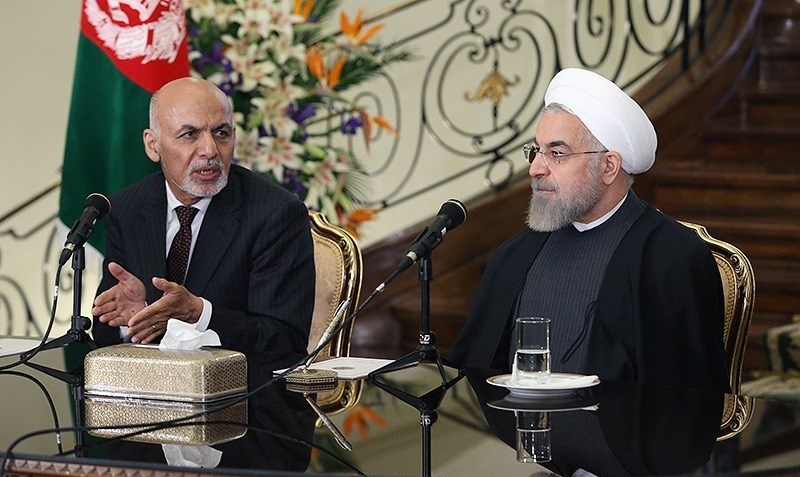
Security, Drug Control, Water, Refugees, and Regional Cooperation | Joint Press Conference with Hassan Rouhani, President of Iran
- Economic Cooperation: Boost trade, investment, energy, mining, and transit. Make Afghanistan a regional hub.
- Refugee Management: Register Afghan refugees. Ensure safe, legal, and voluntary movement.
- Security: Share intelligence. Coordinate against terrorism and strengthen borders.
- Narcotics Control: Reduce drug production. Promote alternative crops and jobs.
- Water & Environment: Resolve river disputes. Manage water and wetlands together.
- Regional Cooperation: Work with neighbors. Build trust, stability, and shared prosperity.
Speech of Hassan Rouhani
In the name of God, the Most Gracious, the Most Merciful. I warmly welcome His Excellency Dr. Ashraf Ghani, the honorable President of our friendly and brotherly country, Afghanistan, and his accompanying delegation. This visit, in the era of the National Unity Government and Afghanistan’s new administration, will mark the beginning of broader cooperation between our two countries in areas of shared interest—particularly in economic matters, energy, industrial and mining cooperation, trade and investment, as well as transit, railways, roads, and the development of southern Iranian ports to connect Afghanistan and other eastern and northern neighbors to international waters.
In our private and public discussions, we also emphasized resolving the issue of Afghan refugees in Iran. It was agreed that all individuals residing in the country should be accurately registered so that both governments can arrange for legal movement, whether for work, education, or other purposes, within the framework of visas and law.
Regarding narcotics, which remains a serious regional challenge affecting Iran, Afghanistan, and other countries, it was agreed that we will cooperate both in intelligence and operational actions against trafficking networks and in planning foundational measures in agriculture to address the root of the problem, so that this region, including our two neighboring countries, can overcome this challenge, God willing.
Another point of mutual emphasis was expanded cooperation to combat terrorism, violence, and extremism in the region, particularly along the Iran-Afghanistan border. This includes intelligence sharing and, when necessary, coordinated operational actions. We also discussed overall regional security and the need for both countries to assist other regional nations, as the problems we face today are not confined to a single country—they are spreading across the region and affecting everyone.
It is vital for all countries to work toward peaceful and political solutions, including in Yemen, where the people deserve peace and security, and military attacks should cease so that the people themselves can resolve their issues through dialogue. The political will exists in both governments today to cooperate economically, security-wise, scientifically, and culturally. During this visit, relevant ministers will hold talks to advance these matters until final resolutions are reached.
Some challenges relate to environmental issues. In Sistan and Baluchistan, we face environmental problems, particularly regarding the restoration of wetlands and lakes and the proper use of water rights under existing laws and bilateral agreements. Both countries have agreed to serious negotiations to reach fair and equitable solutions that benefit both nations.
Some initiatives are multilateral, involving Afghanistan, India, China, Tajikistan, Turkmenistan, other Caspian littoral states, and the Caucasus and Central Asia. These topics were discussed comprehensively, and through trilateral, quadrilateral, and multilateral contacts, we will continue to pursue these issues, which we hope will benefit both nations and the region.
Speech of President Ashraf Ghani
In the name of God, the Most Gracious, the Most Merciful. Your Excellency Dr. Rouhani, President of the Islamic Republic of Iran, high-ranking officials of the Iranian government, and the honorable people of Iran, first of all, I would like to thank you for your warm hospitality on behalf of the people and government of Afghanistan and my accompanying delegation. I hope you will accept our invitation to visit Kabul at the earliest opportunity, so we can host you.
The relationship between Afghanistan and Iran is long-standing and multifaceted. We emphasize opening a new chapter to fundamentally study and address existing challenges, explore solutions, and seize opportunities for bilateral, trilateral, and quadrilateral cooperation, transforming the region from a “danger zone” into an area of prosperity, peace, and stability.
Today, we face serious threats from new forms of terrorism. We suffer daily casualties and confront acts of horror and barbarity. Without comprehensive regional cooperation, malign forces like ISIS cannot be controlled. However, the will of the Afghan people is strong—we will be the graveyard of these movements—and there should be no doubt about this determination. Our bilateral cooperation framework is essential to address this challenge, which distorts the true teachings of Islam. Islam is a religion of mercy, not violence, and our shared beliefs and culture form the foundation for comprehensive cooperation.
We are grateful for Iran’s hospitality regarding Afghan refugees. We must implement a comprehensive plan for their voluntary, gradual, and systematic return. In parallel, an agreement was reached to register all Afghan refugees in Iran. This initiative will be overseen by Mr. Alimi Balkhi, our Minister of Refugees.
Narcotics have formed the economic foundation for criminal activity in the region, which terrorism exploits. Therefore, the shared interests of our two nations and governments are deeply connected. We must create viable economic, social, and security alternatives to eradicate this scourge at its root. Iran’s support in developing a transit system for Afghanistan is vital. The Iranian market is vast and can provide the foundation for alternative economic growth. Accordingly, we agreed to establish a joint economic commission, led by our Finance Minister, Mr. Akil Hakimi, to examine issues comprehensively.
While challenges exist, there are more opportunities that must be seized. In terms of security, we agreed on a specific mechanism for cooperation: my National Security Advisor, Mr. Hanif Atmar, and his Iranian counterpart, Mr. Rahmani, will soon initiate operational work to address threats and regional cooperation opportunities.
Environmental changes are occurring, and even small changes in temperature affect all our lives. I could not arrive sooner due to the extraordinary snowfall in the month of Hoot, which claimed 196 lives in Panjshir province. Environmental changes require broad regional cooperation. We must conduct detailed studies so that negotiations are informed and solutions are clear. Our focus should be on opportunities rather than dangers.
Afghanistan will, God willing, become a “transit hub and energy trade center” in the region. Our minerals are unique, our water and land are invaluable, and most importantly, our people are determined to achieve stability, prosperity, and regional cooperation. I once again thank Your Excellency for your hospitality. Our task is to transform political will into practical action to gradually build trust, addressing major issues step by step within a clear timeframe. This will establish a strong, enduring foundation for future generations of both our nations. Thank you.
Hassan Rouhani: Thank you very much.
Question from an Iranian Journalist: With respect to the Presidents of Iran and Afghanistan, I have a joint question: how will Iran and Afghanistan cooperate in combating terrorism and narcotics trafficking in the region, especially following yesterday’s terrorist attack in Afghanistan that killed and wounded more than 140 people?
Hassan Rouhani: One of the issues we discussed both in private and public meetings was security and combating narcotics. Production of narcotics has increased in recent years. We must first control and reduce it, then ultimately resolve the issue regionally. Two approaches are needed: first, intelligence and security coordination between our two countries, including joint operations if necessary; second, addressing narcotics at its root through alternative crop cultivation in Afghanistan. Our Ministry of Agriculture will provide all necessary support. Afghanistan has fertile land, sufficient water, and hardworking people. With proper transit systems, Afghan agricultural and mineral products can reach international markets. This is a long-term effort that will progress step by step.
Question from an Afghan Journalist: I am Zabihullah Zahir from Shamshad TV. I have two questions: one for Mr. Rouhani regarding your recent call for joint operations against ISIS in Afghanistan and Pakistan—if the Afghan government agrees, what strategies and approaches will be used? The second, for President Ghani: there are disputes over the Helmand River water between Iran and Afghanistan—was this discussed and resolved?
Hassan Rouhani: Please, President Ghani.
Ashraf Ghani: Thank you. We have five major water basins. Only the Helmand River has a treaty that establishes all rights and responsibilities between Afghanistan and Iran. Regarding the Hari River, we agreed to conduct studies first and then negotiate in light of those studies to find a fundamental solution. Environmental changes are a vital issue, requiring a broader cooperation framework beyond the Hari River. We aim to properly manage trade and water usage, which will be a major part of our collaboration. Modernizing Afghan agriculture and connecting it to global markets is crucial for eradicating narcotics. Efficient water use throughout the region is a priority.
Hassan Rouhani: Thank you. As President Ghani mentioned, cooperation between our countries can be much broader than it has been, and we will expand it. Regarding water, we have a treaty on the Helmand River, and we must implement it. For environmental issues and water rights regarding wetlands and lakes, both sides must negotiate to reach new agreements. Even in rivers without formal agreements, customary rights exist, which must be studied and resolved. I do not believe the two great nations of Iran and Afghanistan, and their governments, cannot resolve their issues—the Hari River will not be an obstacle to our growing relationship. Together with Turkmenistan, we aim to establish a framework benefiting all regional nations.
Ashraf Ghani: Finally, I would like to congratulate you and Dr. Zarif [Iran’s Foreign Minister]—I believe the Geneva negotiations will mark a brilliant chapter in diplomatic history, and I wish them success.
Hassan Rouhani: Thank you very much.