Advancing Agricultural Development and Ensuring Peace Through National Unity
- Agricultural Prosperity: Promoting farming, horticulture, and livestock for stability.
- Support for Farmers: Government and private sector partnership to serve producers.
- Water Management: Efficient irrigation and equitable water distribution.
- Land Security: Protecting farmers’ property and preventing land grabs.
- Scientific Agriculture: Linking research, education, and practical farming methods.
- Private Sector Role: Encouraging business support in agricultural development.
- Peace and Security: Ensuring stability for rural communities and national growth.
- National Unity: Fostering cooperation across all ethnic and social groups.
- Sustainable Development: Long-term planning for production, exports, and livelihoods.
- Commitment to Progress: Using resources wisely for a prosperous and peaceful Afghanistan.
In the name of Allah, the Most Gracious, the Most Merciful.
Aziz watandarlo khosh kelip sili. Afghanistan dee bazla wee sazla saskalk. Dear compatriots, welcome. We must build Afghanistan together. Grano watanwalo kha raghlast. Mo aw tase bayad da watan jorh krhu.
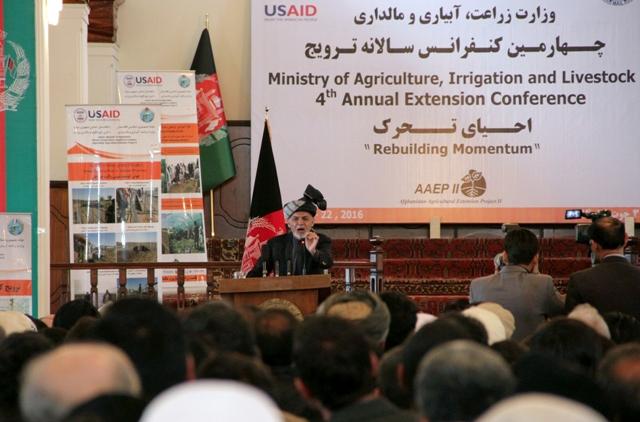
Esteemed farmers, orchardists, livestock owners, dear sisters and brothers, all personnel of the Ministry of Agriculture, foreign guests, the Governor of Kabul, and the Minister of Agriculture: Peace be upon you all, and the mercy and blessings of Allah.
Welcome to your own home (the Arg). My heartfelt thanks for "lending" me this house for a few days. First, I wish to express my deepest respect to the farmers, orchardists, and the sisters and brothers engaged in this noble profession. It is you who feed this nation. Without you, this land would have no bread; therefore, your value is beyond measure every single day.
The Agricultural Foundation of Stability
Every day that you produce with the sweat of your brow—whether it is wheat, pomegranates, or saffron—you are preventing poverty. You constitute the foundation of the majority of the Afghan people. No one should forget that the majority of Afghans today are employed in the agricultural, gardening, and livestock sectors. Without an effective and all-encompassing agricultural sector, stability cannot come to Afghanistan. Prosperity may come from mines, but stability cannot come without agriculture. Therefore, the issue of agriculture is not merely a matter for the Ministry of Agriculture; it is one of the most vital subjects of our governance and national commitment. A prosperous agricultural sector is our goal because the political, social, and economic stability of Afghanistan is tied to it.
Secondly, I want to thank the private sector. Regarding what Asadullah Khan said on behalf of the Tabassum company and what Alokozay Sahib [Deputy of the Afghanistan Chamber of Commerce and Industries] mentioned, let us confess: our private sector has been far more effective in promotion and assisting farmers than the Ministry of Agriculture.
Is it not so? This is not a criticism; it is a reality. From this perspective, their ideas are fundamental. Farmers, the private sector, and the state are partners. The old philosophy where the Ministry of Agriculture viewed itself as the commander and master of the farmer is abolished and rejected; it is not acceptable to us.
The Partnership Model: State as Servant
This is a partnership. The principle is that the farmer and the private sector are the customers, and the Ministry of Agriculture is the servant and service provider. I am your first servant; I hope the Ministry of Agriculture (and Livestock) is your second.
At the same time, we thank the Ministry, especially the Minister, for focusing fundamentally on agriculture over the last year and a half. They will tell you that I personally held at least sixteen meetings on wheat alone. What is my instruction and demand of the Ministry? Every single item of Afghan production must be given attention, and for every item, the Ministry must have a plan. Look at saffron; today our saffron is exported under the names of neighbors and Europeans.
Which of our export items has its problems solved today? The heritage we received is that we have not paid fundamental attention to our exports, and we must solve this problem. We will solve it fundamentally, and God willing, we are solving it. At the same time, I want to thank our international partners—the various universities, Purdue University, and others. USAID has helped, Japan has helped, the World Bank and all others have helped. I forgot Dr. Scott O'Ganhighs; he is a very old friend and a great advisor to me. We thank all of them, because agriculture can no longer be done in the traditional way; everyone’s cooperation is needed, and all ministries must work together.
The Call for Inter-Ministerial Coordination
Today, something I regret is that other cabinet ministers are not here. This is not acceptable. How can agriculture exist without public works, without water and power, or without trade? It appears the Cabinet of Afghanistan has not yet fundamentally noted the importance of agriculture. In the next session, tell them this is a priority; they must be present. We are here for a few days; the real owners of this house have come home today. Therefore, the results of your conference must be deliberated in the Cabinet and practical decisions must be made in the High Economic Council.
The Five Elements of Afghan Agriculture
The second point I wish to present is our culture of agriculture and extension. For those who have looked at Afghan agriculture from a historical perspective—and I have spent at least ten years of my life trying to understand our several-thousand-year history—five elements have always been in the vision of our farmer:
-
Water
-
Land
-
Seed
-
Tools
-
The Cultivator (the farmer himself)
These five elements have formed the basis of our social relations. Is that correct? I understand your language, don’t I? [Laughter] So let us speak in our own language.
Here, Minister of Agriculture and Minister of Higher Education, we have a fundamental problem: our scientific discussions are not yet aligned with the needs of our farmers. They teach one thing in the faculty, but the farmers need something else. If we want extension to be fundamental, the faculty must listen to the farmer, the orchardist, and the livestock owner. I will give you a practical example: In Pakistan, there is a very good agriculture faculty, Faisalabad. But the one who helps with livestock is a company called Nestle, the largest milk producer in the world. Do you know what they teach? They say you must understand the "mood" of the cow daily. The cow actually sends you a message; if you understand its mood, the milk will be right. Let us not separate science from action. Let us connect science with the practical work of the farmer.
The second point is that the private sector’s connection with the farmer is weak because the state does not perform its role. The role of the state in strengthening the farmer and the private sector must be specified.
The Strategy for Water and Land Management
First is the subject of water. If there is "foolish money," it is Afghanistan itself, which has provided its waters for free to others for centuries. Our water must be harnessed and put at our disposal. This year, God willing, we will start 21 water dams, which are your wishes. We do not need international experts to tell us what our priorities should be. Naeem Khan gave us the priority: harness the water. And God willing, we will harness the water.
It may take a few days, but the essential point I tell you is that my focus and commitment are on harnessing our waters. Organizing our waters will result in two things: First, we must make maximum use of the water, which we are not doing today. Second, floods have destroyed us; every year we lose at least a billion dollars to floods. Instead of creating jobs, our riverbanks cause destruction. We lose thousands of hectares of land. Water must be regulated in every form and served to the farmer; this is our first program.
Second is the subject of land. The current land situation has fundamental problems. The first issue is land grabbing (ghasb). I have instructed all governors to prevent grabbing in the future and return grabbed lands to the nation. Our landowner must understand that their property is secure. No one, through gold, force, or position, can endanger the legitimate land of our landowner. God willing, all our security officials are at your service to ensure land is secure first. Today we have problems, brothers; you didn't say it, but I know your hearts. I was forced to wall in lands that had been in our family for six hundred years, where for six hundred years a wall was not needed. Today, if there is no wall, someone plunders it. We will prevent plunder, God willing. Correct?
Another issue: the amount of land currently under cultivation compared to the last year of Daoud Khan—we have only brought two-thirds back under cultivation. That means one-third of our land, 33 percent of the land we were farming in the time of Daoud Khan, we are not farming today. This is a tragedy for this country. Bringing these lands under the plow and under irrigation systematically is essential. Today, water is a tool of injustice; are the upstream and downstream of the canal equal? We had a very good irrigation system; unfortunately, our irrigation system has been called into question. Therefore, Minister of Agriculture and Minister of Energy and Water, the farmer needs a fair distribution of water. Until water is distributed fairly—today you see villages where they plant rice upstream and wheat downstream—it will not yield results. It is the duty of the state to observe justice in the distribution of water. Additionally, God willing, several hundred thousand new hectares can come under irrigation, which will be a means of great change. These 21 dams we are building are not just water dams; they irrigate the land, and our farmers must gain the confidence that work is being done for them.
Productivity and the Future of the Farmer
You say the Afghan is honorable; he engages in legitimate competition. In the sector of landowning, our competition is not right. Compare our production. If you want us to compare ourselves, Minister, only one criterion is needed for all your colleagues: how much production does one hectare of land have compared to our neighbors?
Leave other things aside; it becomes simple. How about it, Alokozay Sahib? You said two very important things and I repeat them: First, how much harvest do you take from one hectare of land? Second, agriculture must become a twelve-month activity.
Look at Parwan; there are many advancements in Parwan today. They earn 300,000 Afghanis from a small plot because they have adopted a system to regulate it. They have popularized "green agriculture." Therefore, maximizing land use is important; we currently make the least use of our existing land. The Governor of Kabul has also been a pioneer in this regard, having a very good connection with the French on how to bring sustainable agriculture. In the past, our farmer knew what to do, which land to produce in which year, and in what form. This links back to chemical fertilizers and such; I won’t go into those.
Our seed issue is still a fundamental problem; improved seeds are not available to our sisters and brothers. The same applies to tools. But the most important subject I come to, and emphasize again, is the farmer himself. Today, our farmer is not confident about his future. The son of a farmer does not want to be a farmer, and his grandson certainly does not. You must change this state of affairs, and it is changeable. Look at the experience of Korea in the 1970s; the income of a farmer can become higher than urban income. Our goal must be for an income balance to exist. This land is gold if the state, the private sector, farmers, and livestock owners work together.
The History of Irrigation and Extension
I will say a few words on extension: First, regarding water, Afghanistan was among the inventors of irrigation systems in the world. We have at least three and a half thousand years of irrigation experience, and our karezes (qanats) were models for the world. When "Balkh the Beautiful" was one of the major centers of the world, it had regulated groundwater; our water distribution system was unparalleled.
If you want an example, for six hundred years in Herat, the distribution of the Harirod water was done based on a book of water distribution. From the smallest point of distribution—an area of 160 acres—to the entire Harirod, everything is regulated. At that time, thousands of years ago, we had irrigation associations. The Ulema had a fundamental role in the distribution and division of water. Minister, my point is that the culture of extension cannot be done by the Ministry of Agriculture alone. Call upon the Ulema, tribal elders, and all the people generally to participate in extension.
Second is the culture of extension. Six hundred years ago, a book was written in Herat called Irshad al-Zira'ah (Guidance for Agriculture). it explained several hundred agricultural products with the type of soil, amount of water, and the type of work the farmer should do. Do we have an extension book today that is parallel to Irshad al-Zira'ah?
The Peace Process and National Sacrifice
My other suggestion is very simple. Additionally, the High Peace Council has not only had a great deal of activity but has also given many sacrifices. Forty members of the peace committee at the provincial level were targeted by the enemy; may their martyrdom be blessed and their memory always honored. Also, 185 people who joined the peace process were targeted and martyred. Similarly, I want to remember again the martyrs of the path of freedom for Afghanistan, especially the security and defense personnel who sacrifice daily to defend the homeland, but whose goal is an honorable and lasting peace. I wish a speedy recovery for the wounded.
I especially want to thank Pir Sahib, Ustad Khalili, and all the deputies. Pir Sahib, you have given me permission—and esteemed uncle, as he is by the side of Hazrat Sahib, Ustad Khalili, and other leaders—having also held the leadership of the Jihad, all his efforts were to bring a cohesive state to Afghanistan. Today, he steps into the "Greater Jihad" (Jihad-e-Akbar), and I am grateful that Hazrat Sahib is present and still guiding us.
Hazrat Sahib! I said that if I ever made a mistake, the tongue of Hazrat Sahib, which is like a sword, will always be present to guide us to the right path. You speak to me privately; if you speak publicly, it is on my eyes. So far, no one has seen that sword go blunt.
I especially express gratitude to Ustad Khalili, the leader of the Jihad and former Vice President. In the speeches you have always given, especially in the last year, your emphasis has been on the importance of peace. Your fundamental emphasis was that every war ultimately has a political solution and there must be a political framework that ensures permanent peace, greeting, and prosperity. It is because of this cohesive thought that you were selected alongside Pir Sahib. I also thank all you esteemed members who accepted the vice-presidency and membership of the Executive Council, and Rafiqi Sahib who took over the Secretariat, and all the sisters, especially the two new members, Dr. Sarabi and our sister Hassina Safi.
National Unity and the Nature of the War
Again, I emphasize that our great national interests are always linked to our national unity, belief, will, and intention. No one should doubt the intention of the Government of National Unity regarding peace. All our relations with the world have been based on ensuring the highest interests of Afghanistan so our people live in peace and harmony. At the same time, war has different dimensions, and it must be clear that we are not in a civil war. The war that is taking place is a war of Truth against Falsehood. The war imposed on us was not of our choosing, and everyone knows that an Afghan does not bow his head to force.
Now that a working atmosphere has been created, the necessity is to make maximum use of it. My emphasis is on what I had at the Heart of Asia conference. Time cannot be static; movement is needed—continuous movement, cohesive thought, and comprehensive foresight. At the same time, there is full readiness of our security and defense forces to defend the sanctities of this land, our Islamic beliefs, and the values of the Constitution. We are waiting for the Peace Council itself to determine its actions and priorities after the first meetings so that we can take practical steps as soon as possible.
Again, I repeat, the High Peace Council has taken great steps in the past and has left sacrifices, and today with full confidence, authority, and the comprehensive cooperation of all officials of the Government of National Unity, God willing, we can bring a new day for the people of Afghanistan.
Long live Afghanistan!