Strengthening the Rule of Law: Police Reform, Accountability, and National Security
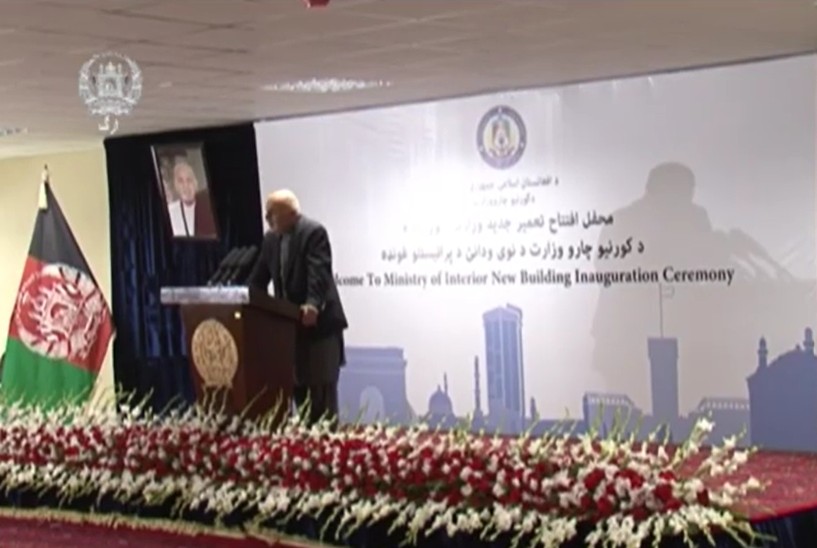
(Speech at the Inauguration of the Ministry of Interior Headquarters, Kabul, Afghanistan)
Keypoints:
- Police Sacrifice: Honoring fallen and wounded forces defending Afghanistan’s unity.
- International Support: Appreciation for U.S. and allied partnership against terrorism.
- Long-Term Security Vision: Moving beyond short-term planning.
- Structural Reform: Reforming the Ministry of Interior and ending bureaucracy.
- Accountability: Fixing contracts, fighting corruption, supporting martyrs’ families.
- Police Professionalization: Better training and equipment.
- Rule of Law: Strengthening legal order and equality.
- Peace with Safeguards: Pursuing peace while protecting constitutional values and rights.
Honorable Minister of Interior, Minister of Defense, Minister of Economy; General Campbell; esteemed members of the Wolesi Jirga; honorable Generals of the Ministry of Interior; members of the Diplomatic Corps; and all my brothers and sisters:
As-salamu Alaykum wa Rahmatullah wa Barakatuh.
First and foremost, I wish to express my profound gratitude to the martyrs and the wounded of our Police force. It is through the blessing of their blood that a free Afghanistan continues to exist today. The design of the enemies of this land was to transform our unified political geography into two separate entities. Through the sacrifices of our armed forces—specifically the National Police, Local Police, Public Order, and all specialized branches—that plot has been thwarted. I honor their immense sacrifice.
I extend my heartfelt thanks to our soldiers, NCOs, officers, generals, the Minister of Interior, and the entire leadership. I especially want to thank the many sisters who joined the police ranks this year; I thank their families and each of them individually. Your presence, sisters, provides a sense of assurance to women across Afghanistan that, according to the tenets of our holy religion of Islam and the great traditions of this country, Afghan women possess security and that the Rule of Law will be provided for them.
I also wish to thank General Campbell, the United States, the Resolute Support Mission, and previously ISAF. The true friends of a nation are revealed in times of dire necessity. Let anyone who harbors doubts observe the commitment shown by Afghanistan’s true allies for even a single week, and they will understand who the true friends of Afghanistan are and why our friendship is enduring. This friendship is rooted in shared interests and a common vision. Regional and international terrorism is a common threat, and countering it is a mid-term process. Because the threat is mid-term, our interests converge. On behalf of the State and the people of Afghanistan, I thank the international forces—specifically the U.S. forces—who fought shoulder-to-shoulder with us and continued their comprehensive support even after the conclusion of the NATO combat mission.
A Shift in Vision Prior to this year, a short-term perspective prevailed. People believed the Resolute Support Mission was limited to a single year. We are grateful for the decision made by President Obama, which has since been endorsed by European leaders and, fortunately, by 40 of our partner nations. We hope this decision provides the assurance that our perspective must be mid-to-long-term, not short-term.
Why was this significant decision made? Above all, it was due to the sacrifices of the Afghan Defense and Security forces on the battlefield. Two years ago, many doubters believed that after the withdrawal of 130,000 international troops, Afghan forces would not be able to hold this land. Anyone who thought this did not know the Afghans. This land has always nurtured heroes; this soil has always been ready for sacrifice and will always give birth to heroes.
As Commander-in-Chief, I state that while we endured a very difficult year, we achieved our primary objective. We proved we can sacrifice for this land. I thank the Minister of Defense, the Minister of Interior, the acting head of NDS, and all citizens who stood as one voice to prove our resilience.
Secondly, our partnership is now based on fundamental interests; two partners working together continuously. There will never be room for doubt, because until the evil phenomenon of terrorism and extremism is eliminated, neither we nor our partners will be safe.
Structural Reform vs. Physical Infrastructure Today, I congratulate you on the creation of the physical infrastructure for a modern Ministry of Interior. General Campbell mentioned to me on the way here that these facilities surpass many offices in the United States. We thank our partners for consolidating the Ministry, which was previously scattered across the city without essential resources. We hope this magnificent edifice becomes the center of gravity for the execution of the Rule of Law in our dear homeland for decades to come.
However, physical infrastructure alone cannot cure our primary ailment. Our core challenge is structural reform. I must mention to the Ministers that I met last week with the committee responsible for the families of martyrs. Unfortunately, your current bureaucracy is completely unacceptable to me! How can it take an entire year for the family of a martyr to process the legal documents required to receive aid?
It is unacceptable! It is unacceptable!
If they offer their lives, we must reach them. The old system of "paper-shuffling" (kaghaz-parani) is intolerable. When a son of this soil goes to the trenches, he must have absolute confidence that if something happens to him, the ministries and institutions are there, and the Commander-in-Chief is monitoring whether they are being cared for. It is a matter of regret that powerful interests can grab millions of jeribs of land, yet we cannot provide a few hundred jeribs to the families of martyrs. This must change.
The Bilateral Contract The police must be the instrument that prevents land grabbing and ensures resources reach the families of martyrs. Our contract with all state officials must be bilateral. Today, we must admit that our "contract" has been one-sided: we demand bravery and martyrdom from our forces, but in return, we have not fulfilled our duties. Therefore, we must all have a systematic method of oversight.
Furthermore, the rate of casualties is excessively high because over 20,000 police officers have not yet received systematic training. It is a fundamental necessity that the police be equipped and trained to prevent avoidable losses. This is a core component of our "contract."
Regarding resources, by the Grace of God, the Ministry of Interior faces no shortages. For consecutive years, 50% to 60% of the budget went unspent. This financial management must be modernized. In the past, there were massive problems. Now, the leadership—Mr. Danesh, Dr. Abdullah, and the Ministers of Justice, Finance, and Economy—review contracts every Monday. Not a single MoI contract from last year met the required standards! We spent the entire year cleaning these up. However, past reforms do not mean we will tolerate lawlessness in the coming year. Our police must be fed properly; that is what these contracts are for.
Regarding the complaints about calorie intake: we compared your calories with the elite Special Forces of the United States. Our calorie count was 300 calories higher. The problem? Our contracting system lacks sufficient oversight. All of this indicates that our contract must be bilateral. Structural reform is mandatory. While we focused on managing an imposed war this past year, which slowed some reforms, I direct that fundamental reforms be undertaken this winter. Just as the people take pride in the heroism of the police, they must also be able to take pride in their transparency and effectiveness.
Peace and the Rule of Law Peace is the desire of all Afghans, but we did not start this war. This is an imposed war. We defend this land and the values of Islam with all our might, and our cause is just. Our Constitution is a covenant in which the entire nation takes pride. No one can prove to us that there exists another constitution in this region more rooted in the principles of Islam or the equality of all citizens.
We hope for peace and will exert every effort toward it. However, we must maintain total readiness for security and stability. Our forces cannot afford a moment of negligence. I assure all security forces that no peace process will exist that does not guarantee the professional standing and independence of the Afghan Security Forces. What our forces have earned with their blood will not be lost in the arena of politics. And our sisters must be assured: the rights of Afghan women enshrined in the Constitution will be defended by the State with full conviction.
Ultimately, the greatest goal of the police—which will be realized with the arrival of peace—is the Rule of Law. All people are thirsty for the Rule of Law. In our holy religion, all are equal. Look at the oldest books of jurisprudence: two claimants stand before a judge; one has no more rights than the other, regardless of whether he is powerful, a khan, a malik, or a general. There is equality before the court, and the police are the instrument of this equality.
The detection of crime is the sole responsibility of the police. Therefore, the Rule of Law is our greatest goal. Insha'Allah, the police will emerge from this imposed war to focus on the duty that all personnel and our noble nation desire.
Once again, I congratulate the Minister of Interior, the deputies, generals, and all personnel. This magnificent building marks the beginning of a new chapter in strengthening the Rule of Law and structural reform. We thank General Campbell and his colleagues. I hope that in the coming years, we can realize the legitimate aspirations of the Afghan people through a cohesive vision.
Long live Afghanistan!