A Strategic Vision for Energy Integration, Economic Sovereignty, and National Reform
Keypoints:
- Transparent Elections: Transparent elections ensure legitimacy and rule of law.
- Security Forces: Security forces stood firm and deserve full support.
- Inclusive Peace: Peace must be inclusive and achieved through consultation.
- Governance Reforms: Reforms are needed for self-reliance and good governance.
- Electricity Development: Electricity expansion powers national development.
- Agricultural Modernization: Agriculture requires modernization to support farmers.
- Tourism Revival: Tourism will revive Kapisa as a regional destination.
- Industrial Growth: Industry and transit will drive Kapisa’s economic growth.
In the name of Allah, the Most Gracious, the Most Merciful.
Esteemed scholars, grand Mujahideen, committed youth, enlightened and prudent sisters, brave generals of Afghanistan, Honorable Chief of Staff of Afghanistan, Honorable Senior Deputy Minister of Security of Afghanistan, General Ebad, General Waziri, General [Sahib], and all the heroic generals and personnel of the security and defense forces of Afghanistan; distinguished representatives of the Parliament of Afghanistan, representatives of the Provincial Council of Afghanistan, elders of Kapisa, respected members of the Cabinet; Mr. Khulmi, Mr. Balkhi, Mr. Yari, Mr. Karimi, Mr. Khwaja Omari, Mr. Durrani, Mr. Barmak; Senior Advisor to the Presidency Mr. Almas, the Governor of Kapisa, Mr. Beig, Mr. Qattali—all elders and attendees of the gathering: First of all, I offer you the gift of the Leader of Humanity. Peace and the mercy and blessings of Allah be upon you!
Historical and Cultural Significance of Kapisa
When I hear the word "Kapisa," what do I think? It is the place and the majesty of historical epics. From the very first short stories of Afghanistan, [Pughman] Torwayna, the great scene was the temple of Kapisa. And in these recent times, thanks to Mr. Liwal, there is an epic of Kapisa’s heroism in the Pashto language that is without parallel in the world. When I think about Kapisa, it is the hero of Jihad. When I think of the holy Jihad of the people of Afghanistan, the martyrs of Kapisa come to my mind. I appreciate the labor of the people of Kapisa, who never bowed their heads before force or oppression. When I think about Kapisa, I think about the talent of the women and youth of Kapisa and the talent of all generations; especially when I think about Kapisa, I think of the future majesty of Kapisa—that a Kapisa emerges which is again the pride of all Afghanistan.
Gratitude and Personal Thanks
I do not have the words to thank Mr. Mozaffari. If the nation were to give me my exam grade in the same way that you, Mr. Mozaffari, gave it, I am ready to go before Allah ﷻ; because the day this heavy burden fell to me and the National Unity Government, there was an atmosphere of despair. I first want to thank the security and defense forces of Afghanistan on behalf of everyone. Did the pessimists not say that this army does not have the stamina and will be torn to pieces? You shall be proven blind [proverbial]; this army and the National Security stood firm and are heroic.
Current National Situation and Achievements
Today, as Mr. Mozaffari said, the survival of Afghanistan is not in danger. We have emerged from the danger and the test of survival. Today, Afghanistan is not in isolation; there is consensus in the Islamic world and nearly 70% regional consensus for us to move toward prosperity, tranquility, and peace.
National Priorities of the National Unity Government
I will not speak on other dimensions, everyone is tired; therefore, we will only speak on a few national issues and then on the issues of Kapisa. Our most major national topics in the remaining duration of the National Unity Government are three things:
1. Elections First: Elections. The difference between the rule of law and the rule of the gun, force, or sword lies in transparent and all-inclusive elections. You saw! I said: conduct the elections on the basis of the law, not at the time you gave me the oath; because every day of delay in the system without legitimacy puts the system under question. Transparent elections are the consensus of the nation. We will conduct transparent elections at whatever cost it may be. Transparent elections are part of our "Greater Jihad." Why? Because the difference between legitimacy and lack of legitimacy is hidden in the elections. I especially ask the sisters to participate in the elections. We are removing the problems that were created against the participation of our sisters in the district councils. Yesterday, the meeting of the High Security Council was held based on Article 104 of the Constitution, and we have a clear decision to remove the problems facing the sisters’ share. The Provincial Council elections are part of the Constitution; without them, the Meshrano Jirga (Senate) of Afghanistan is not completed. And here, yesterday, I issued a declaration that any individual from our security and defense forces who acts in the elections against or for a candidate will be subject to reprimand, punishment, and penalty. I have given time to the Minister of Interior to clean our security and defense forces from politics. The "Great Politics" of our security and defense forces is God, Country, and Duty, and for this, we are united, and the active share of the people will be encouraged in every way. I thank the great people of Kapisa that you had a share in registering votes and becoming candidates; Inshallah Ta’ala, your good example will be repeated throughout all of Afghanistan. This is our national dignity, and without internal legitimacy, we cannot perform great external tasks.
2. Peace Two things have been major factors. Two years ago, who could have thought that until the year 2024, we would give a clear commitment for the funding, equipping, and training of our defense forces? Why were we able to execute this? At the Brussels and NATO conferences—first, we did not abandon the sacrifice of the trench; we gave our heads but did not abandon the trench. Second, we behaved with prudence and based on legitimacy, and with unity, we defended the interests of the respected brothers and sisters. Defending our interests is not done with shouting; rather, it is done with a plan ( طرح ). It is not done with harshness; it is done with logic, unity, and changes. Therefore, our second great subject is Peace. In the section of peace, this great nation of Afghanistan has consensus, and the ceasefire changed the great case. In what sense? People thought that, God forbid, this country over forty years had been torn to pieces to the extent that from within a family to within a district, up to our national level, we are divided; but the ceasefire showed that this nation is future-oriented and not past-oriented. What nation do you know where, one week before the ceasefire, a thousand people went into battle with each other, but on the day the ceasefire happens, the Taliban eats ice cream? Long live ice cream! Think about this separately—is this a big issue or not? Did 98% of the ceasefire not be implemented? Did our governors, police chiefs, and Minister of Interior not go into discussion and enter into talk spontaneously? The point is that this nation is future-oriented. We have this massive capacity that, on one hand, we sacrifice for all the values of our Constitution, and on the other hand, we want our embrace to take in every Afghan. I am the President of every Afghan child, woman, and man. The speaker of every language of Afghanistan is the crown of our heads. The resident of every province is the light of my eye, and the women and men of Afghanistan are the cause of my pride. If we do not have a great embrace for the child, the widow, and the child of the martyr, how can we call ourselves Muslim and human? For this reason, I welcome your great demand regarding work for the ceasefire. Soon, you will likely see the announcement of our decision. But greater than that, the fundamental point is to solve the war through political means. The war in Afghanistan has different dimensions. The internal dimension, which is with the Taliban, we will perform through the great will of this nation via political negotiation. But the point I want to assure every Kapisayi and Afghan of is that peace comes in the bright day, not in the dark night, behind curtains, and in the absence of the people and without the validation of the nation. We will bring a peace that is stable and lasting and takes every Afghan into its embrace. In the section of peace, there is absolute consensus, and in the peace plans, there are reasonable differences of opinion. Different plans exist. My request to the whole nation is to include themselves in the consultation. You saw in these few days, I had consultations with all political strata, and consultation continues. This homeland is the land of Jirgas; this homeland is the land of consultations; and consultation is the command of Allah ﷻ. We consult, and the women of Afghanistan should have full confidence that all stages of peace will take place with your participation and under your supervision. You will not remain deprived; fundamentally, Inshallah Ta’ala, we will show this.
3. Reform Our third subject is Reform. Without reforms, this country cannot stand on its own feet. The insurance and guarantee that Afghans want for their future should not rely on foreign aid. There is a Pashto proverb: "A stranger's bed is for half the nights." We do not want a half-night bed; we want our own bed. For this reason, a few months later, we will present a clear plan to the international community on how to ensure the economic growth of Afghanistan so that in the year 2024, we are no longer in need of small and minor aids. A nation does not reach prosperity through international aid, but rather through its own internal resources. Therefore, the most important work on which our Unity Government will focus will be the plan for Provincial Reform. Governance must change fundamentally. Reforms are coming, and I especially—one reason I come before each of you is because of my slogan—when I go everywhere and shake hands with every Afghan, it is because no Kapisayi is less than another Kapisayi; no Afghan is less than another Afghan. And furthermore, my main point is that I understand the pulse of the people. And today, Mr. Governor, I congratulate you that at least forty people said: "Thank you for sending a good Governor and an active Director of Education." Mr. Governor! By attracting the trust of the people, you doubled my trust. Thank you. I also thank the Director of Education. I hope other directors are also appreciated.
Specific Commitments and Projects for Kapisa
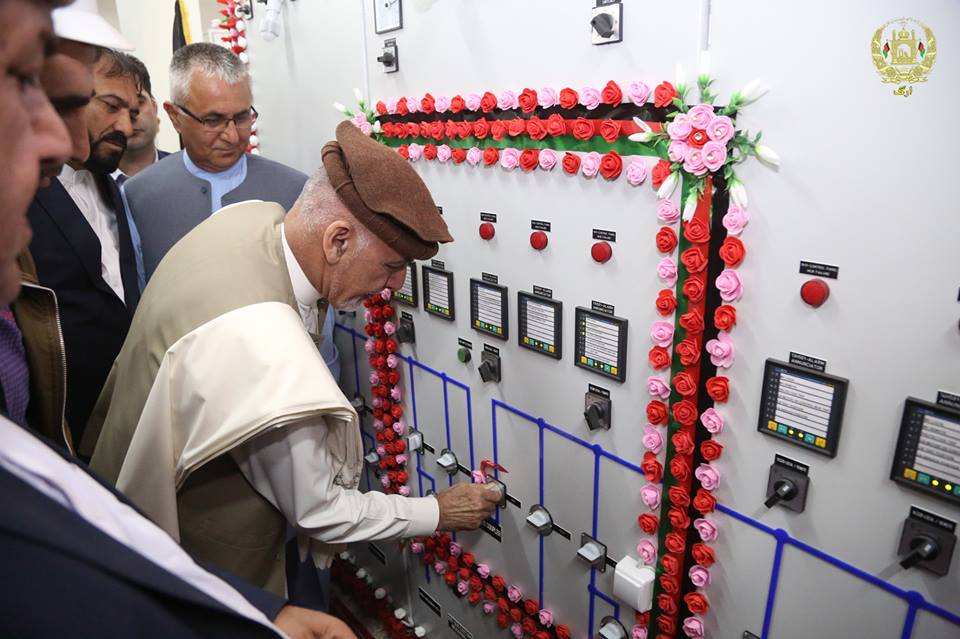
I come specifically to Kapisa, which has two dimensions. One, the proposals you made, and the other, the plans I have. Your first proposal regarding the Danesh Road is in preparation at the Procurement Commission, and in the coming weeks, Mr. Yari will finish it. Inshallah Ta’ala, its fundamental work will start soon. Second: Your Administrative Complex is also going to procurement, and I have given clear instructions that the Kapisa Administrative Complex be funded. Third: Sayad Park is a national park; its work may start soon. We have come to a new method of construction. I had a discussion with Mr. Qayoumi and gave instructions that Sayad Park be funded. At the same time, our sisters had proposals; we will build at least one Fateha-khana (mourning hall) and several kindergartens as part of your administrative complex. In the section of Kapisa’s fruits, the Governor informed me; Bagram has agreed. Clear arrangements, Inshallah Ta’ala, will be taken and fundamental action will be performed. And on water and electricity, obviously, work is being done. The point that Mr. Mozaffari said—our goal is that Afghanistan’s electricity becomes all-inclusive and "Kapisa-inclusive." Respected brothers and sisters! When this burden came to me, Afghanistan was 9 islands of electricity. With all the facilities that had come, electricity did not reach several provinces, and it had not reached the majority of Afghanistan’s provinces. Today you saw that 9 provinces of Afghanistan are gaining electricity this year. We came from 9 islands to 9 [provinces], and in two years, we will have a unified electricity system for Afghanistan. And I thank the loyal son of Kapisa, Mr. Ghalib. Electricity is the foundation of infrastructure. For this reason, I want to share with you very briefly my future vision for Kapisa. First, Kapisa is Agricultural. Mr. Minister of Agriculture, a great oppression is ongoing: the farmers of Kapisa spend 6,000 Afghanis on wheat, and its price is 4,000 Afghanis. This is oppression and it is not acceptable. Provide a clear plan for the modernization of agriculture, fruits, and the forests of Kapisa. Do not tell them to find a market; that is your duty, it is not their duty, Mr. Durrani and Mr. Karimi! You must bring a clear plan. Sisters and brothers! You have 7 billion dollars in imports, nine items of which are agricultural or industrial and can be produced inside the country. A market exists; for God’s sake, fill the market with Afghan products. And in the textile sector, we have progress with Uzbekistan; I am personally following this. The second future of Kapisa is Tourism. I learned a new word: Gardeshgari (sightseeing). The Persian language is a wonderful language; it changes every day. We who are from the past generation... truly, Sayad becomes one of the most important resorts of Kabul, Afghanistan, and the region. And the beauty of Najrab, Tagab, Alasay, Hesa-e-Awal, and Hesa-e-Dowum has no bounds. Let the people of Kabul not be upset—when Kapisa was the center of civilization, Kabul was a military fort. This majesty must be revived. In this section, all departments, especially Mr. Minister Safi along with Mr. Beig, will work so that we can have a clear and fundamental plan. The sisters made a request of me, and you be assured that in Sayad Park, the share of women will be significant. Another dimension of Kapisa is the Transit dimension. We instructed the Minister of Interior that good security now exists. Let the Sarobi and Gulbahar road be transformed into a transit crossroads. All around this road—just as you called the Danesh Road "Danesh" (Knowledge)—a massive industrial zone must be created in Kapisa. You and I have work for an Industrial Kapisa. We have water; you witnessed the electricity today. I want industry to emerge from Kabul and come to Kapisa, Parwan, Logar, Maidan Wardak, and go to other provinces. This is the capacity. Otherwise, where will Kabul find its water? The necessity is clear. My last point is this: Kapisa, more than all, is the cradle of thought, and it needs intellectual capital. Mr. Balkhi! A fundamental transformation of Kapisa’s schools and Al-Beruni University is necessary so that our young cadres emerge.
In conclusion, I thank you again. Let there be clear lists of Kapisa’s cadres so they may shine at the national level, just as you have always shone. And Kapisa, Inshallah Ta’ala, will be the focus of everyone’s attention. Again, I thank you all for your welcome.