Launching Prefabricated School Construction: Advancing Education and Infrastructure in Afghanistan
Speech at the Inauguration Ceremony of the Pre-fabricated Housing Factory of the Housing Construction Enterprise.
Keypoints:
- From Paper to Reality: Stalled projects become tangible schools.
- Speed Builds Trust: Pre-fab schools ready in 6–8 weeks.
- Modern Technology: Kabul uses world-class systems.
- Afghan Talent: 80% local engineers trained in 2 months.
- Transparency: Standardized production ensures fair cost and quality.
- Service in Insecure Areas: Pre-fab enables schools in unsafe regions.
- Infrastructure Tiers: Heritage, affordable housing, government complexes.
- Protecting Assets: 420 acres secured from land grabbing.
Part I: From Vision to Execution
In the name of Allah, the Most Gracious, the Most Merciful.
The fundamental point is that we waited a long time for this work; however, patience yields sweet results. Today, we are witnessing a major movement. Insha'Allah (God willing), when we say a school will be built in a certain location, it will truly be built.
Before this program began, the primary issue was that the construction of hundreds of contracted schools remained incomplete. Dozens of schools had been contracted, yet not a single brick had been laid. Furthermore, there was a persistent complaint that we could not operate in insecure areas. The main reason for this program is the social contract between the nation and the state—that the nation, according to the Constitution, must be provided with services. This program provides the framework for reliable service delivery.
As the Minister of Finance noted—and I thank the Minister of Urban Development, Dr. Qayoumi, Mr. Ahmadi, and all colleagues for their efforts—our schools must be connected to the internet. Heating and climate control must be standardized. There is a Chinese proverb that says: "If you want a harvest for a year, plant wheat; if you want a harvest for five years, plant an apple tree; but if you want a harvest for fifty years, invest in your children." This is an investment in our children. Insha'Allah, this will bring about a fundamental change. I wish to thank the Honorable Ambassador of Turkey and specifically the Vefa Company, which has reached an agreement and partnership with our Housing Construction Department. We shall witness further investments in prefabrication, the results of which will be seen by the entire nation of Afghanistan.
Part II: National Unity and the Spirit of Progress
Honorable Mr. Muslimyar, Honorable Minister of Finance, Dr. Qayoumi, Honorable Minister of Urban Development, Honorable Minister of Hajj and Religious Affairs, Honorable Minister of Rural Development, Mr. Balkhi (Acting Minister of Education), Mr. Nejrabi, Mr. Zaki, the Honorable Turkish Ambassador, Directors of the Vefa Company, brothers and sisters, members of the Alokozay group, Mr. Mohmand, national businessmen, and all specialists: As-salamu alaykum wa rahmatullahi wa barakatuh.
First, I congratulate everyone on the victory of our cricket team! Do you know what Shahzad wrote? He said: "West Indies, get ready, we are coming!" When asked why he said that, he replied: "I spoke with the President last night; he said the prayers of the entire nation are with you." This victory proves that when Afghans work together, they can achieve anything. We wish them continued success.
Today, I congratulate all the children of this country, my dear colleagues, teachers, and the staff of the Ministry of Education. When this project began, people held the same doubts they had about our cricket team. They wondered how a country torn by forty years of war could break into the world's top ten teams. Similarly, they thought establishing a prefabricated factory in Afghanistan's current conditions was impossible. The problem was not the idea; the problem was a lack of belief. Today, our Housing Factory has done exactly what our cricket team did. This is for the smile of that child. On the opening day of the school year, teachers from Nangarhar, Jawzjan, and other provinces told me they didn't even have a room for meetings. Prefabrication will make these service delivery problems a thing of the past.
I want to state here: the promise I made to the National Assembly three years ago—Mr. Muslimyar, you were present—that we would do this work; today, you see another one of our promises being fulfilled. My promises to the people are not "paper promises" or populist rhetoric; they are real, and Insha'Allah, we will implement them all. While some things take time and do not always move at the speed we desire, the commitment of our cabinet, Dr. Abdullah, Mr. Danish, and others, is to act with honesty, not to deceive the people.
Why Prefabrication?
The question arises: Why prefabrication, and what is its importance?
-
Speed: In the past, the Ministry of Education suffered from a lack of trust because hundreds of schools were started but never finished. Years passed, and hundreds of schools never saw their foundations laid despite advance payments being made. Nearly a thousand schools remained incomplete. Speed creates certainty. Completing a project in six to eight weeks creates an atmosphere of trust.
-
Transparency: All Afghans have complained about construction contracts. Now we know exactly how much a project costs, and it is completed transparently.
-
Quality and Cost: Standardized production ensures high quality while actually lowering costs. The primary reason for prefabrication is that an Afghan child should not have to study under the burning sun, in a tent, or in the rain.
Our commitment to future generations is that they must study in a secure environment. Today is a day of great joy, and I congratulate the Minister of Urban Development and his colleagues because 80% of the engineers and skilled workers in this factory are Afghans.
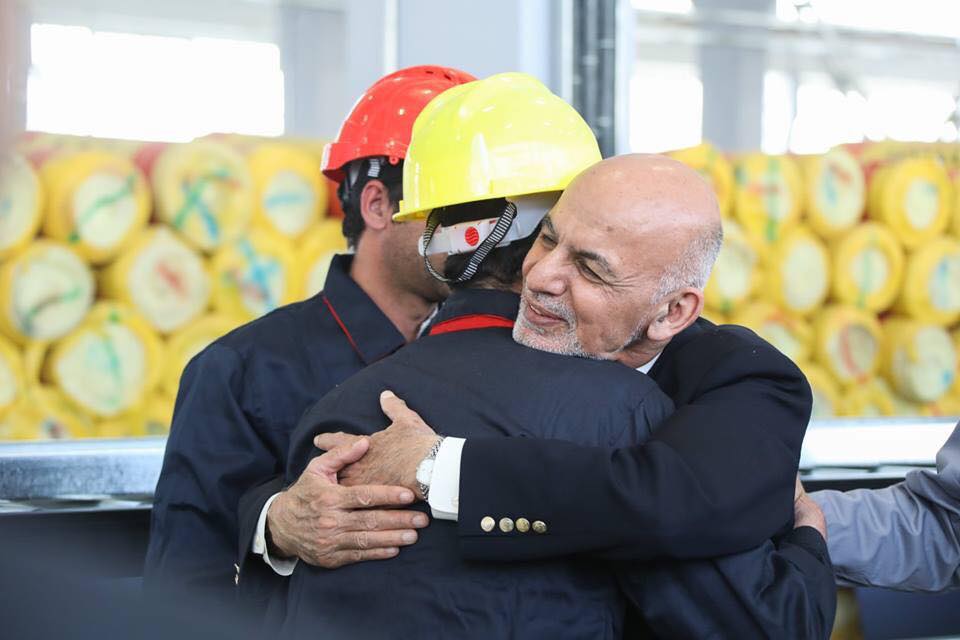
I embraced each of them today, and there were tears of joy in our eyes. Why? Because Afghans are now managing the world's most modern technology after only two months of vocational training. Why should an Afghan only perform manual labor under the sun? Intellectual and technical work is now possible for us. When our Turkish partners said they were proud of the talent of these Afghans, the entire nation should be proud.
Three Pillars of Infrastructure
Prefabrication has its place, but so do other types of construction. My message to the private sector is: the state steps in where you are absent, but on Wednesday, we will see your significant participation. I will briefly outline three types of construction:
-
Restoration of Historical Buildings: In this area, we sometimes move at a "snail's pace" because every brick of our past is the pride of our future. Projects like the Mosque of Golkhana, Chihilsitoon Palace, and the Eidgah Mosque require extreme precision and the artistry of past centuries.
-
Affordable Housing: With the return of refugees and the increasing number of families of our martyrs—especially from the security forces—internally displaced persons, and teachers, the need for affordable housing is immense. This sector will create massive employment. We have established a Land Bank, and this program will put 100,000 of our compatriots to work.
-
Government Facilities: The large administrative complex in Darulaman is meant to be a legacy for the next 300 to 500 years. It must combine modern technology with our traditional architecture and culture.
Acknowledgments and Future Outlook
I want to express my gratitude. First, to Minister Hakimi, who worked tirelessly—people don't realize he is an engineer [President laughs]—I thank you for your focus on the budget. Second, to my friend Dr. Qayoumi, whose years of service are beyond count. I thank Mr. Ahmadi for his economic efforts, and specifically Minister Sadat Naderi, the head of the Housing Factory, and all their colleagues. Minister Naderi, please submit a proposal to honor these staff members who worked day and night.
I also thank the Turkish Ambassador and the Vefa Company. They told me that the technology now in Kabul is not even present in Istanbul. We are not receiving second-hand technology; we are receiving the very latest. I hope this factory's capacity will multiply and that Afghanistan becomes an export hub for this technology in the region.
I thank our Afghan specialists who view this as a point of national pride, much like our cricket captain Asghar Stanikzai, who fought through illness on the field. A commentator once said that Afghans play cricket for their country, not for themselves. I see that same spirit in our workers today. I also thank the Harirud Company, Kawoon Kakar, and DLA Piper. Legal firms are vital because every action is a contract, and in Islam, contracts hold special importance. In our Sharia, a debt must be settled before a body is even buried. Transparency in contracts ensures a future of trust rather than dispute.
Final Word to the Private Sector
There are 420 acres of land here. In the past, the goal was to grab or loot this land. The people of Afghanistan pay the price for corruption. Now, the difference between transparency that benefits the nation and the wasting of national assets by a few must be clear. I call upon the private sector: join us in unity so that this factory becomes a massive construction complex in Kabul and eventually across the country.
I thank you all and wish everyone a Happy New Year. May this be a year of progress for students and teachers. Minister Balkhi, I thank you for accepting this great responsibility.
Long live Afghanistan!